Derek Murphy | Why Amazon is deleting book reviews: understanding Amazon’s new review policy and how to get back deleted reviews

Very good breakdown from Derek on understanding why Amazon is deleting reviews. Nobody took me (and others) seriously when we said it was not wise to include the words, “I received this book for free in exchange for an honest review.” Maybe you’ll listen to Derek:

“So it’s fine to give copies of books or ARCs away as long as you don’t require a review in exchange. Jennetta Penner recommends language like “I received an ARC at no cost from the author” – so you might want to ask your readers to stop using the word “exchange” in book reviews.”

CLICK HERE TO READ THROUGH TO THE ORIGINAL ARTICLE.


As a reminder, Renaissance is 99cents on Amazon. I’ve never received 20+ reviews but I am almost there! I need just one more review to reach this mini milestone. To purchase this book at just 99cents. CLICK HERE and, if you would like, I’d be honored if you could leave an honest review. 

4 Lessons I Learned from the Movie American Gangster

CEVWBh1UkAIumVq

American Gangster is based on the true story of real-life drug kingpin Frank Lucas, who, by the 1960s, constructed an international drug ring that spanned from New York to Southeast Asia. The film features Denzel Washington as Lucas and a New York City cop (Russell Crowe) who busted a big-time heroin ring.

I have a love-hate relationship with this movie. I love the many lessons the movie provides but dislike how the message can be perceived. The movie can easily cause young people to admire drug dealing. Frank takes care of his family, runs the show, and even works with the cop to lessen his sentence at the end.

However, if we can get past the drug part, there are many good and bad lessons throughout the film. A young person with the proper guidance can also easily see how this life only leads to one of three places: Death, jail, or that old drunk on the corner at fifty telling the teenagers how you used to run the block as you beg them for some change. There is no in-between. Drug dealers don’t get pensions.

Lesson #1: Influence Can Be Good and Bad

“I want what you got Uncle Frank. I wanna be you.”

In the film, Frank’s nephew, Stevie Lucas, is an excellent baseball player who has played since childhood. Now, at the prominent financial level to do so, Frank schedules a meeting for his nephew Stevie (T.I.) with the Dodgers. This is an amazing opportunity for Stevie to fulfill his dream of playing baseball, but he does not show up for the meeting. Even worse, he doesn’t want to play baseball anymore. Now that he is a part of his Uncle’s multimillion-dollar drug enterprise, he desires to be a drug kingpin just like Frank.

In an age where people can choose to become social media influencers, it often gets underscored that being influential is not only about persuading people to do the right things. Being an influencer can also mean influencing people to do wrong morally or in a way that dramatically changes their lives for the worse. Influence is also not only verbal. You don’t have to say a word to influence someone to do something; your actions alone are enough.

“You know Frank, quitting while you are ahead is not the same as quitting.”

Another example of using influence negatively is Frank moving his entire family to New York to participate in his drug enterprise.

Social influence occurs when someone’s emotions, opinions, or behaviors are affected by others.

Frank played a significant role in his brothers lives. You can tell (at least in the movie) that they looked up to him and already admired him. Frank did not have to travel to North Carolina and recruit them into his drug empire. He already had their love. However, Frank used his influence to charm his country family to come to the city and become part of his drug business, directly or indirectly. Frank is responsible for his part in taking advantage of his brother’s innocence. Even his mother in the film said: “If you were a preacher, they would have all been preachers.” They would have followed their big brother anywhere. We all have people who watch and look up to us, even if we don’t know it. Frank could have used his money to invest in legitimate companies for his brothers, leaving them out of his shenanigans and out of jail.

Lesson #2: Say Less and Follow Your Own Advice

“The loudest one in the room, is the weakest one in the room.”

Nicky Barnes, one of the biggest heroin dealers, was known by the New York Times as “Mister Untouchable” because the cops couldn’t touch him. He was also known for his arrogant demeanor and flashy dress. When Frank’s brother Huey adopts the same colorful look, Frank gives his brother some critical advice: “The loudest one in the room is the weakest one in the room.”

The quote is self-explanatory and goes hand in hand with other quotes like, “The more you talk, the less you know.” It speaks to how, when people talk a lot, it is usually nothing but talk.

However, another lesson the movie shows from the quote is how we should follow our advice. Later in the film, when his wife buys him expensive fur, Frank wears it to the Ali/Fraizer fight, causing him to stick out like a sore thumb among his peers, many of them fellow drug kingpins and some cops.

The same “clown suit” he warned his brother not to wear he was now symbolically wearing with that loud fur coat. It is the same coat that made the police take notice and pay attention to him. From this one mistake, they learned of Frank’s every move.

Lesson #3: Be the CEO of Your Life / The Business Mind

“Nobody owns me though. That’s ’cause I own my own company and my company sells a product that’s better than the competition, at a price that’s lower than the competition.”

We have already established that selling drugs only leads to a future of death and despair, so this point doesn’t justify Lucas’s actions. However, despite the kind of business he ran, people with a business mind can still learn from the movie. You can learn a lesson from anything if you pay enough attention to it.

One of Frank’s many experiences had to do with launching a new product that was cheap but still held quality. In the 1970s, heroin was often diluted with sugars, chalk, flour, or powdered milk to stretch it so addicts understood that the drug would have a lower potency. Frank stepped outside of this established heroin supply chain by cutting out the middleman and not diluting the heroine.

To create his one-of-a-kind product, Frank went directly to the source, a heroin producer in Saigon, Vietnam. In the movie, Frank didn’t dilute his heroin, which made it more potent. He also sold the undiluted, more powerful drug at a lower price.

The lesson is not that you should run your own drug empire. The lesson is that when building a business, you sometimes have to step outside your comfort zone and take risks to reach new levels. It also speaks to the power of authenticity. You don’t have to dilute your self-worth to be accepted. Give people the raw, unadulterated you; it will be more powerful than any filter you could have come up with.

Lesson #4: Not Everything Is As It Seems

Lucas_Brothers

Finally, I learned not to believe everything I see. Upon researching the film, I learned that much of the movie is made up to achieve the dramatic effect that movies do. Denzel is an even more exaggerated version of what the real Frank Lucas was like.

In real life, Frank Lucas was also not Bumpy Johnson’s driver for fifteen years, and he was not with Bumpy when he died. The real Frank also diluted his heroin, though not as much as other dealers. Frank also collected numerous mink and chinchillas aside from the one his wife bought him and was just as flashy as Nicky Barnes. This is partly why undercover cops could catch him with the fur on because he wore them. Denzel Washington’s version in the movie is also much wiser and more strategic than Frank, who is rumored to have been illiterate.

The persona of the cop, Richie Roberts, was also exaggerated in the movie. Roberts did not have a child and was not in a custody battle with his ex-wife. He also had a much smaller role in capturing Frank Lucas.

As I’ve said since starting this post, selling drugs is never something to aspire to, and the lessons I learned in the movie should not be perceived as implying that I advocate selling drugs. This last lesson proves that what young people see on TV is not always true. People are looking up to a Frank Lucas who did not exist in the same way he is portrayed on film.

The movie’s role is to entertain, even if that means embellishing a character’s role. If you are a young person reading this, don’t believe everything you see. Even salt looks like sugar, and spoiled milk is still white.

Let’s Congratulate Don! Introducing DSM Publications!

Guys, help me to congratulate my author friend Don Massenzio on his new business endeavor. DSM Publications offers Editing and Formatting services to Indie Authors at a reasonable rate with advice and networking with other authors. Don is a big supporter of this blog so I am delighted to return the favor! Be sure to like his new Facebook page HERE and to follow his new blog HERE and subscribe to his email list HERE. (If you sign up for DSM Newsletter, you’ll receive a free copy of Don’s book, The Ultimate Guide for Independently Published Authors.) To learn more, visit his post HERE . Remember, we are in this together! Whoo hoo.

Writespiration: Have You Done All That You Could Do?

This is my husband’s advice to everything and I love him for it. It always brings me back. Whenever I am stressing about something this is the first thing he asks me. “Have you done all that you could do?” I want to use this question as motivation for some writespiration today.

Writing books is not easy and building a business around those books is even more challenging. Sometimes I get down because things are just not going the way I want them to. Or need them to! Sometimes I get frustrated and I really want to give up. I say to myself: Is it worth it? Is there anyone who really cares? Am I wasting my time? These are questions we all have from time to time. After all, we are human with feelings and emotions and every now and again, we get down. We do not stay down, it is my hope, but it happens. (Especially when we are on the brink of something great.)

“Nothing will work unless you do.” – Maya Angelou

But then my husband’s voice goes off in my head: Have you done all that you could do?

This means to me, have I done everything in my power to move this thing forward?

If the answer is no the follow-up question is: what can you do with what you have financially, intellectually, practically? Is it money that’s limiting you? Is it a lack of knowledge that’s limiting you? Is it the practical application? Is it lack of support? Are you communicating with your audience? No problem can be solved without a thorough understanding of why it’s even a problem in the first place.

Have you done all that you could do?

If the answer is yes, the follow-up is: It’s out of your control now. Now you must pray for Yah to move on the spiritual realm. Let Yah bring the super and you bring the natural. Ask him to remove the stumbling blocks and demonic forces blocking your way. Ask him for the strength and the courage to wait for what is on its way to you. Ask Yah for patience and believe he has the power to make it happen.

Have you done all that you could do?

This question asks us to examine our goals in a logical way instead of sulking and complaining (which literally does nothing) and gives us something practical to work with. By implementing action we are usually capable of shifting the negative energy toward a more positive vibe. Do not forget that you have the power to change the way that you feel and to take a negative emotion or situation and turn it into a positive one at any time. When you ask yourself, “have I done all that I could do?” it will bring forward new ideas and force you to do something and see the good rather than the bad. You will begin to examine what you have done instead of what you have not done and what you do have instead of what you do not have.


Be sure to pick up your copy of Revolution: The Nora White Story – Book Two, available now for pre-order on Amazon. Didn’t read book one? Grab it for 99cents here from now through 5/30.

Yecheilyah’s Book Reviews – The Author Blog: Easy Blogging for Busy Authors by Anne R. Allen

Title: The Author Blog: Easy Blogging for Busy Authors

Author: Anne R. Allen

Print Length: 176 pages

Publisher: Kotu Beach Press

Publication Date: December 4, 2017

ASIN: B077Y5DKP9

Anne R. Allen is no stranger to the blogging world. Writer’s Digest named “Anne R. Allen’s Blog…with Ruth Harris” one of the “Best 101 Websites for Writers”, and the blog made The Write Life’s list of the Best 100 Websites for Writers for 2017. Bloggers and authors such as myself share her advice and suggestions daily. As her book is targeted, I am a busy author and love to blog. Blogging. It has become one of the things I must incorporate into my schedule. I love interacting with the WordPress platform, networking with other authors, readers, and bloggers, and being able to share my post on social media. In short, if there was a book out there for busy author bloggers, I am definitely one of them, which is why I knew I would need this book. I was not disappointed.

This book is simple to comprehend. It is beneficial to provide thorough guidance for authors who are new to blogging. Allen’s book will offer you the skills you need to make blogging a part of your platform whether you use Blogger or WordPress and regardless of how busy you are. The information about how an author blog differs from a business blog is what I appreciated the best. The section on crafting an author bio was also interesting to me, and I immediately put it to use.

Some of the information on author newsletters is what I liked least.

Allen does, however, offer some helpful advice, such as refraining from using your list to advocate a hard sell, promote, or spam; how blogs may be shared on social media, how they appear in search results, and how they are interactive. She mentions the street team newsletter, where everyone is considered a part of the author’s team and works to review and promote the work, and I find that to be helpful.

I wouldn’t recommend this book just for busy authors. I recommend this book for author bloggers in general. It’s an easy read and gives all the tools you need to start your author blog today.

Entertainment Factor: 5/5

Thought Provoking: 5/5

Authenticity / Believable: 5/5

Overall: 5/5

The Author Blog: Easy Blogging for Busy Authors is available now on Amazon. Authors, go get it!

Anne R A

Anne R. Allen is the author of nine comic novels. THE GATSBY GAME, FOOD OF LOVE, and THE LADY OF THE LAKEWOOD DINER are available singly or in a boxed set called BOOMER WOMEN. She’s also the author of the hilarious Camilla Randall mysteries: THE BEST REVENGE, GHOSTWRITERS IN THE SKY, SHERWOOD, LTD., NO PLACE LIKE HOME, SO MUCH FOR BUCKINGHAM, and THE QUEEN OF STAVES. She is currently published by Kotu Beach Press.

She also has a collection of short stories and verses called WHY GRANDMA BOUGHT THAT CAR.

She’s the co-author of HOW TO BE A WRITER IN THE E-AGE…A SELF-HELP GUIDE, written with Amazon #1 seller, Catherine Ryan Hyde.

Her latest book is THE AUTHOR BLOG: EASY BLOGGING FOR BUSY AUTHORS.

Writer’s Digest named “Anne R. Allen’s Blog…with Ruth Harris” one of the “Best 101 Websites for Writers”, and the blog made The Write Life’s list of the Best 100 Websites for Writers for 2017.

Anne is a graduate of Bryn Mawr College and spent twenty-five years in the theater–acting and directing–before taking up fiction writing. She is the former artistic director of the Patio Playhouse in Escondido, CA and now lives on the foggy Central Coast of California with an imaginary cat and a lot of fictional people.

Easy Blogging for Authors: 10 Tips for a Successful Author Blog, Anne R Allen

Anne is at it again with a most excellent article on Blogging for Authors. If you’re an author and you’re looking to learn more about how your blog differs from a business blog, check out this post. She talks being true to your brand, not defining your blog success by numbers, networking and not sacrificing your WIP (work in progress).

My biggest mistake was that I didn’t see that an author blog has a different purpose and goal from a business blog. Author blogs aren’t about making money directly with ads or sales.

Instead, they provide a platform for your writing and a way to communicate with readers and fellow writers. An excellent one. In fact, a blog is still the best platform-building tool for authors, according to agent Laurie McLean of Fuse Literary, (Laurie will be visiting us in January.)

Good writers don’t need gimmicks. We only need to entertain and inform: content really is king. Be accessible and be yourself. Nothing else matters. (Well, correct spelling and grammar help too. 🙂 )

Click through to the ORIGINAL POST HERE to read the entire article.

Setting up with MailChimp

Setting up an email list isn’t part of every author’s platform but for those who are looking to set up, you have a number of them to choose from:

  • Convertkit
  • Mailerlite
  • Mailchimp
  • Aweber

….and so on…

Today, I’d like to talk a bit about MailChimp and show you how easy it is to get started. (It is free for your first 2,000 subscribers)

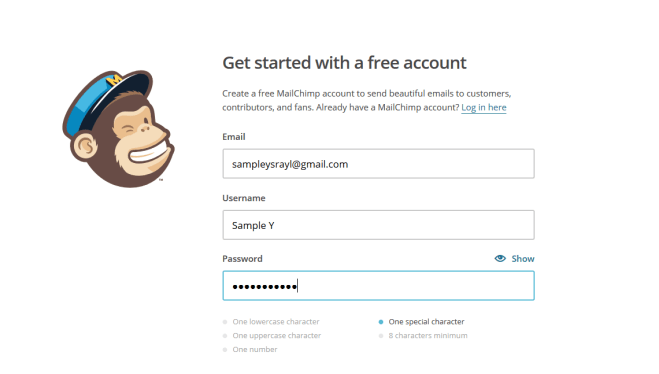
First, go to www.mailchimp.com and set up an account.

When creating a password, be sure you have a password using at least one capital letter, a number, and a special character:

Example_1 is an example of what would be accepted. If you don’t have at least one number, capital letter and special character it won’t let you go on.

After you set everything up, check your email and activate your account.

Here is where you enter your name and the name of your business.

Screenshot (59)Screenshot (60)

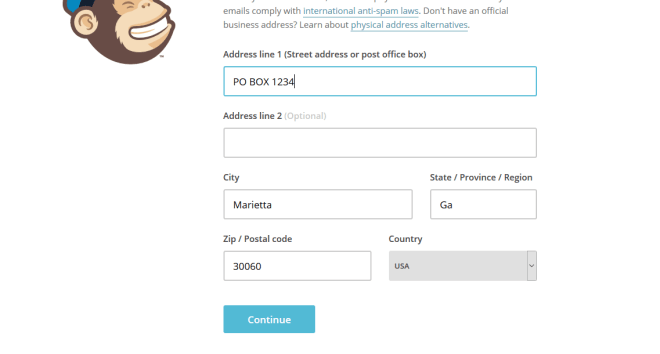
Next, you are going to have to add a physical address. This is because of anti-spam laws. Learn more about that HERE. But you can always come back to this page to change it later.

I would recommend your first and last name and the city, state, and zip in place of Do Not Contact. It looks more professional.

Your Name

Your City, State, Zip

Remember, a street address is optional so you don’t really need that and also remember that you can change this later.

Screenshot (61)

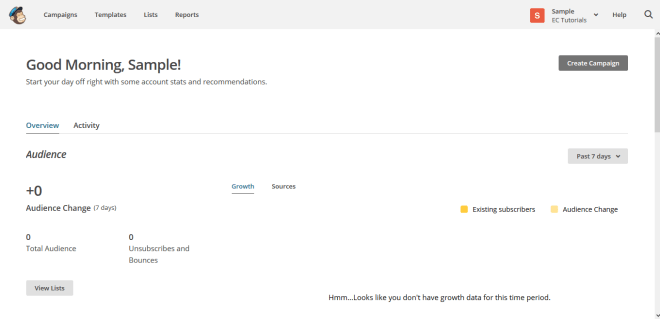
This is your dashboard. When you start sending emails you will see your campaign here, your data and so forth.

Screenshot (62)

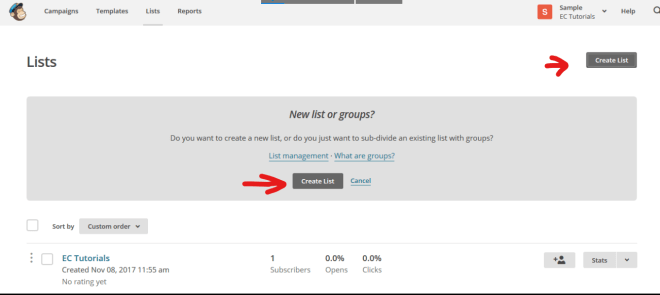
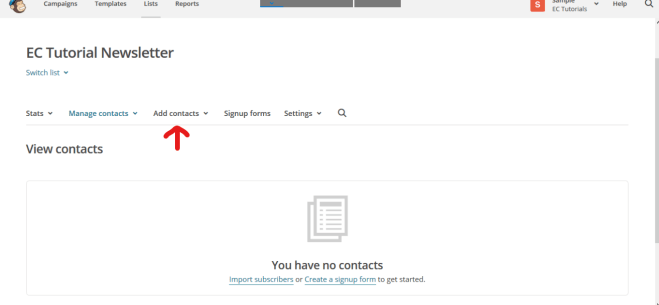
Now for the fun part. It’s time to get started. First, you need to create a List. Click on the List tab.

Go ahead and create list.

Screenshot (77)

List Name > The Name of Your Newsletter

Default from email > Your Business Email

Default Name > I highly recommend using a name people are familiar with already, such as your name. I started with Literary Korner Publishing but then switched to Yecheilyah and my open rates have increased tremendously since then. For your default name, I recommend using your name.

Remind people why they signed up > Wherever people could have accessed your form, put that here “You are receiving this email because…”

Screenshot (84)

Scroll down and check the address for this list. If you want to change it from when you first set up, do that now.

Screenshot (87)

Scroll down. Now that Mailchimp has changed to offer Single Opt-In, you can decide if you want to continue with a double opt in or not. Double Opt-In means once people sign up to your list they will have to confirm again before they are added, like always. Single Opt-In means they are automatically signed up when they first fill out your form. No checking emails and confirmations. They will be automatically added.

If you want Single Opt-In, leave this as is. If you want double opt-in, click on it.

Now, move on to notifications and check all that apply. It’s just asking how often you’d like to be emailed on activity with this list.

Screenshot (90)

Next, you’ll see this page. Until someone is subscribed to your list, you’re done.

Or, you can manually add subscribers you have been given permission to add.

You can also import contacts from your email, assuming you’ve been given permission from those people to be added.

In any event, you won’t be able to send a Campaign or email until you have subscribers to the list.

To manually add subscribers, click add contacts and go from there. In the meantime, let’s move on to how to send emails.

(Reaching out to people to ask if they would like to join your list and if you can add them manually is another great way to increase your number of subscribers. Everyone doesn’t have to sign up, sometimes you can get creative and just ask around (Text messages, Facebook Messages, DM Twitter and IG Messages) All that matters is that you have their permission to sign them up.)

Screenshot (95)

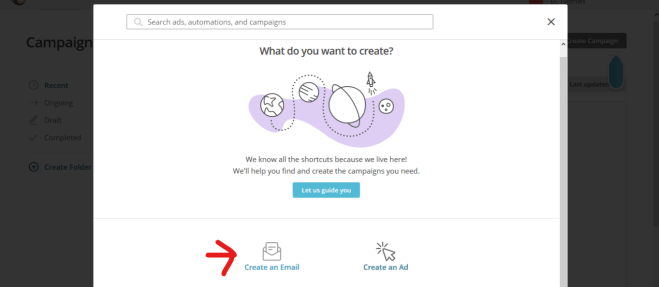
I added myself so that I can show you how to create a Campaign. Click on the campaign tab to get started. This page will come up with the floating arrow to show you where to click.

Screenshot (99)

Click on Create Email

Screenshot (103)

Name your campaign. Whatever your email is about.

Screenshot (105)

The next page is self-explanatory. Just complete the fields based on your list. The To field will ask what list you are wanting this email sent to. Choose the list (you’ll just have one list if you just started), save and proceed to the other fields.

Screenshot (109)

When you get to Design Email, you’ll see a page come up that looks like this. Choose the template of your choice. I am going to go with the follow-up.

Screenshot (111)

This is where you design your email. It’s super easy. Just drag, drop and enter text wherever you want. I am not going to bore you with a step-by-step with this. At least not yet, maybe in another post. However, I would like to caution about one thing….

Screenshot (113)

When I first started my email list I had colors and pictures and it was just going all the way on. While I can only offer suggestions (not guaranteed solutions), I would advise against this. As much as we want to showcase our personality, it helps if our email design is plain and simple. I know, that sounds boring but it’s easier on your audience.

Your email list is really not about you, it’s about the people who read them. Everything, from your subject line to your content and even your design is about making it easier on your subscribers. Therefore, I would say to stay away from too many colors, lots of widgets and pictures, and super long emails.

Personally, I love using my Cartoon Bitmoji as well as my Banner. Aside from these basics, I have taken everything else away. Here’s a snapshot of my real email list to give you an example:

Top

Screenshot (121)

At the top I have my banner (which can be your logo) and a display of my social media buttons. I WOULDN’T PUT MY SOCIAL BUTTONS ALL THE WAY AT THE BOTTOM. I would put them at the top and at the bottom.

Body

Screenshot (122)

The body of my emails have gotten a makeover since I first started. Black letters or gray against a white background. That’s it. Plain, simple, and easy to read.

Bottom

Screenshot (123)

My bitmoji cartoon takes us on out with a reminder to add me to your address book (so my emails don’t go to your spam), check your Spam and Junk Folders (in case my emails go to spam), and a reminder that Gmail emails from Mailchimp tend to go into the promotions folder.

Very Bottom / Signature

Screenshot (126)

Under the reminders is another look at my social widgets and my links.

OK, we’ve had enough Mailchimp for today. Just make sure your emails are clean, easy on the eyes (colors that are not too light or dark), easy to navigate and to the point.


Yecheilyah (e-see-lee-yah) is an Author, Blogger, and Poet of nine published works including work in progress and short inspirational guide “Keep Yourself Full.” Learn more by exploring Yecheilyah’s writing on this blog and her website at  yecheilyahysrayl.com. Renaissance: The Nora White Story (Book One) is her latest novel and is available now on Amazon.com.

Subscribe to Yecheilyah’s Email List HERE.