How often have you heard a traditionally published author say, “I’m a traditionally published author?”
They might say they are a published author but not a traditionally published one. That’s because there are millions of traditionally published authors.
In the same way, introducing yourself as a self-published author does nothing to help the person understand what you write.
It is not bad to call yourself a self-published author or to be proud of that. However, since many self-publishers have smaller budgets, we often desperately identify how we published instead of what we published to get people to take a chance on our books. But this strategy does not work well.
When I pitch schools and bookstores to carry my book, I rarely introduce myself as a self-published author. They will already know this when they look up my ISBN.
Instead, I discuss the book and why it is a good fit for their audience.
Instead of telling people, “I’m a self-published author,” and pushing your book in their face, identify your genre, book, and how it serves your target audience.
You can do this in one sentence:
Original: “I am a self-published author of three books.”
Revised: “I am the author of The Stella Trilogy, a Historical Fiction series that explores African American History, civil rights, and the struggles of Blacks in America.”
Being an author is hard work. Being an Independent Author with no large publishing company, financial backing, or publicity to support you is downright grueling. Who would even want to do this? It is certainly not for the weak.
However, there are things that set some authors apart from others.
And usually, I talk about producing a professional book, but I am not even talking about that here. It is also not about:
If those authors are better writers.
If those authors are better people.
If those authors have more money or even make more money.
It is not even about those authors having a better-quality book (tons of pretty books are not selling).
It is about how those authors have taken the time to nurture and edify their audience with their message before, during, and after their book is published.
These authors have an identity people are familiar with because they have authentically shared their stories, experiences, and knowledge surrounding their topic. This increases their value and creates an emotional bond that makes people want to go out and buy their book when they do publish it.
But this is different from what most self-published authors do.
Most self-published authors, especially new authors, publish a book on a random topic no one has heard them speak on before and hope people will buy it.
We call this hope marketing and it does not work.
You must absolutely take the time to educate and inform people about the content of the book you are writing if you expect them to care enough about it to buy it.
While I have bought books on a whim, for the most part buying a book is an emotional decision. This means we must build awareness that gives people a reason to buy.
People need to know who we are, what we do, and why it’s important to us.
None of this is about selling a book. That part comes later. In the beginning, it is about awareness and emotional connections.
It is as deep as understanding your morals, values, and identity and communicating how this ties into the topic you are discussing.
In Beyond the Colored Line, book two of The Stella Trilogy, we meet Noah Daniels who is a member of The Black Panther Party for Self-Defense. There are two books I read that helped me to conceptualize his character in the most authentic way possible: Revolutionary Suicide by Huey P. Newton and The Assassination of Fred Hampton: How the FBI and the Chicago Police Murdered a Black Panther by Jeffrey Haas.
These books helped me to capture the language and the spirit of the movement as realistically as possible. I modeled Noah’s persona after both Huey Newton and Fred Hampton. Noah uses terms like “Pig,” regarding the police like the Panthers did in the 60s, but reading Newton’s story helped me to understand this wasn’t a random term they pulled out of the sky to be derogatory.
Black Panther rhetoric like “All Power to the People,” and the concept of “pig,” came with Newton’s interest in A. J. Ayer’s logical positivism, that nothing can be real if it cannot be conceptualized, articulated, and shared. While I do not agree with this philosophy as a person of faith (because faith is the opposite of this…the belief and expectation of something even when you cannot see it), it was helpful in me understanding the Panthers on a deeper level and thus helped me to make Noah’s story more real.
Not all research needs to be included in the story so you won’t hear Noah quoting A.J. Ayer. The point of research for historical books is to help the writer to better understand the culture of the time so the characters can interact with the setting genuinely.
Historical Fiction is not an easy genre to write because while the story itself is fictional, the dialogue and personas of the characters have to be true to the time. A young person living in 1960 wouldn’t speak like a young person living in 2020. If done right, adding authentic historical details enrich the story by triggering memories of the past.
Excerpt from Chapter Ten:
“That just bugs me. We supposed to march and get hit upside the head by the pigs?” he would say in conversations with his mother when he would visit her. Unlike many young black men raised by their mothers, Noah’s mother had decided early on that her son’s narrative would be different. When he came of age, she would turn him over to be raised by his father. She could provide a lot of things, but she could not teach him how to be a man. She supported most of Noah’s radicalism, but only to an extent.
“Now don’t you go rappin’ ‘bout all that communist jive talk in here boy. Violence and hatred never helped to expand no revolution.”
“But Ma, that’s where you’re wrong. It’s not about violence. It’s about defending ourselves. Violence is only the guilt complex that exists in the minds of America.”
Mama Daniels would lift her head to the ceiling, wishing she’d said nothing.
“To say that a man is violent because he defends himself does not differ from saying a man who is being lynched and thus fighting back is himself violent because he fights back.”
“Boy, what? You know, sometimes I wish you weren’t so smart.”
Noah laughed, “’cause you know I’m right. Mama, white Americans know that they have been violent against Negroes, and they fear that one day the Negro will do unto them as they have done unto the Negro.”
The 1960s presented a new wave of leadership and identity for people of color who went from being Negroes to Blacks. Just the previous year, the heavyweight champion, Muhammad Ali refused induction into the army on both religious and political grounds. The epitome of the black power movement was the Black Panther Party, founded by Huey P. Newton and Bobby Seale. This party organized the use of self-defense in the accomplishment of black justice and was right up Noah’s alley.
I want my truth
before slavery.
I want customs and traditions
without being conditioned
I want unconditioned
hair.
I want my stuff.
I want my Kings and Queens
my silver and my gold
I want my laws and commandments and my stories
retold.
I want do-overs
for how we’ve been done over
I want my children re-educated
Give me raised fists
and two-parent households.
I want functioning Black family units,
Afros, Black power, curly hair
and I want my cocoa butter skin.
I want credit for all my skills.
I want my midwives
I want my tribes
I want my inventions before you re-invented them.
I want Lewis Howard Latimer
not Thomas Edison.
I want my covenants renewed
I want my 40 acres and a mule.
I want my land rich as I left it
I want my spirituality accepted
I want my names changed back
I want my Proverbs and freedom songs
and I want my Moses Black.
I want what you stole from me
I want King Solomon Black and comely.
I want it all back.
I have always enjoyed looking at book covers. Choosing a cover is my favorite part of the Indie Book Publishing process. In the beginning, I didn’t care too much about the cover and that was cool. But then, as I matured, I started to look at my writing differently. I stopped looking at my writing alone and started looking at the book as a complete package. In doing so, I’ve learned that the best chances of a book succeeding is not just one thing, but a collection of things. Not just a nice cover alone or a well-written story alone, but everything together. That is what I’ve learned, and that is how I will look at book publishing from now on. I will look at the process as a complete piece, a body that I must dress not just outwardly but inwardly and not just inwardly but outwardly.
I have had a little success with I am Soul so I thought I’d talk a little bit about the evolution of the cover and how I think it has played a major role in that success.
To start, I wasn’t going to even release this book when I did. I was supposed to release book two of Nora December 20, 2017, my mothers birthday. Instead, I pushed that book back (it wasn’t ready) and released I am Soul.
I am Soul is a collection of poems from this blog as well as my personal journal, collected, compiled and edited into what is now my 4th collection of poetry. I call it I am Soul because some of the poems are personal, some of them are centered around the African American experience (a people of Soul) and also because people have always said that I have an old soul. Even as a kid people have said that I was mature for my age. For these reasons, I am Soul.
Grainy pic of me and I am Soul with old cover.
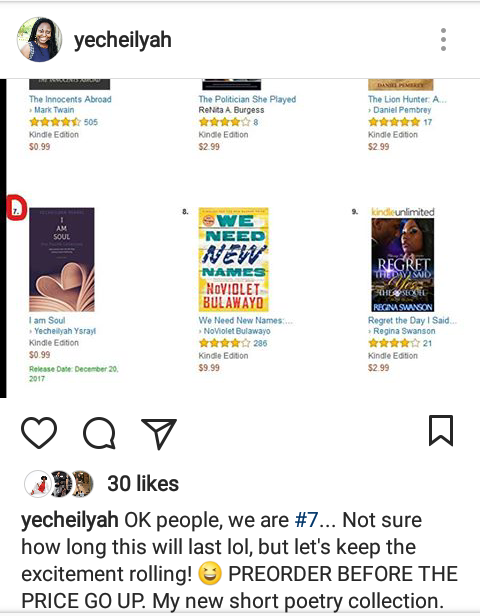
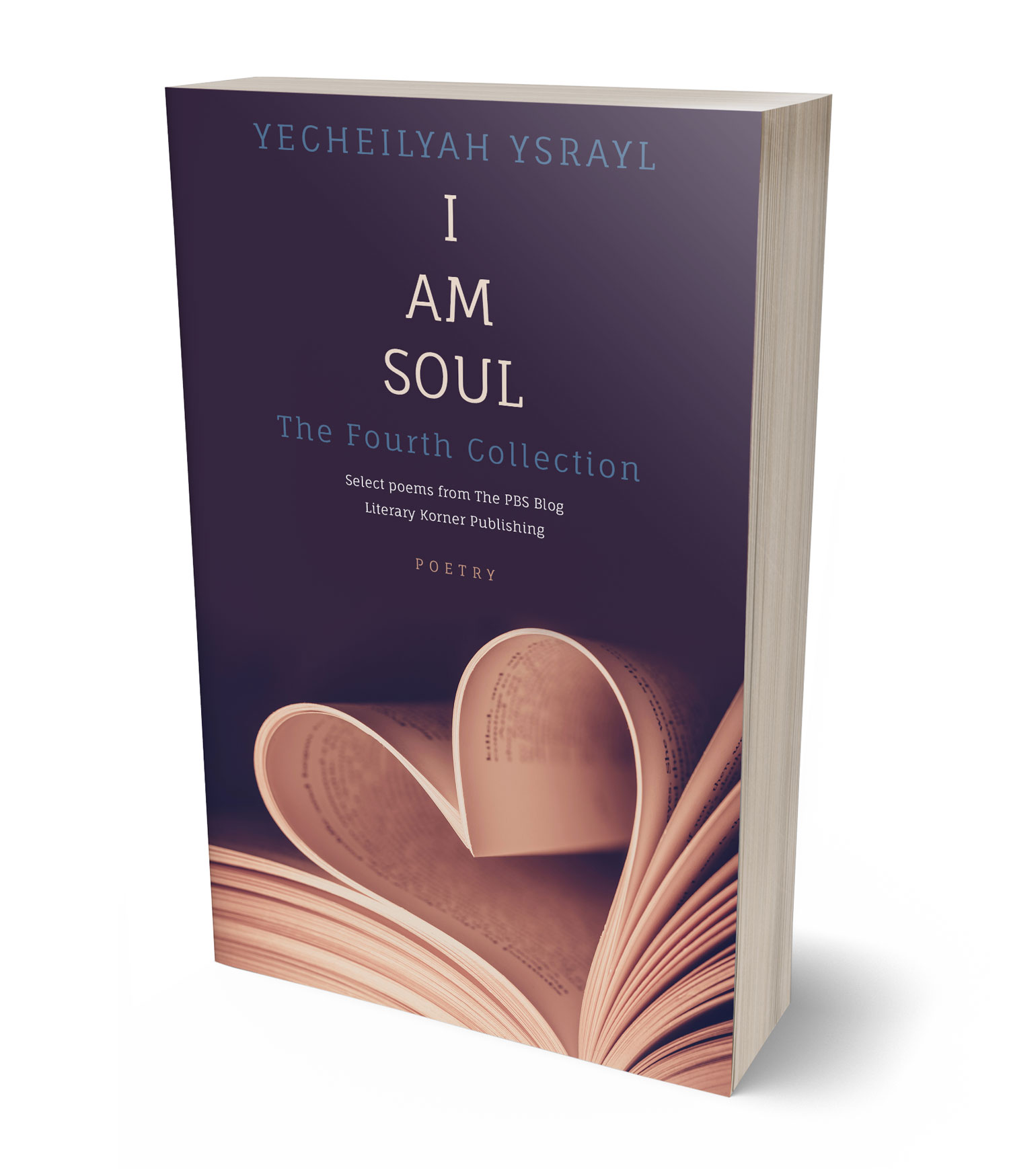
The first cover was decent. I liked it a lot. A purple book with a heart-shaped bible page. It was nice enough to land me the #7 spot in the African Literature category of Amazon before release day. It started at number 17, then dropped to number 9 and then number 7.
But…
I liked the cover a lot but I didn’t love it. I couldn’t help but notice that the cover looked better electronically, to me, than it did when the paperback arrived. It also didn’t stand out very well on Amazon.
I still think this is a cute cover but it doesn’t look all that great offline. Once the book printed it didn’t look the same. The dark blue on top the purple didn’t pop. In fact, this is still the cover on Goodreads. I don’t know how to change it. At first I didn’t care but after awhile I had to follow my heart and change the cover. (A privilege of publishing books Independently. You can change what you want, when you want.)
I decided to try something that matched the name of the book and the content in full. When you think of Soul you think of something deeply personal and connected to that individual.
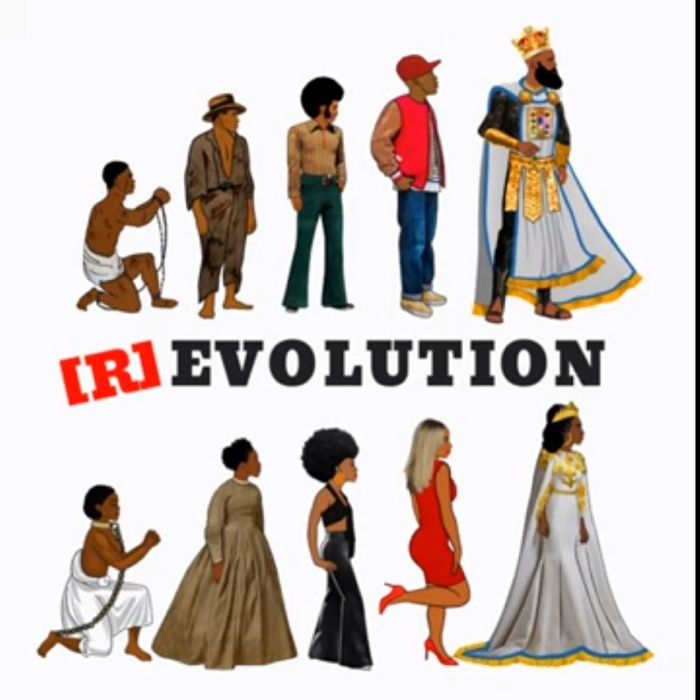
Soul is something Israelites (Blacks) have always had (think Soul Train), from our hair styles to our creative way of dance, the way that we dress, the way that we sing, and the way that we speak. We set the trends and nothing was more trendy than the Afro at the peak of the Civil Rights and Black Power movements. From the practice of shaving the head to pass as a free person in the antebellum south, to the Afro of the 60s and 70s that said that Blacks were proud of who they were and free to be so openly, natural hair had made a comeback.
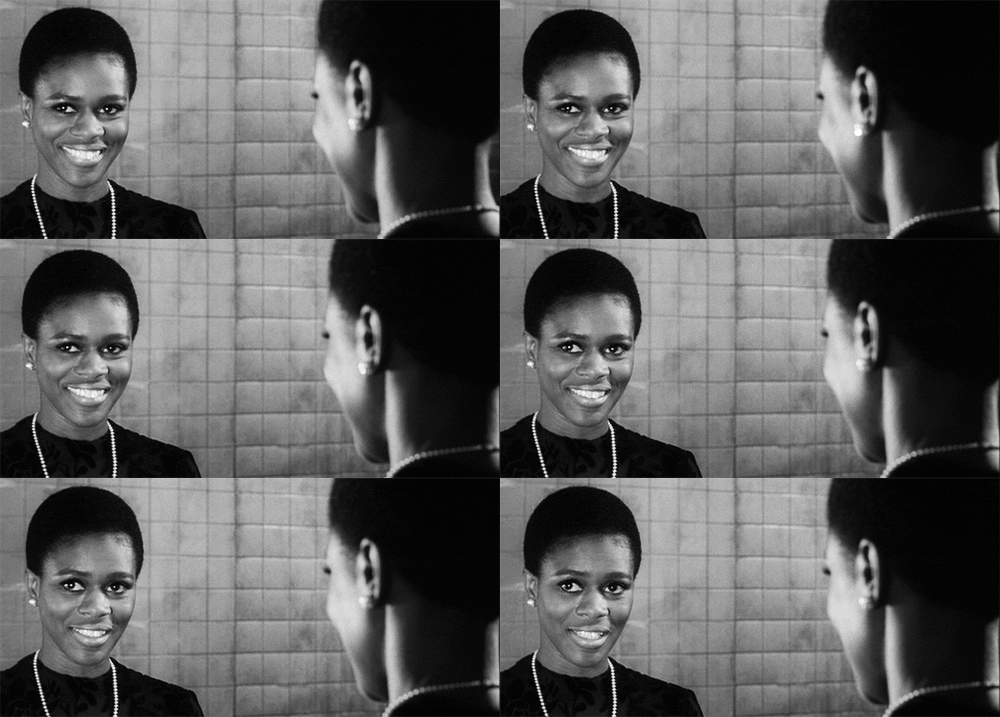
Young, beautiful Cicely Tyson.
In the 1950s-60s it was common for Black women in Africa to wear their hair in small bushes. In America, Black women stopped straightening their hair. Women like Nina Simone and Abbey Lincoln are examples. And then Miriam Makeba (“Mama Africa”) emerged with a fro in the January 1960s issue of Look Magazine and Cicely Tyson wore her hair in a fro on episodes of the CBS drama East Side, West Side. And as college students and political activists like Jesse Jackson and Angela Davis started wearing fros, the fro had eased on into the mainstream.
Before and After
It wasn’t just about hair no more than Samson’s locs was about being trendy. Those locs were a representation of power and strength and so the Afro was a representation of the social-economic and political era of the time. A time when Black men and women were gaining strength and reclaiming parts of their lost heritage, one hairstyle at a time. A similar revolution is taking place today. Black men and woman are embracing more of their natural selves and waking up to the true knowledge of who they truly are.
For all of these reasons, I felt an image of a Black woman wearing a fro spoke volumes concerning the kind of messages I was seeking to give with the poetry inside of the book. Not just the soul of one woman but the soul of a people. The soul of an era.
I still think both covers are nice in their own right but the one that sticks out the most and which embodies a much more clear message; the one that will not just appeal to those who are biblically conscious but reach a larger audience; the one that makes people stop in their tracks, is the new cover.
When I uploaded this to social media, readers responded immediately. This had not happened with the first cover.
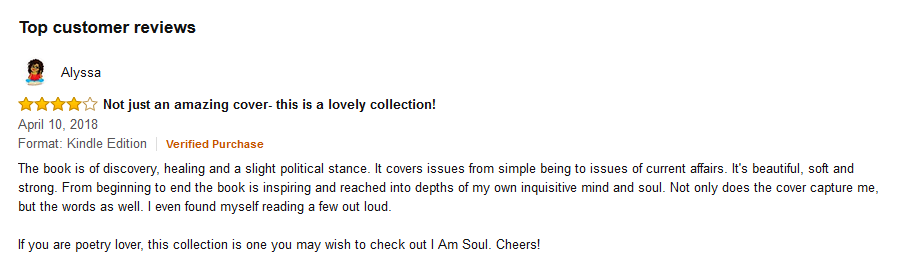
The new cover got me new reviews…
I submitted this book to two different bookstores. One using the old cover and one using the new cover. The one with the new cover got a call back and the book is beginning to sell at the store. I am still waiting on a response from the store using the old cover.
I’ve learned that book covers really are important because I’ve experienced how important they are. Don’t get me wrong, content is just as important. At the end of the day if there’s nothing special to read there’s nothing special about the book. I am Soul still had to be edited and get through the bookstore’s professional reviewers to be stocked.
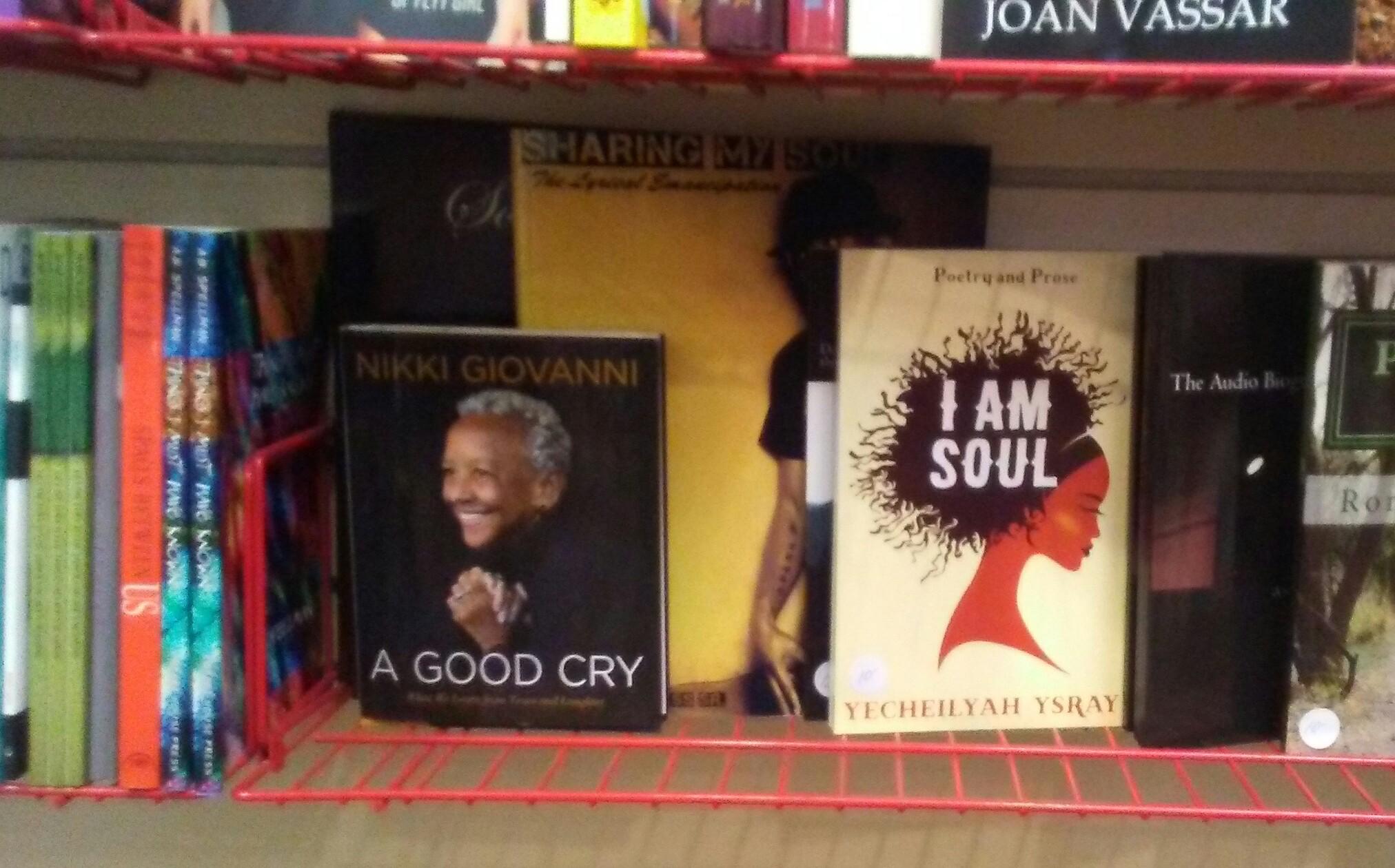
But, when I walked into the store yesterday, I couldn’t help but notice that because of the cover, Soul stuck out more than some of the other books that I could tell, as an Indie Author, were also self-published. In fact, to my surprise, Soul was sitting right next to Nikki Giovanni’s A Good Cry. Whether someone just sat it there or not, I cannot be sure. But, I was sure enough proud. I wasn’t going to taint the moment with thoughts of how it got there. It was there nonetheless.
I know we are all still on a high from The Black Panther movie. It’s a great film. While we are in this space–this feeling of pride and empowerment– I’d like those who choose to do so to not let something else go over our heads. If you think about it, it is easy to miss. There’s so much happening around Black Panther, no one has said anything about the misrepresentation of ourselves (Blacks) happening right before our eyes. The misrepresentation I am referring to is The Samson Movie.
If you don’t believe in the bible you may exit now. I don’t expect this to have any significance to you. If you believe in the bible however then there is one thing we must realize about two things that have taken place before our eyes, overshadowed by the excitement surrounding Wakanda and T’Challa.
Both Samson and Nefertiti have been misrepresented. They have both been portrayed as Europeans when this is not the case.
On February 16, 2018, The Samson movie came out. I don’t believe in coincidences so it’s no coincidence to me that this movie came out on the same day that Panther came out. Naturally, Black people will be excited about seeing themselves represented, for once, on screen. Naturally, we would support Black Panther over The Samson Movie. Naturally, we are tired of seeing white heroes. Naturally, we would miss this. I am asking you not to miss it. I am asking you to pay attention. Now, I am not asking you to go see Samson. Do not misunderstand me. I am asking you to realize that Samson was one of our heroes and he is being misrepresented in this movie. I am saying that Wakanda has got Blacks searching and talking about identity for once, which is great. Interestingly enough, Samson is our identity. The Israelites were black. The Philistines were black. The Egyptians were black.
As we are being represented in Black Panther, we are being misrepresented in Samson. Showing Israelites and Egyptians as Europeans is disrespectful. Do not lose sight of this. It is not a small matter. Samson was a very powerful man, a superhero with great strength. Black Panther is a great film with powerful symbolism and messages (that I hope to address soon. In the meantime, see my recent post on 6 Reasons Black Panther is Popular (and it’s not even out yet) I wrote before the movie released.) In short, Samson’s portrayal as a white man is just as offensive to me as Nefertiti being portrayed as a white woman and no one’s talking about it.
Do you favicon? I have started to pay more attention to them and love the neat look it gives my browser. First, what is it?
Favicon – Also known as a browser icon, website icon, site icon, or URL icon, a Favicon is a tiny logo / image that shows up when you visit any website.
Custom Favicon’s help to brand a website, establishing your website’s identity. Instead of the default icon that shows up when you create a website, your logo will show in the browser when people visit your website and looks good for your online presence. Plus, it looks cool. I added a favicon when I acquired a domain for my blog so that both my author website and my bog have matching browser icons:
So, if you’d like to add a Favicon to your blog, here’s how.
First, be sure you have an image or logo to add. The recommended file type is ico or PNG (if you’re still using Internet Explorer, shame on you. No, seriously, PNG website icons won’t show on some Internet Explorer browsers so try JPG).
The standard Favicon sizes is 100px x 100px and 300px a 300px and they will show smaller of course at 16px by 16px. Be sure your image does not exceed 100KB.
The next set of steps is as easy as 1, 2, 3.
Go to your WP Dashboard
Scroll down to settings > General
To your left is Site Icon > Upload your image
After uploading your image refresh your page. If the favicon still doesn’t show in your browser you should clear your cache. (In Firefox: Tools > Options > Advanced > Network > Clear now).












 The PBS Blog