
6 Consistent Blogging Ideas for Busy Bloggers

Blogging takes up a lot of time. To arrange a decent post takes at least an hour depending on how long the post is. For posts that require lots of research, it can take several days of research and gathering links before actually composing the post in the WordPress editor. Still, we are told that the best way to blog is to do it consistently. For busy bloggers, those with jobs and children and basically a life outside of the internet, blogging consistently is a real challenge.

You Don’t Have to Blog Everyday

The assumption that you have to publish a post every day is not entirely accurate. While posting every day is cool, that’s not ideal for everyone. Keeping a consistent blog is important but you don’t have to publish a post every single day in order to be successful. Be disciplined but do not obligate yourself to other people’s schedules. Just choose 2-3 days out of the week that you would like to dedicate to updating your blog.

Schedule Your Posts

Not every post has to be in real time. One of the biggest time savers for me is scheduling posts. This requires a bit of discipline since I have to get started days earlier depending on when I want the post to publish. For my Black History Fun Fact Friday posts, these are always scheduled days ahead because it requires research, fact-checking, and accuracy. To schedule your posts, here’s what you do:

Dashboard > New Post > Write out your post
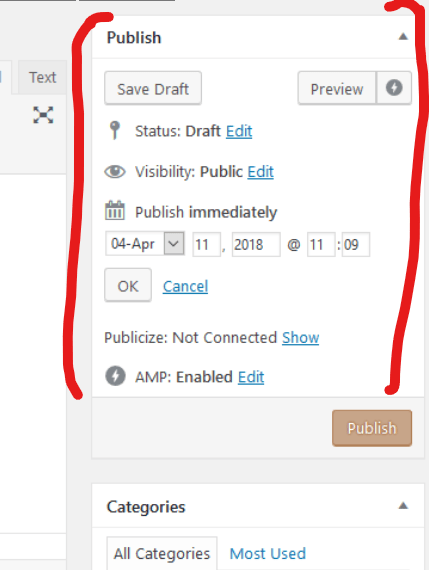
Once you have written out your post, added tags and all that good stuff, scroll over to the publish section of the screen. It should be in the top right-hand corner. Next, to publish immediately, click on edit. The calendar will come up and you can choose when you would like the post to publish and the time. Keep in mind that the time will be in accordance with the timezone you have set. I am on USA Eastern Standard Time but my settings are Central Standard Time because I have moved to another state. When scheduling posts, I keep this in mind. (For those of you in the United States, it helps to choose a scheduling time that is convenient for people in other countries too. Scheduling my posts midnight my time means it will publish sometime in the morning in other countries. I have found this to work well).

Establish Segments

Publishing quality posts is important but the quality posts usually take up the most time. You may get something good every so often, but not every day. (I have not published a poem in awhile). That’s why I think establishing segments can help. A segment is something special you have going on that occurs at the same time or day every week or every month. My No Whining Wednesday and Black History Fun Fact Friday are examples. I’ve been slacking, but segments like these help to keep this blog updated and it may help you as well. It will give you something to look forward to and if you are a super busy blogger, will help you to be consistent with your posts at least once or twice a week. I find it also helps with branding. People will get used to your segments and look forward to them. They may even follow your blog specifically for that segment alone.

Choose from the most used tags

Tagging your post can be time consuming, especially if you’re OCD like me where everything has to be perfect. You don’t want to just use any tags but you also don’t have a lot of time to publish this post. Well, once you’ve been blogging a while, under the tags you will see something that says “choose from the most used tags.” These are tags you use often.

You can click on these tags quickly to tag your post with the generic tags (like, blog, wordpress, writers, etc.) and then spend the rest of your time adding authentic tags, or tags that are specific to your post. You can also blog from your phone if that saves time, which leads to my next point.

Install the WordPress App

I am not always at home when my posts publish but I am capable of responding to comments quickly and visiting other blogs because of the WordPress app. It took me a minute to actually catch on (I used to do it the long way by just checking my email) but once I did it has made blogging for me easier by cutting down on time. You can instantly see who has commented on your post and who has liked your post using the app. Am I the only one who still pays attention to post likes? Probably so but this helps me to get to know my readers more actually. I know who the active followers of this blog are and the followers who no longer participate. I am aware of those who used to comment all the time and now do not and I know who the new subscribers are who have taken on that role. I even know some of the followers who have been here since day one.  This leads to my last idea.

Pay Attention

Pay attention to the posts people are really engaged in, the posts they enjoy most and interact with the most. This will cut down on a lot of time spent drafting something no one wants to read. I mean, I don’t spend a lot of time caring about what people will think of my posts, to be honest, but that doesn’t mean it’s not a good idea to think about others from time to time. It’s your blog and you can write what you want and you should but blogging’s not fun without engagement. If you wrote a poem everyone liked, you may want to start to incorporate more poetry into your blog. After all, it’s about being of service to the people and not just in service to yourself.


 

bitmoji-470945688
You could be doing this as your post goes live, but you didn’t schedule it!

Can you afford to be an Indie Author? | Angela J. Ford

Finances are a big deal when it comes to Indie Book Publishing. For those who want to do it right, it pays in more ways than one to have a budget for every book you intend to publish. Check out this article from Angela Ford on ways to break it down and later, I’ll publish a separate post on how I break down the costs for my very own books. Until then, enjoy:

“Can you afford to be an indie author? As independent authors, we have to be aware of the way cost plays into self-publishing. Cost can mean the difference between turning book publishing into a business versus having a very expensive hobby. The question is, how much is too much? When do you know if your books are bringing in a positive return on investment?” – Angela J. Ford

Keep reading through to the original article here.

KDP Print Just Got A Whole Lot More Attractive

Nicholas gives us the scoop on some hot new upgrades to KDP for Print.

Nicholas C. Rossis's avatarNicholas C. Rossis

CreateSpace-Amazon logos | From the blog of Nicholas C. Rossis, author of science fiction, the Pearseus epic fantasy series and children's booksI’m sure most of you have heard the news by now, but if you haven’t, Amazon has announced some major changes to its KDP Print program. Only two days after I was telling people in this blog’s comments that I wouldn’t even consider moving to KDP Print from CreateSpace until Amazon addressed its two most glaring issues, the company announced it had. On top of that, it addressed my major problem with CreateSpace, thus making it a whole lot more likely that I will soon be moving over.

Problem #1: No Physical Proofs (Solved)

The first problem with KDP Print concerned its means of proofing your manuscript. Well, you can now order printed proofs from KDP. Proofs allow you to review a physical copy of your draft paperback prior to publication.

Note, however, that the process is a bit more cumbersome than the one CreateSpace uses. Specifically, here’s how you…

View original post 884 more words

Good Writing Advice Acknowledges That Everyone Is Different

Well said. Post Quote: “Good writing advice acknowledges that everyone does things differently. They’re at different places in their lives. They have different barriers to productivity and creation. They have different preferences, different likes and dislikes. They are not you. And talking to them like they are is like talking into a mirror. Your audience isn’t going to stick around.”

Meg Dowell's avatarMeg Dowell Writes

I’m tired of reading bad writing advice.

I’ve always hated it. It’s one of the reasons I started Novelty Revisions. Even though I wouldn’t have called myself anything close to an expert at that point, I wanted to fill as much of the web with good advice as I could.

You can’t stop people from giving bad advice. But you can contribute enough good advice that people start ignoring the unhelpful, generalized, and, in some cases, wrong.

When I’m thinking of ideas for blog posts, there are a few things I always try to stay away from — even if the ideas do come to mind.

  • I never want to rant about something unless I have a solution to offer — either practical or theoretical.
  • I won’t ever call someone out for being terrible, unless I’m giving my readers an example of what not to do (or what to do…

View original post 737 more words

MASTER LIST of Facial Expressions for Writers! – Bryn Donovan

Awesome. Authors, check it out. Very helpful list.

I created this list to address that challenge. The expressions are broken down by the part of the face. Note that some of them work for more than one emotion—a person might narrow their eyes out of vindictiveness or skepticism, for instance, and their face might turn red out of anger or out of embarrassment.

Some of them require a little more explanation on your part. You’ll have to say what she’s glaring at, or if his face is contorting in rage, or grief, or what. And not all of these will work for every character—it depends on what they look like and how they generally react to things.

Some of these aren’t exactly facial expressions, but useful for dialogue tags. In many cases I’ve given several ways to describe the same thing. While I have included some longer phrases, they are not proprietary and it’s fine to use them.

Click through to the ORIGINAL POST HERE to read the facial expressions. I am sure you’ll find a few to put to good use.

Easy Blogging for Authors: 10 Tips for a Successful Author Blog, Anne R Allen

Anne is at it again with a most excellent article on Blogging for Authors. If you’re an author and you’re looking to learn more about how your blog differs from a business blog, check out this post. She talks being true to your brand, not defining your blog success by numbers, networking and not sacrificing your WIP (work in progress).

My biggest mistake was that I didn’t see that an author blog has a different purpose and goal from a business blog. Author blogs aren’t about making money directly with ads or sales.

Instead, they provide a platform for your writing and a way to communicate with readers and fellow writers. An excellent one. In fact, a blog is still the best platform-building tool for authors, according to agent Laurie McLean of Fuse Literary, (Laurie will be visiting us in January.)

Good writers don’t need gimmicks. We only need to entertain and inform: content really is king. Be accessible and be yourself. Nothing else matters. (Well, correct spelling and grammar help too. 🙂 )

Click through to the ORIGINAL POST HERE to read the entire article.