5 Ways Books Can Help You Publish Your Book (Besides Just Reading Them)

5-ways-books-can-help-you-publish-your-book

I’ve been re-reading a lot of books, specifically literary classics. As I think about my next project, I’ve also thought about my previous works, noticing the things I did wrong and that I’d like to improve on this time around. That’s what I like about Self-Publishing, with every new book there is something different that I discover (for better and for worse). This time around, I’ve been paying more attention to the interior layout and formatting of my books; how to do so properly for eBook and for the paperback.

I stood in front of my bookshelf and stared at the books. I went to another book shelf and stared at it. I went back to my bedroom (since my favorites are in the bedroom) and took a handful of books and scattered them on the bed. It hit me: Here is all the research I need to help properly format my books. I discovered in that moment that books can help Indie Authors in more ways than one. Obviously, reading them. Here are five more:

  1. Book Cover Design

Probably the most obvious is Book Cover Design. Reading books can help Indie Authors to study the graphics of Best Selling books and how the design help to interpret what the story is about. Because I am not a graphic designer, I may not understand typography and all the important elements that should go into a Book Cover. True, I can pay someone to do this for me. However, if I am on a budget and therefore purchasing a premade cover, I need to understand how the colors and text all come together. Premades aren’t as easy to choose as they may seem since the author must choose one that will accurately represent the book.

  1. Front Matter

One of the primary things I’ve been paying attention to is the front matter. This is the first few pages of the book before the first Chapter (or before the Prologue). It’s the title page, copyright page, dedication page, acknowledgment, forward, preface, introduction, and so forth. Looking at how professional-quality books format their Front Matters has helped me to understand the foundation of how it is to be done. I can see where the ISBN Number is, how the wording of the Copyright Notice is set up, and the credits to the editor, co-author, or illustrator. I can also notice that the Front Matter is not numbered or is numbered differently than the book Chapters. Either there are no page numbers or there are Roman Numerals instead.

  1. Paragraph Structure

Another huge aspect of formatting for me with this next book is improving my paragraph structure. If you would take the time to browse the books on your shelf you’ll see how the paragraphs are lined up. Further, they are different for the kind of book. Young Adult books for very young adults (starting at maybe pre-teen) have text that is larger than general adult fiction books. They also have more space between them. This makes it easier to read. On the other hand, books that are harder to read or are for older audiences have text that has less space and is closer together. How does this help the author? We want our books to be appropriate for the grade level to which it is meant for. A children’s book is going to have the big text and lots of space but as we go up in grade level or age, then the text becomes smaller and less space.

  1. Page Numbers

Another tidbit we can pick up from looking over the books we already own is the page numbering. While I add page numbers to my books ChronologicallyI’ve noticed that some books (most of the ones that are Traditionally Published and that I grew up with), are numbered in a certain order: The “even” numbered page is on the left-hand page and the “odd-numbered page is on the right-hand page. I don’t know why as this style of page numbering isn’t very important to me, but it can come in handy for those who’d like to mimic this style.

  1. Back Matter

Finally, books can help Self-Publishers to see how to properly format the back cover of their books. Maybe you’d like your picture in the corner with a brief bio or maybe you want it all blurb. If you don’t have a professional Book Cover Designer already, you can easily mimic a professional-looking back book cover layout for your print books just by taking the time to browse your bookshelves. This can even be done on the Spine. Have a Publishing Company behind your books? Maybe you can add your logo to the spine or on the back so it looks like “Your Awesome Publishing Company Name Inc.”

And now for my 2 cents….Be Inspired

What I find so inspirational about Malcolm X, is that he was what I like to call an uneducated smart man. He didn’t start as what people considered smart or expert, but a criminal, someone who robbed banks and snorted coke. The point is that he wasn’t someone you looked up to or came to for knowledge on a skill aside from running numbers. Yet, he became someone who spoke to and inspired millions of people. What I’m saying is that it is not who he was, it is who he became. By reading books and studying history his voice alone commanded the attention of thousands. I believe Indie Authors can do the same. Don’t underestimate yourself. Anyone can follow a trend or rehash the same kind of advice but until you’re willing to step outside the box and be different, until your are willing to do something beyond what you’ve never mastered, you will never grow.

How to Get Your Blog to Work for You Even When You’re Not Blogging

The PBS Blog was not my introduction to blogging. At first, I hosted a blog through Blogger in honor of my first novel The Aftermath. My second blog, A House of Poetry, was dedicated to poetry and hosted here on WordPress. Neither of these blogs went very far. When I transitioned from A House of Poetry to The PBS Blog, I had a different intention. This time around, I enjoyed blogging, and I did not want to miss a day of publishing content. I was relentless and almost obsessive. I posted three times a day for five or six days a week. My routine looked something like this:

  • A Poem
  • A Creative Piece or Article
  • An Inspirational Quote 

I did this for the first year of The PBS Blog, which I discuss in detail in How I Reached 300 Blog Followers in 3 Months.

Create

Of course, you have to first produce something. This post is about getting your blog to work for you when you are away, but that doesn’t happen unless you have first created something. 

My first tip to getting your blog to work for you even when you aren’t blogging is to be consistent in publishing valuable content when you first start your blog so you have tons of content to repurpose later.

My first posts did not do well far as engagement. But what it did was help me get used to writing publicly, posting regularly, and creating content that people will read weeks, months, and even years later. People are still engaging with posts I wrote four and five years ago because blog posts have a long shelf life, unlike a social media post.

I believe in hard work. I also believe that hard work pays off. These are pretty much the basic principles that help me to keep this blog going.

Update: We are now in the era of the COVID-19 pandemic, which we were not in when this post I first published this post in 2016. More people are at home now, which is a wonderful opportunity to engage your audience because people consume a lot of content. Time spent reading blogs and social media posts have increased significantly, with everyone being at home. On the flip side, there are also more distractions which means that you are easily forgettable if you are not showing up regularly.

Another thing to remember is that a post you publish today can blow up a year from now. A post with five likes now can get 50,000 likes in a year, depending on the spirit of the time and how it is relatable to your post. Here’s an example of what I posted in the original version of this post from 2016:

“Last week, a blog post I published two years ago suddenly got lots of attention. My stats were going crazy! Shooting up to over six hundred views within 48 hours, over 3,000 by the end of the day, and over four thousand shares on Facebook. This was an old post that new visitors were just discovering. This is a clear example of your blog working for you. If I wanted, I could have sat back and took an entire week off and made it up in views, likes, and follows coming in from that post alone. This same thing can work on articles that surround certain historical events, like 9/11. Maybe you posted something on 9/11, and two years from now, it gets all of the attention you thought it deserved when you first published it. It’s all about timing.” – Yecheilyah

You won’t have to worry about posting as much once you’ve been doing it for some time, and you won’t have to worry about losing followers when you are not blogging  because there is enough content for people who have not yet discovered your blog to read.

Schedule Your Blog Posts

Although I was publishing a lot initially, it doesn’t mean that I was coming up with the content on the fly. I planned my posts out and scheduled them. If you go into your WordPress dashboard, you can schedule your blog posts so that they will go live without you having to sit in front of the computer or phone and do it manually. If you are in the US, I recommend scheduling it to go live at midnight so you can reach people all over the world who are in different time zones. We talked about this in another post already, so as not to be redundant, I will refer you to that post which you can find here.

Download the WP App (Or Whatever App is appropriate for your blog platform)

You can also download the WordPress app, which, once the post is live, helps respond to comments and share to social media on the go.

This is probably one of the best tips of them all because you can grow while you sleep, which is like working while you sleep. And who doesn’t like that?

Support Other Blogs/Bloggers

Publishing posts regularly is good, but it is not enough. It is just as important to follow other blogs, comment on other blogs and interact with other bloggers.

The more I interacted with veteran bloggers, participated in challenges, followed and commented on other blogs, the more I became aware of the little nuggets and tidbits I needed to help my blog, not only to grow but also to keep growing. And consistent growth is a goal that I consistently strive for.

Guest blogging, interviewing others, and being active within the community will help you grow even on days you are not blogging because you are leveraging your platform through others. Someone might not have read the article on your page, but if you were a guest on someone else blog or a more prominent blog reblogged/shared your post, their readers become your readers depending on the subject and how it is relatable to them.  

It’s a challenge for authors who write and publish books to be consistent in publishing blog posts while trying to write books because blogging is still a form of writing. Whether you are publishing a poem, short story, article, how-to, research article, giving a testimony, or breaking down how a quote is inspirational to you, it’s all still writing.

One solution is that by frequently posting in the beginning, supporting other blogs when you are not blogging, repurposing content, and scheduling blog posts, authors can continually publish books without neglecting their blog.

The key is a little bit of discipline and networking with others, incorporating blogging into your platform building strategy as a necessary part of the work, and producing quality posts as early and as often as possible in your blogging journey.

Why I Ditched My Blog Sidebar – Guest Post…

My November Guest Post with The Story Reading Ape. Should you X the sidebar? Read on to see why I did.

*Comments disabled here. Meet me on the other side!*

Chris The Story Reading Ape's avatarChris The Story Reading Ape's Blog

Why I Ditched My Blog Sidebar

I took a two-week break from posting on my own blog a few months ago. In that time, I was refueled with post ideas but I also had the opportunity to read most of yours. In that process, I realized something I hadn’t paid much attention to before. I didn’t pay much attention to it because that’s just how ingrained these things are in our lives today. The Cell Phone. During my observation, I realized that I read most of your blog posts (90%) from my phone. In fact, I observed that the only time I read blog posts from my laptop / desktop, is when I am logged in to draft a post that I can’t draft on my phone.

The number of mobile-only users has recently surpassed the number of desktop-only users. According to an article in Marketing Land, “Mobile now represents 65 percent of digital media time…

View original post 764 more words

Talk Yourself into Achieving Your Goals

trainer3

Like many of you, I experience doubt, fear, and all the other emotions that can bring about stress and negativity. I am no different than you in these feelings. I am human and like you, I have emotions. Sometimes I am broken, undetermined, and lack confidence. However, I soon remember that this is not how I want to live my life. It is not that I am “happy go lucky” all the time, fake, or that I do not have feelings of despair, but that I have made the conscious decision not to give my energy over to such feelings. Of course, there are days when I am not consciously strong enough to make that kind of a decision, and that’s when prayer comes in.

So often I hear writers, bloggers, and friends complain about not being good enough without realizing how they’re speaking this into existence. If you truly don’t believe you have worth or value, then that is how it’s going to be. It’s not about being flawless (for we have all fallen short in some way or another) but what it is about is talking ourselves into achieving our goals instead of talking ourselves out of them.

Like learning, self-examination is not a one-time thing, but it is forever constant in our lives. One of the reasons self-reflection is so important is because we often deceive ourselves. Self-Deception means that you are not consciously aware of your true self. The person in the mirror is not reflective of what really exists. There are often two kinds of ways in which we deceive ourselves:

a. The part of self-deception that makes us look at ourselves and downplay everything about us because we know that we are flawed.

b. The part of self-deception where we know everything.

Both of these views are wrong.

Self-examination is not comparing ourselves to others or being mean to ourselves. It does not make it so dark that nothing new can grow. In this instance of Self-Deception we’re just too busy counting our mistakes and being “down and out” to make any real changes. It’s almost as if we want to be in that low place. Walking around carrying the burden of this dark cloud over our shoulders like its a responsibility, and brushing off any inkling of light that wishes to squeeze itself through.

The other one simply leaves no room for improvement. Self-examination is not self-exaltation.

It is possible that the way we perceive ourselves is flawed. If we think we know everything it is possible, then, that we are self-deceived. Likewise, if we believe that we know nothing, then it is possible that we are self-deceived, for everyone has a little bit of something in them. We all know in part and working together we become whole as we all bring something different to the table. No one knows everything, but everyone knows something.

When we have these low moments, we must talk ourselves into those changes we want to happen in our lives and implement a plan that will help us to reach these goals in a practical way. Again, it’s not about having it “all together”, it’s about changing your perspective on life itself and going from concept to execution. Words have power and they do not come back void. Instead of speaking negativity over your life and having a “woe is me” attitude, try being inspired. Try optimism. Try faith. Try something different, for insanity is repeating the same thing over and over again and expecting a different result. You already stressed yourself out about that today. Try something else.

So, your blog isn’t growing the way you want it to, what are you doing to change that? What practical steps are you taking to change what you don’t like? Or are you just complaining about it? So, you’re not where you want to be with your writing, or business, change it. Sit down and outline a plan. So, you don’t like the way your stomach looks right now, change it. Maybe you can’t run a mile starting out. You don’t have to. Run a block. Walk a block.

Anything you don’t like in your life can be changed but first you must change your perspective. In addition, there must be a willingness to be uncomfortable. Only when we are in that place can we really grow. For as the saying goes, “Comfort zones are beautiful places, but nothing ever grows there.” Yes, it’s going to be hard. Yes, it’s going to take persistence, and yes it’s going to take dedication but it begins first with the self-confirmation that yes, IT IS possible. We have to start using words like, “I can”, “I will” and “I will learn” instead of “I can’t”, and “I will never”. Don’t talk yourself out of achieving your goals. Talk yourself into them.

Confidence and Writing Discipline

o-WRITING-YOUNG-PERSON-facebook

The most important factor in a writer’s life, at least in my opinion, is not mere talent. Neither is it some mysterious entity floating in the air called luck. It is not how much you blog or how less you blog. It is not how much money you spend or how little money you spend. It is not even your profound research and marketing skills. These elements surely help, but the greatest difference and perhaps the most unique too, between writing and other careers is a writer’s level of discipline and confidence. To keep writing, I often find that I must maintain a proper balance of each of them. Believing enough in your ability to write and having a consistent writing practice is often the difference between aspiring authors and published authors. Of course, it does not stop here but it is a step in the right direction.

The advice we hear from like-minded bloggers, agents, editors, or just authors, in general, have always, and perhaps will continue to be, our focus on writing. Because engaging in any activity of whatever sort on a daily basis naturally makes one more familiar with it, we will always hear how important it is to write and to keep writing. While this is good advice, I think that for many writers finding the time to write and sketching out a daily routine is not always easy and this is often underestimated  by those who are not writers or those who consider writing to involve less work than other careers.

“Self-discipline, what many call will-power, refers to the ability to persist at difficult or unpleasant tasks until they are completed. People who possess high self-discipline are able to overcome reluctance to begin tasks and stay on track despite distractions. Those with low self-discipline procrastinate and show poor follow-through, often failing to complete tasks even tasks they want very much to complete.” – Wikipedia

When a writer transitions from the workplace to fulfill a writing career, his initial challenge will be to maintain a certain level of self-discipline. For years he has not had to create his own time sheets, develop his own projects, and schedule his own lunch breaks. All of this has been done for him by the corporation in which he has worked for. It is now that, as a full-time writer, he must put in the necessary time to ensure a proper work day, rest, and vacation time.

He must dig deep into his resourceful mind and find the inspiration to write, in some way, daily. If he is not writing, then he must attempt to focus that energy in the direction of reading, social media marketing, offline marketing, and public speaking events to keep in line with the workflow. As we can see, the full-time writer has a lot to do and it is not always easy finding the discipline to get it done.

Sometimes it is just so hard finding the time. What I have come to invest in, however, is my purpose. As long as I remember my purpose and invest in that it is usually enough to keep me moving. This is because discipline works hand in hand with motivation and drive. It is that ingrained, determined urge to attain a goal or satisfy a need. It is the answer to the question, “Why do you write?” This answer is different for each of us but the result is the same. If every full-time writer kept his primary goal, the answer to the question of why he or she must write, always at the forefront of his mind it can undoubtedly become the catalyst to a more disciplined writing life and as a result more material.

Yet, in all of this, a writer must still believe in his ability to write and speak this into existence.

There’s a lot of criticism out there for writers. It is enough to keep us full for a lifetime. Not only in its relation to the backlash geared at Self-Publishers, but many people also do not see entrepreneurship, specifically writing, as being a “real job”. For this reason, confidence is necessary to be an apart of this movement. It is not to think more highly of yourself than you should think, (*caution: recipe for disaster*) since there is a power greater than you. But confidence is the state of feeling certain about something.

Working for you can feel like a blessing and a curse. There is so much to do, so much to strive for and (wait for it) so much failure. But if you believe in that aged old saying, “hard work pays off”, you will allow self-discipline and experience to train you into the professional you need to become.

One of the greatest ways to maintain just enough confidence to get the work done but  at the same time maintain just enough humility is to be of help to others as best and as often as you can. What you do always comes back. How you treat others will almost certainly reflect how you yourself are treated. It’s not always about you, and yet your personal goals are still important.

So there’s a balance between our level of discipline–which will get the work done–and our level of confidence, which will keep us going when a project has failed to meet the goal. In the words of Kevin Nance, “failure curdles into something else… I go down into that failed place, and I think, ‘I’m going to take a look at that failure and make something of it”.

7 Common Sense Reasons You Should Build an Email List

  1. Direct Communication

Many Indie Authors don’t see the immediate need for an email list until after a book is born. That’s because after a book is published we come to see the pertinent role emails play in driving traffic to our blogs, websites, and increasing revenue. According to The Direct Marketing Association, email marketing on average sees a 4300 percent return on investment (ROI) for businesses in the USA and according to The WordPress Beginner Guide, in our business, email lists get 10 times higher conversions than social media campaigns. One reason is because of direct communication. Also known as Electronic Mail, e-mail has been around forever as a way to directly communicate over the web.

While it’s unrealistic to think all (place number of subscribers here) of your blog followers are going to be reading your content and providing feedback, the hope is that at least half of them are. How do you know? Sure, someone may like your blog post and comment but that’s not a genuine system of measurement. A blog can have lots of followers with only a handful of views or lots of views and only a handful of feedback, and so on down the rabbit hole that is blogging. But then, ahh but then!

But then there’s the email list. Briefly, the email list is not the same as someone subscribing to your blog. When someone follows our blogs via email, they are opting in to receive email notifications of new blog posts. This is not an email list. This is someone following your blog. An email list is literally a list of email addresses and names of people who are highly interested in your content and thus gave you permission to add them to your list. The good thing about the blog is that many of those same blog subscribers can easily turn into email list subscribers. The email is essential for gazillion reasons but mainly, here is a direct line of communication. You can even monitor the open rates of your emails and see which of your subscribers are opening your mail consistently and which of them are not.

  1. Your email list subscribers are your real supporters. This means that they are the people who will actually invest money into your business

I’m not saying that the people who follow your blog or who support you already won’t support you because they’re not on your email list. I am also not saying that every email list subscriber will purchase your product(s) or open your emails. Not at all. What I am saying is that emails are personal. People get flooded with tons of emails a day and for them to give you permission to send them one is a BIG deal. How is it that some authors have people waiting for their next book? Fingers on the Buy Now button? There are many reasons but one of them that I’ve come to notice personally is the email list. I’ve noticed that many of the people on my email list are the same people who put their money where their heart is.

When people give you their email address, they are giving you permission to contact them and to connect with you on a deeper level. As a result, they are more than likely to actually purchase your next book. Not to say you should build one just for that reason, but email lists really narrow it down far as who is really true about their support and who is just doing lip service.

  1. An email list is the only communication asset that you actually own online.

I’m sure we’ve heard this a million times but its worth repeating. Of all the faith we put into Facebook, Twitter, SEO, and other things, email is the only true source of electronic communication. If all of these social networking sites come crashing down, email will prevail.   True story:

Before I really got into social media, before Facebook and before blogging I would send email shouts out to my email list of family, friends, and people who bought my books before. Many of you already know because you are one of them! Remember those days I’d email you on the release of my poetry books? Ahh, the memories.

Anywho, back to the story.

I didn’t know anything about landing pages, Lead pages,  Mailchimp or any of that. Though I’m still learning, I didn’t know a thing. Nada. Zip. Targeting those people already in my email was just common sense. It was the only way I knew to get the word out. I was green to selling books online but sometimes simplicity is wisdom. So, in not having all of the big brain marketing insight, I did the only thing that made sense: I sent promotional shouts out to my email contacts and was unknowingly doing what many email marketing services have you to pay them for.

The only difference is that I was doing it the hard way. It was  my first real stab at getting serious about my work. Once people started to email me for orders consistently (back then I was strictly paperback), I decided to create a website for the first time.

  1. Social Media is the traffic driver to your email list.

One thing I’ve admittedly not done is take as much advantage of my social media pages as I should have. Social Media is not about selling books directly, in my opinion. Obviously, we all want to sell more books online (don’t be phony, you know you wanna sell more books!) but consistently pushing buy my book links gets old eventually. Social Media is about building relationships and making connections. New relationships = visibility and reach. Visibility and reach = readership and readership is the platform.

  1. Feedback

When people subscribe to your email list they can respond to your emails just by clicking reply and give you valuable feedback. Why is it valuable? Remember, these are your real supporters. They can let you know what works and what doesn’t, helping you to create better and consistent content that targets your audience interest.

  1. Every Successful Business Has One

Name one successful business, entrepreneur or otherwise, that does not have an email list opt-in or use the old fashion style of emailing in some capacity, in general? I’ll wait. There are two reasons for this that I’ve identified in my experience dealing strictly with emails (again, before I got into social media and blogging):

#1: Email is the best form of marketing. It’s low-cost and allows companies to easily and effectively spread information about their products and services, both to existing customers and potential ones.

#2:  Our email subscriber list is the real deal. It lets you know if your business is growing or not and for Independent Authors this is massively important. Of all of the Facebook Friends, Twitter Followers, IG followers, AND blog followers your email is the truth. Why is it the truth even more so than your blog numbers? Because its targeted. Meaning, these are the group of people who are specifically interested in your content. Really interested. They didn’t just follow your blog but they took it a step further and subscribed to your personal email list.

If I had 8,000 Twitter Followers (which I don’t lol hee hee), and 1,000 email subscribers, you know what? My real number is closer to that one thousand! This isn’t to say the 8,000 aren’t genuinely interested but that these one thousand are highly likely to support versus the 8,000 because they are already tuned into the content on a personal level. You can even break it down further when you  look at open and click rates. If 1,000 people are subscribed but only 500 open the emails on a consistent basis  then those 500 are even more likely to support. But…

It’s less about the open and click rates and more about the conversion rates. That is, how many of those supporters have we converted into buyers, and how can we  aim our marketing strategies and focus toward the activities that’s going to not just increase open and click rates, but also generate revenue. Again, this isn’t to say its all about the money (because its not, its actually all about the relationship and connection) but keeping this in mind will remind you why you should never buy an email list. Apparently that’s a thing? I didn’t even know what buying an email list was but apparently instead of building a list on your own you can buy one. I’ve even read that you can rent email lists! That’s just lazy. Click Here to learn more about buying email list and why you shouldn’t because I’m getting a headache just thinking about how stupid that is.

But I digress…

So you see, email also makes it easier to track interest and thus, create relevant content:

“According to research conducted by the Direct Marketing Association, 93% of email users have opt-in relationships with a consumer brand, as opposed to 15% on Facebook and 4% on Twitter (according to Chris Brogan, president of New Marketing Labs).”

The point is that email lists remain one way to make it easy to gauge the reach of your support system. Interestingly enough, with all of the advice (and carefully strategic opinions) out there I’m surprised there isn’t more talk concerning how to build and maintain the email list.

  1. An email list gives you the opportunity to connect with people who are not active online or who are technologically deficient

“It’s true that email is fighting with other services for online communication, but it is still ubiquitous in a way that other social media networks are not. If you want to reach the majority of your audience, email is still the safest bet.”

– Smashing Magazine

I talk to my husband all the time about the differences in how I saw technology when I was just a student in Chicago versus being an adult running my own business. Back then Facebook didn’t exist, (Myspace didn’t even exist!) and I didn’t know anything about blogs. Granted, I’ve taken computer courses but although I enjoy technology, I was at a time in my life where I wasn’t into the social media thing. It was just a different world for me on so many levels. However, even though that was years ago, I am always surprised to discover how many people are still not into social media.

Aside from updating their Facebook posts, you’ll be surprised to discover that a lot of people are just unaware of how to browse the web in its basic form, and not just browse the web, but are aware of its many uses. This is where your email list can make a huge difference. Back in the day when I didn’t know much about the online scene one thing I did have was email. It was a big thing back then and guess what? It still is!

“It’s worth noting that people tend to be members of multiple social media websites simultaneously, with varying degrees of involvement, but they usually have only one or two active email addresses. The email address remains the unique identifier online; you use it to log into almost everything, so it would take a lot for it to become obsolete.” (Smashing Magazine)

People who don’t spend their lives on Facebook, Twitter, and other social outlets will have an email address for sure. (I’ve also found that people who are not online are more interested in getting hardcopy, paperback books as well as opposed to digital. It’s always wise to have your books in both formats).

Well, I am off to find something else to do but I sure do hope these tips have helped you. So, go on. Start that email list!

But wait, EC I’m not an expert…

Secret #1: Worried about what to include in your email list? Don’t! You don’t have to know EVERYTHING. No one person knows everything but we all know in part. If you’ve ever been good at something or done something that got you positive results, then you’re an expert at that thing and don’t let any so-called professional tell you any different. Expertise just means knowing more than the person you’re targeting and no one should know more about you than you.

Tidbit: You can always just start with updates as your first few emails if you’re not sure what to provide to your list. Or you can release free exclusive chapters of works you haven’t done yet or just talk about something fun like how you got started writing. Just make sure that you’re offering something of value.

Nugget: Just like with your blog posts, compose your emails in a conversational manner and avoid “preaching to the choir”. Just be cool, calm, collective, and professional. People aren’t stupid so we don’t have to speak to them like they are. Your email subscribers are special and should be handled with care. One negative of emails is that they’ve been around so long that they are easy to ignore. People unsubscribe and delete emails everyday so when we can build an email list (no matter how small), our supporters deserve all of the value we can give them. Showcase your real self. OK wait, some of you shouldn’t do that! I mean your real polite self.  I like to keep my emails fun. At the same time, there is a level of professionalism that must be maintained as well. Obviously, we don’t want to just lose all common sense  ; )

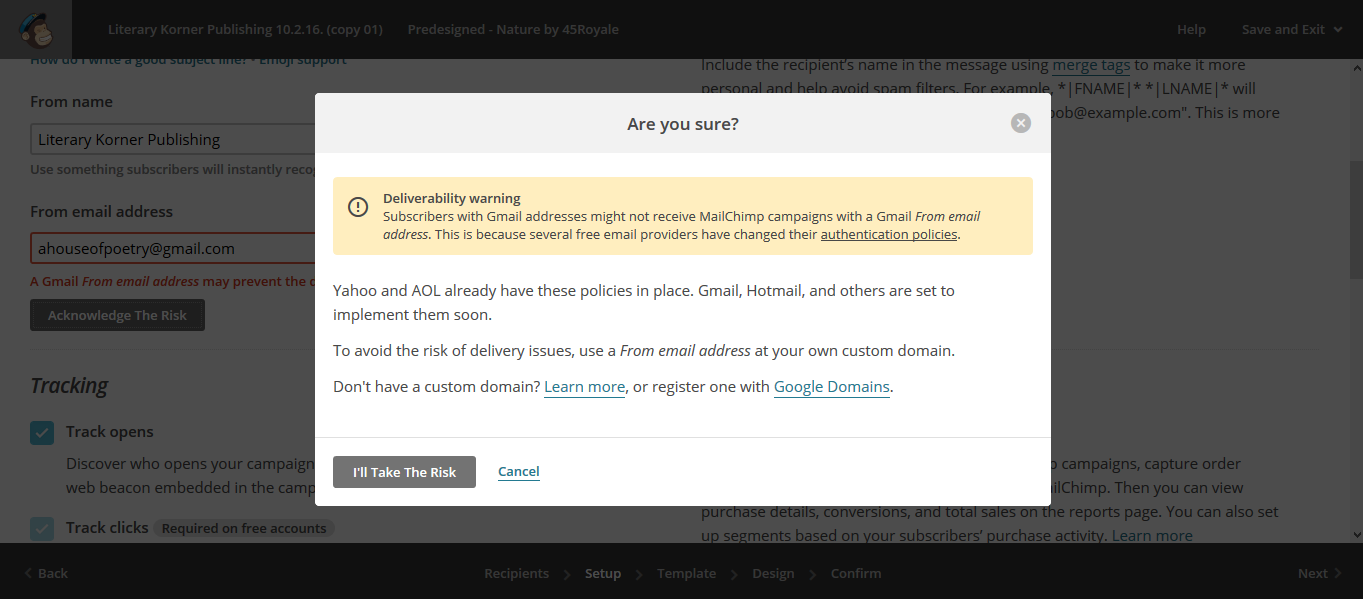
Secret #2: As much as I didn’t want to, I recently upgraded my email. I now use my own personalized business email for my email list instead of my Gmail account. Here’s why you should too if you get the following message:
 screenshot-75

In case you can’t see the words, it says:

“Subscribers with Gmail addresses might not receive Mailchimp campaigns with a Gmail from email address. This is because several free email providers have changed their authentication policies. “

What It Means

This means that if you’re using a return email address like Gmail or Yahoo and you’re also using an email service that has upgraded their authenticity policy (like Mail Chimp but not just Mail Chimp), Gmail and Yahoo may not allow those emails to go through because a lot of Spam users create bogus emails using Gmail and Yahoo email addresses (I know, boo). This may account for your low open rates as many people are probably not getting the emails.

*****

These secrets are usually reserved for my email list, but I wanted to give you the opportunity to see what you’re missing. I’m considering writing a memoir and you know what? Friday, my subscribers  received the first potential chapter! They are the first to see the unedited, raw, and uncut first chapter to what can become the book about my life (if I so decide). In fact, I’m releasing the first five chapters. (On my list? Didn’t see it? Check your email!)

I’ve talked some time ago about doing video tutorials and I’ve officially started production on my first video. I am releasing these tutorials to my email list ONLY so don’t miss out.

Just click on the image below to subscribe. You’ll be taken to my landing page where you can enter your name and email address. Easy Peezy.

Note: Entering your email means that you’re subscribing to my email list for more secrets, nuggets, tidbits, novel excerpts, sneak peeks, resources, spiritual and writing encouragement, the list goes on and on.

ATTN. I HAVE UPDATED THIS PART SINCE SOME OF THE INFORMATION, LIKE THE TUTORIAL SERIES, IS NO LONGER RELEVANT. TO SUBSCRIBE TO MY EMAIL LIST, CLICK HERE.

The Walls You Build

Walls

There are two kinds of walls that hinder us in our lives. The first wall is there naturally and I wouldn’t even call it a wall. It is more like a warning; that blockage there to indicate a possible or impending danger. It exists to stop you from being involved in situations that do you harm or that cause you to make a life altering mistake. It’s that internal alarm that rings, warning you that something is not right, something does not vibe, or that something is about to go wrong.

Some people call it anxiety, fear or paranoia and while these exists, this feeling is none of these. You’re not paranoid. Your body is just telling you that something is wrong. Sometimes it happens when you’re around certain people. Sometimes you’ll say, “It’s something about him or her”. That’s because when the vibe isn’t right, the entire body reacts.

I remember having that feeling when I was eighteen years old. I was out on a date and I got this extreme nervous, anxiety feeling. I wanted to turn around but felt it was too late as we were already entering the restaurant. That night ended with me in the hospital and five staples in my head.

We were jumped by a group of men and women. There were just too many of them. We were thankful to make it out alive.

Even so, not all walls are natural internal clocks. Some walls are built by us.

Sometimes the wall exists because you built it. A person cannot move their hand to do what the mind does not already believe it is capable of doing. Not having the strength to persist is one thing but having the strength and choosing not to be strong is another thing entirely. Growth isn’t always what you can see but we often walk by sight and not faith. As such, we hinder ourselves because we didn’t really believe it was possible.

I know that people say to “Believe in yourself”, but that’s the problem.  I don’t believe achieving anything of value is about believing in yourself but in something greater than you. But you do have to reach inside of yourself and find that excitement for the possibilities. Not even that you’ve made it, because none of us have, but the mere possibility. As my sister says, have a now faith not just a future faith. Rejoice on the journey, not just the arrival. And while the goal is so much bigger than you, the choice to begin starts with you.

There’s a quote by Andrew Murphy that says, “You’re confined only by the walls you build yourself”.

“People only work within the confines of how they perceive themselves, and when your self-esteem is low, that perception is usually far from the truth. You won’t be successful until you believe that you are truly worthy of it.” – Stephanie Lennox

Sometimes it’s worth considering that we’re not limited by resources, or understanding, or support but by our own walls. It’s mind over matter. It’s like people who sit down for a card game and proclaim, “I’m not really good”. I guess you’re not. You took yourself out of the equation before you even started. These are the walls we build.

Ultimately, the only time anything possesses power over us is when we weaken ourselves.