Why Black Americans Empathize with Michael B Jordan’s Eric Killmonger over Boseman’s T’Challa

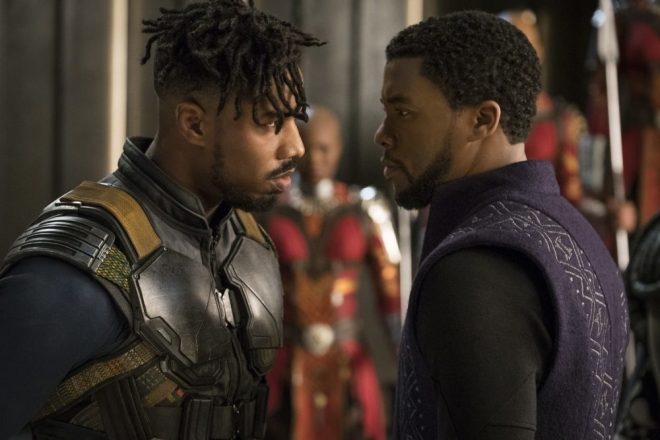
Photo: Marvel Studios

Because Eric Killmonger is a reflection of many Black American’s on a much deeper level than T’Challa. In fact, many Black American’s do not know T’Challa. They know Eric. This is why most Black Americans, more so than sympathize with him, empathize with him. They can put their lives into his shoes.

I’ve only seen the movie once (which is only important when talking about a movie nearing $900 million dollars worldwide and is #1 in the World…the world ya’ll…that people have seen two and three times.)

Saying this, I have only read two articles that brought up the real concerning the conflict between T’Challa and Killmonger (cited below). I liked that they put this conflict  in the movie because (as I believe one of the actors pointed out) there is a private conversation among Black Americans concerning the relationship between those who have been taken captive and those who have not. As I’ve stated on this blog time and time again, Africa is a continent with over 50 countries and even more nationalities of people. That said it’s impossible for a people to be called African as nationality because it does not specifically point to a place of origin. Which country in Africa are we talking about? Where in Africa can you claim? Who in Africa would claim you? Herein lies the conflict between Eric and T’Challa.

Here’s the phrase that has captured our hearts:

Bury Me
Movie Quote: Eric Killmonger

Killmonger was left behind, left out and rejected from among his people. He was locked out of the greatness of Wakanda and forced to grow up in the gritty streets of Oakland. His struggle and longing for a place of belonging and nationhood is the exact sentiment of the Black American. This statement (“…bury me in the ocean with my ancestors that jumped from the ships…”) is proof that he is a descendant of those who have been taken captive via The Transatlantic Slave Trade; a Wakandian by blood but rejected. Not privy to the knowledge and advancement of his homeland, Killmonger attended instead American Universities and studied his culture from a distance. Having grown up in America, not even Killmonger’s name is a reflection of his identity. His name is Eric which is not as exotic as T’Challa. It does not signify or denote any kind of place of origin. Eric also does not speak with an accent and uses language common to any Black American male growing up in the hood.
tenor

Eric is angry but rightfully so. He has had to watch his people suffer while Wakanda has thrived with resources that could have helped them. Eric wears his rage concerning the mistreatment of his people like a garment and does not understand how to direct that energy in a way that is less destructive. He reminds me of the young black men standing on the corners, full of rage, but without a way to release it in a way that is productive. Given the proper guidance, education, and resources, I believe these are some of the most powerful men the so-called Black community has. While many of us drive by them, shaking our heads and sighing, these boys are absolutely fearless and, like I said, given the proper direction can be the warriors they are descendant from.

drug-300x300

While Killmonger’s temper gets the best of him, his desire to use the wealth of Wakanda as a way to help his people in America is a noble one (just don’t weaponize the vibranium by putting it into the hands of black people with no training in how to use it Killmonger. Train your people first lol.) For all of these reasons, and many more, I believe many Black Americans empathize and connect more so with Michael B. Jordan’s character than Boseman’s T’Challa. For many of us, Killmonger is the hero, choosing to die (symbolically and literally) with his people than to serve among those who have rejected him.

The first article I want to share is: “Are Black Americans Allowed in Wakanda?”

“Every time a Wakandan referred to Killmonger in the film, he was called an “outsider.” Even though he proved he was of Wakandan blood, he still wasn’t one of them. Killmonger grew up hearing stories about a home he’d never been to. He had knowledge of Wakanda’s wealth and culture but he had no access to it himself. While T’Challa was able to visit a lush, African landscape surrounded by his ancestors, Killmonger’s trip to his own ancestral plane led him back to an apartment complex, where he was mostly alone.”

Read more Here: https://www.huffingtonpost.com/entry/opinion-doggett-wakanda-racism_us_5a901b35e4b01e9e56baef3e

The second one is: Erik Killmonger Is Not A ‘Super-Villain,’ He Is A Super-Victim Of Systemic Oppression

“I refuse to see Killmonger as a super-villain. I see him as a super-victim of systemically oppressive forces, forces that forced him into a hyper-awareness of his dueled unwanted status in Wakanda and in America, due to having the blood of his mother, who was a descendant of black folks forced into the United States via the Trans Atlantic Slave Trade. This two-pronged othering serves as the source of his super-power. His super-power did not derive from radioactive spider bites like Spider Man, or mythological alien strength like that of Superman. Killmonger’s character harbors a super-power more potent than the fictive mineral Vibranium, housed exclusively in Wakanda: Killmonger is the possessor of un-tempered black rage….Killmonger’s black rage is my black reality, and I cannot see Erik Killmonger Stevens as a villain because it would mean seeing myself as a villain as well (and as a black man in America, I have been vilified enough.)

Read more Here: https://blavity.com/eric-killmonger-is-not-a-super-villain-he-is-a-super-victim-of-systemic-oppression

T’Challa and Huey next to Yoruba Tribal ruler in West Nigeria sitting on throne surrounded by elephant tusks.

Personally, I liked both T’Challa and Killmonger for different reasons and enjoyed the Martin Luther King Jr. and Malcolm X undertones embodied in the characters. Marvel’s Black Panther came out around the same time Huey Newton and Bobby Seale founded The Black Panther Party for Self-Defense and it is believed that X-Men is based on The Civil Rights Movement. Created in 1963, fans allege that Stan Lee wanted to create a comic that showed bigotry and racism via fantasy and that Magneto and Professor X are direct correlations of Martin and Malcolm. In Black Panther, T’Challa and Killmonger also seem to have the same correlation. Those who were fans of Malcolm will definitely be a fan of Killmonger.

Furthermore, prior to Stan Lee’s comic and the organizing of The Black Panther Party, the term “Black Panther” existed already. The 761st Tank Battalion was an independent tank battalion of the United States Army during World War II. The 761st was made up primarily of African-American soldiers, who by federal law were not permitted to serve alongside white troops. They were known as the “Black Panthers” after their unit’s distinctive insignia; their motto was “Come out fighting.”

Now, go watch the movie!!

tumblr_p488cimC1W1tkezu4o1_500

Detach Yourself from Bad Vibes: Don’t make other people’s energy yours

braden-collum-87874-unsplash
Photo by Braden Collum on Unsplash

When running your race and trying to build something it’s most important to block out any and all negative vibes (from others and from your own self-doubt). One of the obvious reasons for this is because you can easily become distracted and lose focus. But, going deeper, you lose focus because you begin to lock into other people’s energy. Whatever the negative minded people around you are feeling, you begin to feel it too. They don’t have to necessarily be bad people but the energy they are giving off can be bad. If you are always surrounded around these kinds of people, their energy can become your energy.

People emit all kinds of energies and some are not even aware that the vibes they are giving off are destructive. People who are not aware of their own destruction are dangerous people because it means they tear down everything around them. As you can see, that makes it difficult to build with these people. You cannot build with a destructive person. You will need to remove yourself from that person’s presence and free yourself from the ways in which their thoughts become your thoughts.

When we take on the negative energies of others we soon begin to:

  • Doubt ourselves. “I shouldn’t have done that.”
  • Create mental notes on why said thing might not work
  • Make excuses for why we shouldn’t move forward with said thing
  • Reject opportunities (because, you know, said person said it wouldn’t be good)

When we do this, lock into someone’s energy, we take our eyes off the prize and start to come up with our own reasons and assumptions which are probably a far cry from the truth. That said, when trying to do something, write a book, build a business, it’s very important not to take on the emotions and feelings of the people around you if those emotions and feelings aren’t uplifting and productive to what you are trying to achieve. This is why it is advised to keep things to yourself because people tend to reject what they do not understand and will begin to project that energy onto you. Even if you have to walk alone, this is sometimes necessary because no one else may get your vision. That doesn’t mean your vision is wrong or that you are wrong. It just means that the vision was given to YOU which mean it’s not for everyone to understand right now. It’s for YOU to understand and to carry it through.

People will pick out the pieces of you they like and understand. That’s life. Everyone does not like you and you shouldn’t expect them to. Expect to be misunderstood by some. Hated by some and looked down upon by some. Underestimated by some. Expect it because that’s real and that’s life. Your job is to love yourself regardless to INCLUDE the parts of you that others reject. Personally, not worrying about what people think (negatively) has been a game changer for me. My stress levels are lower and I find myself being much more productive.

The truth is that I know what I have been commanded to do and what I bring to the table behind the scene. I am secure in that and being secure in this is a daily practice of constant focus and a whole lot of ignoring! (You gotta learn to ignore people for a little bit sometimes and focus on you.) In this, I can block out all energy that is not conducive to what I am trying to do and where I am trying to go. I can turn my back on it without regret and without apology. I can be who I was purposed to be without being held back by other people’s negative opinions, thoughts, and limitations. I can be free. And so can you.

Weight

Photo by henri meilhac on Unsplash

They say it’s the ones with the dirtiest hands pointing the finger. That the world is fake on social media, where we hold our masks together long enough to log off. People pointing fingers and laughing at their neighbors while they pretend to be someone else…until no one’s looking. We forget that integrity is less about what you post and more about your heart. Is it in sync? What of our actions behind each others backs? Studying is not for taking pictures of scripture but for showing yourself approved. Bibles are not meant to be in pictures and blamelessness is not a selfie. To be upright for the sake of a post is not integrity. So unless your presence here is a reflection of your true self, that armor you’re carrying is not armor. It is weight. The unnecessary burden of trying to fit in when you were meant to stand out.

Can you afford to be an Indie Author? | Angela J. Ford

Finances are a big deal when it comes to Indie Book Publishing. For those who want to do it right, it pays in more ways than one to have a budget for every book you intend to publish. Check out this article from Angela Ford on ways to break it down and later, I’ll publish a separate post on how I break down the costs for my very own books. Until then, enjoy:

“Can you afford to be an indie author? As independent authors, we have to be aware of the way cost plays into self-publishing. Cost can mean the difference between turning book publishing into a business versus having a very expensive hobby. The question is, how much is too much? When do you know if your books are bringing in a positive return on investment?” – Angela J. Ford

Keep reading through to the original article here.

The PBS Blog Podcast – Ep 11: Love Liberates (Plus iTunes)

The PBS Blog Podcast is now available on Itunes. Click Here.

Inspired by Maya Angelou who said that love liberates, today’s podcast speaks about how freeing it is when you know yourself enough to love yourself and to be yourself. In this, you are not just liberated from your own personal demons but also the negativity around you as well.

Listen to Love Liberates and be sure to subscribe for notification of new episodes.

For some reason the track is not showing up in the player. You’ll have to CLICK HERE.

Also I’d like to thank everyone who have been actually clicking on the links and listening. Thank you.

Soundcloud: https://soundcloud.com/user-573689310

Itunes: https://itunes.apple.com/us/podcast/the-pbs-blog-podcast/id1344901312?mt=2

Twitter: https://twitter.com/pbsblogpodcast

IG: https://www.instagram.com/thepbsblog/

Black History Fun Fact Friday – Willie James Howard

Welcome back to Black History Fun Fact Friday.


Willie James Howard was born on July 13, 1928, in Live Oak Florida. At fifteen years old he was in the 10th grade and worked at the Van Priest Five and Dime Store downtown.

According to the story, Willie sent Christmas cards to employees of the store for the Christmas Holiday. One of the employees, a popular white girl named Cynthia, was offended by the gesture. According to the account (which has just as many variations as Emmett’s story), at the bottom of the card for Cynthia, Willie indicated the letter “L” for love.  Later, Willie wrote Cynthia a letter, this time apologizing. He signed this one with a little poem:

“I love your name. I love your voice, for a S.H (sweetheart) you are my choice.”

(Source of poem: Documentary Trailer https://vimeo.com/105289596)

On January 2, 1944, Cynthia’s father Phil Goff, who saw the letter (most likely by Cynthia showing it to him as some accounts suggest) and two of his friends arrived at Willie’s home and the three men dragged the boy from his mother’s arms. They also kidnapped his father. They drove to the Suwannee River and bound Willie James by his feet and hands and made him stand at the edge of the river where, according to his father’s testimony, he was told he could either jump into the river or be shot. The boy jumped in and drowned.

The Suwannee County sheriff ordered Ansel Brown, the local black undertaker, to retrieve the boy’s body from the river and bury it immediately. To cover up the incident, Phil and his friends forced Willie’s father to sign a document alleging that Willie jumped into the river on his own accord. According to their written statement which was included in the Lanier Report, the three men admitted taking the boy from his home and tying him up on the way to the river but they said he fell in accidentally. This conflicts with the first story that the boy jumped into the river. Either the boy jumped into the river on his own or he slipped accidentally. It was obvious the men were not telling the truth but there was never an arrest.

After signing the document, Willie’s father (also named James) packed up his family and moved to Orlando. No death certificate was ordered for his only son and the grave was unmarked for 60 years.

Thurgood Marshall demanded a full investigation and after hearing about Willie’s case, it was picked up by Harry T Moore of the NAACP who had gone to school with Lula Howard, Willie’s mother. Moore received documented proof from Willie’s parents explaining what really happened. They stated that Willie’s father had been threatened and forced to sign the document. However, a grand jury did not indict Goff and his friends and prosecution were never achieved.

Moore continued fighting for the case and in 1947 wanted to reopen it but Thurgood Marshall was unwilling to dedicate any more NAACP funding.

I found that Howard’s story mirrors that of Emmett Till’s in chilling ways. Though Emmett’s death was far more brutal, Willie is one of those unfamiliar faces we do not hear much about. Like Claudette Colvin and Rosa Parks, Emmett Till and Willie Howard are on the same side of History.

  • Willie James Howard was born in July (7/13)
  • Emmett Louis Till was born in July (7/25)
  • Willie was 15 years old when he died
  • Emmett was 14 years old when he died
  • Willie wrote a letter to a white girl
  • Emmett whistled at a white girl (allegedly)
  • Willie was taken from his home
  • Emmett was taken from his home
  • Willie died in the Suwannee River
  • Emmett ’s brutally beaten body was found weighed down by a cotton gin in the Tallahatchie River
  • Willie died in 1944
  • Emmett was only 3 years old when Willie was murdered. He would be killed exactly 10 years later in 1955.
  • Both boys murderers were acquitted

The similarities here are chilling so when you remember Emmett  Louis Till this August, remember Willie James Howard too.