I’ve been watching The Handmaid’s Tale on Hulu. It’s slow, a little boring and I find the portrayal of submission and authority and the use of scripture to verify abuse offensive, filled with all of the stereotypes and misconceptions the world has taught in regard to a woman and man’s divine role. But, there is one perfect example in the series that illustrates why self-love is so important.
The TV show is based on the best-selling novel by Margaret Atwood and is set in Gilead, a totalitarian society in what used to be part of the United States. Gilead is ruled by a fundamentalist regime that treats women as property of the state and is faced with environmental disasters and a plummeting birth rate. In a desperate attempt to repopulate a devastated world, the few remaining fertile women are forced into sexual servitude. One of these women, June (Offred), is determined to survive the terrifying world she lives in, and find the daughter that was taken from her.
In the series, the Handmaid’s (whose purpose is to birth the children) are treated worse than the baby they carry. The society and the household only love the Handmaid’s to the extent that they love the child they are pregnant with. They treat the women like crap, like slaves and only extend kindness when they get pregnant. When the women get pregnant they are allowed privileges, mercy, and compassion. But only until after the baby is born, where they are to nurse the baby for a few months before turning the baby over to the wives. The women are then shipped off to another family, where their purpose is the same. Make babies for the barren wives of the wealthy families, to be loved only when they have conceived. But how can you love the baby but hate the mother who births the baby?
Self-love is important because you can only love others to the extent that you already love yourself.
When the wives of the wealthy men abuse their Handmaid’s, it’s because they hate themselves. They hate themselves for not being able to bear children. They only show love (if we can call it that) to the Handmaid’s when they love themselves and they only love themselves when they have conceived (through the handmaids) children.
Love Yourself. Know Yourself. Be Yourself.
Self-love is not being arrogant and prideful, it is not about the clothing you wear, not about how many likes and comments you get on a post, not about the amount of money you make or what you do for a living. Rather, self-love is a state of appreciation for yourself that grows from actions that support your physical, mental, professional, and spiritual growth. When Self-love is present, we begin to accept better our weaknesses as well as our strengths without thinking badly about ourselves. We are not easily provoked, popping off and cursing people out every time they say something bad about us. We have less of a need to explain our actions and decisions when we know who we are and what our intentions are. We are not quick to over-intellectualize our shortcomings in an effort to get people to understand us. We have more compassion for ourselves instead of beating ourselves down when we do something wrong and we are more centered in our life purpose and values.
Self-love also gives us the discipline to deny what we want for what we need. You love yourself when you can turn away from something that feels good and exciting to what you need to stay strong, centered, and moving forward in your life, instead. By staying focused on what you need, you turn away from automatic behavior patterns that get you into trouble, keep you stuck in the past, and lessen self-love.
When we love ourselves, we expect more of ourselves and of the people around us. No longer does it become acceptable to treat us any differently than we would treat ourselves. When we love ourselves, we demand more and we give more. When we love ourselves, we become more productive professionally, spiritually, and physically. Our cup runs over and we are able to give more to others.
Self-love is important because you will otherwise hate others in the same way that you hate yourself…
…which leads to abuse. Abuse of your friendships, abuse of your relationships, abuse of your career, abuse of your children, abuse of your family. People who hate themselves destroy everyone and everything around them. In turn, they cope by deceiving themselves into thinking it is someone else fault. The truth is that relationships are two-sided. It is never 100% the other persons’ fault but each person has come with their own set of issues. But if you don’t love yourself, you’ll lack accountability for your actions. You’ll tend to always make other people the villain and you, always, the victim.
Remember, without love, knowledge is nothing. Without love, prophecy is nothing. Without love, the truth is nothing.
Now, Enter the 2nd Annual Poetry Contest before July 31st!
Win money. Win books. Get published. Get noticed.
The theme for this year is: Self-Love, Self-Care. Write a poem that talks about self-love or self-care in some way and email it to yecheilyah(at)yecheilyahysrayl(dot) com
Don’t forget to read the full rules and guidelinesHEREto learn more about this year’s prizes and how to enter.
That’s it! 3poem max per poet. Enter BEFORE 12:00pm EST on July 31, 2018. Winners announced on August 22, 2018.
Welcome back to Black History Fun Fact Friday. Today, we learn about Lucy Craft Laney.
Lucy Craft Laney was a famous educator in the late 1800s and early 1900s. She opened her own school in 1883, which became known as Haines Normal and Industrial Institute in Augusta, Georgia where she served as teacher and principle for 50 years.
Laney was born on April 13, 1854, one of ten children, to Louisa and David Laney. Laney was not enslaved as David Laney purchased his freedom twenty years before Laney’s birth and then purchased his wife’s freedom sometime after their marriage. Laney was taught to read by her mother at the early age of four. By 12 Laney could translate passages in Latin. She attended Lewis (later Ballard) High School in Macon, GA which was sponsored by the American Missionary Association.
Laney prepared to be a teacher at Atlanta University in 1889 (later Clark Atlanta University), graduating from the Normal Department (teacher’s training) in 1873.
Sewing class at Haines Normal and Industrial Institute, Augusta, Georgia
Laney’s school started out small with just a handful of students. She began her school in 1883 in Augusta. Her school was chartered by the state three years later and named the Haines Normal and Industrial Institute. Originally, Laney intended to admit only girls, but several boys appeared and she could not turn them away. By the end of the second year, there were more than 200 Black students enrolled in Laney’s school.
Over the years, Laney made many improvements and additions to the school. In the 1890s, the school was one of the first to offer kindergarten classes for African-American children in the South. She also opened a training center so that black women could train as nurses. The school’s curriculum provided the students with traditional liberal arts courses as well as vocational programs, which was groundbreaking at the time, but that’s not all. Laney’s school also acted as a cultural center for the Black community, hosting lectures by nationally famous guests, and various social events.
First, I want to thank everyone who shared the original post on their social media’s and all of the wonderful and generous bloggers who reached out. The struggle is real out here and the magnitude of having someone to host me on their blog for free is not lost to me so thank you. As of now I am no longer accepting invitations to be featured on any more blogs. If you emailed me, thank you for your interest.
Below are the blogs that I will be visiting starting next month and into October. Unlike a traditional blog tour, this tour will feature new material per blog stop. This means that there is one new poem per blog so you will get something different on each blog! The tour stops are also one week apart so that you’ll have a chance to catch up in the event you don’t catch it on the first day. You will also be helping the host bloggers out by visiting their blogs and sharing the post on your social media.
I am closed to accepting any more inquiries, however, if you emailed me or if you wanted to participate in the tour I can still use more reviews. If you are into poetry and would like to be gifted a copy of the book, let me know. I would also appreciate any shares of this post in promotion of the upcoming tour. You don’t wanna miss out!
I don’t usually review Traditionally Published books on this blog because I am usually too lazy. Sorry, it’s the truth. But also because most of these books already have a gazillion reviews so I’m thinking, “they can’t miss my little review.”
But…
I have decided to change things up a bit and review traditional as well as Indie books on this blog.
The first book I’ll review (because I just finished it so it’s still fresh and it’s the latest talk right now) is The Hate U Give by Angie Thomas. It is being made into a movie this fall.
Author: Angie Thomas
Title: The Hate U Give
Genre: Young Adult
Publisher: Balzer + Bray; First Edition Later Printing edition (February 28, 2017
Language: English
ISBN-10: 0062498533
ISBN-13: 978-0062498533
Basically, I loved this book and it was refreshing to pick up something that kept me glued to the page (or screen rather) for the first time since I read American Marriage (another must read). I am not surprised Thomas got a movie deal because reading this was like watching a movie. I yearned to physically see everything that was going on and I am thankful that we’ll get to do just that this fall.
Sixteen-year-old Starr witnesses her best friend Khalil, an unarmed black male, get gunned down by a white police officer. This book gives us a personal and up-close look at the Black Lives Matter movement through the eyes of Starr, her family and the pain experienced by their community and Black America in general at this very hour. The Hate U Give is a spelling out of the acronym Thug Life as made popular by rapper Tupac. “The Hate U Give Little Infants F—s Everybody.”
If you know me, you know I love history and writing historical fiction. I enjoy writing Black Historical Fiction because it’s fun for me to place fictitious people in the midst of real events that happened in the past. That’s what this book is like except it’s a modern, new-school, updated, millennial version (I seriously felt real old reading this and the Tupac thing was a little much for me. I get it but I don’t think he was the best thing since sliced bread lol) and I think it’s perfect for young adults. There’s enough history to educate (references to Nat Turner, and the Black Panthers for example) but in a way that young people can understand and won’t get bored with. The way the author broke down the meaning behind the book’s title, “The Hate U Give” through the dialogue between Starr and her father was well done.
Everything about the book was well-written from the dialogue to the characters and the events taking place. For Starr and her friend’s age, everything they did and said was authentic. Even though the movie is coming out and I had heard all the rage, I wanted to read this for myself. I am not one to jump on bandwagons so I wasn’t going to champion this unless I had read it for myself. I have to say, Angie did not let me down. I even liked the doggie Brickz (“Brickz you been pissing on my roses?” Loll)
There’s a lot going on. The situation of immigrant children being separated from their parents locked away in cages, and “lost” is a very serious and sad situation. It amazes me that a country that can lock children in cages and hang people from trees are celebrating freedom today. A Walmart has even been turned into a shelter housing undocumented children separated from parents in Brownsville, Texas. Walmart’s being turned into detention centers and camps was talked about years ago but people said they were just conspiracy theories.
In the midst of this, there is an increase in racist behavior toward Blacks. It seems that every week someone is calling 911. It’s not just “BBQ Becky” or the woman who called the police on the group in Oakland but 911 calls are being made every day. Videos of racial profiling by white police and White Americans have gone viral. A Black girl was selling water without a permit, a white woman assaulted a Black man who “did not belong at the pool,” a Black boy accidentally mowed some of his neighbors lawn and an 89-year-old Black woman was forced to urinate in public after being denied the use of the bathroom at a Circle K gas station.
Lynchings are also taking place regularly, even though no one’s talking about it. It is happening so much that Congress’s three African-American senators introduced a bipartisan bill Friday to make lynching a federal crime. “The Justice for Victims of Lynching Act of 2018 notes that during the first half of the 20th century nearly 200 attempts to pass anti-lynching legislation failed to gain support from the Senate despite urging from seven sitting presidents.”
What they won’t say is that Lynchings didn’t stop there.
The body of Frederick Jermaine Carter, 26, was found in 2010 hanging from an oak tree in the predominantly white North Greenwood area of Leflore County, Mississippi, Otis Byrd’s body was found hanging from a tree in 2015, and on April 18, 2018, the mutilated bodies of two young African-American men, Alize Ramon Smith and Jarron Keonte Moreland, were found in a pond near Moore, Oklahoma. A woman was discovered hung near a Walmart in College Park, Georgia on May 14. And a man was found near Atlanta University Center on April 27. (Essence also listed 5 additional attempted Lynch cases.) Many of these cases are deemed suicides. That’s for the people who do not know any better.
…and the myriad of unarmed Blacks being shot and killed daily which are now being deemed modern-day lynchings.
“The tragic shooting deaths of 17-year old Trayvon Martin in 2012 and 18-year old Michael Brown in 2014 reawakened the nation to the epidemic of killings of unarmed blacks by private citizens and law enforcement officers. Sadly, the shooting of unarmed blacks seemingly continues unabated despite the numerous nation wide street protests, town hall meetings, and pledges from politicians and law enforcement agencies to address this systemic problem. According to the Washington Post, “Although black men make up only 6 percent of the U.S. population, they account for 40 percent of the unarmed men shot to death by police in 2015. What is more, the Post’s analysis documents that black men were seven times more likely than white men to die by police gunfire while unarmed. Whereas in 2012, Trayvon Martin was literally the poster child for unjustified killings of unarmed blacks, today there are a litany of black victims (Eric Garner, Walter Scott, Tamir Rice to name a few) that can fill that role.” (Source: 21st Century Lynchings)
TODAY I’D LIKE TO EXTEND A WARM WELCOME TO BALROOP SINGH. WELCOME TO THE PBS BLOG! LET’S GET STARTED.
What is your name and where are you from?
My name is Balroop Singh. ‘Bal’ means strength and ‘roop’ means beauty. My maiden name was Balroop Bal, which changed after marriage, as the tradition goes, to change the surname. I chose Singh, which is a common middle name in the Northern region of India. ‘Singh’ was adopted by tenth Sikh guru who baptized his followers as “real Sikhs”. Derived from the Sanskrit word for lion, it was adopted as a title by warriors in India and mandated by Guru Gobind Singh for all Sikhs. It was later adopted by several castes and communities.
I am from India, and have spent the best part of my life there, exploring the incredible magnificence of the Himalayas in the north, the grandeur of Thar desert in the west, dotted with historical towns, untouched beauty and splendor of the tea gardens in the east and the spectacular backwaters of Kerala in the south…all four directions offer myriad experiences, enriching beyond imagination and too hard to describe in words. Oh! I didn’t mention the poetry in marble – the Taj Mahal! Each time you visit, it evokes a different emotion and the moment you come back, the yearning to visit again sets in! I live in California now.
I won’t call myself an atheist but I don’t believe in visiting religious places regularly. I visit once in a while when I hear the call within. To me, faith is a very personal emotion, not to be worn on my sleeve. Probably because religion was never forced on me and since I had the freedom to choose it or leave it, I never made an attempt to understand it. But I was always curious to know how could it evoke such strong feelings in some people! I have gathered that it depends on how much it is instilled into a person at an impressionable age.
I respect those who pray regularly but my faith has been shattered a number of times. Each time, I have tried to rebuild it but I always had my unanswered questions, my moments of wrath and protest against blind faith; I always would wonder why God is so unreasonable. How could he be right in giving so much suffering to some and so much love and happiness to others, absolutely no rights to some and all the privileges to others? The unending self-confabulation continues.
Married?
I have been happily married for 40 years. It was an arranged marriage though I had no inkling what I was stepping into just at the age of 23! When there is an unwritten societal decree that you have to marry when you are asked to, just because it is convenient for the people around you, when the society values your muteness at such decisions, when you are expected to concur with what your near and dear ones decide for you, when you don’t want to displease them…do you have any choice? I happened to marry a kind and understanding gentleman though there was no permission to reject the groom chosen by my family.
That leads perfectly into my next question. In your own words, what is love?
There are many definitions of love. In fact it changes with the person as love is more of a perception. I have written a lot of poems about love and plan to publish a book about them one day.
There was a time when love was a petrifying emotion for me. Love was just a passing thought, a mirage that could only be seen in the movies. It was not real. It was never around. I could never touch or feel it. The society in which I lived didn’t give any importance to expressing it openly. Falling in love was equivalent to falling in a well. Romantic love was offensive. Sex was a repugnant word! I don’t belong to middle ages though!
Love was caring for others but only those who were valuable to the society. Love was sacrifice…giving all your time and effort for the welfare of others. Love was thinking what was expected to think. Love was listening to and complying with all the diktats of the family and society. Self-love was taboo. It was being selfish. Till I realized love is much more than all this, which had been drilled into my mind. Till I decided to break free and get access to free thoughts. Till I realized love is an invisible force that can transcend all the barriers.
Love is a natural instinct that grows if it is nurtured. It evolves itself but withers if it is not watered with affection, care, respect, and kindness. Romantic love morphs into a loving and eternal relationship if we understand what is love; why passion is such a sweet word. Love is a much wider term… encompassing friendship, family, and bonding.
Writing is one of the most amazing gifts that we receive with life. It calms down my emotions. It is therapeutic, it makes me happier, it inspires! The elation of recording our feelings is so fulfilling, so heartwarming that we can create our own world of fantasy, in which all the characters are mere puppets in our hands. We can unlock all the doors, as the keys are in our possession… isn’t it a wonderful feeling?
Writing gives clarity to those ideas, which are confusing or blurred. It leads us to self-discovery. Writing has given me wings. I can fly anytime, anywhere. I often perch on the branches of my favorite trees and can communicate with everyone without any reticence. All those who sit far away, in the comfort of their homes can hear me as I let my voice merge into the clouds that float around, merrily.
I like that, “writing has given me wings…” What genre do you write in?
Poetry is my first love, as it flows spontaneously and effortlessly from my pen. I don’t remember when I started liking poetry. Probably I was born with it or was fascinated by the lyrics of Mother Nature. Poetry is a painting that gets its hues from words. Just one metaphor can evoke emotions that could not be described in a thousand words. I like this genre due to its succinct style. It soars on the wings of words. Poetry touches your deepest cords effortlessly. It develops perceptions. It liberates us from the mundane. It gives us wings. Due to its ambiguous nature, it can be interpreted in more than one way, depending on how the reader discerns the thoughts.
I also write creative non-fiction and have published three books in this genre.
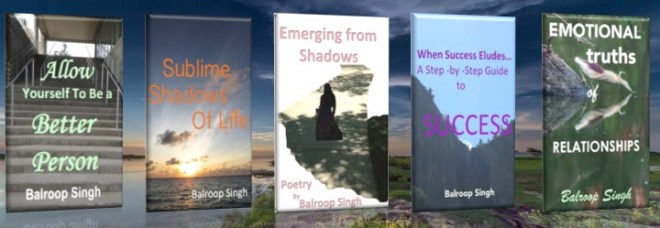
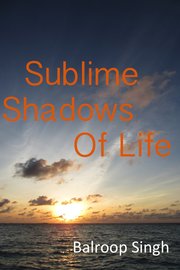
Sublime Shadows of Life is available now on Amazon.
Speaking of publishing, when did you publish your first book?
When I published ‘Sublime Shadows Of Life,’ my first poetry book in 2013, I didn’t have a blog. I didn’t know that an author ought to plan. Writing to me was a natural gift, an innate ability to share what lies within our heart.
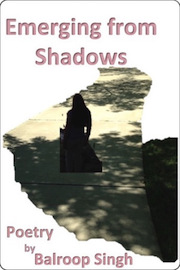
The allure of Indie world was so dazzling that I just waded into it like an enthusiastic adolescent, soaring on the wings of hope, unaware of the pitfalls. I didn’t know I would flounder and flail and almost get drowned! It has been a long journey of striving to learn and I am not the one who would give up so easily. Now I have a lot of support from bloggers and authors who have been kind enough to help me with my second poetry book ‘Emerging From Shadows.’
What would your perfect writing / reading room look like?
I just need a comfortable couch, cushions behind my back, laptop, peace of mind and peaceful surroundings. I like to read in bed before dozing off every night.
I know that’s right. What is the most annoying habit that you have?
I am outrageously outspoken, which has landed me in hot soups many times.
Outrageously lol. What would be the most amazing adventure to go on?
Water skiing though I don’t know swimming. What is the harm of dreaming? Thank you for hosting me. I am honored to be your guest.
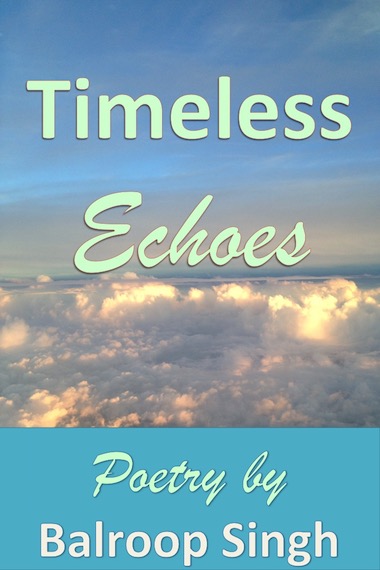
Be sure to pick up your copy of Balroop’s new collection of poetry!
Book Blurb: Certain desires and thoughts remain within our heart, we can’t express them, we wait for the right time, which never comes till they make inroads out of our most guarded fortresses to spill on to the pages of our choice. This collection is an echo of that love, which remained obscure, those yearnings that were suppressed, the regrets that we refuse to acknowledge. Many poems seem personal because they are written in first person but they have been inspired from the people around me – friends and acquaintances who shared their stories with me.
Some secrets have to remain buried because they are ours
We do share them but only with the stars
The tears that guarded them were as precious as flowers
Soothing like balm on festering scars.
While there are no boxes for grief and joy, some persons in our life are more closely associated with these emotions. Their separation shatters us, their memories echo, we grieve but life does not stagnate for anyone…it is more like a river that flows despite the boulders. When imagination and inspiration try to offer solace, poetry that you are about to read springs forth.
THANK YOU, BALROOP, FOR SPENDING TIME WITH US TODAY, WE ENJOYED YOU!
Balroop Singh
Bio.
Balroop Singh, a former teacher and an educationalist always had a passion for writing. She is a poet, a creative non-fiction writer, a relaxed blogger and a doting grandma. She writes about people, emotions and relationships. Her poetry highlights the fact that happiness is not a destination but a chasm to bury agony, anguish, grief, distress and move on! No sea of solitude is so deep that it can drown us. Sometimes aspirations are trampled upon, the boulders of exploitation and discrimination may block your path but those who tread on undeterred are always successful.
When turbulences hit, when shadows of life darken, when they come like unseen robbers, with muffled exterior, when they threaten to shatter your dreams, it is better to break free rather than get sucked by the vortex of emotions.
Balroop Singh has always lived through her heart. She is a great nature lover; she loves to watch birds flying home. The sunsets allure her with their varied hues that they lend to the sky. She can spend endless hours listening to the rustling leaves and the sound of waterfalls. The moonlight streaming through her garden, the flowers, the meadows, the butterflies cast a spell on her. She lives in San Ramon, California.
James Shober was an African American doctor and the first Black doctor in North Carolina. James was born on August 23, 1853, in what is now Winston-Salem, North Carolina. James father Francis Edwin was a white businessman and politician who served in the North Carolina state legislature and the United States Congress. His mother was an 18-year-old enslaved woman named Betsy Ann.
Betsy was of mixed race who lived in Salem and passed away in 1859 when Shober was between six and seven-years-old. He was sent back to the Waugh Plantation near Waughtown, North Carolina, where his grandmother lived with other family relatives.
Educated at Lincoln University in Oxford, Pennsylvania, Shober then enrolled in the Howard University School of Medicine in Washington, D.C. where he was one of the forty-eight graduates in 1878.
Image from Library of State, James Shober
After graduation, he began practicing medicine in his home in Wilmington, then the state’s largest city. Shober was the only Black doctor in a city of more than 10,000. There were only a handful of licensed black doctors across the United States following the Civil War. Shober now joined those ranks in 1878 and became the first professionally trained Black physician in North Carolina.
On June 28, 1881, James married Anna Maria Taylor, an educator who taught at the Peabody School in Wilmington, and they became the parents of two daughters, Mary Louise and Emily Lillian. His daughters both graduated from Fisk University and pursued a number of professions. James Shober died young, at just 36 years-old on January 1, 1889.





 The PBS Blog