I walk into a library tighten the mask around my ears choose a table in the furthest corner of the room. No one comes over. “Good,” I think to myself. “It’s good to social distance.” I say that as if I wouldn’t have distanced myself anyway. The girl with the braids smiles, waves. I nod. Afraid to speak. She might think I’m friendly and come over. She carries her book over to the table on the other side of the room away from me. “Good,” I say to myself again. I don’t feel like discussing the book she has in her hands. I wonder if she knows how to pronounce the name. I wonder if she knows the author is sitting over here in the corner trying not to be seen.
I don’t know which new Indie Author needs to hear this, but it shows in your writing if you don’t read.
It is said that writers write, which is true, but writers also read. It is through reading that we learn the basics of how to write. This means that reading and writing are a partnership, and one cannot exist without the other.
This is not to say that someone who was never into reading can’t write a book. They absolutely can, but only if they are willing to start reading. There is no way around this. Aspiring writers need to consume books like aspiring doctors need to go to medical school.
“If you want to be a writer, you must do two things above all others: read a lot and write a lot. There’s no way around these two things that I’m aware of, no shortcut.”
Stephen King
There is no such thing as loving to write but hating to read.
This is one of the biggest issues I see in the Self-Publishing community. It is not the act of Self-Publishing that gives it a bad reputation. It is the audacity of people who never enjoyed reading and writing in the first place who suddenly want to write a book.
“It’s hard for me to believe that people who read very little (or not at all in some cases) should presume to write and expect people to like what they have written, but I know it’s true. If I had a nickel for every person who ever told me he/she wanted to become a writer but didn’t have time to read, I could buy myself a pretty good steak dinner. Can I be blunt on this subject? If you don’t have time to read, you don’t have the time (or the tools) to write. Simple as that.”
Stephen King
The first red flag that someone doesn’t read is when I am sent a manuscript so badly formatted that it does not resemble a novel or book or anything. It is just letters on a page with weird spacing and no chapter headings.
This is because the writer isn’t familiar with the story structure, which comes from reading books. They are hoping I can take their scrambled notes and turn them into something legible. They want me to write the book for them. (If you want someone to write the book for you, you’ll have to hire a ghostwriter.) The same issue arises when new authors are choosing genres. I can’t tell if this is supposed to be a cookbook or a romance novel.
How the book is published is not the problem, weak writing is.
If you want to publish a book but you’ve never been into reading, that’s an easy fix: Just start reading. The more you read, the more you will write, and the better you will be at it.
Reading books in the genres you want to write in to familiarize yourself with them is also a good idea. Want to write a poetry book? Read poetry. Memoir? Read memoirs, and understand they are not the same as autobiography. Wanna write historical fiction? Read historical fiction, and so on.
Ready to publish your book but not sure where to start? Click Here.
At its core, businesses are built on the foundation of relationships. This is especially true in the Self-Publishing world, where authors do not always have access to the exposure traditionally published authors receive.
When it comes to social media, it’s about being social and making connections with others, so it’s okay to talk about things outside of your books. It helps people get to know you on a deeper level and feel comfortable shopping with you.
Some basics to start with is sharing a little about you and maybe throwing in your thoughts on current events.
What are some things you like to do when you are not writing? What’s your favorite color? What are you passionate about in life? What do you think about the Covid-19 pandemic and the vax/non vax wars? What about what’s going on in Haiti? When is your birthday? What exciting things did you get into this weekend?
And so on…
I’m going to make this short because the message is pretty straightforward. No one wants to be inundated with “Buy My Book” messages all day, not on social media and not in their inboxes. I know it sounds kinda funny, but people only care about how what you are saying is relatable to their lives. You really do have to care about people, which sometimes means stepping outside your comfort zone and opening up a little about other things that may have nothing to do with your books. The great thing about this is you can still come back around and tie it into your brand.
Independent Authors have become obsessed with rankings, reviews, and becoming an Amazon Best Seller over the years. While there is proof book reviews carry weight (social proof, credibility, increased visibility), there are many myths surrounding rankings.
According to Amazon, “the better the sales rank, the more sales it’s getting on Amazon.”
But, is this true?
Yes, selling books will naturally raise your book ranking, but your Amazon ranking can also be high for other reasons.
When I released I am Soul back in 2017, I set it up for preorders and, on release, it made it to #7 on Amazon’s Best Seller’s List.
How I thought I was doing it
To the untrained eye, this can look like I sold tons of books. And by the “untrained” eye, I mean everyday people who are not Self-Publishers or are not familiar with how the system works like family and friends.
But then…
According to my sales report for December 2017, I sold five preorders between December 16-19 (the book was released on the 20th).
Yes, I said five.
Five books sold, and I was #7 on Amazon’s Best Seller’s List.
Just so you know I am not BS-ing you, here’s a screenshot:
How is this possible? Shouldn’t the book that sold more copies rank better? Yes, but as many people have already said, no one knows exactly how Amazon’s algorithm works. What we do know is books sold aren’t the only thing that determines a book’s ranking.
There is nothing wrong with pushing your book to sell tons of copies on release day and to make that Best Sellers list, but your book’s success is not contingent upon how well it does in the first few days or even weeks. A book that continues to sell over time does better than a book that does well all at once and then stops selling.
In the long run, steady, organic growth will always outperform sudden bursts of activity.
“At the end of two weeks, a book that sells five copies a day will rank significantly higher than a book that sells 3,000 copies on its launch day.” (Doppler, J)
It’s like book reviews, in a way. The newer the review, the better.
Book A gets about twenty reviews out of the gate. Your review team showed up and showed out. But, over the next few days, weeks, and months, there is no new activity.
Book B gets a couple of reviews out of the gate, a few more a week later, a few more the following week, and several more over the next few months.
Because Book B has newer reviews, it tells Amazon’s algorithms people are still interested in this book.
The Moral
A book that gets reviews slowly but consistently over time does better than a book that gets tons of reviews at once, but then the reviews stop coming in.
But what does this have to do with the sales ranking?
The book that continues to get new reviews is likely also the book that is continuing to sell. It might not be a #1 Best Seller or rank in Amazon’s top 100, but the author is selling books consistently.
And this is what authors should focus more of their attention on.
Most indie books that take off running, in the beginning, stop selling after the release date because so much energy is directed at the launch that authors forget they need to continue to sell books AFTER that.
It is not to say being an Amazon Best Seller is not a cool thing. It is to say it doesn’t carry as much weight as people have made it out to be. Being an Amazon Best Seller is great, but it doesn’t really mean anything if the author is not making sales in the grand scheme of things.
There is no need for Indie Authors to stalk their Amazon ranking because a high ranking doesn’t always mean they are selling books. In the same way, a low ranking doesn’t always mean they are not selling books.
Sales rank plays a minor role in determining the order of Amazon search results. Other factors such as relevance, keywords, sales history, product listing quality, and available inventory may influence Amazon’s algorithms. Therefore, a book with a high sales rank may appear later in search results than lower-ranked books.
How do you tell if your sales rank on Amazon is reflective of books sold or just a bump in Amazon’s algorithm because of other influences?
Consistency
Besides monitoring your sales report through your KDP account, consistency is the best determinate that your book ranking on Amazon is legit. By legit, you are a best seller because you are selling books. If you are a #1, #2, #3 (and so on) best seller in your category for weeks, months, or even years at a time, the chances are that is because you are selling books regularly, getting reviews, and doing the dango thang. Congratulations, you are an actual bestseller.
Suppose you are only a #1 Amazon Best Seller for five minutes. In that case, it could be a combination of things influencing the algorithm, causing the numbers to fluctuate where one minute you are number one (let’s say because tons of people looking at your book page), and the next you are #512.
You should certainly be proud of yourself for making it to #1, whether you were there for five minutes or five months. However, don’t allow yourself to be deceived by Amazon’s ambiguous system. Ya’ll are out here going crazy and being scammed over something that doesn’t even matter.
This isn’t about Amazon. This is about Indie Authors and how we’ve allowed our writing self-esteem to be determined by numbers and rankings. Just because you are not an Amazon Best Seller does not mean you are not selling books. Period.
And, for clarity, I did not say you should ignore your book ranking, just that there’s no need to stalk it, as in repeatedly going back to refresh the page every five minutes.
I am from Chicago, where kids paid close attention to the shoes you were wearing after winter break.
Everybody was checking to see who was wearing something new. See, in the hood where money is scarce, you got your best clothes and shoes around Christmas, so when kids come back from break, everybody is looking to see what you got on.
I walked into my eighth-grade classroom with my all-blue suede Timbs (what we called Timberland boots), and I didn’t like the way everyone’s eyes noticed them.
The same thing happened in High School.
I grew up poor and didn’t start wearing name-brand shoes until the second round of sixth grade. While I loved Air Force Ones, I had never owned a pair of Jordans.
It wasn’t until High School I owned a pair and joined the other “cool” kids and experienced what it was like to sit on the pedestal of those who wore Jordans.
And I didn’t like it.
I wished I hadn’t worn those shoes. I liked them a lot, but I didn’t like the attention they garnered. I also didn’t like being like everyone else. I quickly realized I wasn’t a Jordan-wearing type of person. As I got older, I learned I am not all that into gym shoes (sneakers if you are not from the Chi) in general. I wear them, and I have them (and I like looking at the different styles), but my personal style is more casual.
But anyway, those Jordans were my first and only pair.
Here’s the truth:
I don’t like the spotlight. Despite what I do for a living, I am not an “out there in front” kind of person, and I get embarrassed easily because I’m shy.
Just as Moses did not want to go to the Pharaoh and tell him to let his people go at first, I do not always want to show up.
But at some point, Moses had to obey the voice that spoke to him and fulfill his purpose which is why I show up despite the quiver in my chest.
Maya Angelou said courage is the most important of all virtues because, without courage, you cannot practice any other virtue consistently.
You can’t be consistently kind or loving, or generous. You can be these things for a time, but not consistently because there is no endurance without courage.
When the threat is too much, you will quit if not for courage. So, while everyone is afraid, those who are courageous go on despite the fear.
“I do what I hate to do, but I do it like I love it. That’s discipline.” – Mike Tyson
What Tyson isn’t saying:
Settle for a life that does not bring you joy.
What Tyson is saying:
Even while doing what you love, there will be moments where you have to be disciplined to accomplish a goal, and this won’t be fun, but it will be worth it.
Quick Tips.
Stop Predicting What Other People Are Thinking
I am pretty sure we are all guilty of this!
The biggest stumbling block to showing up is thinking about what other people would think of you. We make up these stories in our head about what we expect to happen and what we think other people are thinking.
Tell yourself a different story than the one in your head.
People do love you and think about you often.
Readers do want to read your book, and they do care about your story.
People want to hear from you more than you think.
You do matter.
I mean, I know you’re a genius and all that, but you can’t predict what people are thinking. You just cannot do that to yourself.
“But I don’t want people to think…”
This is a phrase we should all work to eliminate from our vocabulary, and I admit, I have work to do myself. When we say things like this, we are expecting a response that may or may not even be real.
“I don’t want to post about my book because I don’t want people to think ________.”
If you don’t tell people about it, how are they supposed to know it exists? What about this instead:
“I am so excited to tell people about my new book!”
I notice the more I am excited about something, the more excited the people around me are. Take the smile test for example.
Look at someone and smile. I bet you they are going to smile back. If they are extra silly like me, they might even laugh. Then you will laugh, and neither of us knows what’s funny.
One of my favorite quotes is:
“What would you do if you knew you couldn’t fail?”
Anticipate the best possible outcome instead of the worst.
Release the Need to Know.
Trying to control the outcome is like trying to catch the wind. Get excited about what you don’t know and all the possibilities of a new experience. You don’t need to know the outcome to start.
You Don’t Have to Say Yes to Everything.
You don’t have to drink from every cup handed to you. That’s how you get poisoned. You are only required to accept those things that speak to your soul, nothing more and nothing less. If it does not set your soul on fire, you don’t have to do it.
Saying no is not wearing Jordans if you really don’t like them.
Another quick story.
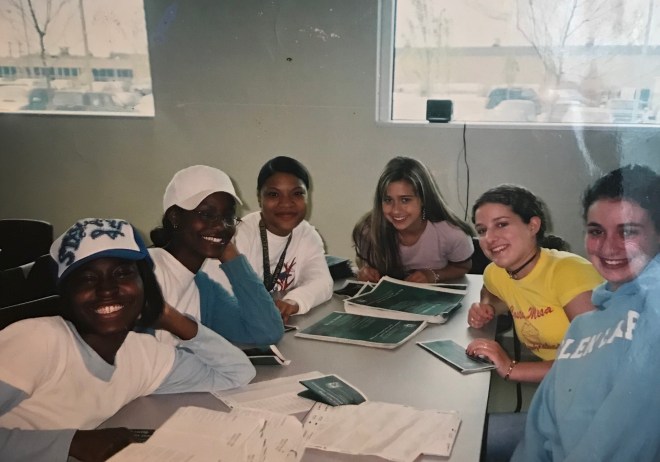
In my early teens, fifteen-sixteen-ish, my brother spray-painted hats and t-shirts for the neighborhood. He did stuff like this all the time because he’s an amazing artist. He even designed clothing for the entire cheerleading team. Anywho, my brother spray-painted my and my sisters’ and cousin hats to match our shirts. That’s how I got into wearing hats that summer. Eventually, my sisters and cousin let go of the hat thing, but I would still wear mine even at school. My twin thought I looked like a boy, but I wasn’t a tomboy. I just liked the hat.
My High School Pen Pal Program. Me in front, rocking my spray-painted hat and a blue long-sleeve underneath my short sleeve because I was cold, lol.
Saying no is also about not denying a part of yourself because of what other people think.
This means knowing ourselves well enough to know what we want and don’t want.
Sometimes, we accept things we don’t like, things that are not inherently us, and things we are not comfortable with because we don’t know ourselves, and that’s another discussion altogether.
It can be hard to show up when you are naturally more laid back and reserved, but I challenge you to push yourself. The best way to get used to doing something is to get out there and do it, and the more you do that thing, the easier it’ll be.
And being an introvert doesn’t necessarily mean that you are shy, although many shy people are introverted.
I took an online quiz before posting this. My results say I am an introvert (not surprised) with the following traits:
You crave alone time. Having time to think, private space, and quiet time helps you feel rested and whole.
People can drain you. Even the most well-meaning people can pull a lot out of you. You can absolutely do social situations; they just take a lot of energy.
When socializing, you like to observe before partaking. You like to think before you speak and have one-on-one conversations rather than speaking in groups.
“Our deepest fear is not that we are inadequate. Our deepest fear is that we are powerful beyond measure. It is our light, not our darkness that most frightens us. We ask ourselves, ‘Who am I to be brilliant, gorgeous, talented, fabulous?’ Actually, who are you not to be? Your playing small does not serve the world. There is nothing enlightened about shrinking so that other people won’t feel insecure around you. We are all meant to shine, as children do. It’s not just in some of us; it’s in everyone. And as we let our own light shine, we unconsciously give other people permission to do the same. As we are liberated from our own fear, our presence automatically liberates others.”
Due to how the royalties are structured, an author with a 99cent ebook on Amazon will only get about 35 cents per sale. For books priced between $2.99 and $9.99, there is a delivery cost for the ebook file (based on the size) for each book sold.
You also pay Amazon a sales commission based on your royalty rate.
35% royalty: the Amazon sales commission is 65% for books priced below $2.99 and above $9.99
70% royalty: the Amazon sales commission is 30% for books priced between $2.99 and $9.99
What about taxes?
You pay that too.
These are just a few reasons why it can benefit you to sell your book directly to readers from your website.
While I have only made a few dollars in ebook sales from my new book, my print book preorder sales from my website are doing far better, and I am close to making money back from the cover art. By the time the book releases next month, I expect to make back what I paid for editing.
I am going to make this post real short because it’s real simple.
The hard truth is that if you are not selling books through your website or worse, you don’t have an author website, you are leaving money on the table.
While some authors have chosen not to deal with Amazon at all, it’s smart to make sure your book is on Amazon for a few reasons.
To start, Amazon is a giant. To have your book available there is just good sense. People trust Amazon, so some people will look for your book there before they look anywhere else. And with the pandemic, people use Amazon regularly. It’s all about making it easy for your readers, and being able to tell them to go to Amazon isn’t only super cool, but it’s also super easy.
But while Amazon is easily accessible to your readers, the relationship between Amazon and you as the author is a bit different.
There are tons of authors making good money from Amazon, but they are not the majority.
Here is an example from an author about his Amazon royalties:
“One month, I sold 5 paperbacks at a list of 13.99 each. The report stated the manufacturing cost was 5.33 (I assume each), and I’m on the 70% royalty. I got a total of 1.30 cents. That’s 26 cents a book. The next month I sold 1 paperback at 13.99, and I got a 3.13 royalty on it.”
The 2021 Guide to Amazon Fees and Royalties for Kindle eBooks and KDP Print, 2019, Comment Section
This is where your author website comes in to pick up the slack.
What if he had sold five paperback copies of this book from his author website? Since he would have to calculate shipping, let’s just round it up to a cool fifteen dollars per book. That’s $75 in his pocket. If he sells 20 books, that’s $300.
It might not sound like much, but it adds up if he sells books at this rate daily.
Even with website transaction fees, authors can still add more to their bank accounts by having their books on their websites alongside Amazon.
In closing, if you are a Self-Publisher, you can buy your books in bulk and sell them in bulk to companies and corporations like schools and independent bookstores.
Heck, you can sell the books out of the trunk of your car if you want.
The sky is not the limit of what you can do when you control the distribution of your own work.
Considering you are not signed to a publisher or are not restricted to any outside contracts that may otherwise prohibit you, you don’t have to be exclusive to Amazon. Instead, you use Amazon as one of many options.
For digital, you can set your book up on Draft2Digital to distribute it to several digital platforms outside of Amazon. For print, you can set your book up on Amazon KDP but also Ingram Spark for distribution to bookstores and libraries.
When Tina’s nephew, Ronnie is killed, she is left to care for his siblings and to solve a series of mysterious murders involving only black men. Investigating each murder thrusts her and her team into a world of deities, demons, and fallen angels, leading Tina to battle a serial killer beyond this realm.
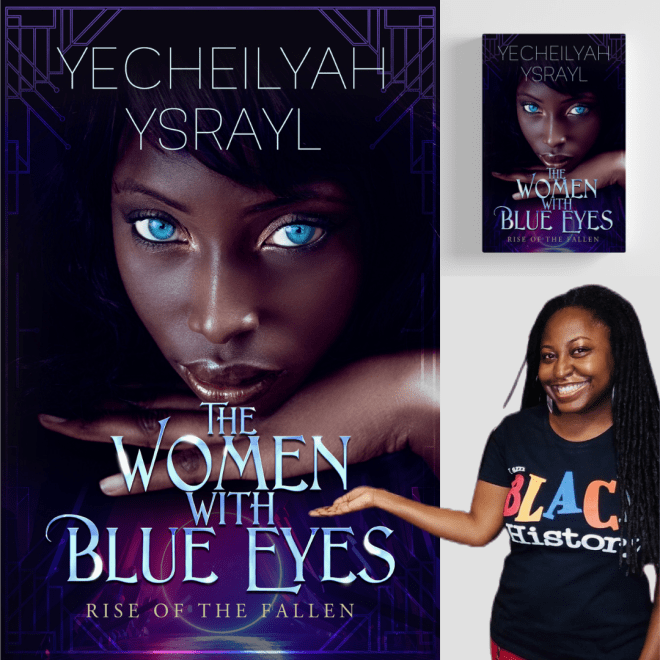
I hope you are all doing well and all that good stuff. I have not blogged much lately because I am working on The Women with Blue Eyes and tons of other projects, including our 4th Annual Poetry Contest I want to get underway next month.
If you are new here, welcome to The PBS Blog! This is a great time for you to learn more about who I am through my most recent interview.
Below is a snippet of the interview and links with WRDE-TV, an affiliate of CBS. Also find links to Fox 34 and WBOC, affiliate of NBC. (If you read one, you’ve read the others cause it’s the same article, just on different platforms.)
Interview Snippet:
What’s your best piece of advice for readers who desire to find success in their life?
Y: Faith without works is dead, so my best advice is to do your work. Get on your knees and pray and then get on your feet and work. I hate to sound so overly simplistic, but sometimes things are a lot simpler than we make them out to be. We must be willing to do the work necessary to manifest all that we believe we can achieve. Belief is good, but alone it is not enough so I cannot tell you to just believe in yourself. You must prove this belief with action. What you say you believe is one thing, but what you do exposes who you really are. Whatever it is you say you want, you must act on it for it to become a reality.
Not only must we love ourselves and believe in our ability, but we must also be prepared to do the work necessary to turn the unseen into the seen. Consistency is also key because while actions speak louder than words, consistency speaks louder than both. These skills Yah has blessed us with are not intended to serve only us. They are meant for us to multiply. This is possible when we combine a steadfast belief with a compelling work ethic.
Speaking of success, what does the word mean to you?
Success to me means to genuinely enjoy what you do with your life without sacrificing your authenticity. It means to multiply your gifts to serve as many people as is destined for as long as the breath of life is in your body and you are walking this earth. To do so with as much grit and love as possible, and to do it all while staying true to your integrity.




 I thought I was big time.












 The PBS Blog