Signs You Are Not Ready to Self-Publish Part 1: Skipping Revisions

I am deep in revisions for my first fantasy novel, The Women with Blue Eyes: Rise of the Fallen. I am on the clock because I want my editor to start work on it next month. As I go over my work, I realize how horrified I would have been not going back over this. As usual, I want to share what I am learning with you. In this new Indie Author Basics series, I am sharing some signs I have noticed that indicate that you are probably not ready to Self-Publish that book.

You Skip the Revision Process

Step one in the process of Self-Publishing is to write the book. It is unnecessary to self-edit during this stage because it would be challenging to finish the book if you are editing as you are writing. Step one is like a brain dump where you are getting everything down on paper. It is the most exciting part of the journey as you let your ideas and creativity flow. Step one is creating the rough draft of your story, the version of your manuscript that is complete but not polished.

I know a writer is not ready to Self-Publish when they skip the revision process.

Revisions are rewrites of the manuscript before sending it to a professional editor.

It is AFTER the book is finished because you don’t want to edit as you write (you’ll never finish) but BEFORE the professional edit.

The rewrite is more challenging than the rough draft because you are not only putting your ideas on paper, but now you are organizing those ideas, cutting out what doesn’t work, and working with what does work. The revision stage (rewrites) strengthens your work into something worthy of publication.

If you skip this stage, you are publishing your rough draft. If you send the rough draft to an editor, you will still ultimately publish your manuscript’s rough draft version. While the editor can clean it up some, it is not the editor’s job to write the book for you. If you are looking for someone to write the book for you, you need a Ghostwriter. If you want to write your own book, it is essential not to skip the revision process when you are Self-Publishing.

The rough draft is not the final draft and will not be the best representation of your writing.

How to Know if You Have Skipped Revisions:

  • You just finished writing the book. You have made it to the end, and you are done. You take this book , create a PDF, and upload it to Amazon. You have not gone back to rewrite or make corrections, and you have not had it properly edited. If I have described you, you have skipped the revision process.


  • Technology has been your godsend. You have finished recording your book using speech-to-text technology that has translated your words to the page. You finish the book, but you don’t rewrite what you spoke into the document for comprehension. Everything is kind of all over the place. If I have described you, you have skipped the revision process.


  • You just finished writing the book. You have made it to the end, and you are done. Then, you take this version (the rough draft) and send it to an editor. If I have described you, you have also skipped the revision process. And unfortunately, for your editor they have the job of rewriting your book. If they are a quality editor, they will send the MS back to you and request a rewrite.

If you have not gone back over your rough draft to make changes, this is a sign you are not ready to Self-Publish.

Check out more Indie Author Basics Here.

Also, here are some ideas for revising!

Revisions: Self-Editing #amwriting

Revisions Part 2

Yecheilyah’s Book Reviews – Immersed in West Africa by Terry Lister

Title: Immersed in West Africa: My Solo Journey Across Senegal, Mauritania, The Gambia, Guinea and Guinea Bissau
Author: Terry Lister
Print Length: 159 Pages
Publisher: Book Power Publishing
Publication Date:  August 29, 2019


Immersed in West Africa details the thrilling trip of one man’s travels through Senegal, Mauritania, Gambia, Guinea, and Guinea-Bissau. I love to travel, as anyone who knows me or has read this blog for any length of time will attest. We were unable to travel because of the pandemic, so it was enjoyable to learn about some less-traveled regions of West Africa from the author’s viewpoint.

We learn about Goree, the infamous island in Senegal with roots in the history of the slave trade. The island had twenty-eight slave houses and transported nearly two million people. We learn that the Maison des Esclaves (The House of Slaves) and its Door of No Return are museums and memorial to the Atlantic slave trade on the Gorée Island that they renovated in 1990.

I appreciated how honest the author was about his experiences as he traveled from one location to another. His accounts were complete, truthful, and thought-provoking in my opinion. Lister is honest about the aspects of his tour that did not go well for him, such as the native community on Lake Retba in Senegal’s Pink Lake (where the residents were pleading with him for money) and the difficulties he encountered entering Nouakchott, the capital of Mauritania. The abuse Terry experienced from the police is a story that black men and law enforcement hear all too often. It was unnecessary to make him wait, force him to the station, and inquire about his finances.

I learned from this that it is an excellent idea to guard against those who see you as a new face and try to take advantage of you. I commend the author’s courage because I would not want to travel from country to country alone, precisely because of situations like this.

Also, about the Pink Lake, the author explains it is pink because of its high salinity, second only to the Dead Sea.

We discover few people visit Mauritania because of its strict policy against alcohol and how Mauritanians love mint tea. I loved reading about making it as performed by a woman in Chinguetti. We learn desert homes use propane gas units that they carry from room to room. In Mauritania, we also discover that they use the sun to power their street lights and have installed solar panels to light up the streets.

If you are already intrigued, you will love this book as I have only scratched the surface of the author’s adventures. There is a lot to learn from someone’s personal experience that adds a seasoning that far outweighs looking it up on Google.

I love learning about how things are different in other countries, like the communal way of eating meals, sitting around a table or on the floor in a circle, and eating with your right hand, no utensils. I also did not know polygamy was legal in Senegal.

I cannot wait until it is safe again, and we can do some international travel. I might consider some places this author visited.  I would love to taste the cold water he got to drink from The Terjit Oasis, where the water fell from the rocks!

Strong Introduction: 5/5

Authenticity / Believable: 5/5

Organization: 4/5

Thought Provoking: 5/5

Solid Conclusion: 5/5

Immersed in West Africa is Available on Amazon and Free with KU!


To have your book reviewed on this blog apply here. The registry is open for a limited time!

509

Yecheilyah’s Book Reviews is a reputable review service that features writers from all over the world, both traditionally and independently published. We are listed on Kindlepreneur as a top-tier book review blog and Reedsy as one of their vetted active book blogs that provide insightful, excellent book reviews.

The Power of Your Author Name: A Message to First Time Indie Authors

Barack Obama released another book on the seventeenth of November, 2020. It was already a Best Seller with over two-thousand book reviews on Amazon just a few days after release. Obama’s name alone skyrocketed this book to the Best Seller’s List before we had time to decide what we wanted for breakfast that morning.

And Sister Soldier’s March 2021 release, “Life After Death,” the long awaited follow up to The Coldest Winter Ever is already a Best Seller. That’s right. A Best Seller and the book is not even out yet.

The same can be said of Amanda Gorman, whose poetry book The Hill We Climb, and Children’s Book, Change Sings, is already a best seller.

These books don’t release until September!

Today, we are talking about the power of your name and the role it plays in your author branding and marketing yourself as a first-time Indie Author.

What’s in a Name?

A person’s name is a connection to their identity and individuality. It is the history of who a person is. When you think of names that have become prolific, you are not just thinking about a person’s name. You are thinking about all the things that person has done, their experiences, and contributions to the world.

Sometimes, we hear a name, and it is not a good image we see. Names like Jefferey Dahmer and John Wayne Gacy make us tremble, but even these names show a name’s power. We tremble because their names are connected with the horrific things they’ve done, and hearing those names brings to our memory those heinous acts, in the same way, hearing Maya Angelou’s name gives us hope.

When branding yourself as an author, it is good to have the same author name consistent across platforms. Your name doesn’t just tell someone who you are, but it helps build brand recognition.

This means using the same name across your author’s website, the same name in your social media handles and emails, and the same name on your book covers.

“You can show genre with cover design, blurb, logo, and many other cues, but publishing under lots of names in the digital age is a recipe for disaster.” – Anne R. Allen

The more people see your work connected with your name, the more they remember who you are.

It is why we call them “Name Brands.”

Michael Jordan is a brand name, an icon whose career has made his identity equivalent to excellence. When people buy Jordans, they know they are buying a top-quality shoe. And even if it is not a top-quality shoe, it is what the people believe. Why? How did someone whose name once meant nothing now mean everything?

Well, that’s another blog post. For now, let’s just stay on topic and keep it simple.

Michael Jordan proved himself as an exceptional basketball player, and his work ethic is connected with his nameThe more his work became recognized, so did his name.

Your work and your name are connected, whether you are a servant of good or bad. If you are doing good work (in this case, we are discussing writing) and not using your name or changing your business name every six months, you make it hard for people to connect who you are with what you do.

“It’s much easier to build brand recognition if you keep all your publishing activity under the same name and the same expression of that name.” – Jane Friedman

Nikki Giovanni, Ralph Ellison, Lorraine Hansberry, Langston Hughes, Walter Mosley, Toni Morrison, and Richard Wright.

Chances are you’ve heard these names before, and if you are like me, you will notice these names on book covers at any bookstore. You might even stop to scan or flip through the pages of a book simply because you recognize these author’s names.

Book Titles

The name of this blog started as the name of a book series I was writing.

In my Pretty Woman voice, “Big mistake. Big. Huge.”

While I have found a new purpose in this blog, it was a mistake to name this blog after a book. The problem with using the title of your book as your blog name, author website, or social media pages is you will probably write more books.

Are you going to create more websites and accounts for all the books you are writing?

Of course not.

Your name is one of the most powerful, FREE resources you have for marketing yourself as an author.

When you first meet someone you introduce yourself, and you start with your name because your name is your identity. It is more important than your job title and degrees. And when people remember our name, it makes us feel important, recognized, and valued.

What about Pen Names?

Anne R. Allen has published an excellent article on that already, so I will refer you there. While her post is about why pen names are not a good idea, Anne’s number one good reason for using a “pen” name is the one loophole.

  1. It’s the name you’re known by, even if it’s not the name on your birth certificate.

It is absolutely okay to use a name that you’ve been known by even if it’s not your birth name. The key is not to keep changing it though. Pick a name and stick with it.

Consider Maya Angelou, Ntozake Shange, Sonia Sanchez, Kwame Ture, Whoopi Goldberg, and others. None of these people were born with those names just as I was not born Yecheilyah Ysrayl. Although I was not born Yecheilyah, I do not consider it a pen name. It is more than that, it is the name for which I am now known.

Use Your Name

“Once you know what author name you’ll be using, be relentlessly consistent in the expression of that name throughout your websites and social media accounts.”

– Jane Friedman

No matter what name you choose to brand, use that name everywhere. It will help people to identify you, and when they remember you, they remember your work.

No one cares about the title of your book or your book, for that matter.

What people care about is you, the author so it is your NAME and your author photo that will stand out the most in your social media profiles and on your website.

Think about it: It’s not about “A Promised Land.” It is about the fact that Obama wrote it. He could have titled the book The First Black President and people would have bought it. People are buying him. People are buying Obama.

I am not a fan of the term, but when people say that “people buy people,” what they mean is in the beginning, readers are interested in the person more than the book. Then as they begin to trust the person, they trust anything connected to the person, including the book.

  • Who are you?
  • What do you enjoy doing outside of writing?
  • What motivates/inspires you to write?
  • What has your journey been like?
  • What’s your story?

Instead of using a lot of different names or the title of your book, focus on branding one name across platforms.

www. AuthorName . com
Facebook.com/Author Name
Twitter: @Author Name
Instagram: @Author Name
Clubhouse: @Author Name

The stronger your brand name, the easier the marketing. We all hope to get to the point where people hear our name associated with something and run out to support it without blinking.

Use your name. That is all.


Looking for more Indie Author Tips? Check out the catalog of articles here. From this point forward, Indie Author Basics posts will publish on Wednesdays.


I am Soul is 99cents for a limited time. And remember, if you read it, review it!

Introduce Yourself: Introducing Guest Author Andi Brooks

Introduce Yourself is back!

Do you like our new badge? Yass!

Please help me extend a warm welcome to Andi Brooks.

Welcome to the PBS Blog!


What is your name and where are you from?

My name is Andi Brooks. I am originally from England, but I have lived in Tokyo for the last 15 years.

Nice! What would your perfect writing room look like?

That’s an interesting question as I was thinking about that only last week. I would love to have a desk in the bay window of a Victorian house overlooking the sea. A rugged, stormy coastline would suit me very well. I love to walk along the beach alone in winter and search the black waves for inspiration.

Yess. That sounds soo relaxing. Let’s talk about when you published your first book? What was that like?

My first book was a collaboration with the American writer Frank Dello Stritto. “Vampire Over London: Bela Lugosi in Britain” was originally published in 2000 and reprinted as an updated and expanded second edition in 2015. A biography of the famous Hollywood actor forever associated with Count Dracula’s role on stage and in the 1931 film, the book was the culmination of a decade of research. It was very exciting to see it in print and gratifying to have it universally praised by critics and readers.

Before working on the book, I wrote articles on vintage horror, sci-fi, and fantasy films for magazines in the UK and America. After the book was published, I put together a Bela Lugosi blog (https://beladraculalugosi.com/) to share the research material and wrote a silly poetry book, but I mainly devoted myself to writing music and promoting live shows in Tokyo.

Apart from one article on the love affair between Bela Lugosi and Clara Bow, which won the Rondo Hatton Classic Horror Award in 2017, I wasn’t really involved in writing much until I threw myself into Ghostly Tales of Japan.

This book is available now on Amazon!

What’s the most difficult thing about being a writer? The most exciting thing?

The most difficult aspect of being a writer for me is trying to overcome a lack of faith in my ability. I generally know when an idea is good, but I can’t overcome my doubts about my skill as a writer. If I hadn’t been firm with myself, I would still be revising the stories in my latest book, but there has to come a time when you have to say that enough is enough and put your pen aside. As it was, the stories in Ghostly Tales of Japan went through endless rewrites. I agonized over every choice of word and punctuation. It is good to strive for perfection, but you have to realize that there is really no such thing. Being always dissatisfied is a good motivator always to try harder.

The best thing about being a writer is hearing back from readers who have enjoyed reading your work. It makes all of the pain that goes into writing worthwhile.

We do tend to judge ourselves harshly but hearing feedback from readers makes it worthwhile for sure. Andi, who is your favorite writer?

It depends on my mood, but H. G. Wells and H. P. Lovecraft were firm favourites for many years. The scale of their imaginations is astounding.

Wait, wait, wait. I gotta ask you about the TV show real quick. Lovecraft Country, did you watch? Like or Nah?

I’ve never heard of it!

Whaat?

Living in Japan, you can miss an awful lot unless you watch Netflix and the like, which I don’t. I always tend to hear about things long after the fact.

Lovecraft is great for radio adaptations, but tends not to do so well on the screen. I did love the Reanimator films, but I haven’t seen many over good adaptations. I did a quick search online for Lovecraft Country and watched a clip. I can’t really tell if it’s for me or not, but you have sparked my interest, so I will give it a go.

And give it a go you should!

I also love the ghost stories written by M. R. James. I don’t think he has ever been better. At the moment, however, I am completely immersed in the writing of Carlos Ruiz Zafón. The Shadow of the Wind is one of my all-time favourite novels. I have reread it so many times. Although I said that there is no such thing as perfection, this book is as close as it comes. Carlos Ruiz Zafón’s skill was breathtaking. It is such a tragedy that he died so early. The world has been denied the many wonderful books he could have written, but what he left behind is something to be very grateful for. I have literally just put down The Angel’s Game, the sequel to The Shadow of the Wind. I can’t wait for the next book in the series, The Prisoner of Heaven, to pop through my letterbox.

I love it. What is the most thought-provoking book you’ve ever read?

Perhaps Oh! The Places You Will Go by Dr. Seuss. I read it to my son many times when he was small. The truth in that wonderful book will always be relevant. It made me reflect on the ups and downs of my life. Things certainly haven’t always gone to plan, but the disappointments resulted in me taking a different path, which led to where I am today, which is not a bad place to be.

What is the worst advice you’ve ever been given?

When I was at school, a career advisor told me that I should forget dreaming of being a writer, an artist, or a musician and get a job in a factory because it was regular work. I have ignored the advice of his like ever since.

I don’t blame you! Like, whaatt.

Outside of writing, what are some of your passions?

Music has been a big part of my life since my teens. I can’t imagine a day without music. I’ve been in many bands, either playing bass, guitar or singing. About three years ago, I put the guitars aside and decided to start making electronic music. It was something that had been in the back of my mind for a very long time. I regret not trying earlier because it has given me total musical freedom, but better late than never! You can find my electronic musical misadventures on my Bandcamp page (https://airstripone1.bandcamp.com/).

I love it. Musical Therapy is a real thing for sure. We love music on the PBS Blog. In fact, today’s Throwback Thursday! What kind of music do you like?

I listen to a very wide range of music. I like to have something to suit whatever mood I am in. My first music love was the 1970s British band T. Rex. They inspired me to try my hand at making my own music. David Bowie was also a big influence in the 1970s. Then along came punk rock, which was the perfect soundtrack for my teens. Buzzcocks, Siouxsie and the Banshees, X-ray Spex, and, of course, The Sex Pistols had a deep impact on me.

Towards the end of the 1970s and into the early 1980s, I loved British electronic music. Along the way, I’ve listened to everything from folk to jazz. I must give a special mention to Christmas music. I love Christmas and its music, both traditional and popular. I think I have around two hundred CDs of Christmas music!

Sheesh, Andi. Lol

Today, I have listened to underground Japanese electronic music, Nina Simone, the Blade Runner soundtrack by Vangelis, some solo albums by Mick Karn, and David Sylvian of the band Japan. I have an insatiable appetite for music, and I am addicted to buying CDs and records. I try to find something new to listen to almost every day.

What songs have you completely memorized?

My memory is absolutely dreadful! There are some song which I have been listening to for over forty years, and I still don’t know all the lyrics. It’s bizarre! The only song, apart from ones which I have written – and I’m not sure that I can remember them, which I think I know all of the lyrics of is, like many people, Bohemian Rhapsody by Queen. It’s not a song I usually listen to, but somehow it has wormed its way into my brain. If you only know the words to one song, it’s not a bad choice. I remember lines from movies more but often forget the plots. I love movies as much as music. One day I would like to make my own.

If you could live in a movie, which would it be?

I’m not sure that I would like to live in any of the movies I watch, being a lifelong horror fan.

Ha!

Even the non-horror films I like tend to have elements of darkness that I wouldn’t want to experience. If I’m forced to choose, perhaps it would be Lost Horizon – the Frank Capra original, not the musical remake. I don’t think I would hesitate to accept the offer of escaping the madness of this world to spend my days in the utopia of Shangri-La.

If you could, would you visit the past?

I would love to. There are so many great periods I would like to visit, but wherever I decided to go, I think I would stop off in 1979 first to give a few words of advice to my teenage self. I’m not sure that he would listen, but there are two facts of life that I wish he had known!

Thank you, Andi, for spending this time with us. We enjoyed you!


Copyright Andi Brooks

Andi Brooks is a writer of English and Irish descent based in Tokyo. He began writing on vintage horror and science fiction films for American and UK magazines in 1991. With Frank J. Dello Stritto, he co-wrote “Vampire Over London: Bela Lugosi in Britain” (Cult Movies Press 2000), a critically acclaimed biography of the Hollywood legend forever associated with the role of Dracula. In 2017, he received the Rondo Hatton Classic Horror Award for ‘Dracula and the It Girl,’ an article which recounted the short-lived love affair between Bela Lugosi and silent screen star Clara Bow. In 2020, he published “Ghostly Tales of Japan,” a collection of thirty original ghostly stories set in various Japanese history periods. He is currently writing a second volume of ghostly Japanese stories and a guide to the terrifying sites of Tokyo.

Be Sure You Are Following Andi on Social Media

…and if you are a Horror/ SciFi fan, be sure to check out his book!

Other Digital Platforms:


Are you an author? Looking for more exposure? Learn more about my Introduce Yourself Feature HERE. 


Note: We pushed this week’s feature back to today, but we will get back on schedule for the next feature. Author interviews post on Mondays.

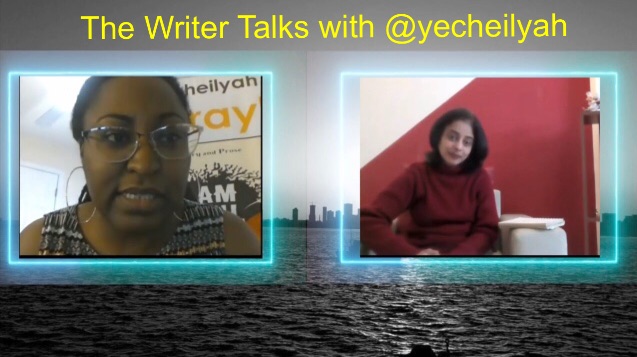
The Writer Talks with Asha G. Kumar Part One

Thank you to Asha G. Kumar, host of The Writer Talks, for having me on!

Check out Part One of this two-part interview with yours truly. In this first part, we talk about the inspiration behind my first forthcoming Urban Fantasy/SciFi/Speculative Fiction novel, The Women with Blue Eyesmy belief in aliens lol, and my latest poetry collection, My Soul is a Witness. In part two, we dig deeper into my journey as a writer, my advice to other writers, Black History, and you know I had to recite some poetry!

Part 1 is available now on YouTube.

Link below!

Subscribe | Like | Share |Save

Vote For My Soul is a Witness Book Cover

They say not to judge a book by its cover…

…but I need you to do just that!

If you like the cover of my book, My Soul is a Witness, please vote for it for the cover of the Month contest on AllAuthor.com!

Here is the link:

https://allauthor.com/cover-of-the-month/10528/

Go, Go, Go!!

And thank you!!

Yecheilyah’s Book Reviews – Daisy by Pat Backley

Title: Daisy
Author: Pat Backley
Print Length: 190 Pages
Publisher: Pat Backley
Publication Date: October 8, 2020


I have not read a book I could not wait to get back to in a while. Daisy is one of those books.

Daisy is a historical fiction novel set between 1887 and 1974. Despite being brief, the prologue skillfully unites the entire narrative. In a flower field, a white hand is on top of a tiny black hand. Daisy chains are being made by the woman and the young child.

“Mum, why am I called Daisy?”

The author transports us back in time to that field of, Daisy’s with the same query from the little Black girl, starting in 1887 and finishing in 1974. It is set in Alabama, Harlem, and London. We will soon understand why she is named Daisy and why the hand on top is white.

The author’s strength here is her character development. Although there were many sudden tragedies, the author did such an excellent job with their backgrounds and personalities that the reader is genuinely interested in them and grieves their loss.

This is a family story, and I loved how the author tied everyone together with the historical backdrop. There are descendants of the enslaved whose lives weave with descendants of slaveowners and poor white Londoners the author interweaves with poor Black Americans’ lives. Witnessing the tension and wondering when everyone would meet was exciting. It was like reading about a generation of people all connected in a six-degrees of separation kind of way – that all people on average are six or fewer, social connections away from each other.

An example is when Samuel, Winifred, and Jeremey Davis, the Black family from Harlem, moved to London in 1952. Leading up to this, we have already met the white family in London (because the author starts in 1887 and moves time forward). Thus, the anticipation is already there as to which of Polly’s descendants will meet one of the Davis. Little Jeremy is five years old in 1952, but by the time he is an adult, he meets one of the great-great-great granddaughters of the London family, and they marry, giving birth to the little girl from the prologue.

It’s juicy ya’ll!

The reader is constantly reminded of the family’s history and how everyone is connected since the author recounts it throughout the story. The book’s main takeaway seems to be that whether you are rich, poor, free, slave, Black, or white, everyone is a member of the human family, which would function much more harmoniously if prejudices like racism, sexism, and classism were nonexistent.

“Being born poor was a scar that never faded.”

“She had never experienced racial hatred first hand, so had no real idea of how it could erode a person’s whole life.”

Plot Movement / Strength: 5/5
Entertainment Factor: 4/5
Characterization: 5/5
Authenticity / Believable: 5/5
Thought Provoking: 5/5

Daisy is Available Now on Amazon


Be sure to visit the Blog Book Review Policy page here to learn how to apply for a review.