The 2020 Lit Mag Literary Magazine for Poets is on its way out! We are proud to feature last year’s Grand Prize Winner Chanelle Barnes on the cover. Volume 2, Edition 2, is scheduled to print Tuesday, March 3, 2020.
This year’s magazine features the winners of “Yecheilyah’s Annual Poetry Contest 2019”: Chanelle Barnes, BuddahDesmond, Jahkazia (Jah-kay-asia) Richardson (our 2018 Champion), Kiyana Blount, and Dondi A Springer. The mag also features the poems of select poets who participated last year.
How can you be featured in the Lit Mag Magazine? Be sure to participate in my annual poetry contests! Rules and guidelines for the 2020 competition to be announced.
Be sure to support this contest by picking up your copy of LitMag 2019 by clicking on the link below. Your contribution helps us to keep this contest going by keeping the entry fee-free or low-cost for participants, allows us to print the magazine featuring the winners, and of course, offers some dope prizes to contestants! Link below:
Last week, I planned on introducing a new Black History Fun Fact Friday. I also planned on revealing the cover to the poetry contest magazine to my social media (which I will do tomorrow, time permitting). This was a busy week for me (more than usual). This isn’t to say that “busy” is a measure of importance, but last week was a hectic one for both my personal and professional life. But also, it was a good busy (more like a focused busy). I got a lot done and gained some clarity. And although I still have emails, I haven’t responded to and travel to prepare for I am sitting down in the few hours I have here before running errands to talk to you guys and send an important message to my email list.
I find that how we direct our focus determines what will show up based on how we have prioritized. Those things we put first or last will naturally manifest in our life and align based on what we give more or less attention. If I know I have coursework due on Wednesday, for example, but I scroll social media until the final hour of when the work is due, chances are I won’t do well, and it won’t be because I am ignorant or incompetent. It will be because I did not set my coursework as a priority this week and give myself time to think through the assignment. Instead, I scrolled social media, which means I have set it as a priority over my coursework and are thus reaping the consequences of that choice. It doesn’t make it social media’s fault, and it doesn’t make social media an evil entity, but it was not the proper decision on this day.
I use social media because it’s an easy example, but I believe this can apply to anything from business practices to relationships and friendships.
What are you sacrificing?
I realized that whatever we pay attention to means sacrificing something else in its place. If we focus too much time on gossip and negativity, we are sacrificing something else in its place. If we spend too much time on social media, we are sacrificing something else in its place. Sometimes the sacrifice is not all bad; it makes sense depending on what is a priority at the moment. Sacrificing an hour of work to sleep and refresh is not a bad thing because, with rest, we can have better clarity to do the job. Surrendering a TV show to post something of value and substance to social media that will help someone else is not a bad thing. You see, I also learned this week that our priorities might change from day to day. What was most crucial yesterday may not be most important today.
From this point forward, I will be more conscious of what I am sacrificing when I am spending my time doing something because I know that whatever I focus my attention will manifest based on those things of which I have set as a priority.
Instead of saying, “I don’t have time,” I will say, “what am I willing to sacrifice to get this done? What am I willing to give up to do this?”
Note: Due to the content of this post I am filing it under Black History Fun Fact Friday.
Erika Alexander (Max/Maxine Shaw/Pam, Living Single) did an interview with The Breakfast Club(I want to say it aired yesterday?? 1/29) that brought out some interesting facts. (Funny because she was not supposed to be a regular on Living Single but…). Like I tell people, Black History INCLUDES music, television, film, art, and much more.
Yvette Lee Bowser created Living Single for Warner Bros and it debuted in 1993. One of the original suggested titles was Friends. Asked if he could have any show on TV, NBC’s President said Living Single. Queen Latifah’s show’s suggested title was called My Girls when they first did their pilot according to Erika Alexander, but it didn’t do well. The networks then chose Living Single, and then the next year they named a separate show Friends. But you got that much from The Breakfast Club. Let’s go a little deeper.
To go further, I wonder why it was decided to call the black show Living Single? Did it have anything to do with black families being largely headed by single women at the time? I am still researching the specifics for 1993 ( the year Living Single debuted) but so far the numbers continue to increase for single-family households in the Black community at the time. In 1991, 68% of Black children were born outside of marriage. In 2011, 72% of Black babies were born to unmarried mothers. In 2015, 77% of Black babies were born to unmarried mothers.
What was really behind the networks naming this show “Living Single?”
Was it the stereotype or assumption that Black men weren’t present that led them to the decision that the black show should be called Living Single? (“We are living Single…”) instead of Friends? (Because I mean, the sistas on Living Single were Besties, you hear me? They were really Friends. Sooo I got questions…)
I know ya’ll probably think I’m reaching so …if you think this is too far-fetched, consider Good Times.
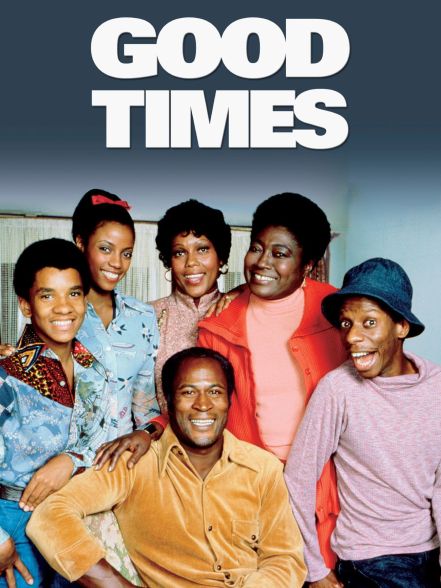
Good Times only had a father figure because Esther Rolle fought for one.
Originally, the show would be based on a single woman raising her kids in the projects in Chicago (I am from Chicago AND I grew up in the projects, trust… we know these things). Rolle said no, she wanted a father for her children and she became a pioneer in fighting for a black father on TV: George Jefferson (played by Sherman Hemsley) on The Jeffersons, Cliff Huxtable (played by Bill Cosby) on The Cosby Show, Phillip Banks (played by James Avery) on The Fresh Prince of Bel-Air. The list goes on and on but one woman opened the door for a complete black family to be shown on television and her name is Esther Rolle.
Good Times was revolutionary because it broke ground not only by showing a low-income family on television but also, a COMPLETE black family. The list of shows Good Times inspired is too numerous to mention, including NBC’s 227 in 1985, Regina King’s first breakout role. Then, in 1989, ABC launched Family Matters as their answer to 227. UPN sought to create the magic of the Cosby Show with Moesha in 1996. It goes on and on and down hill from here…
“I just thought it was a poor representation of what Black women were being able to do. And frankly, if you didn’t fit in that mold, there was nothing you could do. It was like watching a train wreck. I actually didn’t think it was real at first. Took me a long time to sort of get that, no this is real, and yet, it’s not real.”
The black father was the hardest legacy Rolle fought for. She grew up with one and an intact family; she wanted that to be shown on television. “I had a wonderful father,” said Esther Rolle, “and I couldn’t bear that television virtually ignored black fathers. I could not compound the lie that black fathers don’t care about their children,” she said previously in media reports. “I ruffle a lot of feathers. And I’m also selective–that makes you a troublemaker, but so be it. I laid a cornerstone for black actors, and that makes me happy.”
Although Rolle worked hard for a black father, they still eventually killed James off. So, I ask, what was the real reason behind naming the “Black” show, Living Single Hmm? That is the question.
Something about sorrow sounds spiritual. It sounds like awakenings and revelations. Sounds like pacts and promises. Sounds contradicting too, like hope and despair are twins. We want to shackle ourselves to change. Something about sorrow got us questioning our own mortality. But how permanent is this grief? Where are we two years from now? Is this feeling fleeting? Will we forget our own deaths could be just as close as Kobe’s? Right now is good. It’s all reflection-like. Our throats are full of emotion and saltwater. Only time will tell if this is real or just another ode to the people we worship as Gods. Today, forgiveness is an anthem we sing each morning. Kisses adorn the faces of our loved ones, and the heavens ain’t heard these many prayers since the last celebrity died. And yet I ask myself how permanent is this grief? What have we learned?
There are people we know and love that are close. We can reach out and touch them. Now. Today. Will we? Some of us will Tupac this young man’s legacy while forgetting the promises we made to ourselves to be better people outside of the internet. We will forget those feel-good words we concocted when the world was in mourning. The “every day ain’t promised,” and “hug the ones you love,” we spit into the air as if life has promised our names won’t be the next one carved into the next hashtag. Like our pictures won’t be the ones swarming the internet like the locust currently congregating in East Africa.
Yea, something about sorrow sounds spiritual. Got us thinking about life and truth and family and love. But will this last? How permanent is this grief? That is the question.
I am stopping through to remind you I am looking for writers interested in submitting articles to this blog for my Black History Fun Fact Friday series. Below is a reminder of the qualifications for submission. Also, notice I have added a deadline to articles for Black History Month. There are four Fridays in February this year and so far we have one article submitted. This means there are only THREE slots left for those of you who want to get in for Black History Month. (This is not a Feb only opportunity, but a weekly one so don’t fret if a Friday in Feb is not open when you submit).
Because of the nature of this series interested writers must be Black/African American (this includes so-called Afro Cuban, Jamaican, Haitian, Cuban, Afro Brazilian, Dominican, etc.).
Must be original work. Do not copy and paste the article from other blogs unless that blog is your own. If you have a Black History article to share that you published to your site you are welcomed to submit it for Black History Fun Facts. I have no problem with that as long as it is your work.
Topics must be relatable to the history of Blacks/African Americans.
Articles must be emailed to me for approval at least one week before publishing. If you email your article on 1/31 for example, I will publish it on 2/7 if there are no needed changes. This series is not exclusive to Black History Month but if you want your articles published in time for February, please have them submitted no later than Monday, January 27, 2020. Writers looking for more exposure will be wise to try for a Feb slot. A Black History Article during Black History Month will naturally attract more readers.
Please send articles in a Word Document, 12p Font, Times New Roman text.
Please do your best to self-edit your work for basic typos/spelling/grammatical errors before submission. Grammarly andProWritingAid are good free self-edit software programs to use.
The BHFFF badge will be included in every post but you are welcomed to create your own image to add as well. Canva is a good program to use to make your own images. Unsplash is good for free images.
This is Black History Fun Fact Friday not Black History Opinions so do your best to submit articles covering accurate historical information. I will vet the submissions to make sure they do. If you have links to sources, please include them.
Please include a photo of yourself, social media handles, websites, or links to books you’ve written on the topic. This will be added to the end of the post as your call to action. This is where you give readers the chance to follow/learn more about you.
Benefits of Guest Blogging:
Increase traffic to your own website/blog
Build Relationships/Online Influence
Build Domain and Search Engine Authority
Capture Wider Audience
Develop Your Authority on a topic
Improve Your Writing
Opens the doors for paid business opportunities
The series is Black Historical so submissions should be articles detailing the history of Blacks in some way. You can talk about The Transatlantic Slave Trade, Enslavement, Civil Rights, Police Brutality, Medical/Educational discrimination, Black Power Movement, Inventors, Black Biblical History, and much more. Tell us about a little Known Black Historical Fact or introduce us to a little-known Black Historical person or place. (For example, I once published a post on Sundown Towns, all-white communities where Blacks were restricted from after Sundown).
Topics can vary as long as they cover Black History (this includes Jamaican, Haitian, Puerto Rican, Cuban, Caribbean, and Dominican.) Specifically, I am looking to feature full-length articles that inform and educate on some part of Black History at 300+ words or more. (Do not send a book, but make sure your article is at least 300 words. We want it long enough to inform but short enough to keep the reader’s attention.)
Email articles to yecheilyah(at)yecheilyahysrayl(dot)com
Questions? Comment below, use the contact form on the contact page or send me an email.
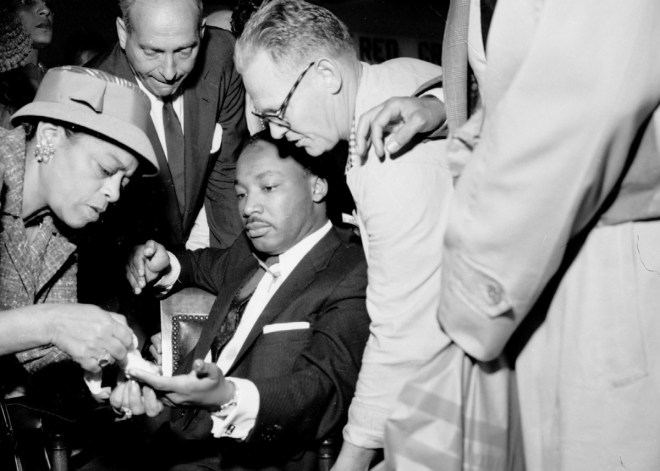
Martin Luther King Jr. recovers from surgery in bed at New York’s Harlem Hospital on following an operation to remove steel letter opener from his chest after being stabbed by a mentally disturbed woman as he signed books in Harlem. (John Lent/AP)
I am reposting this because February is approaching and we will see a lot of false information attached to Black History memes, same as always.
According to a famous Facebook post, King was not killed during an April 4, 1968, assassination attempt, but survived that shooting and was later “smothered by someone in the hospital.”
Is this true?
Let’s see.
Updated 1/28/2021
It’s Throwback Thursday so let’s go back in time a lil bit.
September 20, 1958
The year is 1958 and we are in Harlem, baby. Dr. King is signing copies of his first book “Stride Toward Freedom: The Montgomery Story,” at the Blumstein’s Department Store, on 230 West 125th Street.
It’s a nice afternoon and young King is just twenty-nine years old, releasing his first book and feeling good. And we are feeling good too because we are ready to get our copy. The line is long but before we get bored a voice makes us all stop and look in their direction.
“Is this Martin Luther King?” shouts a well-dressed black woman wearing rhinestone glasses and a matching necklace and earrings but carried an ugly brown bag and an even uglier scowl. The woman stepped out of line, causing groans from the people in front of her.
We don’t know this yet, but she is forty-two-year-old Izola Ware Curry, the black daughter of sharecroppers.
King nodded, “Yes, it is.”
“I’ve been looking for you for five years,” says Curry while pulling a letter opener with an ivory handle from her purse, which we don’t really know is a letter opener because we don’t use those anymore.
“Ooh, snap!” We gasp, placing our hands over our mouths. “Why she come so dressed up for if she was trying to kill somebody?”
“What is she doing?” says another one of us.
“Yea, man. Doesn’t she know this is Martin Luther King?”
“He not all that popular yet,” says a young black boy wearing chino pants and a white polo shirt. He put his hand in his pocket when he said it, smiled and then tilted his head like he was better than us. “Ya’ll not from here, are ya?”
Before we could answer, the sound of screams forces our attention back to the direction of the strange woman. She swings the letter opener at King, and sliced his finger then plunges the seven-inch blade into the left side of his chest.
“Oh, my God!” someone screams and just like that, the store is in an uproar. We are all screaming and running as someone apprehends the woman.
We look at King secretly hoping she didn’t get him because we still kinda want our book.
But when we see somebody who looks like our Grandma rush to his side, we know that’s not going to happen.
Dr. King is sitting in this chair all calm and cool like he ain’t just been stabbed. Meanwhile the letter opener’s ivory handle is still protruding just below his collar.
The police arrive. “Don’t sneeze, don’t even speak,” says Officer Al Howard, fearful of the blade’s proximity to King’s heart. Because of how the letter opener hit him, if King had sneezed, he would have died.
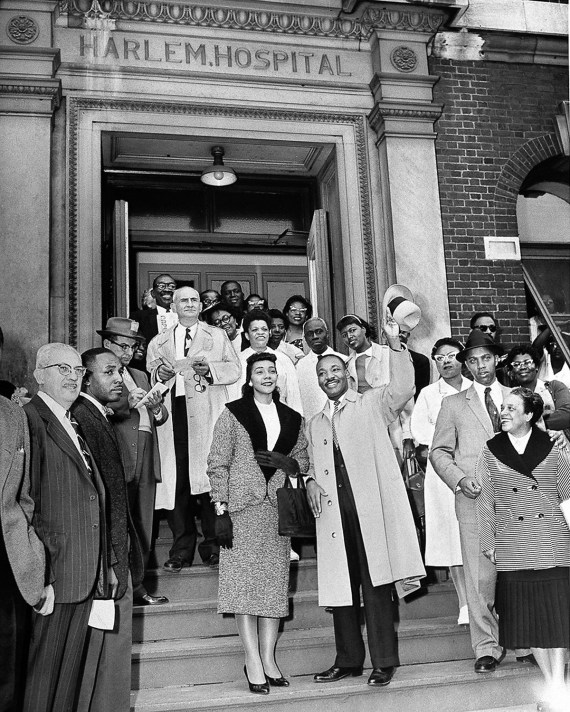
So, they move King slowly and carefully and take him to Harlem Hospital, and he undergoes emergency surgery.
Then, we jump in our time machine and head back to 2021 because it’s wild out here in the 50s.
Oct. 3, 1958 King leaves the hospital almost two weeks after the stabbing
The photo at the start of this post is not of Dr. Martin Luther King Jr. after being shot in Memphis, Tennessee in 1968.
That is a picture of Dr. King ten whole years earlier in 1958 at a New York Hospital after being stabbed at his book signing. He spent almost two weeks in the hospital recovering.
“If I had sneezed, I wouldn’t have been around here in 1962, when Negroes in Albany, Georgia, decided to straighten their backs up. And whenever men and women straighten their backs up, they are going somewhere, because a man can’t ride your back unless it is bent.” – Martin Luther King Jr., “I’ve Been to the Mountaintop.” April 3, 1968
I hope this creative backdrop added some perspective. Although I wrote it like a short story, everything I said here is the truth. Izola Curry, really did attack Dr. King at his book signing in Harlem.
Now to the original post…
There are tons of Black History memes circulating on the internet and this number has increased even more due to it being Black History Month. However, many of these memes are not historically accurate. Please be sure to double check your facts before sharing. Otherwise, you are guilty of spreading disinformation.
Black people have contributed to the world so that we don’t have to make stuff up. If you see a meme with a fun fact on it, just open the internet on your phone and type the name or fact into the search bar. You can tell from there if the material is accurate or not. Sometimes it will even come up that the information is an opinion or cannot be verified by any trusted source.
Use not only your phone to log into Facebook, Twitter, and Instagram. Use it to research these things and educate the people right.
Look for scholarly, peer-reviewed articles on .gov, .edu, or .org sites and trustworthy blogs. Peer-reviewed means information from a reputable source, information that shows that other professionals have reviewed and deemed it worthy of publication.
Wikipedia is not a credible source alone. Other trusted sources should support anything gained from Wiki.
And on the Monday of MLK day when everyone takes off and celebrates his legacy, remember that he was born on January 15, 1929, not whatever Monday you take off.
My Soul is a Witness is a title inspired by the Negro Spiritual song, “Witness,” but I did not choose such a title because I think of myself and my people as “Negroes.” I chose such a title because of the powerful messages and influence these songs had on our people as they transitioned from enslavement to freedom. Powerful messages I hope to also convey through my poetry.
There is a great spiritual awakening happening among Black people today as we strive to unlearn the lies they taught us for over 400 years. Whether that is starting and running our own businesses, embracing our natural hair or re-educating our young people on the parts of our history left out of the history books.
And to what am I a witness?
I am a witness to the trials and struggles my people have endured and I am a witness to our power to overcome those struggles. I am a witness also to my own sufferings which I am sure have been experienced by others. In this way, I am a witness to the fight that we all have. And why the fight? It is easy to present an image of healing and wholeness, but I believe it is much more fruitful if people knew of the struggles that got us where we are today.
From a historical perspective, I have not experienced the Middle Passage or enslavement or Jim Crow, but as a descendent of people who did, I am connected to those experiences just as if I had been there with them. In the Black community, we do not say, “when they fought for freedom,” we say, “when we fought for freedom.” The same can be true of the struggles of our own personal lives. If someone says they have been homeless before, I can relate because I have been homeless before too. I am a witness to what that’s like. If someone says they have a family member who is an addict, I can relate. I also have family members who are addicts. The anguish that causes in a family and what it does to that person and their loved ones are not lost to me. I can relate to that. I am a witness to that experience.
I believe epigenetic trauma is real. Epigenetics is the idea that trauma can leave a chemical mark on a person’s genes, which then is passed down to subsequent generations. (C. Benedict, New York Times) This means that a child or grandchild can experience side-effects from the traumatic experience of his/her elders. Since the concept of epigenetics, more and more studies hint to the inheritability of trauma where our own day-to-day health (and perhaps our children too) may have something to do with our inheritance of our parents and grandparents suffering.
One personal example is my own mother’s struggle with COPD (Chronic Obstructive Pulmonary Disorder). Her grandson, my nephew, suffers from asthma badly, though both his parents do not have asthma. Could he have inherited my mother’s affliction to a degree?
Thus, I do not find it far-fetched that Blacks/African Americans could still struggle from the mental and spiritual grief that plagued our forefathers long ago. We are witnesses to this pain on a deeply personal level which makes the Negro Spiritual deeply personal to us. While our ancestors were escaping physical enslavement, I believe we are escaping mental enslavement today.
As it applies to all people from the perspective of suffering and struggle, we all have a fight we are engaged in and when we overcome this fight, we become witnesses to that experience and can help others to overcome those same tribulations.
If trauma can be passed down, then so can healing. My soul is a witness.
Have you read I am Soul yet? Grab it here. My Soul is a Witness is coming this fall.











 The PBS Blog