Guest Bloggers Wanted!

file-3[1]

In honor of my first year completion (8-18-15) I have decided to implement Guest Bloggers this year for the days where I will be off. I wanted to wait until I had been blogging for at least a year to do this and now that I have, I’m ready.

To volunteer to Guest Post here please Visit the new GUEST BLOGGER page. I travel often and I would really like to have Weekend Guest Bloggers (Sat and Sun) and also Guest Bloggers for when I need to be away for longer than a week. My immediate need is Weekend Guest Bloggers, someone to fill in with exciting posts from week to week on The PBS Blog. I plan to start scheduling them within the next couple months so feedback is needed if you want to participate. I don’t have a 50,000 follower blog but some exposure is better than none for those wishing to promote their writing for free. Plus I think my followers would appreciate the variety.

I appreciate any re-blogs of this post:

  • Must be at least 18 Years or Older
  • Must not use extremely vulgar language or nude images
  • Must have the post submitted to me no later than 8:00p CST the Thursday of the week you are to guest post. If I choose you for a Weekend Blogger your post must be into me by 8pm every Thursday.
  • Must include attachments of any images you want me to include in the post in your response email.
  • Suggested length: Anywhere between 100-1000 words (Please try to keep from writing extremely long posts)
  • The article must be your own work. Do not copy and paste work from other sites.
  • Multimedia: images, podcasts, and videos are welcome
  • A short bio and photo of yourself can be included at the end of your post. You may include a link to your own website

Comment Moderation:

By default, blog postings are set to allow comments from readers. I always try to respond to every comment but I will not comment on a post you wrote. Please respond to comments made on your own blog posts. The idea is to keep in context with how I run my blog. If I respond to comments, I expect you to as well. Always respond positively and professionally :).

That’s it! Thank you for your time. Yall be great.

3 Reasons I am Not a Professional Author

hospitalityClothing

I strive to implement levels of professionalism in everything that I do whether it includes monetary compensation or not. In which case people who know me are already familiar with my level of organization and from that end, professionalism. However, I do not consider myself a professional author in the traditional sense of the word. Here’s why:

I’ve heard my share of advice from author blogs, books, tweets, Facebook, Twitter, articles, the list goes on and on (and on). I’ve taken valuable advice under my wing and even incorporated some into my day to day schedule and strategic writing techniques since it is, after all, wise to consider the advice of others. But the truth is that I will never be a professional author because my writing process is not the same as what is perpetuated in the mainstream.

The professional says:

  • Use the same business name across all accounts. This is the easiest way to brand yourself and to get people used to associating you with that name.

Makes sense, but I totally transgressed this rule! My blog, author website, and social media sites, for the most part, all have different names which I heard is bad. To balance this, I have taken to using one picture to represent every account. This photo you see associated with this blog will probably never change because it’s attached to all of my accounts: My personal Facebook Page, Twitter, Blog, IG, You Tube, LinkedIn, etc. I believe images are a strong form of communication and that many people have already become used to seeing this picture and associating it with Yecheilyah Ysrayl. I have also taken to using the same email address to represent these accounts across the board (with a few exceptions).

The professional says:

  • Plan out your book before you write it. Create an outline for your new masterpiece.

Umm, I think I’ll just go ahead and skip this step. I do not write outlines before each book. I just write and organize as I go along. Once I start to build on a story idea and start to write and develop some kind of form to the story, then I know what it is I need to research or the books I need to read for better clarity of this particular genre. It only makes sense to me that you write something down first and get an idea of how the story will develop, only then will you be able to clearly see what kind of information you will need for this story and can thus move on from there. For instance, its not until I start writing the story that I am able to create a Family Tree of my characters.

I know, I just said something else different didn’t I? Yes, a family tree. I found it easiest to organize my characters (after I’ve written about them) using a Family Tree. I’ll speak more about this in a separate post, but after I’ve written the characters into the story to some extent, I sit back and think about how to better develop them as real people. Not just by way of physical attributes (ethnicity, hair, eyes, relationships, persona, etc.), but also lineage. Where did this person come from? I do this by using a Family Tree, which can be created easily using Microsoft Word. The reason I choose this method is because the one rotating around blogs and professional websites is boring to me. (You know, that long list of questions you ask yourself about the people in your story: Hair:__________ Eyes:_________ Nose Shape________ …just kill me now). Not to mention I’m a visual learner. I have to see it to better understand it and laying out the family in this way helps me to accomplish this. Far as outlines go for the entire story, the first draft is the outline.

The professional says:

  • Stick to one specific genre.

I write in whatever genre the story that just popped into my head falls in. I heard this is a no no. According to the rules, in order to brand yourself it’s important to stay within a certain genre because it’s easy to become known for it. But in my opinion, brains don’t work like that. Well, at least mine doesn’t. What am I gonna say, “Sorry totally awesome story idea, I can’t use you right now because your Sci-Fi and I only write Romance”. That’s like telling me to write one kind of poem. Yea, that’s probably never going to happen. I mean sure, every idea is not meant to be built on. Some of them should just stay ideas until it is time for that idea to be brought forward. However, because the creative mind is not one dimensional, I find it hard to believe that I can force my thoughts to only create stories that appeal to one category.

The truth is that I will probably never do exactly as the professionals say do. If the world says this is how it is to be done, you can rest assured that chances are Yecheilyah’s over here doing something completely different…and maybe even a little weird. 🙂

Word to the Wise

how-to-self-publish-your-book-pop_8319

As we approach the month of August, when teachers return to work and students go back to school, I couldn’t help but to get excited that in just a few short weeks (mid August) I will be publishing another book. I’m really excited about this one and this excitement led me to a thought which in turn led me to something I think all Self-Publishers should take into consideration. I know that finances are a big deal to Self-Publishers and we are always looking for the most cost effective, yet professional, way to produce so here goes:

Never use POD (Print on Demand) services like LuLu and Createspace for anything other than Printing your books. Do not use POD editing services, POD promotional services, or POD book cover design services. Why? Because you can save a lot of money not doing so.

The most effective and creative action we can take as Self-Publishers is to use Print on Demand Companies as Printer Companies for our books, and then sell them from our own Author websites. Let people buy your books from YOU and you take a percentage of that income to pay the Printing Company (Createspace) to print the book AND if you don’t have the funds to buy your books in bulk from the POD, you can still send it to the buyer directly from the POD service. Remember to apply wisdom to everything that you do, so remember that you still have to pay the POD to print the book and to ship it so set your prices high enough to actually reap a profit but low enough to be reasonable. When people have to go to YOUR website this helps build you as an Author brand.

LOL

However, there are some exceptions  to be understood when considering these methods:

  • You’ll never make Amazon’s Best Sellers List using this method because your buyers are not buying from Amazon they’re buying from you. If making Amazon’s Best Sellers list is important to your writing goal (which is understandable) I suggest you ignore this post, carry on and not use this method. (It would be wise to use Amazon to sell your e-books and your Author site to sell your print books, kill two birds with one stone).

*Here’s another secret*

Amazon, Createspace, Kindle Select etc., is extremely popular right now. When people hear your book is on Amazon they go and inquire, they get excited and you feel like you’ve accomplished something great, AND YOU HAVE. But, it’s not really that big of a deal. If you really want to build yourself as a Self-Publisher, invest in your own Self-Publishing Company and make YOUR name the one people get excited about. It doesn’t have to be anything fancy, just your name alone will do. (I will draft another post for another day on building a Self-Publishing Company and creating a name brand in the most cost effective way possible).

  • If you don’t buy in bulk and are shipping directly from your POD, you won’t have the chance to include promotional products with the book since it ships directly from the POD, which doesn’t help you with promotion.

BUT …

(OK so I’m really letting all the cats out the bag, gonna have to get a dog)

…you can send readers a separate gift with the money you saved AHEAD of the books arrival with these special offers (bookmarks, flyers, business cards, gifts etc.). Make sure to expedite the mail so that it gets there BEFORE the book for a professional outcome. Include a little note that thanks them for the purchase and that you hope they’ll enjoy the free gift. Don’t forget to include your contact information (business card) and to also inform them that their book is on the way! Readers will appreciate this, trust me. Why? Because, who doesn’t like to get mail filled with free goodies? Plus, if your readers are anything like yours truly, they’re extremely anxious for the book’s arrival and a little something ahead of time will help calm their nerves while they wait .

I hope this information has been helpful. Now, get off the internet and back to writing :).

An Easy Way to Prepare Your Book’s Table of Contents for E-Book

sample e-book properly formatted (not just converted!)


One of the most challenging aspects of Self-Publishing for me, in the beginning, was preparing my book for e-book conversion for proper viewing as an e-book on electronic devices. Of course, formatting and conversion slightly differ (anyone can use the method I am about to show to make ePub and Mobi files, but unless you format the underlying HTML and CSS properly, the result will not look as professional as we all intend as authors like the image above. Often there will be blank lines between paragraphs, no indentations, no TOC (table of contents), links that don’t function, and everything left aligned including headings that were meant to be centered hence, the difference between conversion and actual formatting…. but that’s another post for another day).

So anyway, as I ventured on this Self-Publishing endeavor, I was practically pulling my locs out trying to prepare my manuscript to be accepted by retailers for electronic devices. As we are familiar, manuscripts that are prepared for an e-book has to be done in a way where the electronic device can easily navigate the book. The electronic device easily accomplishes this by utilizing the navigation functions built into an EPUB file to move around the e-book. This is done by properly creating a Table of Contents section or in technical terms, a Navigation Control File. Basically, because your device is not going to be printed like in the old days, it needs guidance on how to move around. Your Kindle or Mobile phone needs to know where each section begins and ends. It does this by looking for Header Styles in your document. While you can either pay someone else to do this or let your POD (Print on Demand) service do it for you, an easy way to learn to do it yourself is to format your manuscript using Heading Styles. Heading Styles are at the top of your Word Document and looks something like this:

styles MS Word

So Below I’ve listed how each section should be properly headed using these Heading Styles to create the TOC. To make this simple, I am only going to assume your book has a few main levels: Title Page, Copyright, Chapter, Sub-chapter, Preface, Body, Epilogue, and Sections:

1. Apply Heading 1 style to the Title and to each line containing a Section name (copyright, prologue, etc.) or section (Part 1, Section II, etc.). Heading 1 style will always appear at the top of the next page.

2. Apply Heading 2 style to each line containing a Chapter name or number

3. Apply Heading 3 style to each line containing a sub-chapter / subtitle or subsection.

That’s it! Pretty simple huh? I know most of you already know how to do this, but you never know who else may be pulling their hair out :). In most cases, your POD distributor will not reject your manuscript if you use this format.

(Don’t use additional Heading styles (Heading 4, Heading 5) to denote chapter or section breaks, as these will not generate most TOC *Table of Contents* entries. Most readers will not be able to navigate to these chapters resulting in retail distribution partners, such as Amazon Kindle and B&N, to reject your e-book).

Self-Publishing: The Workflow

Banner_Fiction

You are not just a writer. You are not just an author. You do not have the privilege of having an agent or big publishing company to stand behind you. You cannot write a book, sit back and then watch things happen because you are not just a writer anymore. You are a publisher. You are a Self-Publisher. You publish your own books. This means you must stop being a writer. You are much more than that. Now that you publish your own books, you must now think like a publisher. You must organize and plan and live as a publisher. You must become a publisher.

“Self-publishing has gained a great deal of popularity over the past few years. Amazon has made it easy to publish our own work through Create Space and Kindle Select. Unfortunately, the fact it is easy to self-publish has resulted in a proliferation of poorly edited novels as well as novels that need a great deal of help with content and structure. Until these issues are addressed, self-publishing will continue to have an unnecessary stigma attached to it. Many authors just entering the arena of self-publishing have no idea where to start – how to find an editor, a cover artist, and formatters.”

– Editor Glenda Poulter of Rainbow Tales Literary Services

I like this quote because the tone is not bashing toward Self-Publishers, at least not to me, it’s just real talk. It’s hard language, but it’s true:  While I don’t think Traditional Publishers or advocates of Traditional Publishing should stigmatize Self-Publishers because of it, I do understand that because it’s pretty much free or extremely cost effective to Self-Publish, it has in many ways brought down the quality of work in some authors who feel that’s all they have to do. Self-Publishing alone does not automatically degrade the quality of work but  rather, the quality of work put in by the author can in fact degrade the business of a Self-Publisher.

1-angry-eye

In certain situations it can benefit us to look closely at how to better use the components of everything we have to achieve a desired effect.  While certain things in our lives require a foundational stance (like morals and values no one should allow another to alter) other things, like Self-Publishing and Traditional Publishing, can both be understood in a way that is helpful to both. It’s a good idea for Traditional Publishers to understand all that goes into establishing oneself as a Self-Publisher, that it is not easy, and that it does add value to the market by having all of these books now available that would have probably never made it had not some undiscovered genius never taken the chance. It’s also a good idea for Self-Publishers to take some ideas from the Traditional Publishing method to help to increase the professionalism of their work as Publishers. Traditional Publishing exist and  Indie Authors should use this as a resource.

For example: You may not have to worry about pleasing a publisher since you are the publisher, but you do want to create a good experience for your readers. After all, this is how you are going to make money. (Side Note: Speaking of making money, there are people out there making money off of your work. There are those writing Self-Publishing Help Books who have probably never Self-Published a book in their life. There are people conducting seminars, creating products, and overall profiting hand over fist because more and more of you are Self-Publishing. They’re making money off of your workflow. Why shouldn’t you? Just a thought, but I digress).

08walmart-pic-articleLarge

A few years ago, I took a brief class on Career Empowerment and received one of the most valuable pieces of advice I could have ever used over the course of my career. It actually saved me from dying of boredom in that class:

“There really is no such thing as not working for someone. Everybody works for someone. A beauty salon owner depends on customers to come in to pay the rent on the building {mortgage or taxes}. She must pay for the electricity, the repairs etc. Everything about her business depends on customers coming in to get their hair done.”

I found this piece of information profound because I had never thought about it in this way.  When someone studies for an exam, they are not studying for themselves in the sense that they pick up a book and instantly understand what is being said. They first need to be taught by an instructor, they then take notes, and then they study those notes without having to be told, thus, they study on their own. The same applies to writing.  Sure, I can be my own boss and set my own hours, but there really is no such thing as an Entrepreneur in the sense that we make money all on our own.We do not make money on our own. What we do on our own that makes us Entrepreneurs is that we put in work. A Wal-Mart employee ultimately works for the owner, but as the owner, we work for ourselves. We put forth the work necessary to convince the public that our product is important enough to invest in. As a result, we get to set the terms and conditions necessary for the company to grow. That’s what we do. We put in work. We build.

Desk2Destiny-Self-Publishing-TheBookCompany-services

As I mentioned in a previous article: 4 Common Sense ways it will benefit you to Self-Publish”, Indie Authors actually put in more work than those who choose to publish traditionally. The reason is pretty much attributed to common sense: They must do everything themselves. For this reason, there are many Indie Authors who may not start off as educated about the book making process. They can be great writers, but they may not understand that the publishing industry is a little different than other businesses: there is a lot to learn. Without the power of a publisher behind us, indie authors are forced to become much more than just writers. We have to become business men and women. We need to have great communications and marketing skills and we have to be relentless in our quest to get our books seen. Indie authors have to do it all. There is no outside help. Sure we can hire an editor, but that comes at our own expense. We have to develop, or at least hire someone to develop, a quality cover; another expense that a traditional publisher would normally cover. Indie authors have to treat every day like a business day. They need both pre-publishing and post publishing plans, goals, and quality material that never wavers. All of this requires a lot of work and investment financially in order to be successful.

enhanced-buzz-wide-31169-1446560988-11

While success can be defined differently to each person, every Indie Author, or Self-Publisher has the opportunity to produce quality material, but they also have an opportunity to become much more than writers if they are willing to learn something from both the Self-Publishing AND the traditional publishing process. Self-Publishers are publishers after all, and if we continue to put forth both the time and monetary investment necessary to be successful, we can quickly tear down the negative connotations associated with this industry.

And it all starts with that workflow. So let’s keep it moving. It’ll eventually pay off. Hard work always does.


Yecheilyah Ysrayl is the YA, Historical Fiction author of The Stella Trilogy. She is currently working on her next book series “The Nora White Story” about a young black woman writer who dreams of taking part in The Harlem Renaissance movement and her parents struggle to accept their traumatic past in the Jim Crow south. “Renaissance: The Nora White Story (Book One)” is due for release spring, 2017. For updates on this project, sneak peek of chapters and the pending book cover release for this project, be sure to follow this blog and to subscribe to Yecheilyah’s email list HERE.

Writer’s Quote Wednesday – Maya Angelou

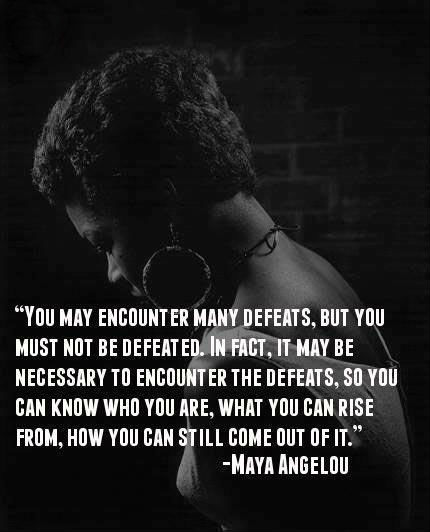
Welcome back to another episode of Writer’s Quote Wednesday on The PBS Blog as Hosted by Colleen of Silver Threading. This week, I take inspiration from Maya Angelou:

You-may-encounter-many-defeats

I still remember when I told my English teacher I wanted to be a writer in High School. Instantly her eyes blushed the same color of worry my mother’s does when she knows I want to do something that is near impossible. As nice as she could put it, she explained that I may want to get an additional job, you know, just in case. Little did she know however that I’d wanted to write books since elementary school, and nothing she said was going to change that. She’d explained how difficult it is for writers and I even had a glimpse of them portrayed in movies. Always the same story: a struggling writer who can’t make ends meet because no one buys his books.

Any author understands how extreme the challenges can be. It seems that if you wish to take on writing and publishing, then you must also wish to take on defeat and failure. But when I read this quote, I am reminded that many of the struggles we endure are necessary to erect a kind of strength, a gift, or a power that we didn’t know existed inside of us at all. If I had not gone through what I have in my life, I would never be as effective in overcoming similar stumbling blocks headed my way. But these struggles do more than strengthen the individual, they strengthen others. None of the education in the world can compare to experience. When you’ve been between a rock and a hard place you can encourage and inspire others with your testimony, same as Angelou has just inspired us here. So, like her, I’d advise this Writer’s Quote Wednesday:

When you encounter many struggles in your writing endeavors, understand that it may be necessary for you to encounter them so that you can find your voice and become stronger at what you do. No hardship seems pleasant at the time, but know that in the end it is for your benefit.

**************************

writers-quote-wednesday

Don’t Forget to check out Silver Threading to see how you can join the fun and support other Writer’s Quote Bloggers. Trust me, they’re awesome. You know what to do :).