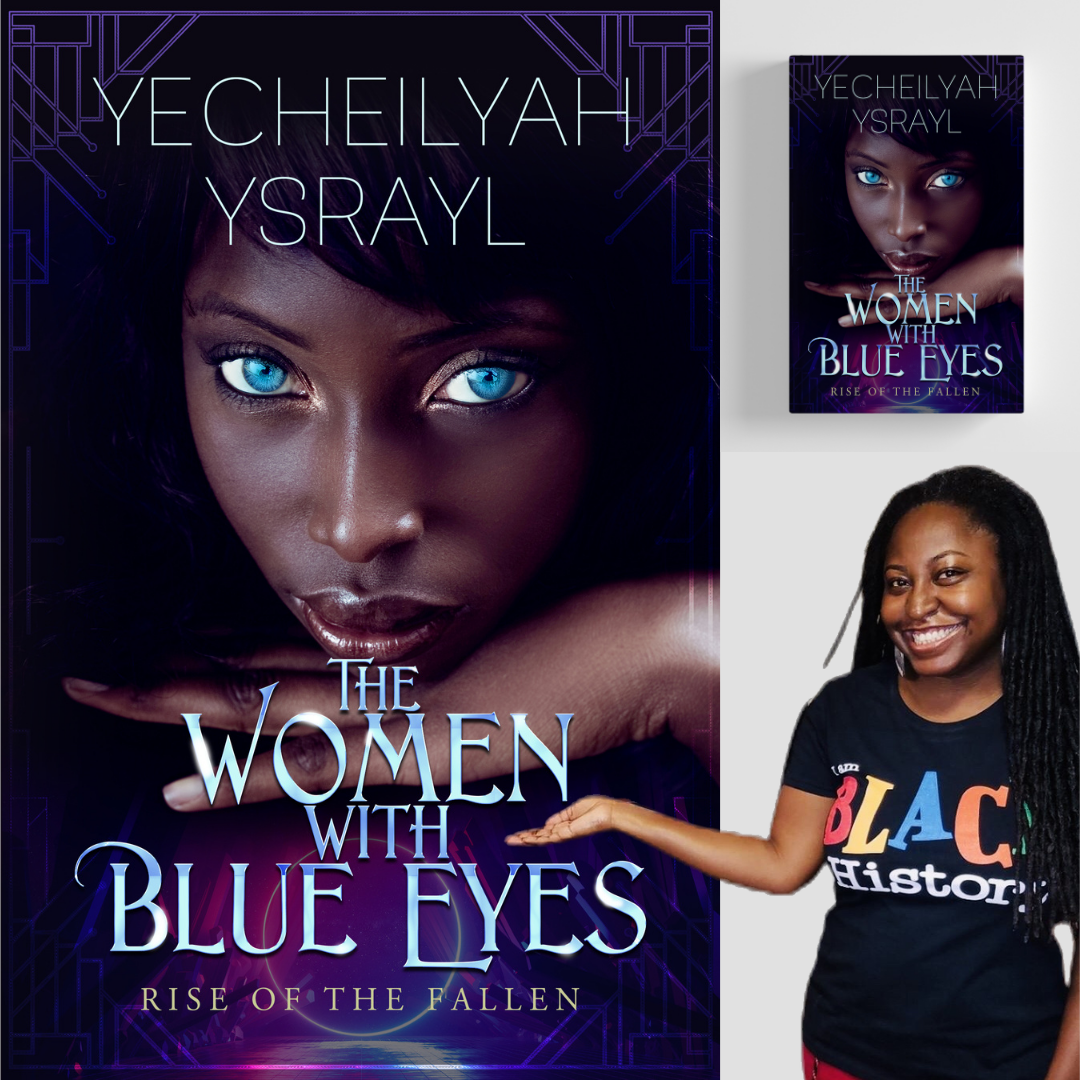
The Women with Blue Eyes:Rise of the Fallen is live!
About.
When Tina’s nephew, Ronnie is killed, she is left to care for his siblings and to solve a series of mysterious murders involving only black men. Investigating each murder thrusts her and her team into a world of deities, demons, and fallen angels, leading Tina to battle a serial killer beyond this realm.
“Paschar walked with confidence and held her head high as she moved her hips from side to side. Red was her most favorite color to wear with this skin. Something about the hue against this dark body is so different from her true form and more comfortable to navigate the Earth. Who wanted to be invisible to humans when it was easier to seduce them in the skin of a beautiful black woman? Passersby, men and women alike, looked, and Paschar smiled. They always stared. Humans were fascinated by blue, crystal pupils against such brown, creamy skin. In real life, Pas thought human bodies were disgusting. She hated the soft, gooeyness of the flesh, how it bruised and bled so quickly, how it fell apart and crumbled with each passing day. She hated the rotting meat on the bone, but she did come to love dark skin tones. Other pigments didn’t make her heart beat like melanin.”
– From Chapter 7, The Women with Blue Eyes: Rise of the Fallen
“Tina walked out of the door as her body trembled. She knew Big Sam had blue eyes, and Ronnie’s death was no accident. They had murdered her nephew, were back, and killing again.”
– From Chapter 3, The Women with Blue Eyes: Rise of the Fallen
We sold out of signed paperbacks on the site, but no worries! You can still order a paperback from Amazon. The next round of signed copies will be restocked soon! Be sure to bookmark my website below so you don’t miss it!
Without further ado, I hope you will enjoy my introduction to Urban / Contemporary / Black AFAM Fantasy Fiction.
About.
When Tina’s nephew, Ronnie is killed, she is left to care for his siblings and to solve a series of mysterious murders involving only black men. Investigating each murder thrusts her and her team into a world of deities, demons, and fallen angels, leading Tina to battle a serial killer beyond this realm.
Title: The Women with Blue Eyes: Rise of the Fallen
Title: Immersed in West Africa: My Solo Journey Across Senegal, Mauritania, The Gambia, Guinea and Guinea Bissau
Author: Terry Lister
Print Length: 159 Pages
Publisher: Book Power Publishing
Publication Date: August 29, 2019
Immersed in West Africa details the thrilling trip of one man’s travels through Senegal, Mauritania, Gambia, Guinea, and Guinea-Bissau. I love to travel, as anyone who knows me or has read this blog for any length of time will attest. We were unable to travel because of the pandemic, so it was enjoyable to learn about some less-traveled regions of West Africa from the author’s viewpoint.
We learn about Goree, the infamous island in Senegal with roots in the history of the slave trade. The island had twenty-eight slave houses and transported nearly two million people. We learn that the Maison des Esclaves (The House of Slaves) and its Door of No Return are museums and memorial to the Atlantic slave trade on the Gorée Island that they renovated in 1990.
I appreciated how honest the author was about his experiences as he traveled from one location to another. His accounts were complete, truthful, and thought-provoking in my opinion. Lister is honest about the aspects of his tour that did not go well for him, such as the native community on Lake Retba in Senegal’s Pink Lake (where the residents were pleading with him for money) and the difficulties he encountered entering Nouakchott, the capital of Mauritania. The abuse Terry experienced from the police is a story that black men and law enforcement hear all too often. It was unnecessary to make him wait, force him to the station, and inquire about his finances.
I learned from this that it is an excellent idea to guard against those who see you as a new face and try to take advantage of you. I commend the author’s courage because I would not want to travel from country to country alone, precisely because of situations like this.
Also, about the Pink Lake, the author explains it is pink because of its high salinity, second only to the Dead Sea.
We discover few people visit Mauritania because of its strict policy against alcohol and how Mauritanians love mint tea. I loved reading about making it as performed by a woman in Chinguetti. We learn desert homes use propane gas units that they carry from room to room. In Mauritania, we also discover that they use the sun to power their street lights and have installed solar panels to light up the streets.
If you are already intrigued, you will love this book as I have only scratched the surface of the author’s adventures. There is a lot to learn from someone’s personal experience that adds a seasoning that far outweighs looking it up on Google.
I love learning about how things are different in other countries, like the communal way of eating meals, sitting around a table or on the floor in a circle, and eating with your right hand, no utensils. I also did not know polygamy was legal in Senegal.
I cannot wait until it is safe again, and we can do some international travel. I might consider some places this author visited. I would love to taste the cold water he got to drink from The Terjit Oasis, where the water fell from the rocks!
To have your book reviewed on this blog apply here. The registry is open for a limited time!
Yecheilyah’s Book Reviews is a reputable review service that features writers from all over the world, both traditionally and independently published. We are listed on Kindlepreneur as a top-tier book review blog and Reedsy as one of their vetted active book blogs that provide insightful, excellent book reviews.
We have already talked about one cool strategy for busy bloggers. I want to extend that conversation by making it easier for those new to blogging to discern if what you are posting is valuable and high quality.
For the record, I am not one of those who think you have to post every day, not on social media and not to the blog. Wasted time is like wasted money, so I will not post or recommend posting just for the sake of posting.
We are not doing all of that.
What we are doing is posting consistently enough to be present enough to serve our audience.
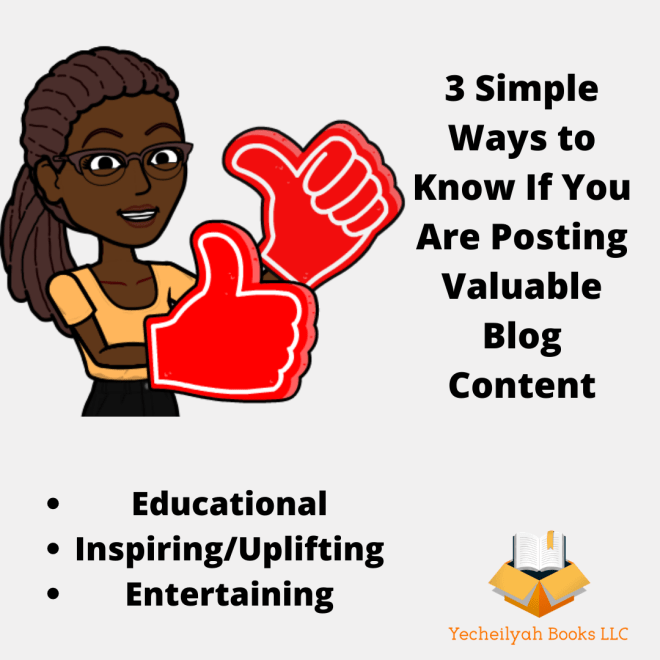
Whenever we post, we want to add value, and adding value only means educating, inspiring, or entertaining your people.
Educational
Inspirational/Uplifting
Entertaining
A fourth category could be Edutainment – Educating through entertainment. Thank me later.
To do this would mean that you must be deliberate about the content you publish.
What does this mean for blogging?
To be deliberate means to have an intentional and purposeful focus. It is the opposite of being fake and posting just to post. It means posting what is important to you and what is helpful, inspiring, or educational to others while somehow making sure it ties into your brand.
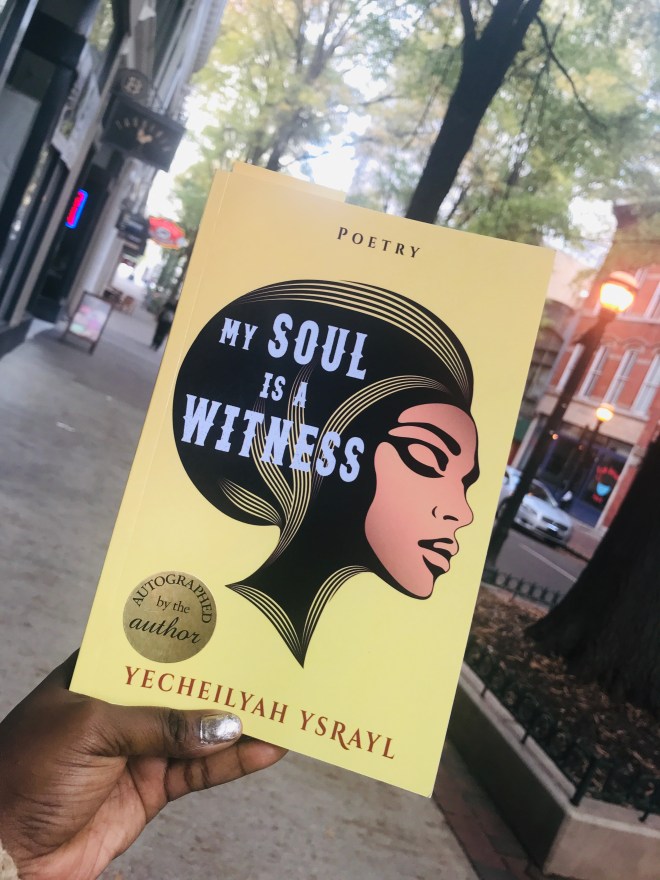
I published I am Soul on December 20, 2017. This was intentional, as December 20 is my late mother’s birthday. She was alive then, and I wanted the book to be a dedication because she had been through a lot that year.
I know value is a big buzzword these days, and sometimes it can sound so complicated, but it’s really not all that deep. Posting content of value means you are posting what will uplift, educate, or entertain. Some examples include:
Creative writing (poetry, short stories)
Promotion for Indie Authors
Posting a think piece on a hot topic
Sharing some life lessons and experiences (as it is relatable to your brand)
Posting a review of a book you read
Posting something funny
Blogging doesn’t have to be a waste of time, especially if you are not getting paid to be here. Suppose you are making money from your blog or using it as an author platform to connect with readers. In that case, you definitely don’t want to waste your time publishing ten posts a week that doesn’t add value to your life or the life of others.
Choose a few days a week you want to post and make sure you are entertaining, educating, or inspiring us.
Title: Daisy
Author: Pat Backley
Print Length: 190 Pages
Publisher: Pat Backley
Publication Date: October 8, 2020
I have not read a book I could not wait to get back to in a while. Daisy is one of those books.
Daisy is a historical fiction novel set between 1887 and 1974. Despite being brief, the prologue skillfully unites the entire narrative. In a flower field, a white hand is on top of a tiny black hand. Daisy chains are being made by the woman and the young child.
“Mum, why am I called Daisy?”
The author transports us back in time to that field of, Daisy’s with the same query from the little Black girl, starting in 1887 and finishing in 1974. It is set in Alabama, Harlem, and London. We will soon understand why she is named Daisy and why the hand on top is white.
The author’s strength here is her character development. Although there were many sudden tragedies, the author did such an excellent job with their backgrounds and personalities that the reader is genuinely interested in them and grieves their loss.
This is a family story, and I loved how the author tied everyone together with the historical backdrop. There are descendants of the enslaved whose lives weave with descendants of slaveowners and poor white Londoners the author interweaves with poor Black Americans’ lives. Witnessing the tension and wondering when everyone would meet was exciting. It was like reading about a generation of people all connected in a six-degrees of separation kind of way – that all people on average are six or fewer, social connections away from each other.
An example is when Samuel, Winifred, and Jeremey Davis, the Black family from Harlem, moved to London in 1952. Leading up to this, we have already met the white family in London (because the author starts in 1887 and moves time forward). Thus, the anticipation is already there as to which of Polly’s descendants will meet one of the Davis. Little Jeremy is five years old in 1952, but by the time he is an adult, he meets one of the great-great-great granddaughters of the London family, and they marry, giving birth to the little girl from the prologue.
It’s juicy ya’ll!
The reader is constantly reminded of the family’s history and how everyone is connected since the author recounts it throughout the story. The book’s main takeaway seems to be that whether you are rich, poor, free, slave, Black, or white, everyone is a member of the human family, which would function much more harmoniously if prejudices like racism, sexism, and classism were nonexistent.
“Being born poor was a scar that never faded.”
“She had never experienced racial hatred first hand, so had no real idea of how it could erode a person’s whole life.”
Plot Movement / Strength: 5/5
Entertainment Factor: 4/5
Characterization: 5/5
Authenticity / Believable: 5/5
Thought Provoking: 5/5
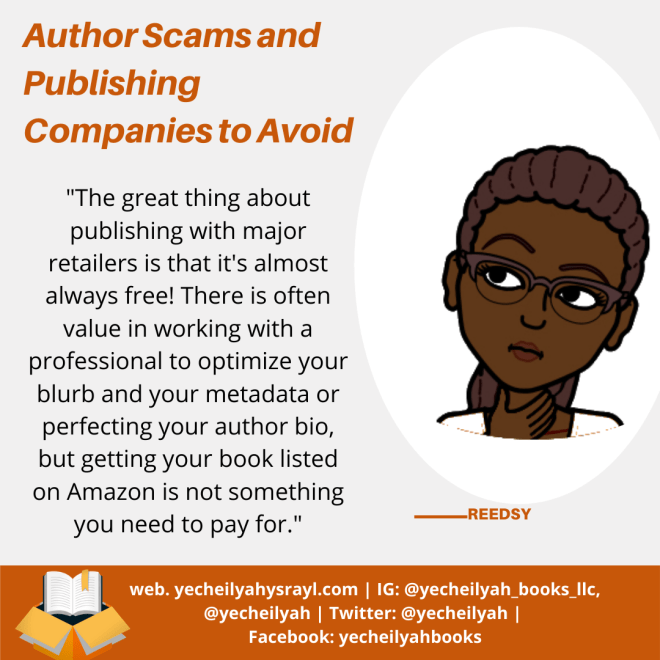
I came across this excellent article this morning on identifying author scams and publishing companies to avoid. Click on the read more here link below for the full article.
“The great thing about publishing with major retailers is that it’s almost always free! And unless you’re 100% technophobic, you shouldn’t have much of a problem uploading your book to Amazon or Kobo or Apple Books within a few quick minutes. There is often value in working with a professional to optimize your blurb and your metadata or perfecting your author bio, but getting your book listed on Amazon is not something you need to pay for.”
Today is Throwback Thursday, and I want to revisit the discussion over the ISBN. I have not given any Indie Author tips in awhile so let’s do it.
What is an ISBN
The short definition is the ISBN is a unique number used to identify a book.
The code captures information about the book’s publisher, title, language, edition, and version. The first form of the ISBN was introduced in the 1960s by Whitaker & Sons Ltd, the British National Bibliography, and the Publishers Association, who set up the Standard Book Numbering Agency (SBNA) British publications.
The SBA then became the ISBN (International Standard Book Number) in the 1970s. It is a group of symbols that identify each book title as a unique product. The number consists of ten digits divided into four groups, usually separated by dashes or spaces, each group having a specific function.
Magazines, academic journals, and other periodicals do not get ISBNs. Instead, they are issued 8-digit ISSNs (International Standard Serial Numbers).
Purpose of the ISBN
Image Cred. CanamBooks
The ISBNs principle purpose is to make the identification of any book possible.
ISBNs are not necessary for ebooks because Amazon will automatically assign the ebook an ASIN, Amazon Standard Identification Number. It’s a 10-character alphanumeric unique identifier that’s given by Amazon and its partners.
If you only intend to give copies of your book to family and friends, you don’t necessarily need an ISBN because you’re not selling the book. However, if you want to sell paperback and hardcopy books to bookstores, libraries and want readers to access it worldwide, you need the book to have an ISBN. Most retailers require ISBNs to track book inventory. Without an ISBN, you will not be found in most book stores, either online or down the street from your house. An ISBN is your first step to ensuring that your book is not lost in the wilderness.
Authors in the U.S. have two choices. Receive a free ISBN given by Amazon, Lulu, or POD (Print on Demand) of choice, or purchase an ISBN from Bowker.
Free ISBN
The advantage of the free ISBN is the author saves money. This is an option for new Self-Publishers just looking to get their feet wet. But while it’s easier to get a free ISBN, it comes with some disadvantages.
With a free ISBN, you are not technically the publisher of record. Amazon, Lulu, or whichever service issued the ISBN is the publisher.
Bought ISBN
In the U.S., getting your own ISBN is not free, and since each version of your book would need a separate ISBN (including if you want to change the book’s publisher, book title, or translate the book into a different language…authors also cannot reuse an ISBN), it can get costly.
But it’s worth it.
The advantage of owning your ISBN is that you own the rights to the book. You have control over the metadata of the book—the descriptions and categories that help libraries, bookstores, and readers worldwide discover your book and decide whether they want to purchase it. Buying your ISBNs and registering your titles ensures information about your book will be stored in the Books In Print database, opening up a world of possibilities that your book is listed with many retailers.
How to Get an ISBN
In Canada, the ISBN is free for Independent Self-Published Authors and Publishers who are Canadian residents.
If you are in the U.S., you should only buy an ISBN from Bowker, the ONLY official U.S. ISBN Agency.
If you plan to write multiple books, it’s best to choose the ten-block option as it is the most cost-effective than purchasing one ISBN. It also makes publishing the next book easier as you can now omit the cost of the ISBN from your budget for the new book.
If you only plan to write one book, though, you certainly can buy one ISBN. Do keep in mind that even if you are writing just one book, you may want to create several versions of that book (hardcopy, paperback), in which case the 10-block can still come in handy since you need a new ISBN for each version of your book.
What is an ISBN and Do I Need One?
An ISBN is a unique number used to identify the book and its data and sell hard copies worldwide. In the U.S., free ISBNs are an option but do limit the author’s ownership. No, you don’t need an ISBN for ebooks sold through Amazon because they will be assigned an ASIN anyway. And no, you don’t need an ISBN if you do not plan to sell the book.
Yes, you need an ISBN if you are publishing a paperback/hardcopy of the book, and you want the book to sell at stores, libraries, and be available worldwide. No, you do not have to purchase an ISBN through Bowker, but it is strongly recommended that you do so you can be listed as the publisher and reap the benefits of owning the metadata. No, you cannot reuse the ISBN, and yes, you need a different ISBN for each version of the book.









 The PBS Blog