I am stopping through to remind you I am looking for writers interested in submitting articles to this blog for my Black History Fun Fact Friday series. Below is a reminder of the qualifications for submission. Also, notice I have added a deadline to articles for Black History Month. There are four Fridays in February this year and so far we have one article submitted. This means there are only THREE slots left for those of you who want to get in for Black History Month. (This is not a Feb only opportunity, but a weekly one so don’t fret if a Friday in Feb is not open when you submit).
Because of the nature of this series interested writers must be Black/African American (this includes so-called Afro Cuban, Jamaican, Haitian, Cuban, Afro Brazilian, Dominican, etc.).
Must be original work. Do not copy and paste the article from other blogs unless that blog is your own. If you have a Black History article to share that you published to your site you are welcomed to submit it for Black History Fun Facts. I have no problem with that as long as it is your work.
Topics must be relatable to the history of Blacks/African Americans.
Articles must be emailed to me for approval at least one week before publishing. If you email your article on 1/31 for example, I will publish it on 2/7 if there are no needed changes. This series is not exclusive to Black History Month but if you want your articles published in time for February, please have them submitted no later than Monday, January 27, 2020. Writers looking for more exposure will be wise to try for a Feb slot. A Black History Article during Black History Month will naturally attract more readers.
Please send articles in a Word Document, 12p Font, Times New Roman text.
Please do your best to self-edit your work for basic typos/spelling/grammatical errors before submission. Grammarly andProWritingAid are good free self-edit software programs to use.
The BHFFF badge will be included in every post but you are welcomed to create your own image to add as well. Canva is a good program to use to make your own images. Unsplash is good for free images.
This is Black History Fun Fact Friday not Black History Opinions so do your best to submit articles covering accurate historical information. I will vet the submissions to make sure they do. If you have links to sources, please include them.
Please include a photo of yourself, social media handles, websites, or links to books you’ve written on the topic. This will be added to the end of the post as your call to action. This is where you give readers the chance to follow/learn more about you.
Benefits of Guest Blogging:
Increase traffic to your own website/blog
Build Relationships/Online Influence
Build Domain and Search Engine Authority
Capture Wider Audience
Develop Your Authority on a topic
Improve Your Writing
Opens the doors for paid business opportunities
The series is Black Historical so submissions should be articles detailing the history of Blacks in some way. You can talk about The Transatlantic Slave Trade, Enslavement, Civil Rights, Police Brutality, Medical/Educational discrimination, Black Power Movement, Inventors, Black Biblical History, and much more. Tell us about a little Known Black Historical Fact or introduce us to a little-known Black Historical person or place. (For example, I once published a post on Sundown Towns, all-white communities where Blacks were restricted from after Sundown).
Topics can vary as long as they cover Black History (this includes Jamaican, Haitian, Puerto Rican, Cuban, Caribbean, and Dominican.) Specifically, I am looking to feature full-length articles that inform and educate on some part of Black History at 300+ words or more. (Do not send a book, but make sure your article is at least 300 words. We want it long enough to inform but short enough to keep the reader’s attention.)
Email articles to yecheilyah(at)yecheilyahysrayl(dot)com
Questions? Comment below, use the contact form on the contact page or send me an email.
I couldn’t help but think about “Vision” on the Top Floor of the World Trade Center in Baltimore. The view is a beautiful layout of the city and the binoculars let you see everything up close. That’s what 20/20 is about for me, seeing clearly.
20/20 = Perfect Vision
At this time of the year, most people are talking about their wins but I believe it is my losses that have caused the most growth and given me the most lessons. It was the letdowns, betrayals, and disappointments that have cultivated in me the strength I’ve had to endure last year and all the other years before it.
Keep Yourself Full didn’t do as well as I had thought and while it bothered me at first, I can honestly say that as of today I’m okay with it. I’ve been Self-Publishing my books for a while now and what I’ve learned is that experience brings clarity.
Hindsight is 20/20 and what I see now are the mistakes I made with this particular book, the audience I thought would be there but wasn’t, and the solace in knowing that my poetry is inspiring enough.
A ‘Snellen chart’ is an eye chart that’s used to help you determine the clarity of your distance vision. Somebody with 20/20 vision has normal acuity (sharpness or keenness of thought, vision, or hearing) meaning if they were to stand at a distance of 20 feet from the eye chart, then they would be able to clearly see each row of letters. This person has good eyesight.
What’s being said is that if you look back at situations that went poorly, you can clearly see (20/20) what you could have done better.
This entire year is 20/20 which means a time of looking back and reflecting on all I’ve done. I know the word “reflection,” is being used a lot this time of the year so it may not hit you as hard but I caution you not to let its repetitiveness water down its powerful meaning.
Reflection is serious thought or consideration but it also shows, expresses, or is a sign of something and an image of something in the mirror. To reflect is to give serious thought and consideration to ourselves, the image in the mirror. It is to look at ourselves. What do we see? What are we showing or expressing?
My philosophy (for lack of a better term) is “do you but do you intelligently.”
I believed, and still, believe, we should not just decide, but that we should make informed decisions. From this point forward it’s not just about making decisions but knowing why I am making those decisions. It’s about being intentional in every way. From this point forward, everything I do has a reason. Everything is a strategic move. From publishing a book to publishing a post.
There are projects I will retire this year and projects I will relaunch. Looking back, I can see clearly what works and what doesn’t work for my writing business.
I am flawed and imperfect. I will mess up but I am striving every day, learning, and correcting as I go along (with all the failures and pitfalls that come with it). I know these losses can do nothing but make me stronger, and wiser so that when I look back, there is nothing to regret.
The losses taught me to focus the first time around and to trust my discernment so I can see things for what they are, not for what I want them to be. The losses are a reminder to see things clearly.
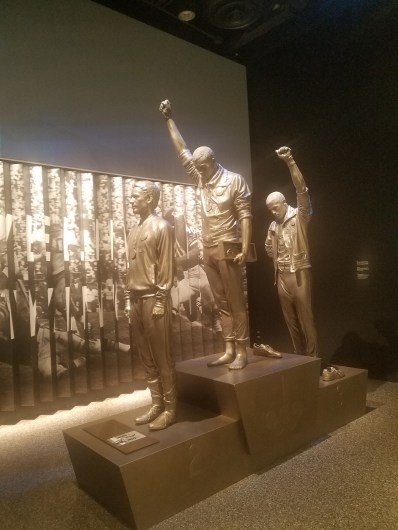
Go to my IG page here to check out more vacation pics at some awesome museums including The Smithsonian Museum of African American History and Culture. Visit me on the web at yecheilyahysrayl.com and subscribe to this blog for notification of more posts.
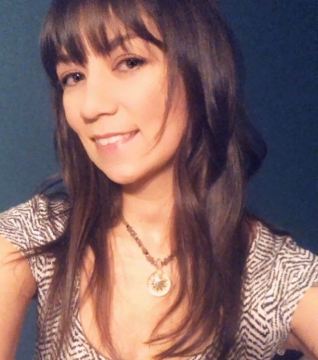
Chanelle’s passion for writing poetry stemmed from an early obsession with song lyrics, reading and discovering the benefits of journaling. Inspired by poet/songwriters such as Jim Morrison, Jewel and Ani DiFranco, she began to find her voice, which has evolved immensely throughout her life experiences.
Over the years, she has shared her work via several blog names and has experimented with the art of spoken word. At times, she’s veered away from writing a bit to work on other creative endeavors but poetry has always been a staple and a place of healing.
More recently, she has moved her focus and research towards storytelling and activism through elements of performance and slam poetry. With this new venture, she hopes that others can relate to her stories and be inspired to start writing and sharing their own.
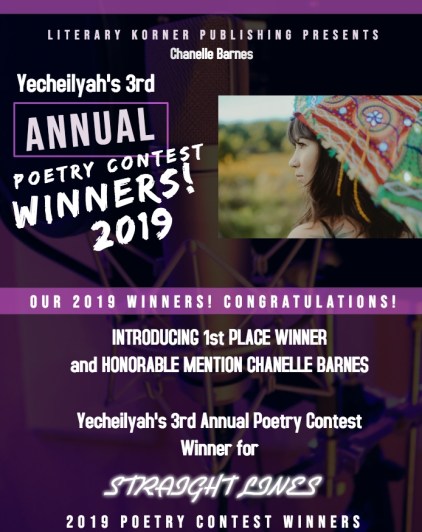
Your piece “Straight Lines,” won this year’s contest and your second submission “My Body Isn’t a Temple,” is an honorable mention. Please, what inspired these poems?
Straight Lines – This piece was a work in process for quite some time. As I struggled through some self esteem issues I began to delve into a different style of writing and healing. This was one of the first poems that surfaced. Soon after, it was performed at a poetry reading and has since been one of my favorites and most meaningful to date. As with all of my writings, I hope that others can relate and find the courage to overcome their insecurities as I did. (even though it is still a work in process)
We are all a work in process chile. I know I am lol. Tell us about “My Body Isn’t a Temple.” I know the title got some people like what? Ya’ll gotta read the poem though! It’s not what you think.
This piece was inspired by the Me-Too movement. So many people stood up to share their stories and I was finally able to voice mine. It was important for me to aid in bringing forth awareness towards such an important issue. I believe survivors and I am proud of them.
Chanelle!! Welcome!
As the grand-prize winner you get a full interview so go ahead and get comfortable. Can I get you anything? Coffee? Tea? Water…wine?
If it’s that kind of party, some wine sounds perfect!
Yass! Here you go!
Okay. Let’s start from the top. What is your name and where are you from?
Chanelle Barnes -Fort Wayne, Indiana
What would your perfect writing / reading room look like?
Somewhere cozy with a fireplace, plants, sunshine (but no too much), lots of pillows, a record player and inspirational artwork. There would be large dormer window with a seat that overlooks an abundant forest.
Nice! That sounds really comfortable. What is the most annoying habit that you have?
I have a habit of being self-conscious and at times, too modest.
What job do you think you’d be really good at?
I think I would be a good travel blogger! Or… perhaps a wedding planner.
I can actually picture you doing both those things. Any siblings Chanelle?
I have two younger siblings, a brother and a sister. They are amazing.
Awwue. Tell me, what skills would you like to master?
Acro Yoga & Ballroom Dancing! I would also love to hone in on public speaking. No matter how many readings I do, I’m still terrified!
What would be the most amazing adventure to go on?
I’ve always wanted to go to Australia, but I have also been wanting to go to a Wellness Retreat somewhere exotic! I also want to take a train ride across the states sometime.
I feel you on the public speaking! Chanelle, what is love?
Love is being your true self. Love is comfort. Love is not giving up but also, love is blind.
If you had unlimited funds to build a house that you would live in for the rest of your life, what would the finished house be like?
My finished house would include a balcony, porch swings, fireplace, a scenic view (preferably with water), a winding staircase, a greenhouse, a large art room, a guest suite for my friends to visit whenever they’d like, a claw foot bathtub, secret passages, lots of plants, pets, a room with a glass ceiling and a telescope to view the stars and an abundance of color.
Let’s talk about writing a bit. Why is writing important to you?
To heal, inspire and release.
Having dealt with trauma at an early age (and being very shy/ introverted) I found writing to be the only way that I could sort out my thoughts and feelings in a way that made sense. Through journaling, poetry and music I felt I wasn’t alone. It wasn’t until much later, did I decide to share my writings publicly. It was at this point, that I realized I could not only express myself in this art form, but also inspire others to write and heal as I did.
Who’s your favorite writer?
Right now, I am really feeling the spoken word artist Kyle Tran Myhre (Guante). He has been a huge inspiration as I move more towards spoken word and event planning. I also have been relating to and enjoying work by Rudy Francisco and Ruby Dhal.
Love Rudy. Just finished his Helium Audiobook. Good stuff.
You said you are moving toward Spoken Word. How would you describe the difference between spoken word poetry and written poetry? How are they similar and how do they differ?
To me, I feel that a spoken word piece is better portrayed when performing and it is written as such. I also feel they tend to be a little more raw. There is more that can be expressed when using tone and body language. With written poetry, it is up to the reader’s imagination to determine the tone and flow which is also satisfying. My spoken word pieces are typically stories and my written poetry is more based on feeling and emotion. I hope that makes sense!
It does! What’s the most difficult thing about being a writer? The most exciting thing?
The most difficult is being vulnerable.
The most exciting is painting a picture with words and words alone.
It takes a lot of courage to put yourself out there to the world, but it’s also one of the most exciting!It’s kind of like inviting others into your soul and like any art form, putting yourself out there for criticism or judgement. It’s a risk worth taking though.
I like to compare poetry with music. You know when you hear a song and it makes you feel a certain way? When you hear lyrics and you can relate or they speak to you even though you really don’t know what the songwriter was thinking when they wrote it? It’s like that. Creating an image or story for the reader or listener to take with them. It’s all about twisting words into a feeling. In the words of Maya Angelou, “I’ve learned that people will forget what you said, people will forget what you did, but people will never forget how you made them feel.” It’s so true!
That’s one of my favorite quotes! Speaking of music, we love music on The PBS Blog. What kind of music do you like and what songs have you completely memorized?
I love all kinds of music! Mostly, I listen to music with lyrics that make me feel something or beats that make me want to dance or relax.There are many, but the first one that comes to mind is Carnival by Natalie Merchant.
Chanelle, what takes up too much of your time?
Working two jobs and taking care of my home. I wish I had more time to work on writing and other creative endeavors.
I feel you. What do you wish you knew more about?
The human mind.
What about the human mind do you find most interesting?
I’ve delved in quite a bit when I was studying for my psychology degree and I think that’s what jump-started the desire to learn more. What I’ve been most interested in is social psychology, dream analysis and mental health. The mind is like an ocean and there are so many parts left to discover!
What’s your favorite drink?
Hot Tea.
Okay Chanelle. You know I gotta mess with you. Tea is supposed to be hot lol so what’s your second favorite drink?
Haha, okay that’s fair. Let’s see… I would say my second favorite would have to be this glass of wine I’m having.
Heey. Here, let me refill that for you.
Thank you.
While you sip, favorite color?
Purple
If you could live in a movie, which would it be?
Across the Universe -I think I lived through the 70’s in a past life.
Chanelle, I am all about self-care and self-love. What do you love about yourself?
Resilience. My ability to rise up against anything that gets thrown my way. This life isn’t easy, but I have my strength and experiences to guide me.
Love it. Speaking of self-love, what is love?
Love is being your true self. Love is comfort. Love is not giving up but also, love is blind.
Most people think of love only in terms of “romantic” relationships and when I ask what it is, most people give me a definition based solely on that so I love that you defined it outside of that box.
I do have to ask though, you said love is blind, what does that mean?
To me, it means accepting flaws and feeling a deeper connection within the soul. In other words, it is felt, not seen.
What is truth?
An unbiased sense of self, void of outside influences.
Thank you Chanelle!
Be Sure to Follow Chanelle Barnes below and look out for both her pieces, “Straight Lines” and “My Body Isn’t a Temple” in the 2nd Edition Lit Mag Literary Magazine, 2020.
Be sure to follow @literarykornerpublishing on Instagram and Facebook for notification of the release of the 2020 Edition Lit Mag Literary Magazine for Poets where you will get to read our winning poets pieces in full AND the poems of everyone who entered this year’s contest! Be sure to also subscribe to this blog.
My one and only classic 1976 original version of Roots: The Saga of an American Family
It took Alex Haley 12 years to finish Roots: The Saga of an American Family, known widely as simply, Roots. The book shot straight to the top of the bestseller charts, and the twelve-hour mini-series (Jan. 1977) was watched by 130 million people. They translated the book into 37 languages; it won a Pulitzer Prize and National Book Award, and sales soared to over 5.5 million.
This was not without controversy. No success story is. Haley had to settle a plagiarism suit out of court—that part of his story was copied from a 1967 novel, The African (The Guardian). It was also said there was no documented evidence that the alleged elder he spoke to in the Gambia had been accurate in his account of Kinte. Critics said that if Haley had written Roots as a fiction novel, there would not have been a cause for alarm. “Most of us feel it’s highly unlikely that Alex actually found the village whence his ancestors sprang”, Henry Louis Gates Jr said in 1998, calling Roots “a work of the imagination.” (But if you listen to Haley here, his story is very detailed. It is also consistent with many of his other interviews and speeches about the story of how Roots came about. This is hard to do if you are lying).
Roots is now part of history and the original 1977 TV series awakened a new generation of young Blacks to the horrors of enslavement when movies and television shows about slavery were few and far in-between (both in books and film). While it may seem an over-saturated topic now, in 1977 this was groundbreaking.
Enslaved persons had little knowledge of what Haley referred to as “family continuity.” They were sold so much that as adults they came to know little about their family lineage, where they came from and who they were. Roots was therefore something special because Blacks had come out of the Black Power movement of the 60s, had just seen the deaths of Medgar Evers, Martin King, and Malcolm X. Roots was not just the story of one man’s family but the family of all Black people who had been taken captive and robbed of their family tree and any connection to it. It would become a history lesson, a recommended educational film that Black parents will watch with their children with just as much seriousness as their parents forced them to watch The Ten Commandments. Some would even name their children Kunta Kinte.
After Roots, Octavia Butler used time travel to explore slavery in Kindred (1979), Alice Walker used an African subplot (Nettie’s life in Africa) in The Color Purple (1982) which also went on to win a Pulitzer and National Book Award, and Toni Morrison made a fugitive slave her protagonist in Beloved (1987). Beloved was voted the most influential African-American novel of the 20th century in a poll of PBS viewers. But as Frances Smith Foster has pointed out, “in terms of actual audience and effect on politics and policies, Roots has been the most influential such story in the modern era.”
As I listened to the entire 2hours of the clip linked above, I wondered why I was doing this when I had (seemingly) much more important stuff to do. That is until I came to the final hour and fifty something minutes. Here, Haley speaks about how the father’s name the babies at eight days old. In the villages, the people would not see much of the father for seven days because he was spending time with the baby to come up with a good meaningful and significant name. On the eighth day the people would gather at the family’s home. The mother would come out once hearing the signal and sit on the stool and hold the eight-day-old baby. The father would walk over, lift the infant, and whisper the name into the infant’s ear three times.
He would do this so that the infant would be the first one to know who he/she was. This resembles, to me, the ancient practice of circumcision of the male child, and naming of the child, in ancient Israelite culture (Gen 17:12) which I believe is also Black culture. For example, the Ashanti Empire was a powerful Akan empire and kingdom in what is now modern-day Ghana. Ashan was the name of a city in southern Israel. The word Ashan in Hebrew means “smoke” “smoke city” or “burning city” so that Ashanti means “the people of Ashan or the people of the smoke city”. This was a reference to the city of Ashan after the Israelites took it over during the conquest of Canaan (1 Ch 4:32, 1 Ch 6:59). The Ashanti people had many Hebrew customs and traditions as part of their way of life. For eight days after the birth of a child, it is only on the eighth day that the child receives his/her personal name.
It was here that I had discovered the purpose of my listening to this piece in its entirety. I believe this to be such a powerfully subtle telling of who we, so-called Blacks in America, truly are. For the customs of the Hebrews is something that can still be found among many African cultures such as the Ashan.
Roots is a powerful example of why we shouldn’t give up on whatever we are striving toward. It inspires me as a writer and as a person of the fruits of patience and of perseverance. While Roots has had (and continues to have) much success, remember that it took Haley 12 years to complete (one whole year from Kunta’s birth to capture… which could be a book by itself).
Think about that the next time you worry about that book taking too long to finish.
I spent most of September reflecting on my writing and spending time with family. I’ve got tons of unfinished manuscripts in need of work and truth is they are hard to finish. I do not mean hard as in difficult to write. I mean hard as in finding the joy in publishing them.
I have felt bored with the monotony of publishing books. The support doesn’t feel the same. The blog doesn’t feel the same and now, even Self-Publishing doesn’t feel the same.
I am always writing, and I love publishing but I’m no Terry McMillan with millions of readers lined up to read my next book or any other author with multi-city tours lined up to guarantee that the next release will provide a change in routine. I do not mean this to sound pessimistic.
I am not giving up on publishing but those of you who have been Self-Publishing for a while may understand. No real change can get tiring. I have felt like King Solomon when he said, “the making of many books has no end and much study wearies the flesh.” (Ecc 12:12)
I feel myself transitioning to a level I do not as of yet fully understand.
Last week, the revelation came and while I know it’s not the only revelation on its way to me, it’s one I think important enough to share.
Growth is uncomfortable.
This is an exciting phase and every day I am reminded of its promise. Just recently a media specialist contacted me for something I cannot speak on at the moment. These kinds of moments provide me with the proof that I am not going crazy and that perhaps my name is being uttered in rooms I have not walked into yet.
Growth is like strength. It doesn’t feel you are being strengthened when you are in process. It doesn’t feel like growth when it’s happening. It feels uncomfortable and uncertain. I can feel myself changing in a way I never have before. I can almost reach out and touch it.
The next time you feel uneasy and uncomfortable, consider that perhaps, you are growing. Evolving. Blooming.
A little discomfort helps us to grow. The feeling is not fun, but it’s a big part of improving our personal development.
“Routines may make you feel at ease and in control, but what a constant routine really does is dull your sensitivities. Think about the times in your life when you’ve driven the same route repeatedly: after a certain number of trips, you start tuning out most of it. Have you ever had a trip to the office where you barely remember what happened after you got in the car? If you don’t get out of your comfort zone, you might find yourself tuning out much of your life on a daily basis. (Sujan Patel Former Contributor Entrepreneurs, Growth Marketer & Co-founder of Web Profits)
To keep from tuning out, I had to stop and think real hard about why I was feeling such discomfort and then I had to accept it, even as I watch people become distant and even as I strive to overcome my own limited thinking.
Brain research shows that putting yourself in new and unfamiliar situations triggers a part of the brain that releases dopamine, the “happy,” chemical. That part of the brain is also said to only be activated when we experience new things.
I don’t want you to think this post is about quitting. This isn’t about quitting. This is about allowing ourselves to grow/level up.
It is tempting to want to revert into that state of normalcy, to remain as we are. It’s easy to go through life unchanged out of fear that this new version of us won’t be accepted or that someone may accuse us of no longer possessing the same moral integrity as before. And how can we not think this way? We’ve been well-trained to think newness and change are inherently bad.
This is not the truth. Not all change is bad and since all change teaches us something, perhaps even change we perceive as bad is not so.
In the words of Maya Angelou, “We delight in the beauty of the butterfly, but rarely admit the changes it has gone through to achieve that beauty.”
Few people enjoy the feeling of being uncomfortable and as we are now a few months away from 2020, time will not wait for us to catch on. My challenge for this month and the rest of this year is to get past that initial feeling of wanting to return to the norm, so I can grow and benefit from that discomfort.
This is an informative post for any writer looking to use blogging to build an author platform. I have said this before (but hey, who am I?) that blogging consistently is possible without taking away from writing and publishing books.
Blogging is part of your branding; if you are confused about your branding, you will be confused about what to blog about. Think about it: if you knew exactly what you were going to write about each week, how much easier would that be? – Rachel Thompson
Even if you are not being paid to blog it is still helpful to helping you to find more readers (which helps you to get paid kind of indirectly). Readers and authors I’ve met through blogging are still among my biggest supporters.(Blogging consistently also helps you to…wait for it…grow your blog).
Below are three links. Two are from Rachel Thompson and the other is an older article I published to this blog three years ago on how blogging between books has been helpful to me. (read more articles on blogging from me on the Blog Tips page). Enjoy.
I enjoy networking with readers, other authors and business people present at conferences and festivals. One of the many ways I have access to these opportunities is through vending. Today, I would like to share a few of the pros and cons of author vending.
What is author vending?
To put it simply, author vending is when authors partner with an organization to reserve a space where they can sell their books/services/products, usually at a book festival or conference. Vending is not new and is something other businesses do all the time. The benefits of vending are numerous but there can also be some challenges for Independent Authors. As usual, I base this on my own experience which may very well differ from other authors.
Con: Financial Risk
“Consider the benefits and risks to your business when deciding to exhibit your product or service. These will be different for each event. Choosing the wrong trade show to exhibit your business’s products or services can result in displaying to the wrong audience. Poor promotion can mean the costs of attending the trade show outweigh any revenue you gain.” – Business Queensland
When you are a vendor, it means you have paid to reserve a table at an event where you will sell your books/products/services. Sometimes these costs can be very expensive. The authors must be careful not to “overpay to play.” I’ve seen tables costs as much as $600. This money could easily go toward good editing or the publishing of another book entirely. Authors should consider that not only will they reserve a table, but they will also buy books and author swag for the table and travel to the event. Before saying yes to vending, consider the financial benefits and potential challenges. Ask:
Do I have enough funds to cover books, attendance, display and other associated costs
Have I worked out how many prospects and readers I will need to obtain to generate a return on my investment
Have I researched/visited/asked questions about the event at which I am contemplating exhibiting and am I confident that a suitable number of people will attend
Have I worked out a way to capture people’s attention (*This is important. I see a lot of authors at expos looking down at their phones or just looking bored. They sit at the table for the entire time and rarely communicate with the people walking by. Then, at the conclusion, these same authors are upset because they sold no books. The people are not just going to come to you. Chances are you are not famous and no one owes you a thing. Stop being lazy, get up, and represent yourself.
Any author who wishes to be a vendor must be sure to research the event, understand what is included in the package, and know what they are looking to gain from the experience. If the goal is only to sell books, the author(s) should consider hosting something at their local library where the table is free or collaborating with other authors to cover the price of the table.
The primary purpose of vending (as I have found it) is the chance to network and get your name out there. It is a discoverability strategy, not neccessarily a profitability one (except if you have a large platform already). While an author can sell books, how many books are sold depends on the strength of that author’s network. More on that on the next con point.
Pro: Networking Opportunity
“Face-to-face communication builds the most memorable brand awareness. Last year our expos had hundreds of people walk through the door. Expos centralize a local audience that will be most receptive and ready to learn. This might be a rare occurrence for your industry depending on where you are geographically. You’ll have an opportunity to connect with new people and reconnect with those already invested in your brand.” – Peter O’Donnell, 4 Key Benefits of Becoming a Vendor
One of the major benefits of being an author vendor is the chance to network with individuals you probably would not have met or had the chance to speak with before. It is a chance to get your name out there in the public and expose your brand to people face-to-face. Last year, I spoke with the owner of Acapella Books in Atlanta when I was shopping my books around bookstores. First, he denied stocking my book, but he told me why and while it hurt my ego, I had to listen to sound advice:
“Your book will only get lost among the hundreds of celebrity authors’ books in the store. The best thing you can do right now is to get your name out there. Are you attending the Decatur Book Festival?”
I told him I was. I wasn’t a vendor, but I would be in attendance. He said good and to start there. He told me to “focus on building your platform and getting your name out there.”
Conferences and Book Festivals attract an array of media depending on the host of the event. You have the potential to meet editors, agents, publishers, celebrity authors and corporate influencers.
I don’t care what the experts say, online will never be as good as face-to-face contact and connection. Giving your readers a chance to meet you in person adds a special kind of value. “People see the truth in you through your actions, personality, and in how genuine you are with them.” (Greg Dabbs, Business Development Manager) They get to hear your voice, see your face outside of photos, ask questions, give advice, laugh and get to know you more personally.
The chances of pitching are significantly higher when you position yourself to be present at these events. You get to practice your sales pitch, research competition and increase the chances of collaboration opportunities. It is not all about money. At a decent rate vending can be the boost you need to jump-start your business. Financial investment in yourself is something you will need to consider in your career at some point anyway. Whether that is vending at a notable event or paying for professional author photos, it is something you will need to do at some point.
It is about showing up and being an author vendor is one of the easiest ways to show up, to get out and connect with people.
Con: Difficult for New/Unknown Indie Authors
Author vending is the opportunity for you to connect with your readers. It gives them the chance to meet with you face-to-face, to take pictures with you, to buy paperback copies of your books, or to have books signed they already bought. But it could be even more challenging for new/unknown Indie Authors.
“No one will come to your book reading/signing unless you are already famous. The packed author readings on the news are only packed because the author is already very well known. Book readings at bookstores are among the worst uses of time for a new author.” – Writing Well
While I don’t believe you have to be famous to do a book signing/reading for people to support you (I do well at signings and I am certainly no one famous), there is some truth in this quote. While the chances of people buying are higher in person because physical presence increases trust, authors who have multiple books out and who have already built a strong platform and audience before vending will do much better. People will already know who they are, and readers will come out to support them.
Paying money to reserve a table at an author event when you are a new author no one knows, when you have done no work to promote the event to your audience or where you have not built an audience will be like posting your Amazon buy link on social media hoping people will take a chance on an unknown author. While some people will (I usually do but I’m nice like that 🙂 ) this kind of “Hope Marketing,” rarely works. Vending is usually not free, and the money is usually nonrefundable. If you can’t at least make the money back you spent on the table, it is not worth it. Not if selling books is your only aim.
Before you spend money on reserving a table, focus on publishing more books and developing a relationship with your readers so that when you do an event people will come out to support you. Now do not misunderstand me, a first-time author can certainly do well at signings and events but only because that author already have people who are willing to support him/her from previous works.
I read somewhere that “the reward for a job well done is the opportunity to do more,” (Dr.Jonas Salk). The biggest benefit to author vending is that eventually, you will not have to look for opportunities. Opportunities will find you. It was at the Atlanta African American Book Festival that I was asked to participate in Velvet Voices, The Velvet Note Jazz club’s new and first Author/Word event. People will remember you and reach out to you for other projects. They may even ask you to be a vendor at another event. This is significant because once people reach out to you, the ball is in your court. You get to decide the terms of your acceptance. Can your table be free of cost/discounted? Can they pay you to speak? Can they purchase your ticket if the place is not in your home city/state? What is it you require for your presence? The idea here is to one day graduate from vending alone to being requested and paid to speak as well.
This is the beginnings of earning the passive income you want to help to leverage the income from your book royalties. These days, you need the additional income that comes from other streams of income related to your writing.
You may not think people are paying attention, but they are. Author vending is a great way to give a very good first-person impression that can lead to an even bigger opportunity and business partnership.
Pro/Con – Organizer / Host
It is important to ask, who is the organizer/host? The person(s) behind the event is a big deal. You want to make sure the organization or cause is something you can get behind. Vending is a big deal these days and it shouldn’t escape authors that it is also a way for businesses and organizations to make money. Choosing to be a vendor is not just about meeting new people and exposing your business, it is also about investment. Vending is an investment in yourself and an investment in the company or organization hosting the event.
The people behind the event can make this a Pro if the organization is well organized, grounded, relatively known and actively promoting the event and its participants.
The people behind the event can make this a Con if the event host is unorganized, the event is poorly promoted (bad for you if you paid for a table and are looking to turn a profit) and does little to nothing to promote the event and its participants.
It is not about jumping on every so-called opportunity available to authors. It is about being strategic and intentional with every decision you make regarding your book business.
When you are asked, invited or when you take part in a vending opportunity, be sure you connect with an organization that is relatable to the goals and the purpose you have set for yourself, that the vision of the organization is something you can support and rally behind and that they will work just as hard for you as you intend to work for them. Vending is a partnership and partnerships are not one-way streets. Or at least they shouldn’t be.
Major Cons
Can be costly
Challenging to sell books for new authors with no audience
Can be overwhelming
Can sometimes go downhill
Every marketing platform has advantages and disadvantages. Don’t let the disadvantages of author vending discourage you from participating in exhibitions and reaping the benefits of it. Just do your research first.
Major Pros.
Exposure to a wider set of audience
Creates brand awareness
Increases credibility
Promotes brand loyalty
Helps in Networking
I know vending is like the It thing to do now but drinking from every cup of “opportunity” is how you get poisoned. Understand the pros and cons first and be sure to research the organization hosting the event.








 The PBS Blog