Dear Writers, A Quote Worth Remembering

“By writing and publishing your book, you have the potential to touch many readers. The possibilities are endless of how your story can positively affect others, whether it’s an entire town or just one person. It’s through stories that we connect to others. So keep writing, you never know how your message could change someone’s life.” – Nicola Gibbs

www.theliterarykorner.com
http://www.theliterarykorner.com

The Art of Storytelling

storytelling

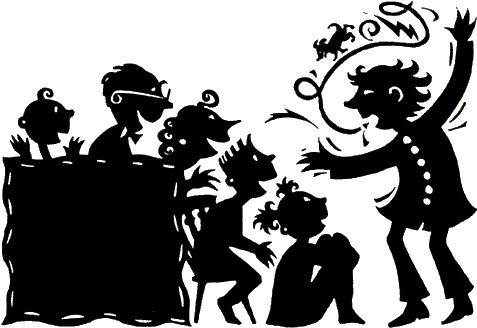
When I think of storytelling, a familiar image creeps into my mind: an elder with the strength of several generations. Eyes covered with glasses slightly tilted off the nose, they nod slowly to the beat of a rocking chair. Their hands and knees are stiff with arthritis so it is rubbed continuously as the history of whatever crawls out of their mouth. And when it does, our ears jump with excitement, wondering how a single individual can be so vivid with detail. The story is told from somewhere down south under the roof of an inherited home, one passed down from generation to generation. A place where even the oldest relative once had his/her diapers changed, a place to always come back to and call home. A house in the countryside or a peaceful place in the city.

Storytelling has been around forever. It predates writing and has proven to be one of the oldest and most effective ways to relay a message. Stories have been shared in every culture for education, cultural preservation, entertainment, and for instilling moral values.

One of the characteristics of storytelling that makes it so powerful is the colorful expression as showcased by the orator. The tone of voice, gestures, creativity, and speaker’s point of view. I always enjoy a good sit down with the elderly in that I may relive moments to which I had not existed. Even in my mind, as I pass an elder on the street, I cannot help but fathom what today’s world must look like through their eyes. It is a silent and private game between that person and me. Quickly and excitedly, I create a background for them. Did that old Black lady experience Jim Crow? What was it like for her? Did that old white lady experience the first integration of schools? What was it like for her? As you can tell, it is why I love writing historical fiction. It is like getting inside a time machine and blasting myself into another world.

As I remember I was one day standing under a foyer at the Veterans Hospital waiting for my husband. Moshe. It was raining out so I was careful to keep under the hood of the building. An elderly white man came walking out of the building. His back was slightly hunched as he glided from one step to the next. “Is it still raining?” he asked, more so to the air than anyone in particular. “Yep,” I said looking into the sky. As he walked away, muttering a phrase under his breath I’d never heard but cannot remember accurately enough to share, I wondered about his youth and about how he would compare today’s world to the one he grew up in. Did he think the direction of things had bettered or worsened? I wondered.

Storytelling is a means for sharing and interpreting experiences. Stories are great teaching tools because, like love, it is a universal language. Universal in that they can bridge cultural, linguistic, and age-related divides. Although my image of the storyteller is that of an elder, storytelling can be adaptive for all ages. It can teach ethics, values, and cultural norms and differences. Books and organized / structured schooling are one way to acquire information, but experience has taught us that social environment and physical contact with others greatly benefit learning. It provides real-life examples of how knowledge is to be applied. Stories then function as a tool to pass on knowledge in a social context.

And since art is defined as the expression or application of human creative skill and imagination, storytelling is also a form of art, producing stories to be appreciated primarily for its emotional power and for the beauty in which it is told.

Good Poetry

creative-writing-hero-bw

“Good poetry could not have been otherwise written than it is. The first time you hear it, it sounds rather as if copied out of some invisible tablet in the Eternal mind than as if arbitrarily composed by the poet.”

– Ralph Waldo Emerson

If These Walls Could Talk

Wall

They would scalpel the mask off your face
Pull back the deception bleeding from your eyes
And reveal how dark you really are.
A slave to the ignorance pulsing from your mouth
Cloned imagination
Words bending, tainted by the cold lashes of society
Originality lying desolate
The inability to bring forth substance
Meat
And bone
Without nourishment
No cultivation
Of the mind
If these walls could talk
they would verbalize the truth
that you starve of love
dish out hatred
but cannot take it
glossed over and hidden beneath a poetic lyric
you love blindness
infatuated with the concept of searching your face in the shadows
chasing tails
finding no where
and understanding none at all
it is easier to be real
than to be mask
a lesson too many have not yet learned
what kind of life really exist inside the pen of a poet?
The things they would tell
If only these walls could talk
And you know what

they do.

Why We Write

writing-skills

Forget about birthing masterpieces, but when you sit down to write, understand your purpose for doing so. Think of nothing else. Un-expectantly you will stumble upon a work of art. Only, do not think of art. Think only of the ambition to write the story. As for the story itself, the drive will take you there.

Singapore and Turkey

Tomorrow is the last day of our International Shout Outs before the weekly wrap up so if you want me to rep your country stop by the PBS Blog! Our love goes out today to our viewers in Singapore and Turkey. Thanks for stopping by! Do come again.

#InternationalViewerAppreciation #IVA

2012_Flag_of_Singapore_Photo