Author Identity: Urban Fiction

Earlier this week, I had the pleasure of reading a reblog to an original post I had not seen until then. After promptly liking both the reblog, as published by Whitney of Write, Live, and Love and the original as published by Ja’da of quizoticmuses (who I do believe also has a book out on Amazon), I felt compelled to reply in a separate post so that my commentary was not limited to the comments section of her blog. I thought the post served as a great conversation starter, and I do encourage others to tune in if so inclined.

But before throwing in my two cents here’s the original (used with permission):

“As a writer, I have come to understand that in every capacity the term “urban” is synonymous with “Black people.” I don’t want to be an urban fiction writer; I want to be a writer. But I’m Black writing about Black people and not exclusively Black people drama. So I feel like I’m automatically fitted into the urban fiction slot when really, I just want to write fictional stories. Period.

How do I get there?”

There are certain words that, although can be applied to various races of people, pretty much is a reference to black people depending on the context. Words like Urban, and Minority, to name a couple. Specifically, the term “Urban” is no doubt a crafty way of saying “Black” and Urban Fiction then is used to denote black fiction.

What attracted me to the post is that as a person who speaks often concerning the state of Black America, Black history, its ancient origins, slavery, freedom, and as someone who is deeply passionate about writing about Israelites or so-called blacks, for blacks, our history, and culture, I must say my writing has never been deemed Urban Fiction. This revelation caused me to think that maybe the characterization of Urban Fiction is a bit deeper than being a black writer writing about black people in general but that it is also about the style of writing.

Writing Styles

“Style is the way writing is dressed up (or down) to fit the specific context, purpose, or audience. Word choice, sentence fluency, and the writer’s voice — all contribute to the style of a piece of writing.”– Google

As I began to think about my own reading experience with UF, I am hearkened back to books that have a certain tone and feel to it. These books tend to follow a certain writing style. Though they do tend to deal with the internal struggle of the African American experience, it’s the way that these books are written that makes them different. Personally, my characterization of Urban Fiction books is based upon the language, setting, and overall surroundings incorporated into the book.

This led me to consider that, though I do find it is exclusive to the black community, Urban Fiction is a label applied to a certain kind of writing that not everyone can do. Everybody can’t write good Urban Fiction books, especially people who have not lived the life they are creating for their characters. Urban Fiction is a unique genre. While you can research for Historical Fiction and Romance or Thriller, if you write a UF novel, you had better have lived that life or be familiar with the setting in some way or it will fall flat. It will read fake.

Black Lit or Urban Fic?

What makes Toni Morrison’s “The Bluest Eye” Black Literature and Tracy Brown’s “Snapped” Urban Fiction? Just by looking at the covers alone we can see that they are two completely different kinds of works, though they are both written by African American female writers about African Americans.

5337019 thebluesteye

Both books are relevant in black society. Both are truths concerning black family life, struggles, and both contain black central characters. So why is Brown known as an Urban Fiction writer and Morrison a Fiction writer? Both are very talented and though Morrison is most prominent, Brown is no less valid. The classification has to do, I think, with the individual writing styles. The overall message of the book itself and the direction in which it tends to expand conversation.

I often find that black writers who write with a passion that is rooted in that hardcore truth concerning black family life, if its raw, uncut, up close and personal, then it is often labeled Urban Fiction.

Believe it or not, this is a conversation that many are already having. Bernice McFadden, the very talented author of nine critically acclaimed novels including SugarLoving DonovanNowhere Is a PlaceThe Warmest DecemberGathering of Waters (a New York Times Editors’ Choice and one of the 100 Notable Books of 2012), and Glorious, has already coined the term, “seg-book-gation”. She argues that black books are lumped into an “African American Literature” category instead of typical genres like General Fiction.

Personally, I see nothing wrong with the separation and encourage Blacks to embrace being such a set-apart people. Nothing we do is going to be normal or traditional because we are not a normal people. We are unique, creative, soulful, we are the salt of the Earth.

Triangle of Sins; Alibi and Midnight: A Gangster Love Story; Diary of a Street Diva; No Disrespect, A Street Girl Named Desire; The Coldest Winter Ever, these are all titles that represent Urban Fiction or “Street Literature” because they focus on the internal struggle of growing up Black in the Hood. They are books that are written in such a way that it captures the personal truths concerning the life many African American’s live and that’s why we love them so much.

These are books about what I like to call, “The Curses” or the struggles blacks have had to endure for centuries now. It is prophecy fulfilled and the gritty reality is what makes them appealing to the Black community.

In closing, Author Identity is all dependent on the mindset and thought processes of the author and who they are. Because Black people set the trend in a host of areas, Urban Fiction and Street Lit is another spin on the norm that African American’s have contributed to. Black people have always been the creators of what is different, creative, or uniquely separated from tradition. If Black writers of fiction are labeled Urban Fiction I believe its more so because of the uniqueness of the work itself. Urban Fiction is not just a genre, but it’s a different way of writing. So whereas one person can write about Blacks and for Blacks and never be looked at as an Urban Fiction writer, the same may not be true for someone else because their styles are different.

(Also, because reading is a HUGE part of writing, people tend to write how they read, what they experienced (or experience) in everyday life, and what they’re most knowledgeable or passionate about.)

Gabrielle Gorman’s “Dear America”: When You Don’t Love the Skin You’re In

Touching. Thank you Shannon for sharing.

Shannon Luders-Manuel's avatar(not) Mixed (up)

On December 8th, I attended the 2015 My Hero Awards, in order to watch my dear friend Kayla Briet win the Emerging Artist Award for her work in film, music and technology.

While Kayla’s work always mesmerizes me, another award recipient named Gabrielle Gorman brought me and many others to tears with her experimental film “Dear America,” for which she won the title of 2015 Student Honoree.

CTkPzWWVEAEKub8 Photo courtesy of the My Hero Project
I just watched the live stream of Kayla’s film screening at the National Young Arts Foundation in Miami, and Gabrielle’s film screened shortly before hers. Watching it again made me question why this film touched me so personally. After all, Gabrielle’s film is about not loving herself as a dark-skinned black youth. She candidly discusses how she wanted to bleach her skin and lessen her large lips–how she wanted plastic surgery to look more…

View original post 339 more words

Writer’s Quote Wednesday – Nelson Mandela

Is it Wednesday? Indeed it is and that means another episode of Silver Threading’s Writer’s Quote Wednesday. I am so excited to be back! For those of you keeping in touch you know I took December off so I have not done a WQW since November! Soooo what better way to resurface than the first WQW of the year.

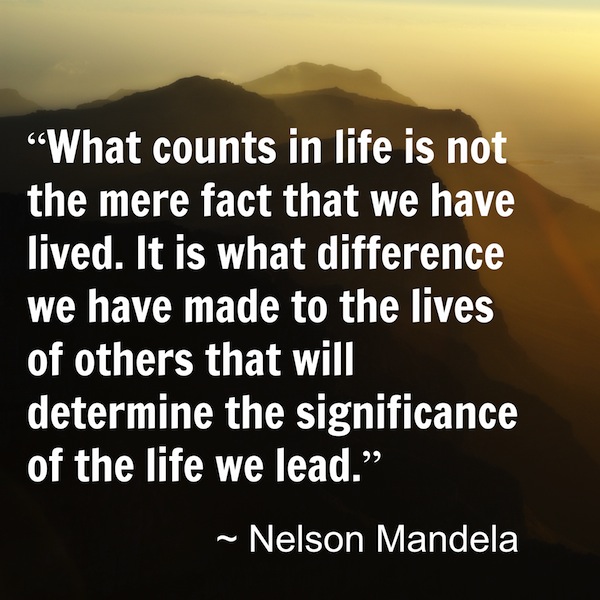
Let’s get started. Today’s quote is from Nelson Mandela:

NelsonMandela-quote

I truly believe that how you treat others play a big part in the life that you live. More than our individual goals and ambitions is how we are wiling to share pieces of ourselves with others that will truly determine the kind of people we are. If we have fed the hungry, encouraged the lowly, or given a kind word to the sick. In short, if we have loved. If we have looked out for others the same as we would look out for ourselves. After the sun slumbers and the dust settles, this is most important. Not so much how important you are, but how important you have made others. The light that you instill into their lives after the goals are realized and the dreams fulfilled. Did you keep what you’ve learned to yourself or did you share it? More so than share it, how much have you multiplied? At the end of the day my passion rest with providing for others to the extent of my ability. If I can change the life of one person with my books, my words, and the life that I live then I have done my job. I believe no earthly possession is more noble.

About the Author:

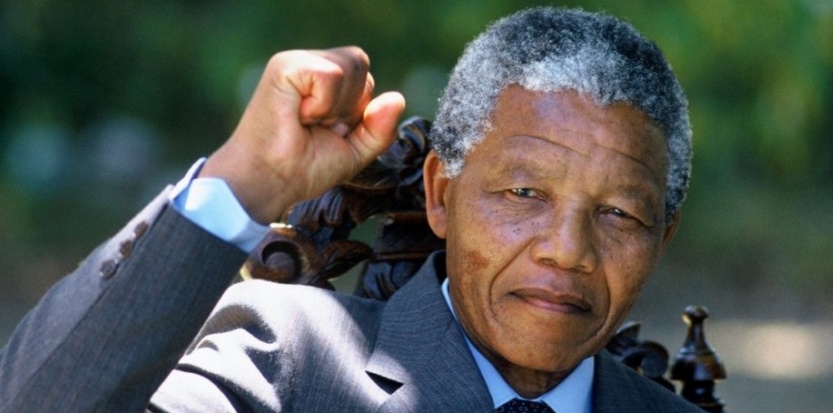
5583290-la-sante-de-nelson-mandela-s-ameliore-selon-la-presidence_zps83dd9590
Nelson Mandela, 1918 – 2013

South Africa’s first black President, Nelson Mandela was born Rolihlahla Mandela into the Madiba clan in the village of Mvezo, Transkei, South Africa on July 18, 1918. In 1930, when he was 12 years old, his father died. Hearing the elders’ stories of his ancestors’ valor during the wars of resistance, he dreamed also of making his own contribution to the freedom struggle of his people.

Born of royalty, the son of Chief Henry Mandela of the Madiba clan of the Xhosa-speaking Tembu people, Nelson Mandela renounced his claim to the chieftainship to become a lawyer. He attended South African Native College (later the University of Fort Hare) and studied law at the University of the Witwatersrand; he later passed the qualification exam to become a lawyer.

On May 10, 1994 Mandela was sworn in as president of the country’s first multiethnic government. He established in 1995 the Truth and Reconciliation Commission (TRC), which investigated human rights violations under apartheid, and he introduced housing, education, and economic development initiatives designed to improve the living standards of the country’s black population.

****

That’s it for this weeks segment of Writer’s Quote Wednesday. Be sure to check out the quotes from other blogger participants.

010516_2129_writersquot1

:Random 11:

Ja’da posed a great question. I think this is an excellent conversation starter. With her permission I would love to use it as a catalyst for a separate post in which to give my thoughts on the answer to this question. My comment would just be too long.

4everQuixotic's avatarquixoticmuses

As a writer, I have come to understand that in every capacity the term “urban” is synonymous with “Black people.” I don’t want to be an urban fiction writer; I want to be a writer. But I’m Black writing about Black people and not exclusively Black people drama. So I feel like I’m automatically fitted into the urban fiction slot when really, I just want to write fictional stories. Period.

How do I get there?

View original post

Winter’s Here

DSCN0124
EC and Major Rhonda Reagor Johnson, New Mexico Military Institute, Roswell NM, 1-3-2016

After a steamy summer season and an autumn just as cool and laid back as the stride of a black man winter finally showed up on my Louisiana door step. First of all the trip to New Mexico was dangerously exciting as the snow storm ripped through the little town and pretty much showed it whose boss. Tiny snowflakes, all beautiful and delicate, proved beyond the shadow of a doubt that size and appearance mean nothing. Those miniature beauties piled one on top the other until we were knee deep in snow. Having endured the rigors of Chicago winters my whole life it was refreshing to see snow again albeit under such conditions. The roads were nothing short of a mess, as if a group of children had taken the opportunity to experiment with slush and dumped it on the tops of buildings that now moaned the loss of roof tops and shingles. Cars were doomed but not even the average pick-up truck could sustain the beast that tore through this small town that is usually not equipped to handle such weather. New Mexico was in a state of emergency and we were smack down in the middle of it. (You risk takers you!) The fog was so thick that you couldn’t see in front of you, like when steam takes over the bathroom after a hot shower and blocks your view of the mirror. We had to slow down and eventually stop on the way over it was so cloudy. You’ve never seen the sky milked like this before.

In any event, by this time last year Shreveport had already seen a splash of snow so we half-heartedly expected to come back to warmer weather. That is until I stepped out the car early this morning, when the sun is still hiding behind the clouds and many of you were calling hogs in your sleep, to the bitterness of the air.

“Well, then. Good morning winter. Nice to see you again.”

Blackdom: The First All-Black Settlement in New Mexico

Blackdom_NM

Many of us are familiar with the Greenwood Community of North Tulsa Oklahoma where blacks built the most prominent community of their time. Deemed “The Golden Door” of opportunity for blacks, the dollar  in “Little Africa” circulated 36 to 100 times, sometimes taking a year for currency to leave the community, hence its nickname “Black Wall Street” along with “Little Africa” before its systematic destruction that left it torn and desolate. But it wasn’t until my trip to New Mexico this past week that I discovered other communities that are also worthy of inclusion in Black Wall Street’s Hall of Fame.

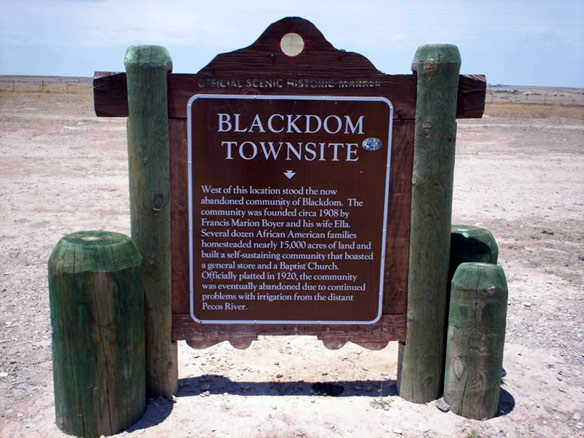
Blackdom

4078441393_62652786a6

Blackdom was a little known African American community about 18 miles southwest of Roswell New Mexico and was founded by Frank and Ella Boyer. Walking 2,000 miles on foot from Georgia to New Mexico, Boyer left his wife and children behind to cultivate land in the free territory of the West before sending for his family some three years later. At this time in history Blacks had begun migrating from the south in great numbers in a movement called “The Great Exodus” following the Homestead Act of 1862, particularly in Kansas. According to a 2001 archaeological study on the Blackdom region from the Museum of New Mexico, “During the decade of the 1870s, 9,500 blacks from Kentucky and Tennessee migrated to Kansas. By 1880 there were 43,110 blacks in Kansas.”

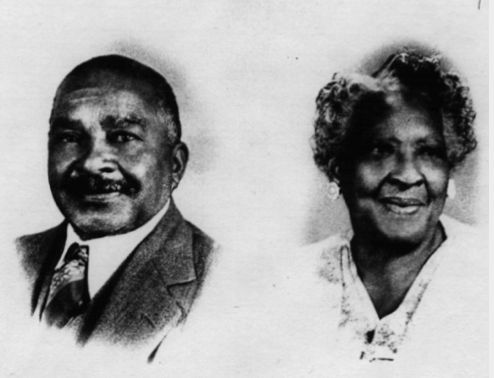
4078441937_d7e66a1164FrankandElla

The Homestead Act gave room for former slaves and free born blacks to reside in the West regardless of race. Here was an abundance of land, free and fertile to anyone who could keep it up. Influenced by W.E.B. Dubois and Frederick Douglass according to historians, Frank was a graduate of Morehouse University and a teacher of Black History which at this time was not very popular. He met his wife, Ella McGruder, a graduate from Haines Institute in Augusta, Georgia, at a teacher’s summer school session. The couple had four children (three sons, one daughter) when Frank set out for New Mexico in 1896.

4078441545_71ab054267

The desire and influence to build community was first conceived in the mind of Frank’s father, Henry Boyer, a free man. Henry was a wagoner in the American-Mexican war when he first set eyes on the New Mexico land. When he came home, he told stories to his family of the land. Growing up during the Reconstruction Era, after the Civil War, Frank naturally grew up with his father’s dreams in his head and saw the West as the Promised Land to a new start. Ironically, the same life force that made Blackdom thrive as a community was also its downfall. The Artesian Water sprang in abundance as more and more blacks were invited and nourished on the land. Blackdom had its own school, and post office. However, the Artesian Wells eventually dried up and citizens were forced to move to nearby cities such as Roswell to continue their lives. The Boyer family were the last to leave.

David-Profitt-house-a-typical-house-in-Blackdom-New-Mexico_1

After Emancipation, in theory black people were free. They were released from the physical chains of bondage. This freedom however, much like sharecropping, said that one could be self-sufficient by earning a profit, but by the end of the year the amount of debt incurred was a reality check concerning the freedom, or lack therof that actually existed. In the same way, Emancipation didn’t mean anything for a people who continued to suffer spiritually, financially, and mentally from the trials of chattel slavery. For this reason, not all blacks settled to continue occupation in the South but many of them invested in the hard work that slavery demanded and sought to use those skills to work their own lands and build their own communities. These stories fascinate me because it is a part of black history that is rarely, if ever, told. Not all blacks endured economic struggle and poverty after slavery but some, if only for a moment, maintained an air of economic dependency and not only succeeded, but prospered in the process.

2015 Annual Report: The PBS Blog

4034761-120875522_3-v1I want to take this time to officially wave goodbye to 2015 with the presentation of our WordPress Annual Report. I’m so excited about how we did and most grateful to all the people who helped us to achieve our goals. Last year I didn’t dare share my data! Yea, it was that embarrassing. But that’s good because it means this blog has shown tremendous growth and I hope to exceed its numbers at the conclusion of 2016. Until then, here’s an excerpt of how we did:

“The concert hall at the Sydney Opera House holds 2,700 people. This blog was viewed about 16,000 times in 2015. If it were a concert at Sydney Opera House, it would take about 6 sold-out performances for that many people to see it.

Where They Came From:

138 countries in all!

Most visitors came from The United States. United Kingdom & Canada were not far behind.

Busiest Day

The busiest day of the year was November 25th with 140 views. The most popular post that day was If Your Blog Was a Resume

Top Commenters:

http://silverthreading.com
http://seasonedsistah2.ccom
https://rebirthoflisa.wordpress.com
https://jmdleflore.wordpress.com

**

I decided not to publish the entire report for personal reasons but I hope you are inspired by our sneak peek. Thank you for spending this time with me and I’ll see you soon.

Peace & Love

– EC