On Fear

I don’t exist out of thin air.

I didn’t just pop up out of nowhere teaching this through Google and YouTube University.

I teach this because I’ve lived through it.

And, while much of what I discuss is well-known on the tail end of 2023, it wasn’t when I first started. Self-publishing has been around for ages, but Print-On-Demand was new, and no one was talking about it, let alone their journey.

Without that first book, there would be no I am Soul or any other book.

I self-published my first book in 2010, and it was trash.

But I was 23 and unafraid.

There is something to be learned from young people.

The content was good, but the production was poor.

I knew nothing about editing, book cover art, or proper formatting.

Every mistake that could be made by self-publishing a book, I have made it and then some over the years.

But even though the book was far from perfect, I still sold copies. And even though I didn’t know what I was doing, my youthfulness had armed me with the boldness to put it out there anyway.

“Take the risk or lose the chance.”

I remember being at my in-laws house in Memphis. My husband had told my nephew:

“You can do anything if you believe it. You can climb that wall if you wanted to.”

Do you know what this five-year-old did?

He proceeded to climb the walls.

The fact that he could fall had never crossed his mind. And if it did, he didn’t care.

As we age and experience the brutality that is sometimes this life, we become more afraid.

This causes us to overthink until fear paralyzes us into not taking action.

And now, we are afraid to move forward because we are afraid to fail. In many ways, this also means we are afraid to learn!

“The fear will become your weakness if you don’t overcome it.” – Yecheilyah

I cannot say if I would have taken that leap of faith, the proof of what is not seen, had I known everything there was to know about book publishing. It would not have been perfect enough for me.

The most insightful lessons you will learn is through doing the work.

Don’t let overthinking paralyze you into not taking action.


Check out more Indie Author Basics articles here.

Preorder Your Copy of Black History Facts You Didn’t Learn in School Here!

http://www.blkhistorybook.com | 2.24.24

The Best Advice is Lived Experience

Photo by Ivan Samkov

I saw an Ad on Facebook where the person was telling authors that selling their books on Amazon is a waste of time and that they should sell directly from their website.

And, if you buy the course for $89.95, he’ll teach you exactly how to do it.

Be careful with this kind of advice.

It’s not even that it’s bad, but it is unbalanced.

Questions.

How many people visit your author’s website monthly? Not your blog, your static author website?

How many author websites do YOU visit regularly?

When you think about a book you want to buy, what is the first thing that comes to mind?

For me, the answer is not from the author’s website but from Amazon, and if I am going offline, I am hitting up Barnes and Noble or my local Independent bookstore.

Photo by Ivan Samkov

I have always advocated for author websites because they allow authors to track leads.

You can collect data to keep in touch with readers, like email addresses and phone numbers—something you can’t do through Amazon, which doesn’t show who bought the book. You only know if that person leaves a review.

But I wouldn’t consider Amazon a waste of time when they are the number one go-to for people looking to buy books.

This person’s perspective lacks balance. Authors can have books available through their websites and on Amazon. Also, consider everyone’s journey is different:

  • Some authors need help to afford or do not want to pay for a website, which requires buying a domain name, paying for e-commerce, and the percentage your cart of choice (say Stripe) takes out of every transaction. Meanwhile (at the time of this writing), setting up an Amazon Author Central page is free.
  • And some authors prefer to add a website outside of Amazon to track leads because they understand that a book is a product. And individuals don’t have products; businesses do. These authors see the value in their books not as the end but as the beginning of a thriving and profitable business, and businesses have websites. 

What I Recommend:

The best advice is lived experiences, and I recommend that everyone do what feels right with their souls. Otherwise, we risk stifling an author’s creativity and rob them of the opportunity to learn.

  • To increase traffic to your static website or landing page, promote it. Let people know the option to buy directly from you is available. Offer your books as signed copies and throw in some book swag. People do buy from author websites if you let them know.
  • Use your blog as your website. Because they are updated often with posts, they get much better SEO and traffic than static sites. You can set it up for free right here on WordPress. You don’t have to buy a domain unless you want to. (I did because I’m extra, lol.) It is also a great way to build community.
  • If you opt out of a website, set up your Amazon Author Central so you can send people there to buy your books and follow you. People who follow you on Amazon will get an email the next time you publish a new book!
  • Experiment! Test things out. Take risks. Sometimes we don’t know what we like because we’ve never stepped outside the box. Let experience be your teacher.

Poetry Myth: “I Have to Perform My Poems to be Relevant.”

One of the MAJOR misconceptions about the poetry industry is that you have to do spoken word to become a prominent figure.

Performance poetry might be the most popular, but there are other ways to be profitable.

Artists like Rudy Francisco, Jasmine Mans, Prentice Powell (who was recently nominated for a Grammy), Obbie West, and others are dynamic spoken word artists I could listen to all day.

But it is not something I am passionate about doing myself.

I enjoy spoken word and have done it, but I don’t want to make a career out of performance poetry.

I am much better at reciting than performing, and I have learned there is a career in them both.

Reciting and performing poetry are two different areas of expertise we can discuss later.

Poets, let me free you today!

  • You can write and publish poetry books.
  • You can recite your poetry before an audience instead of performing it. In the same way that spoken word artists get paid to perform, you can get paid to recite!
  • You can get paid to write poems for others, organizations, and even movies. Think Poetic Justice. Maya Angelou wrote the poems Janet Jackson’s character Justice recited in the movie.

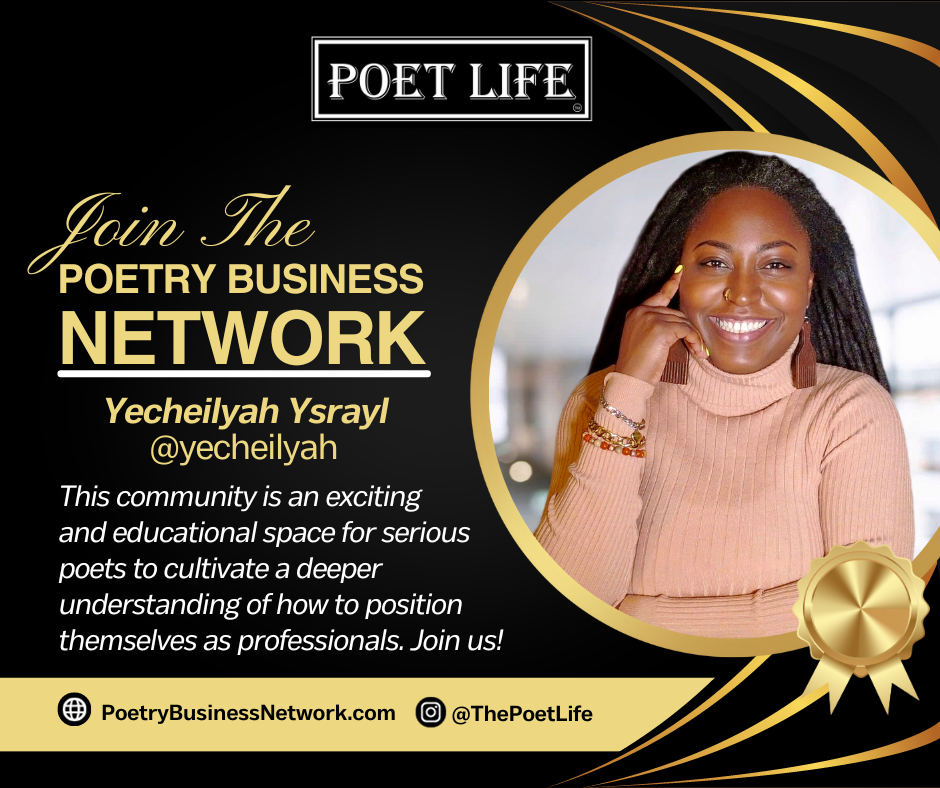
If you are serious about turning your passion for poetry into a profitable business, I invite you to join The Poetry Business Network.

The Poetry Business Network is a global community where poets learn how to do more with their poetry and create a poetry career.

In this community, you will learn…

  1. How to transform yourself from an individual to an entity (business)
  2. How to start your poetry business step-by-step
  3. How to launch your poetry business step-by step
  4. How to audit your poetry business (if you already have a one)
  5. How to build your brand on a national and international scale
  6. How to identify what services to offer
  7. How to create predictable income with your poetry
  8. How to create, offer, and distribute your own merchandise
  9. How to determine what signature experience you will be known for
  10. How to create your own platform people will be attracted to
Join Us!

And the best part? Membership is FREE (for now! Get in before that changes).

Visit us online at The Poetry Business Network to join.

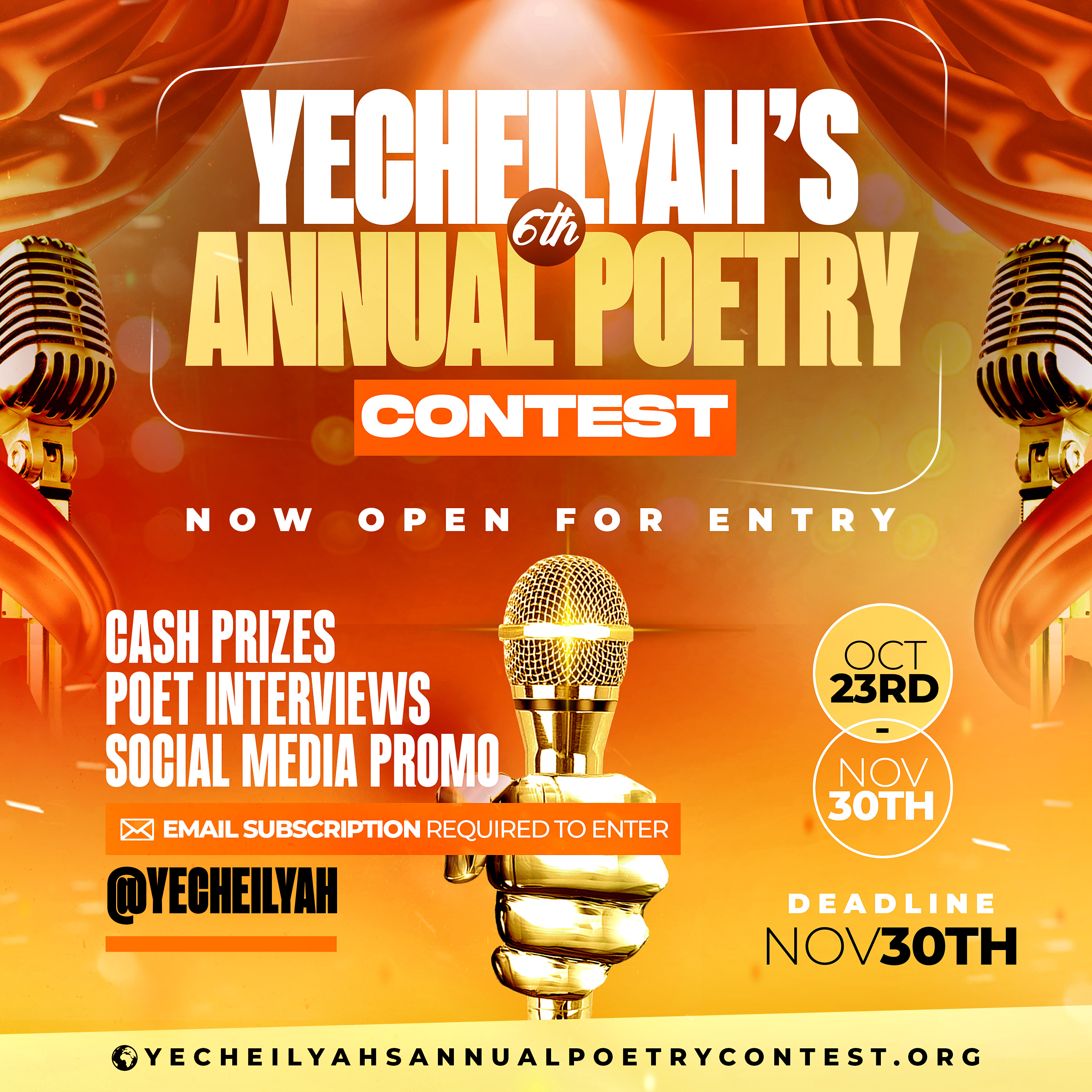
Submissions for this year’s poetry contest is coming to an end soon! Get your poem in on or before Thursday, November 30th!

yecheilyahsannualpoetrycontest.org

Join Our Past Winners!

338

Yecheilyah’s 1st Annual Poetry Contest Winners 2017

Yecheilyah’s 2nd Annual Poetry Contest Winners 2018

Yecheilyah’s 3rd Annual Poetry Contest Winners 2019

Yecheilyah’s 4th Annual Poetry Contest Winners 2021

Yecheilyah’s 5th Annual Poetry Contest Winners 2022

We Get Better at Writing by Writing

When I was a child, I always carried a diary, journal, or notebook, and I would write about what was happening in my life each day, with dates and everything.

When my cousin got jumped so badly that one side of his face was swollen, I wrote about how terrifying it was to see him like that.

When I graduated eighth grade, but my twin sister didn’t, I wrote about the guilt I felt for having to leave her behind and how nervous I was to start High School by myself.

I wrote everything down, from the boys I had a crush on to the ways my mom and aunts pissed me off. (I was an angry kid.)

It is why I can tell you what my thought process was like on Tuesday, September 11, 2001, because I wrote it down.

I can still feel what it was like watching the Twin Towers collapse like a dissolving palace of snow and what 14-year-old me was thinking at that moment.

I can tell you I was dumbfounded and full of nerves. I had never seen anything like this before that was not in a movie. And they were saying now we are going to war.

War? Will large army tanks cover the streets? Will soldiers greet me at the door? Will I ever go back to school? What does war look like on the soil of the United States? The only wars I knew were my own.

“God bless America,” I scribbled.*

*I laugh at that now, but I was so serious back then, lol.

I didn’t know it then, but I was doing something powerful.

It didn’t really sink in until I was an adult, but writing regularly allowed me to develop writing abilities and maintain my goal of being a writer by keeping it at the forefront of my mind. And even if my friends and siblings dabbled with other careers and hobbies as I grew older, my objective remained constant.

I was to be an author.

We can read all the books and blogs…

Follow all the writing tips and advice…

Listen to all the podcasts…

But the only way to improve at writing is through practice, and the only way to practice writing is to write.

The Amazon Bestseller Approach: A Warning

In the words of James Baldwin, “If I love you, I have to make you conscious of what you don’t see.”

Here’s the Game:

Once upon a time, when print-on-demand publishing became more popular thanks to companies like Amazon and Lulu, self-published authors discovered a powerful manipulation tactic: they could reach a higher ranking by reducing their ebooks to 99 cents and getting all their friends to buy them, skyrocketing their books to the #1 spot.

And before you knew it, tons of Self-Published books, both excellently written and mediocre alike, hit the Amazon Best Sellers List. Some authors even put the sticker on their covers.

It was an exciting time…

…for a few minutes.

Most of these authors stayed at #1 for a maximum of a few hours.

Over time, their book sales continued to plummet until the next book, where they repeated this strategy: setting the price to 99 cents and telling all their friends to buy it.

The problem with this is it caused many Self-Published authors to lust after that pretty orange tag, even if it only lasted for a few minutes.

They’d refresh their browsers repeatedly to see where the numbers are.

When I first put I am Soul on preorder at 99 cents in 2017, it was #7 on Amazon’s Best Sellers list.

But I had only sold five preorders!

Chile, my bank account was dryer than a Popeye’s biscuit.

It looked good on the outside, though, and I was technically a bestseller on paper, but I wasn’t making any money.

By focusing on more organic ways to sell my book, I became a bestseller on and offline.

It wasn’t until I started to shop my books offline and talked to the owners of bookstores that I truly understood how little being an Amazon Best Seller meant to the outside world. I focused my efforts on getting my name out there and increasing my reviews, and this helped me to become an Amazon Best Seller the organic way.

I was also selling out of brick and mortar bookstores and I didn’t have to beg my family and friends to make it happen.

Back to the Story…

The problem with getting all your friends to buy your book is once they’ve bought their copies, the book stops selling.

And that’s what happened to these authors. Unlike traditionally published authors or Indie Authors who focused on other methods and reached the bestsellers through sales, the self-publishers who used the tactic couldn’t maintain the momentum. In a matter of hours, their orange tags were gone.

It’s exciting and praise-worthy to make it onto the best sellers list, whether it’s Amazon or USA Today. However, it is not something Self-Published authors should stress themselves over or allow to consume their writing career.

If the bestsellers list is a goal, authors should strive to do it more authentically. Instead of trying to manipulate the algorithm, focus on selling the book to your target audience, getting early reviews, offering sneak peeks, running Ads, book signings, book tours (virtual or in-person), speaking, and a host of other creative ways to get the word out about your book.

Click here for More Indie Author Basics

Should You Put Your Book Up for Preorder? It Depends.

What is a preorder?

A pre-order is when you make a book available for purchase before its official release date—typically a week to a year in advance.

Traditionally, publishers have books available for preorder as early as six months to a year in advance. They do it because strong pre-sales tell retailers the book will be in high demand, affecting the number of books stocked at stores and allowing them to make bestseller lists.

Self-published authors can learn from this, not necessarily to make the bestsellers list but to gauge interest in their new book and give them time to market/promote it.

I believe studying the traditional publishing model can help Indie Authors become better self-publishers in some areas, but that’s a conversation for a different day.

By putting my book up for preorder, I have not only made early sales but already have a bookstore interest in stocking it. (I am also aiming for schools. We’ll see how this goes!)

Reasons for setting up preorders depend on your marketing strategy, which could be:

  • To gauge interest in the book based on preorder sales
  • To increase sales ranking
  • To get the proof copy of the book into the hands of early reviewers, bookstores, and organizations
  • To give you time to market /promote the book (on/offline)
  • To prepare your audience for the next book in a series
  • To build excitement and anticipation

Preorders that tend to do well

Authors with several books published and larger audiences tend to do better with preorders because they already have people waiting for their next book.

Even if the author has a small audience, preorders can be good if the book is in high demand. It is one of the reasons I put my black history book up for preorder so early.

I’ve built up enough hype and awareness for the book that people were already looking for it on Amazon and asking where they could buy it. Putting it up for preorder ensures I take advantage of the opportunity to catch interested readers while the book is on their minds.

blkhistorybook.com

Authors writing a series also do well. They might offer the first book at a discount and then have the next book on preorder. People who love the first book in the series will likely buy the next one.

Preorders that don’t do as well

First-time authors who don’t have an audience do not always do well with preorders and might benefit from just releasing the book. As stated, preorders are more useful for experienced authors because they already have an audience.

It is also not a good idea to set up preorders if you’re not able to commit to a publication date in advance.

The most important thing to remember is that you have much more flexibility and creative control as an independent author than if you were traditionally published. You can play around with different strategies and see what works.

Cover Reveals

Cover reveals are fun and all, but they serve no real purpose if people can’t buy the book or preorder it on the spot. I recommend holding off on showing the cover until you are ready or almost ready to accept orders.

Promoting Preorders

Although preorders are a beneficial marketing strategy for some authors, it is also a lot of work. Here are my top tips:

  • Consider running your preorders for a shorter time than the traditional model. Just because your celebrity authors release books on preorder a year in advance doesn’t mean you have to. We are Indies. We do what we want. (*wink*) Yours can be as short as two weeks to a month before release. Also for Amazon, the preorder only counts on the day of the order. This means that the longer the preorder period, the harder it is to sustain a high ranking on that book. (If your goal is to achieve a high ranking.)
  • Preserve most of your energy for when the book is out. Too many authors get hung up on the release date and wear themselves out. Remember that your book will sell for weeks, months, and years afterward, so pace yourself. If your preorders are through Amazon, you still receive your royalties per their regular royalty payment schedule after your book is published anyway, not before.

This is my first experience running a lengthy campaign, but I’m saving most of my energy for when the book comes out. Those of you who know me are aware that I rarely do anything without a purpose. Because I anticipated my schedule would be hectic toward the end of the year, I postponed the release until the new year. I’ll put it to the test and, of course, report back!


Check out more Indie Author Basics articles here.

Preorder Your Copy of Black History Facts You Didn’t Learn in School Here!

http://www.blkhistorybook.com | 2.24.24

Joy Lived Here Too

My husband’s cousins came over to get some Italian Beef meat we brought back from Chicago. We had frozen it for them. They stayed for hours, most of the time comprised of us sitting around the table catching up. Although we have been married for almost 14 years, there are still family members of his I am meeting for the first time.

“So you’re from Chicago too?”

“Yes. I grew up in Robert Taylor…”

His wife, the cousin, tilted her head, her eyes widening, “Really?”

“You know how to fight then huh?” The husband says, shaking up with my husband, “You gotta know how to fight growing up in Robert Taylor!”

I laugh with them, but my spirit settles into uneasiness. I don’t want to talk about me anymore. We changed the subject.

Lil R’s Bday Party. Can you find me in this pic??

People are baffled to discover I grew up in Robert Taylor, and they don’t know what to say. Even those who try to form words still end up saying something that sounds like “sorry.” They look into my eyes as if they can see what I see. They want to know how someone as educated and “put together” as myself grew up in the place their mothers have warned them to stay away from.

But, we were not aliens living on a different planet. We were people, Black people, and where there are Black people, there is joy to be found somewhere. When the first of the month hit, we took advantage of the glints of light that seeped in to offer a reprieve to our distress.

Women sat on the porch laughing and gossiping as their sheets dried on the gates, and children ran back and forth, bellies full of food and hope.

The men and hustlers brought out tables and chairs they carried downstairs to play spades in front of the building. You couldn’t tell them they weren’t sitting on their own front porch instead of in front of a 16-story government building. They talked smack and poured out liquor for the homies they lost.

As for music, it was our salve and savior.

We left our doors and windows open so that the music from the stereo could scream and echo throughout the building. Nobody protested when someone’s entire door was open, and music was blasting. We sang along to Whitney Houston, Mary J Blige, Tupac, Biggie, Queen Latifah, MC Lyte, and many more, grateful for the opportunity to hear these songs while they were young.

Music transformed our pain into power. It didn’t feel like we lived in the ghetto when cousin Rachel blasted The Fugees from her speakers. It simply felt like home.

Where despair tried to rob us of joy, creativity flourished, and we created our own fun, and I think it’s important to talk about this light, too. It wasn’t all gangs, crack addicts, and shootouts.

Joy lived here too.