Note: We are in the process of moving all our winning poet interviews to the website. Please be sure to bookmark it at yecheilyahsannualpoetrycontest.org/.
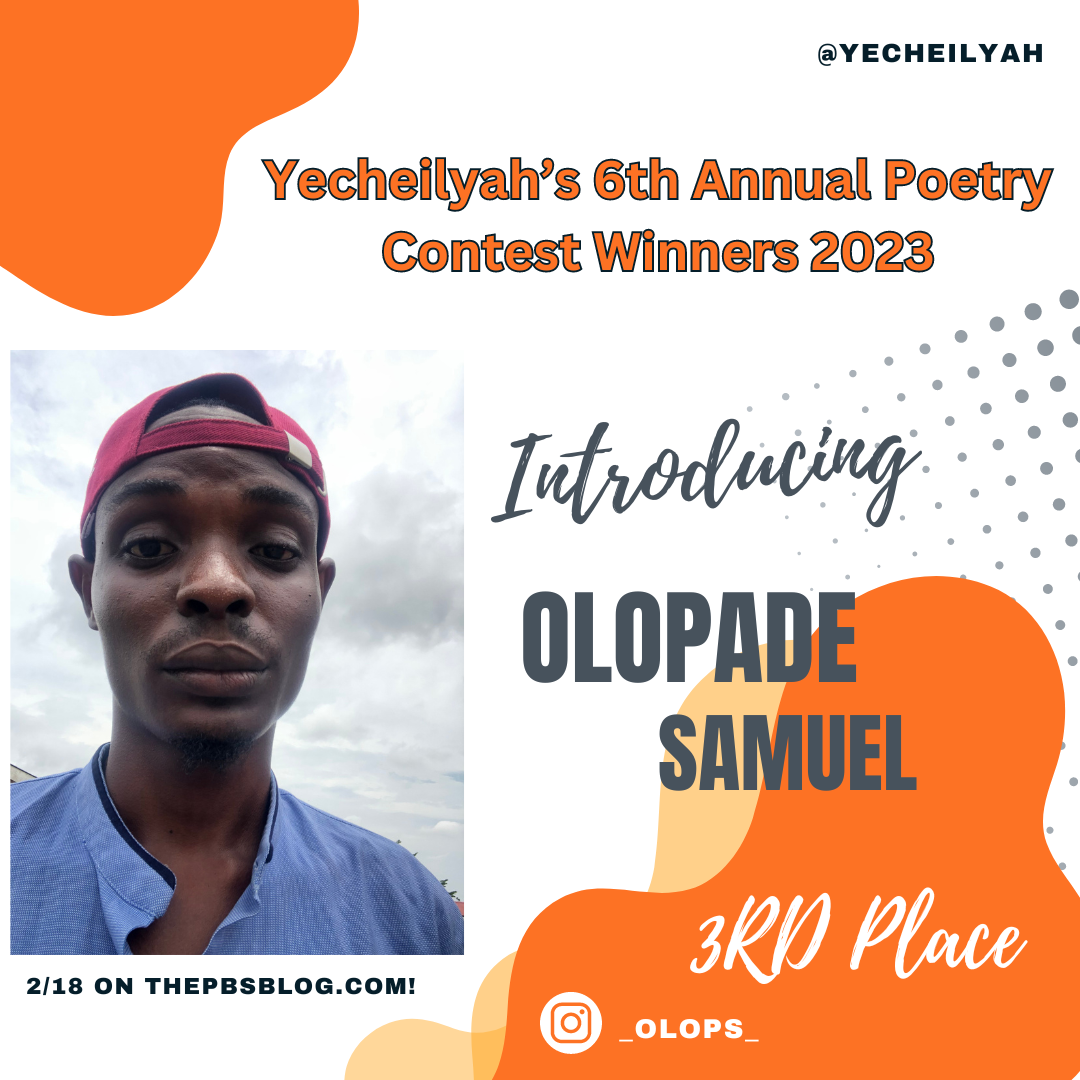
Introducing Samuel Olopade
Instagram: @_olops_
Samuel, welcome and congratulations!
Please, tell us, what is your name and where are you from?
My name is Olopade Samuel, im from Lagos, Nigeria.
Nigeria in the housee!! When did you first fall in love with poetry?
Poetry/writing had always been my sort of remedy. Growing up with a speech impediment made me value writing as the best way to express myself when words failed me.
What inspired your poem?
You know the saying, “You don’t know what you have till you lose it?” It’s synonymous with “You don’t know what you really want till you have it.” I see Grace in the same light. Being from dark places or places of just basic wants, the same wants everybody’s after, but then you find you’re getting things in an unparalleled manner. I see that as Grace. Basically, it’s an unparalleled favor.
In your own words, what is Grace?
Unparalleled favor, lol.
Lol. In what ways can we extend more grace in our own lives and in the lives of others?
In understanding, we’re all in similar races, on different fronts, but in the same cycle. As a volunteer and a fervent altruist, I believe in giving. Someone somewhere needs that unparalleled favor to get to the point they really need to be at, and you never know who your act of kindness could affect via a series of chain reactions you’re not even aware of.
What are you hoping to achieve with your poetry?
I am hoping to be a voice for the voiceless, a way to express and share feelings and emotions that are not easily seen.
A voice for the voiceless. I like that. Where do you see yourself one year from now?
I see myself thanking the past me for not giving up.
Now that’s a poet thing to say! I love it.
And without further ado, I introduce to you “Grace,” by Samule Olopade
Photo by TUBARONES PHOTOGRAPHY.
In the crucible of pain, we find our Grace, A journey from the depths to a higher place. From sorrow’s grip, we rise to happiness’s embrace, A transformation beyond what words can trace.
Beyond physical exertion, it’s the strength of soul, Grace, like a river, making wounded hearts whole. In every stumble, in every broken pace, Grace is the warmth of a loving, forgiving space.
Accepting our shortcomings, embracing them with love, We find Grace showered from the heavens above. In this masterpiece of life, we all play a part, Grace, the melody that harmonizes every heart.
So let Grace be the bridge that carries us through, From pain to happiness, from old to the new. In this tapestry of life, a wondrous embrace, Grace binds us all with love’s enduring Grace.
In the realm of Grace, we find our way, Where kindness and love forever sway. A gentle touch, a whispered word, In Grace’s embrace, our hearts are stirred.
Through trials and storms, we often roam, Yet Grace is the light that guides us home. It’s the hand that lifts us when we fall, The sweetest voice, a comforting call.
In Grace, forgiveness finds its place, A healing balm, a warm embrace. For in our flaws and in our fears, Grace dries our tears and calms our tears.
It’s the beauty of a sunset’s hue, A gift of love from me to you. In Grace’s dance, we all take part, Uniting every soul and heart.
So let us cherish Grace’s art, A masterpiece from the very start. In kindness, love, and blessings too, Grace shines on all, both me and you.
I’m Olopade Samuel, a proud Nigerian volunteer, engineer, and upcoming politician. As far as I recall, my whole life involved humanitarian activities with clubs like the Red Cross, Rotary, and Lions Club. My interests lie in observing nature, human advocacy, and wishful thinking to be a better artist. My life goal is to be that person others look up to, that model person who rises above stereotypes.
Note: We are in the process of moving all our winning poet interviews to the website. Please be sure to bookmark it at yecheilyahsannualpoetrycontest.org/.
Introducing S.R. Graham
Instagram: @thesensualgenius
S.R., welcome and congratulations!
Please, tell us, what is your name and where are you from?
My name is Shakeitha Graham. I am from Salters, South Carolina.
When did you first fall in love with poetry?
I first wrote poetry when I had to write a poem as an assignment in my first-grade class. I didn’t know much about poems, but I’d write them occasionally without really understanding what I was doing. I never thought I was good at writing them until I started posting my poems on social media and getting compliments on them. I first fell in love with poetry when I went to college and started learning about it extensively. That was when I was exposed to more black poets like W.E.B Dubois, Nikki Giovanni, Toni Morrison, and James Baldwin.
Excellent! Tell us, what inspired your poem?
I used to be a perfectionist, so I would give myself a hard time about everything. I always wanted things to be perfect or I wasn’t able to recognize the value in it. I’ve grown from perfectionism a lot, but I still have my moments when I am hard on myself. It has always been easier for me to extend grace to others than it is for me to do it for myself. That’s what inspired my poem.
I can relate to that! In your own words, what is Grace?
Grace is the empathy and compassion we have for ourselves and others even when we fall short. It’s the space we hold for the imperfection within us since we are human.
In what ways can we extend more grace in our own lives and in the lives of others?
We can extend more grace in our own lives by recognizing our inner critic as the young version of us that doesn’t approve of the things we may be doing in the present. We should nurture that inner child and help it to understand that we are no longer in that stage of our lives. We can extend more grace to others by being more understanding and not judging them based off our values and principles.
Well said! What are you hoping to achieve with your poetry?
I am hoping to inspire people to feel the hard emotions when they read my poetry. I also hope to make people feel seen, heard, and felt.
Where do you see yourself one year from now?
One year from now, I see myself being an established poet and performing spoken word poetry on small and big stages.
I believe it!
And without further ado, I introduce to you “What I Lack,” by S.R. Graham
Photo by Karolina Grabowska.
I offer it to those who pluck sin from between their teeth, and pass down trauma like family recipes. I offer it to those whose chests are desolate like coal mines, but their eyes are brightly lit when love comes with a prize. I offer it to those who take pain religiously, like daily vitamins, but still implement hope and faith in their regimens. I offer it to those who serve destruction as a three-course meal, and make friends with drugs because they’re too afraid to feel. I offer it to those who are at odds with life. They are the ones that need it most because their intrusive thoughts hold them hostage with a knife. I offer it to the ones who are addicted to the light, even though they pull foolish stunts to remain in the public’s sight.
I offer it to women who wear their burdens like pearls around their necks. The ones who hide from their reflections to dodge the secrets they want to forget. I offer it to men who are spoon-fed large helpings of responsibilities but are always thought of last when we are serving reciprocity. I offer it to children who are forced into adulthood too soon. Their inner beauty is sometimes stagnant like butterflies who aren’t ready to leave their cocoon. I’d offer it to the tired eyes looking back at me in the mirror, but sometimes my vision is too cloudy to see the value in me clear.
So, I give offerings of grace to those whose sins are severe, hoping that what I lack rewards its adherer.
S. R. Graham was born in October 1990 in South Carolina, where she still lives. She has a bachelor’s degree in creative writing and English attained at Southern New Hampshire University. She is a versatile writer, creating anything from poetry to novels and novellas. She is the author of the Two Monogamous series and the Pretty Privilege series. You can visit her website at srgraham.org to learn more about her and find all her works in one place. S. R. Graham is also a podcaster, a cosplayer, an advocate for sickle cell disease, and a sickle cell warrior.
There are a few things I am tired of hearing every February, but let’s call this part one.
I am tired of hearing “Black history is everyday,” or some variation of this every time Black History Month comes around.
Bruh. We KNOW.
While I agree with the sentiment, it is frequently expressed by folks who, for 11 months of the year, never discuss Black history or any campaign they are advocating to educate the masses.
Black History Month wouldn’t have to exist if, instead of regarding it as a footnote, the true history of African Americans was widely taught and not as an elective.
And, perhaps, Black History Month wouldn’t have to exist if we could name other leaders and activists outside of MLK.
Maybe, if we knew about Irene Morgan and the Journey of Reconciliation, we’d better understand Rosa Parks, the Bus Boycott, and the Freedom Riders.
Perhaps, if we understood Nat Turner’s rebellion, we would know why it became unlawful for Blacks to read and write during slavery and use it as a catalyst to promote reading in the African American community.
It is wise for scholars, researchers, and historians dedicated to teaching year-round to use this moment to impress this knowledge on young people who are only thinking about their heritage in February.
As unfortunate as it is (with all of its 28/29 days), most people’s hearts are more open to learning during February than any other month, so let’s use it to our advantage. Perhaps we can spark inspiration where there was none, and people will begin to study Black history outside of this month.
Until then, consider it a doorway by which we can shine some light with almost certainty that people will pay attention, even for a moment.
Imagine you were enslaved on a plantation, and someone approached you with an opportunity to be free. Wouldn’t you take it?
Imagine you were the person to free someone else, but you only have a short window to do it. Wouldn’t you take it?
Note: We are in the process of moving all our winning poet interviews to the website. Please be sure to bookmark it at yecheilyahsannualpoetrycontest.org/.
Introducing Our #1, Chandra T. Mountain!
Instagram: @musings.from.my.younger.self
Chandra, welcome and congratulations!
Please, tell us, what is your name and where are you from?
My name is Chandra Tyler Mountain. I am a NOLA (New Orleans, Louisiana) girl living in Northern Alabama.
When did you first fall in love with poetry?
I’ve been in love with poetry practically my entire life. Poetry first came to me through song. My family has a strong musical heritage, so music reverberated throughout our home, especially Sunday mornings. The crackling of vinyl records followed by music from the 50s, 60s, 70s. Jazz, Blues, R&B, Soul, Funk, Pop, you name it.
I can hear them ole school jams now!
I sat, listened, and sang my heart out. Even though music [singing] was my first love, I was keenly aware of the lyrics and how the combination of words, rhythm, and sound created meaning that could also make me feel. I “wrote” my first song at 5, a song with strange lyrics by a kid trying to process something she heard or read. Reading and writing poetry came a little later.
As a preteen, I was moved and inspired by the poetry I found in youth magazines. I began to dabble with writing my own poetry at age 11 or 12. I later borrowed my older siblings’ poetry anthologies and literary journals. I devoured the poetry. Gwendolyn Brooks, Langston Hughes, Mari Evans, Claude McKay. I loved the way poets succinctly expressed a potent moment or feeling in just a few words and could leave me staggering. I wrote profusely as a teen and in my college years. My hubby rediscovered those earlier works five or so years ago, and I self-published two books just last year featuring the writings of my youth, Musings from My Younger Self (April 2023) and Into the Garden (September 2023).
We got another poet author in the building ya’ll!
Sorry. Sorry. Go on, lol.
Creative writing slowed down to zero productivity while I worked on my master’s and doctoral degrees and as I focused on research and writing in Africana and women’s literature and theory. I wrote a poem here and there for a couple of decades but returned to [consistently] writing poetry about five years ago–after losing my second sister to cancer and trying to cope and make sense of devastating losses.
Oh no. I am so sorry to hear about your sisters.
Tell us, what inspired your poem?
“I’m Living” was inspired by a brief conversation with a former student. I knew she had been struggling with her mental health and trying to process emotional traumas. One day she called to thank me for a gift. When I asked, “How are you?” She responded, “I’m living.” There was such candor and weight in her brief response. Most people would either commiserate or move on, but this individual lost a sister to suicide, so I knew “I’m living” was more than just words. When we ended our conversation, I penned the poem to lessen the weight of her grief and trauma on my own heart.
Oh wow. See, that’s why you are #1!
In your own words, what is grace?
So, the “textbook” answer is grace is “unmerited favor.” I’ll remain in that lane and try to steer clear of the theological nuances. We don’t earn grace. Can’t buy it. Can’t extort it. It’s a gift from God. Grace does not come our way because we are better than or worked harder than or are smarter than anyone else. Why one cancer diagnosis ends in death and another in 50+ more years of life has nothing to do with goodness or pedigree or wealth. A brief glance outside ourselves will reveal there are others who work harder; there are others who, by our flawed human standards, deserve more. There are certainly others who are good good—absolute angels walking on this earth—who have less of our comforts and less of our fortunes but more in intangible ways that matter.
A line in my poem is “life is grace.” We are in the land of the living not because of our merits but because of grace. What stopped the “knife held at my throat” from being plunged deep inside? Only the grace of God. One of life’s greatest mysteries is this thing called grace, and once we acknowledge all our comforts, privileges, fortunes, and gifts are grace, only then will we begin to get a little insight and understanding of grace as a concept and a reality.
Beautiful. In what ways can we extend more Grace to ourselves and others?
Can we just cut ourselves some slack? Can we cut everyone else some slack? It’s become cliché, but can we acknowledge life is hard, and everyone is going through hell? Everyone is grieving. Everyone is trying to heal from unspeakable trauma or suffering in one way or another. Extending more grace is not difficult. Just do it. Exercise more kindness, more patience, more acceptance for ourselves and others.
How do we show more grace in our own lives? Accept ourselves for who we are, where we are in life, and the journey we’re on. Stop comparing. Stop striving for perfection. It’s elusive. We are amazing for just being here and staying in the fight.
How do we extend grace in the lives of others? Acknowledge their humanity and let others be who they are and who they’re becoming. It’s not our job to craft people into our own image. I actually have a poem about that!
What do you hope to achieve with your poetry?
Poetry is my space to process big emotions and haunting questions. I listen, observe, feel, and write. I am not writing for a Pulitzer, but I hope my poetry allows people to see themselves, gives them courage to wrestle with the questions, and shows them there is hope even in the darkest moments.
That’s beautiful, Chandra.
Where do you see yourself one year from now?
I am a one-day-at-a-time kind of woman. I’m not sure I can think that far in advance. 😀 I have a rich and full personal and professional life (as a professor and dean), but I am writing all the time. I maintain a blog, Pics and Posts (iamchandralynn.com) to take care of my immediate need to write and share. I write every morning and at least 30 minutes per day. As a result, within the last few years, I have drafted [by hand—gasp!] not one or two but five books—poetry, inspirational writing, and a “semi” children’s book.
My goal is to push at least one of them to publication by the end of this year. Two, if time allows. I have a lot of “other” writing, so I plan to submit to more journals and magazines. Thankfully, placing first (squeals!) in Yecheilyah’s 6th Annual Poetry Contest encourages me to put more work out there. Confession: I have used creative writing to avoid work on an academic title, so as much as I don’t want to, I have to put a pin in the creative writing just for a little while to complete that work—which [for me] takes a lot more time, intention, and energy. I’m amazing (right?), so I’ll finish it and get back to creative work!
I love this for you and we are looking forward to reading more of your work!
And without further ado, I introduce to you “I’m Living,” by Chandra T. Mountain
Photo by Josh Sorenson
for those who answer “How are you?” with “I’m living.”
To say “I am living” is to say much. It is to say: Life is grace. Unearned. Gifted. It is to say: I have survived those who went to the grave too soon and the grief that would surely engulf me. It is to say: I have survived the knives held at my throat, clutched by my own hand. It is to say: I have clawed my way out of pits of despair and have learned to dance in the rain. It is to say: I choose to keep breathing keep fighting keep moving. In light. In truth. In love.
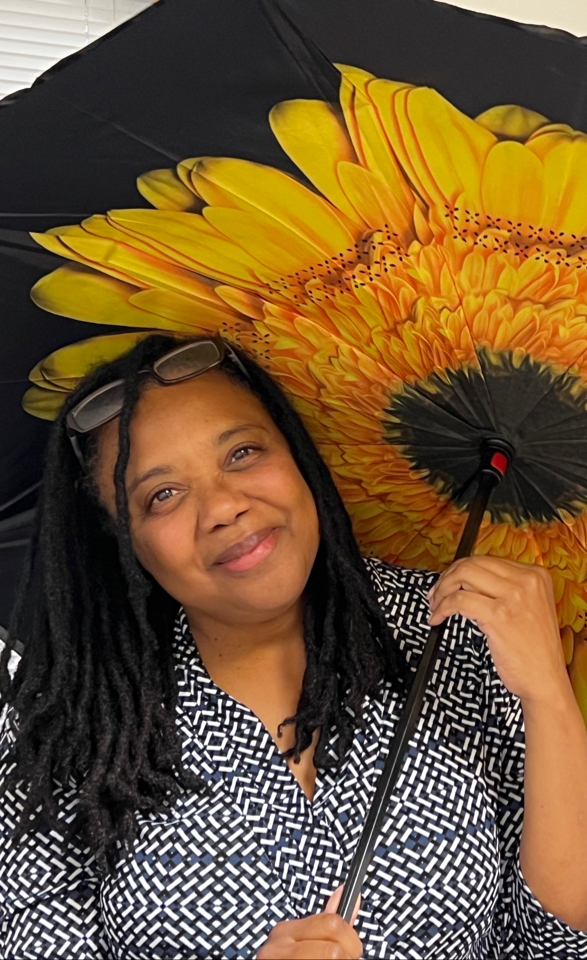
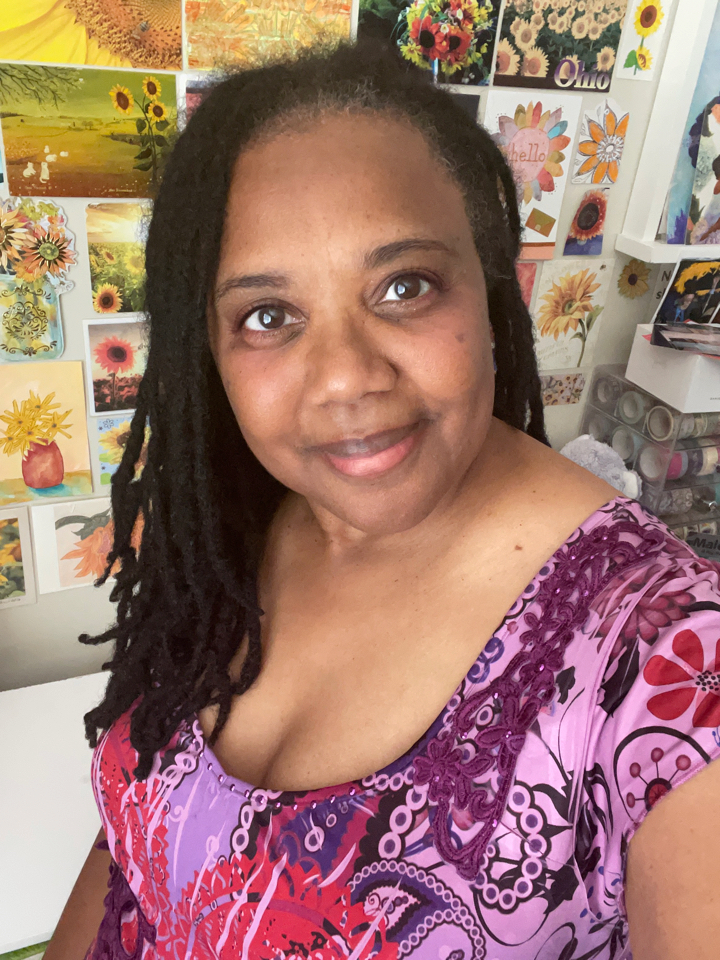
Chandra Tyler Mountain is a native New Orleanian living in Northern Alabama. She whines when work gets in the way of fun and wakes up in the wee hours to spend time with God, write poetry, short prose, and inspiration. When she is not with her guys (hubby and son), in meetings, or in her sunflower-brightened office, you might find her roaming–camera in hand–shooting beauty and capturing light, or sitting quietly in the shade of a tree doodling flowers. By day, she serves as Dean of the School of Arts and Sciences and Professor of English at her alma mater, Oakwood University. She maintains “Pics and Posts,” a weblog about snail mail, photography, and the beautiful facts of life (iamchandralynn.com). Her recent publications–Musings from My Younger Self (Chandra Lynn Tyler) and Into the Garden—are available through Amazon in ebook, paperback, and hardcover formats.
I don’t know who needs to hear this today, but the world is so much better with you in it. So much more wise and so much more full. So much more flavorful. Has anyone ever told you how tasteless we’d be without you? Without seasoning. No salt. Bland. There is a power in your voice and in your breath that cannot be replicated. Your anointing simply cannot be copied.
I just thought you should know that.
That someone’s life is made better because you exist. I thought you should know how valuable you are and how empty the world would be without your influence. And when I talk about value, I am not talking about the fake social media kind where we post a thousand pictures of ourselves and brag about how personal the year is.
Nah.
I mean real value. The kind that makes you want to elevate your whole life.
I am not talking about a vibe. I am talking about a spiritual frequency.
And when you know your frequency (and I mean really know it), everything that touches you is also full of power. When you know your worth (and I mean really know it), you become fertile ground for precious new seeds to grow. You flourish and expand in every way.
In our Poetry Business Network community, we are challenging ourselves to create and post a writing prompt to engage our audience. Yesterday’s challenge was an MLK writing prompt, but I missed it so I am posting it today!
Writing Prompt / Challenge
Photo by Aukid phumsirichat
Yesterday, people worldwide paid homage to the life of Dr. Martin Luther King Jr, the only non-president whose birthday is a national holiday.
Today, write your own “I Have a Dream” speech as a poem!
If you were to leave something behind for the next generation to learn from and to be inspired by, what would you say? What is the most important thing the world needs right now in 2024 America?
It doesn’t have to be a speech about race. It can be anything you think is important for this generation.
What words would you want immortalized as part of your legacy?
You may share a snippet in the comments, on your own blog, or scribble it in your own personal journal.
If you post it to Instagram, tag me so I’ll know!
I am going to do the challenge as well. I hope you’ll join me!
In 2020, I thought TikTok was an app for children doing dances to go viral. That is until I went mini-viral myself.
Only I wasn’t dancing, singing, or participating in trends.
I was talking about books, poetry, and Black history.
The impact of people tuning in for these topics in a world where people read comments and captions on social media more than they read full-length books is not lost on me and quite humbling.
I posted a video at the end of 2023 showing the books I read that year, and it currently has over 9K views, over 800 likes, and 453 saves…
…and I’m only showing books!
No words. No explanations. Just a showcase of about six books I enjoyed this year and a dope song to go with it.
Photo by Kishan Rahul Jose
If you are a creative in any field and want to advance this year in a certain area, I hope this inspires you to tap into the power of your authentic self.
You don’t have to be on TikTok, Facebook, Instagram, or YouTube if you do not feel drawn to those platforms. The one calling out to you won’t feel forced, and you will never have to act out of character to succeed.
You can discern this is not just about TikTok and social media platforms.
When we open ourselves up to being the most authentic versions of ourselves, no matter where we are, doors open that we don’t even have to knock on. We won’t have to chase opportunities; they come to us.
Here I am, getting viral-like numbers for discussing topics the average young person would typically find boring in a traditional classroom.
And I’m not even posting every day.
It’s spiritual, how things align when we show up as who we are.













 The PBS Blog