What to Do When People Unsubscribe from Your Author Email List and Why it is OKAY

Please check out this repost from 2019 below. It is about email list, but can apply to blogs and social media just the same.

Let’s address the elephant in the room.

Email Unsubscribes / Unfollows.

pexels-pixabay-53125

They can feel like silent rejections and sometimes confusing because you don’t always know why the person left. Unsubscribes can leave authors feeling abandoned, especially if the person was a long-time member of the list. All kinds of thoughts go through your head.

“What did I do wrong?”

“Am I providing value?”

“Does my writing suck?”

“Do I suck?”

“Did I email too much? Too little? What happened?”

The good news is that it is okay whether someone leaves your email list or your blog. In 2019, we were not taking losses, only lessons, and there are tons of lessons we can learn from email unsubscribes.

This list encourages and motivates you to push past that feeling of confusion and rejection.

  • Don’t subscribe people to your list without their permission.

Please don’t do this.

There are laws against doing things like this. Never, ever add anyone to anything without that person’s permission. I don’t care if it’s a Facebook group or email list. Get permission first. When you let people subscribe on their own, they can unsubscribe whenever they want and do it all without you being sued.

However, if you subscribe someone without their approval, you can be sure they will unsubscribe.

While there’s nothing wrong with compiling a list of supporters and emailing the old-school way (directly), we live in a different time. You need a track record that shows proof this person agreed to get emails from you. You need permission. Do not grab emails from blogs and websites. Choose an opt-in email form and let people subscribe on their own, or create an opt-in form of your own using google docs but just get permission. Don’t get sued.

  • Mailchimp
  • Mailerlite
  • Convertkit
  • Don’t take it personally.

If the subscriber was legal, and the person decided to leave, the most important lesson you can learn from this is not to take it personally. It could be because they did it to enter your contest and are no longer interested. It could be because they thought they signed up for something that turned out to be different from their expectations.

People have reasons for subscribing to a list/blog, and only some are clear about that reason. If someone mistakenly thought your list would offer something that it doesn’t, they may unsubscribe because it’s different from what they thought it would be.

It does not mean they are disinterested in you or that you do not have value. Don’t take unsubscribes personally. They are not rejecting you.

  • Never respond to an unsubscribe.

Resist the inclination to ask people why they left. Do not send them follow-up emails unless they have reached out to you. If they unsubscribed from your main list, they probably want to stop receiving emails from you. Again, don’t take the unsubscribe personally. One apple doesn’t stop no show (and that’s grammatically incorrect on purpose). Just keep grinding.

  • Quality over Quantity: You don’t have to have a gazillion email list subscribers to be Relevant.

With email lists, remember it’s more about the quality of your team. It’s better to have 30 or 40 committed people who are eager to support your work and read your books than 2,000 who won’t lift a finger to give you so much as a piece of advice. You ask a question and hear crickets. I have only about 172 subscribers to my list, and I am more than okay with this. Of course, I’d like to grow (who wouldn’t?), but I am in no rush. It’s challenging enough managing the people I already have. I’ll wait patiently. Always remember quality over quantity. It’s easier to manage 30 or 50 subscribers than to manage 200 or 300 starting out.

  • Resist the urge to vent your rage on your favorite social media Platform

Again, don’t take it personally. Email unsubscribes are like bad reviews that only you see. Just as it is not recommended to discuss the bad review, it is also not recommended to discuss the unsubscribe. We are all human but venting about these things on social media makes you look like an amateur. Accept this person has decided they are no longer interested in your content (for whatever reason) and move on. People come in and out of our lives for a reason, and we just have to accept when that season is over. Don‘t make it bigger than it is.

  • Remove and Renew

Don’t be afraid to lose people. You need to unsubscribe people you see who are no longer interested because there will also be people who won’t unsubscribe. They’ll just ignore you and delete your emails, or they may just ignore it without acting.

In pop culture, we call this Ghosting when someone disappears from your life without a word, leaving you to wonder what happened. It is a form of passive aggressiveness I do not recommend people to do. Communicate like an adult.

It’s a good idea to do a good ole cleansing occasionally. Delete some people. Don’t be so thirsty for high numbers to your own detriment. If they aren’t active, it doesn’t matter, and you are deceiving yourself. Every 2-3 months, I clean my list. I delete people who have yet to be active, have not been opening emails, clicking links, responding to questions, or participating. Their presence is irrelevant. I love them, but my emails are clearly not their cup of tea, and they shouldn’t be forced to drink. They must go.

If they aren’t active, it doesn’t matter that they follow you. Their presence is irrelevant, and you are deceiving yourself.

  • It takes time.

Writing is a business; like all businesses, it takes trial, error, consistency, and time to build. We may have been born with gifts, but no one knew exactly how to execute them. No one woke up with the skills to hire a team or produce excellent products. Similarly, you only know how to manage an email list through practice and hard work, and people will still unsubscribe.

UPDATE: Sadly, the Six-Figure Chick has passed on since this was first posted.

I used to transcribe to the same practices of some “gurus” who said to only email once a month. While I understand why you wouldn’t want to email too frequently, you must do what works for you. It’s a personal journey first.

So I followed my own path and now email whenever I have news. The truth is, it’s hard to stay connected to anyone you don’t speak to for months at a time. The email list can be an essential source of support if you want it to be. Or, the email list could be another social media account you update to tell people about your new books. *Yawn.*

Truth is, there will always be someone to unsubscribe. The real question is, who cares? People always unsubscribe from our lives, but we can’t stop working just because people leave. People unsubscribing from the list can be a blessing as it teaches us what works, what doesn’t, and how to better connect with our audience.

People unsubscribing is not even the real problem. The real problem is learning to connect with those who genuinely follow us. If we do our jobs well, we don’t have anything to worry about.

  • One door closes, one door opens.

Every time someone unsubscribes from my list, someone new subscribes. That’s the fun thing about it. When one door closes, another always opens. Just because a few people unsubscribe does not mean more won’t come. I’ve been successful in keeping my numbers steady because I am always blessed with a new person whenever someone else leaves. When unsubscribes do happen, now I just smile, knowing someone new is on their way, and hopefully, they’ll find value where the other person did not. The end of one relationship is the beginning of another.

Helpful Tips:

  • Ask your people questions to discover what they want.
  • Let your readers in a bit on who you are. Write stories, give updates not shared anywhere else, showcase your personality, e.g.
  • If possible, use a domain email address as your from address instead of gmail. Ex: yourname(at)yourdomainname(dot)com.

Reminders:

1. Don‘t take the unsubscribe personally
2. Don‘t subscribe people without their permission
3. Never vent your rage about it on your favorite social media platform
4. Quality over quantity
5. Recognize the growth that comes with removal and renewal
6. Remember that it takes time to build anything of substance
7. and that when one door closes, another always opens

For more email list building tips check out one of the most popular posts on this blog:
7 Things I Learned About Email List Building.

Introduce Yourself: Introducing Guest Author Trish Hubschman.

Today, I’d like to welcome Trish Hubschman. Welcome to The PBS Blog! Let’s get started.


What is your name and where are you from?

I’m Trish Hubschman.  I live on Long Island, NY.

What was your childhood dream?

Since sixth grade, 40 plus years ago, I wanted to be a published author.

Awesome. What skill would you like to master?

I’m not very good at navigating websites and blogs. That seems important in this business. I have to learn how to get around them better.

No worries. If you have the means, you can pay someone to do that for you ;-). Trish, what’s your favorite food?

Same as everyone else’s – – pizza and cheeseburgers.

Ha! Pizza is my husband’s fav. Let’s talk about writing a bit. When did you publish your first book? What was that like?

The first Tracy Gayle mystery  novel, The Fire, was published in 2015.

Stiff Competition (Miss America) is available now on Amazon.

What was that like? Must have been exciting!

I  published with America Star Books. They were free.  I didn’t have any involvement in it. This book Stiff Competition means more to me.  I was part of the whole process. 

Trish, married?

I’ve been married 27 years this coming March.

Congratulations! What’s your favorite TV Show? Movie?

I don’t watch TV in this century. In the 70s I did. My favorite show was Little House on the Prairie.  I grew up with Laura Ingalls.

And what are some advantages, in your opinion, of eliminating television? What can we learn?

TV in the past was better, the shows, for one.  The   visual and  sound quality were better in the past too.  I’m hearing and visually impaired.  It’s worse now than it was, but today’s TV turns me off, so I don’t bother trying.

Got it. Trish, why is writing important to you?

It’s a big part of me that makes me feel whole.  As a hearing impaired person, writing is the best way for me to communicate and express myself.

Beautiful. What genre do you write in, why?

For novels, romantic suspense. I love, love.  The mystery part makes it more fun.  In short stories, I write all genres.

Trish, thank you for spending this time with us. We enjoyed you!


Copyright ©2019. Trish Hubschman. photo used with permission.

Bio.

Trish Hubschman has published three books with America Star Books: a short story collection of time travel and romance stories called Through Time and the first two books in the Tracy Gayle/Danny Tide series: The Fire and Unlucky Break. Trish attended college at Long Island University’s Southampton campus, earning a BA degree in English with an emphasis in writing. She lives on Long Island with her husband and two dogs.

About the Book.

America’s favorite rock band, Tidalwave, is playing the Miss America pageant. Band leader Danny Tide is emceeing the event.  All is going according to schedule. The judges have picked the 10 semi–finalists. Suddenly, everything comes to a halt. Miss New Jersey is missing. Nobody knows what happened to her or where she is. Danny calls his longtime PI friend, Tracy Gayle, and asks her to come down to Atlantic City to help figure things out. In need of her best friend for personal support and eager to get to another case, Tracy agrees. There’s an all–out search of the hotels on the boardwalk. They find Miss New Jersey, but it’s not good. Her kidnapping leads to another assault and murder. The big star and the lady PI work together on this one, so that the Miss America pageant can continue as usual.

Be Sure to Follow Trish Online!

https://www.dldbooks.com/hubschman/


Are you a new author? Looking for more exposure? Learn more about my Introduce Yourself Feature HERE.

Warrior

Photo by Beth Tate on Unsplash

You were a warrior from the womb and your entrance was a victory. Since the moment you opened your mouth, they knew you were a prophet/prophetess. In your lungs was a war-cry, your fingers fit to hold swords and angels sang. When your footsteps kissed the ground, you were savior and fallen angels bowed when you breathed because the Gods ain’t got nothing on you. Magnificently and incredibly made from the richness of the soil. There were rumors about your skin and the audacity of it to shine like that. They didn’t know it was because you were born with a crown on your head. They treated you that way because they didn’t know you were a warrior and now that you know this, do not become a peasant. Do not lower yourself from the throne you were promised at conception if you want it. Do not shrink. Rise.

Jer 1:5 “Before I formed you in the belly, I knew you, and before you came out of the womb, I did set you apart – I appointed you a prophet to nations.”

Editors and Beta Readers – Vital for Independent Authors

Excellent post. Indie Authors, take heed.

Don Massenzio's avatarDon Massenzio

Publishing contractThis post focuses on the importance of using an editor and enlisting beta readers if you are an independent author.
Let’s start by comparing/contrasting independent and traditional publishing. In traditional publishing, an author receives an advance (if he or she is lucky). This advance is usually a fairly small amount. The author may then receive royalties for books sold after a certain number. The royalties can vary from pennies per book to dollars if you are a bestselling author. In exchange for allowing the traditional publisher to publish your work, you receive editing, formatting, publicity, and marketing services. The quality and effectiveness of these services can vary depending on how much the publishing company believes it can make from your book. In the end, very few published authors make a living wage from traditionally published books.

Independent authors know that their world is a different one. All of the services mentioned…

View original post 982 more words

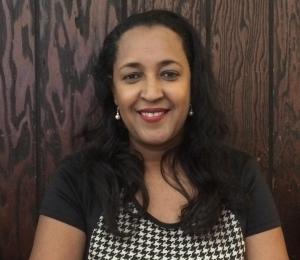
Introduce Yourself: Introducing Guest Author Sophia Tsegaye

Today, I’d like to welcome Sophia Tsegaye to the blog. Welcome! Let’s get started.


What is your name and where are you from?

My name is Sophia Tsegaye; I am an Ethiopian American living in Cincinnati, Ohio. I was born in Addis Ababa, Ethiopia.

Ethiopia in the house. What was it like transitioning from Ethiopia to America? Any major adjustments?

I arrived in America as a newlywed, and my husband and I had to adjust to the cultural difference at first, with the help of my sister.  And soon our neighbors and co-workers led us through our new lifestyle. One of the adjustments was being away from my parents and extended family members.
The other adjustment was the difference between American and  Ethiopian calendar. Ethiopia uses Julian Calendar and is 7 and a half or 8 years behind the American Calendar.  Ethiopia has 13 months (12 months of 30 days each, and one month of 5 or 6 days).
Now as a family, we celebrate both cultures. My children have learned to embrace the diversity in the family. In short, we have two New Years, two Christmases, two Easters and the like.

Wow, I didn’t know that about the calendar difference. This is why I yearn so much to travel outside the country!

When did you publish your first book? What was that like?

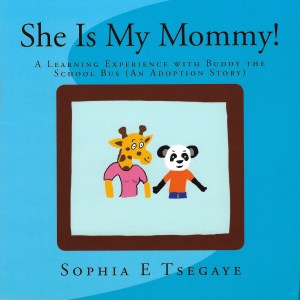
I published my first book “She Is My Mommy!” in March 2019 through CreateSpace. Holding my book for the first time was rewarding. Carrying a task to completion was my first goal, and I felt fulfilled. It has kindled the desire and the strength to go forward with my second book. And now I am working on my third one.

Congratulations! Amazing feeling right? Are you married Sophia? Got a boo somewhere?

I am married to a wonderful and supportive husband for the last fifteen years.

Awesome. Children?

Yes. I have three awesome boys, ages 14, 12 and 3.

Beautiful. What do you wish you knew more about?

Growing up, one of my many challenges was speaking up. Both in Middle and High school, I was known for being timid and introvert. It continued well into my graduate class. For example, I would know the answer to a question, or want to voice my opinion, but could not make myself to say something. It was like being present and absent at the same time.

Later on, I realize that the only thing that was holding from communicating was the fear of making mistakes.

Now, I know that making mistakes is all right, you learn from them and move forward.

I can relate for sure. What small things makes you life easier? What makes it difficult?

Living a simple life, being grateful and exercising kindness make my life easier. I try to see the positive in people. I believe that it is wise to listen to your conscious before you speak.  We often forget that a calmer tone conveys a message more effectively. I think that we all have the choice to decide whether to make our life easy or difficult. It is a choice we need to make every day. If you always feel you are a victim and everybody is onto you, then you will remain a victim of your own conscious.

If you do not control your temper, you will be treated as the perpetrator even if you are on the right.

If you are not kind, then you will miss the heart-warming reward that you get from it.

I love that Sophia. Wise words. Let’s get back to writing a bit. What’s the most difficult thing about being a writer? The most exciting thing?

The most difficult thing as a writer is writer’s block.

The most exciting thing is when you are in that creative zone, and you have no control over your writing.

Why is writing important to you?

When I write, I let myself go to places I have not visited for a long time. I navigate through my thought and dig deep into the desire to correct the wrong, to encourage the weak, to give a voice to the timid, and the like.

I want to show the reader that she or he is not alone in any circumstance. Happiness, fear, triumph, sadness, friendliness, and depression are a part of life. Therefore, what we need to do is find a way to fix the problem. In my books, I encourage children to learn to ask for help.

Outside of writing, what are some of your passions?

I love making pieces of jewelry and cooking.

You’re a children’s author. What do you think of the bullying in our schools?

Unfortunately, bullying is a real and dangerous issue. I try to focus on this issue in my books and demonstrate the effects it can bring.

My boys have experienced bullying, and I have also heard of various incidents in the school. I have seen firsthand how bullying can break the spirit of a fun loving and active child.

As a parent, we should teach our kids empathy at an early age. If we see our child push another child, we should be able to explain that it is wrong.

We have to encourage our kids to communicate with us, or the school personnel if they feel unsafe or overwhelmed. Schools have councilors, and they should use these resources.

And I urge parents to listen to their kids. If a kid voices concern then parents should intervene immediately.

If you could, would you visit the past?

Yes, I would visit the past if I could. Would I give some advice to my young self and try to change the past? I do not think so, because those experiences made me the person I am today.

Precisely. What advice would you give your younger self?

I would advise my younger self to trust her instinct and be comfortable in her own skin.  And of course, tell her to take it easy, enjoy life, and laugh more.

Thank you Sophia for spending this time with us! We enjoyed you.


Copyright©Sophia Tsegaye. photo used with permission.

Bio.

Sophia E Tsegaye, is a stay-at-home mom, with three boys who keep her busy. She’s a children’s book writer, living in Cincinnati, Ohio.

From the Author:

I enjoy listening to what happens in school.  Every day, my boys will come home with new stories, but unfortunately, not all are pleasant.  I use their stories as a learning experience, and I guess this is how my books were born.

Many little kids are fascinated by school buses and animals. Hence I chose to have a school bus and animals as the characters.

There are different approaches to explain to kids about being unique, being different and being accommodating, so I try to bring these issues through my books.

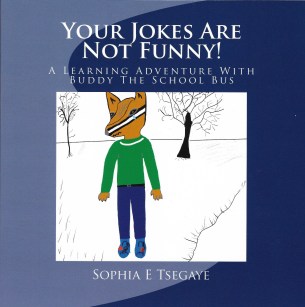
The first book “She Is My Mommy!” is about transracial adoption, and the second book “Your Jokes Are Not Funny!” is about bullying.

Kids can be simple and yet complex. They ask us complex questions and are satisfied with the simplest explanation.

I believe in teaching kids empathy at a tender age.

You can reach me by email at tsesophia@yahoo.com

Be Sure to Follow Sophia Online!

Web: https://tsesophia.wixsite.com/tsegaye-1

Twitter: @SophiaTsegaye

Facebook: https://www.facebook.com/SophiaETsegaye/?modal=admin_todo_tour


Are you an author? Looking for more exposure? Learn more about my Introduce Yourself Feature HERE. Stay tuned for our next featured author.

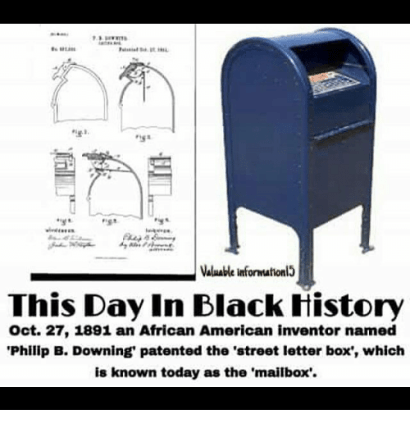
Black History Fun Fact Friday – Phillip  B. Downing and the First Mailbox


Every day, we use our mailbox, checking it for packages and letters and bills. You look at it every single day but did you know a black man invented it? Thanks to Phillip L. Downing (some sources and memes say Paul but so far I have only been able to verify that his name was Phillip), you don‘t have to travel to the post office every day. You can just walk a few steps from your home. But Downing didn’t call it a mailbox. He called it a Street Letter Box.

Downing was born in Providence, Rhode Island on March 22, 1857. His father, George T. Downing was an abolitionist and business owner. His grandfather, Thomas Downing, was born to emancipated parents in Virginia and also had a successful business in the financial district of Manhattan in 1825. Thomas Downing also helped to found the United Anti-Slavery Societies of New York City.

Coming from a family of business owners, it‘s no surprise that Phillip would become an inventor. During the late nineteenth and the early twentieth century, Downing successfully filed five patents with the United States Patent Office. Among his most significant inventions were a street letterbox (U.S. Patent numbers 462,092 and 462,093) and a mechanical device for operating a street railway switches (U.S. Patent number 430,118), which he invented before the predecessor of today‘s mailbox. On June 17, 1890, the U.S. Patent Office approved Downing’s application for “new and useful Improvements in Street-Railway Switches.” His invention allowed the switches to be opened or closed by using a brass arm next to the brake handle on the platform of the car. Then, on October 27, 1891, his two patents for a street letter box also gained approval.

Downing’s design resembled old school mailboxes (see image). A tall metal box with a secure, hinged door to drop letters. Until this point, people wanting to send mail had to travel to the nearest post office. This is how the enslaved “heard it through the grapevine,“ communication started on slave plantations where information passed from person-to-person, by word of mouth. The Black person who was sent to the post office to get the mail would linger long enough to get a drift of the conversation from the group of white people who congregated there. The mail carrier on his way back to the master‘s house would retell the news he heard so that the other slaves knew what was going on in the world. While many records accredit this to the news that came through the telegraph, it actually began before then. The “grape-vine telegraph” (Washington, p. 9) was unofficially invented first as mouth-to-mouth rumors, gossip, and worldly conversations and news of the war from Southern blacks on the plantation.

Knowing this, it is not surprising that a Black man would make these “conversations” easier by inventing a mailbox. To this day the term, “I heard it through the grapevine,” is still a common saying for someone who has heard gossip. The phrase has even been recorded as a song by Gladys Knight & the Pips in 1967 and by Marvin Gaye in 1968.

Before, those wishing to send mail usually had to travel to the post office but Downing’s invention changed that. Instead, the street letter box would allow for drop off near one’s home and easy pickup by a letter carrier. His idea for the hinged opening prevented rain or snow from entering the box and damaging the mail.


Misty Brown, “Ever Wonder,” Afro-American February 6, 1988; Eyvaine Walker, Keeping a Family Legacy Alive: Unforgotten African Americans (Atlanta, GA: Twins Pub, 2011), 316 – 317. “Philip Downing, Boston, Retires After 31 Years Service in Custom House,” The New York Age, April 9, 1927.

Mahoney, E. (2017, October 31) Philip B. Downing (1857-1934). Retrieved from https://www.blackpast.org/african-american-history/downing-philip-b-1857-1934/

Washington, B. (1995). UP From Slavery. Dover Publications Inc. Edition. Original Publisher, Doubleday, Page, circa 1901, NY. Chapter 1: A Slave Among Slaves, p.9