Bad Reviews

Linda G. Hill over at Life In Progress opened an important discussion on Bad Book Reviews and since I happen to be patiently waiting for feedback myself, I thought I’d share my thoughts.

file(2)

First, let me just say that Linda’s dilemma is a very difficult position to be in and as such I think she handled it well. I’m going to try and respond from both perspectives since I too review books and I am also an Indie Author.

The Author

As an author, though there are tons of authors asking for reviews, this is a decision I take very seriously and I think others should too. When I ask people to “read my book free in exchange for an honest review” to me this means I am asking for their honest opinion. An opinion I think is much more valuable than the money they would otherwise pay to just read the book on their own time. When I ask for an “honest review” it means I want them to be respectful about it, but I also want them to be real. That said, I include in my correspondence emails that if the review is negative, for the reviewer to email me their criticisms personally. This is so I have the opportunity to see where I falter before the world does. If my book is that horrible, I want the chance to correct myself. This, I feel, is only natural. Even when you have an issue with someone in everyday life, you have a responsibility to alert that person first before anyone else. You don’t tell Sally, Laura, and John and you do not inadvertently third person Facebook, Twitter, or blog post them. No, you tell them. People aren’t stupid. They will know if your post is about them. So that is why I’d want the opportunity to know where I falter before being put on front street. Now, let’s flip the script.

The Reviewer

From a personal perspective, I do not care to write reviews on books I would rate at below a 3 (for Indie Authors) because I know how important of a consideration people take Book Reviews when deciding to purchase the book. I also know how damaging low ratings can be specifically for Indie Authors.  I prefer instead to message the author privately.

As a reviewer, I email my below 3 thoughts to the author personally (just as I’d want done to me) and I give them the opportunity to decide if they want me to continue on with the review and to publish it. Since I am providing an honest review, I refuse to rate and or post a good review for a not so good book. For this reason, I think personal outreach is the best option. Not only is it professional and respectful, but it is also what I would want someone to do for me.

How Bad is a Bad Review?

It really depends on how bad the review is and the buying habits of the reader. Not everyone will buy a book based on its reviews. I am a prime example of this. I paid no attention to reviews before I became an author. Prior to this, I read the descriptions of books and decided for myself if it was for me. You can say that I’m old school. If the book was bad it was just money burned but it wasn’t a grand deal. I suppose back then every book was a gamble: win some, lose some.

Today, I pay more attention to reviews (obviously) but I still do not always buy books this way. Meaning I am more likely to purchase a book from Amazon based on its description and preview (first few chapters) more so than the reviews. Why? Because in the end they are still others opinions and while everyone is entitled to their opinions my thought process may not be the same. Just because you disliked a book does not mean that I won’t love it. On the other hand, there’s Amazon.

Every good writer will get a low rating at some point, but too many low ratings and reviews can damage an Authors overall Amazon rating. While I do think Indie Authors need thick skin in this industry, as a reviewer I would consider the stigmas already imposed on Self-Publishing, my own thoughts as an Indie, and how ratings influence an authors account. As a result, I publish nothing lower than what I see as average, like a C which is a 3. Before, I wouldn’t even publish three’s but have recently decided to do so.

So How Important is a Book Review?

Book reviews are essential to Self-Publishing, specifically, because its the conversation about the book and the discussion it fosters that makes the review of such value. Traditional Publishing already has a head start. It is backed by big publishing houses with large teams. Indie Authors on the other hand have to garner attention and discussion about the book on his or her own–which can be done in many ways– but is largely done by way of the book review. Good or Bad. For me personally, there is a greater purpose the book review serves. While book reviews can increase sales, they can also be used in other ways.

Good book reviews for instance can be printed on promotional items or used to spark important conversations. Bad reviews on the other hand can help the author to grow in the areas where his  writing is weak. Who else is going to inform a Self-Published author (who has no large team of professionals) that they should tighten up than the compassionate book reviewer?

Final Thought

Bad reviews suck but as an Indie Author  I prepare myself for them because I am, after all, asking people for their honest opinion. While I am not so naive to think all negative feedback is warranted (some people are just not going to be interested in the story), criticism is part of growth and even best selling Traditional Authors whose work we know is top quality, even they receive negative feedback sometimes.

If you’re really serious about your writing, you will expect the good and the bad. Think of it this way: For most successful Traditionally Published authors, there is not the privilege of someone successfully reaching out to them personally and getting anything but their agent or whoever else checks their emails. For this reason, these authors get bad review publicity all the time. Sistah Souljah’s “A Deeper Love Inside” (sequel to “The Coldest Winter Ever”) has so many bad reviews I would just cry. The moral of the story is: don’t expect everyone to love you. No author has this privilege. Understand also that while valuable, book reviews is just one way people decide to buy books so one bad review doesn’t necessarily mean your career is over.

As reviewers, I think its important to highlight where we think the author has done well and then give constructive feedback to the author on that personal level and let them decide if they want it made public (just in case they want to take your advice and change something). Speaking of advice, I also think its important for reviewers to give feedback that will benefit the author. Don’t just say the book is bad (different ways to say this) but be sure to tell the author why. Be thorough in your analysis of someone’s work so that they can follow through and improve.

“The thing about a book (even yours) is that not everyone will love it. If you don’t believe me, look up your all-time favorite book on Goodreads or Amazon and check out the 1-star reviews. Those people hated the book you love.

When you get your first bad review, you will want to defend yourself and your work. Don’t. And don’t let Aunt Freda defend you, either. This will be hard, because it will seem like some of the reviewers either didn’t read—or skimmed—your book.

Remember why you write. Is it for praise? No, it’s because you love telling stories. So, tell them. If praise comes as a result, smile and strut around for a while. If not, consider whether there’s anything valuable in the critical reviews and then get back to your work-in-progress.”

– Julie Doherty

Blogging and Writing: The Benefits

edit-your-blog-postsI do believe blogging has had an impact on my writing life and that it can do the same for you. While not every blogger is a writer, as a writer I do not separate the two. For me, blogging and writing has a unique relationship. There is something about instant feedback that I believe helps bloggers to improve their writing. Yes, like a critique group of sorts and for bloggers who also happen to be writers, this can only be a good thing. At its core, writing is communication. It is about recording thoughts and while not all bloggers are writers blogging is still a platform that presents people with a unique medium from which to express themselves in writing. To that end, writing  improves with practice. Blogging will not make  you a better writer, but it can highlight those areas where improvement is necessary. It also helps to highlight those areas of strength. For me, blogging is not the key to authored success or anything like that and it is not something influenced by money. What it does instead is help to increase my interaction with readers which has a natural ability to sharpen my writing skills. When you know people are watching you have no choice but to produce your best, and becoming a better writer holds important benefits for the rest of your life—whether you are writing a book, a presentation, a resume, or a love letter to your spouse.

Because the process of writing includes recording thoughts on paper, the blogging process forces you to think about what you’re going to say before you say it, and encourages you to stop and think deeper. You will delve deeper into the matters of your life and the worldview that shapes them and how to communicate this over to people in a way they can understand it. With immediate feedback by way of Likes and Follows, you’ll get to see how others view your form of writing and gain access to instant critique. Blogging can help you to write more, and in so doing stay focused on your writing goals. Blogging can not only improve and change your writing life; it also changes the life of the reader. As you write, the reader gains and because blogs are free for the audience and open to the public, on many levels, it is an act of giving. It is a selfless act of service to invest your time, energy, and worldview into a piece of writing and then offer it free to anybody who wants to read it. You will find your voice, and others will find inspiration.

Underground

720x405-121715-celebs-underground-tv-show-still-macon-7

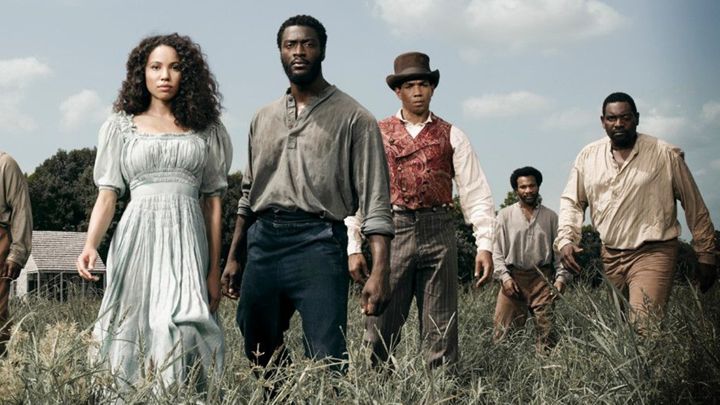
The season premiere of Underground aired this pasted Wednesday, March 9, 2016. The TV series stars Jurnee Smollett-Bell and Aldis Hodge and is about a group of slaves planning to escape a large plantation and will be helped by an abolitionist couple along the way. Underground is short for the Underground railroad, a system of secret routes and safe houses used to help slaves to escape to free states and Canada with the aid of abolitionists and allies who were sympathetic to their cause. Below is a synopsis of the show:

“Early in the premiere of WGN America’s slave-revolt drama Underground, a captured runaway named Noah (Aldis Hodge) is shoved into a decrepit shed on a plantation in rural Georgia. The year is 1857; the Civil War is still four long years away. The camera whips around 360 degrees from Noah’s point of view, catching glimpses of sick, malnourished black men and women, all of them shivering in makeshift bunks and slumped against unforgiving walls. And though he does not say a word, the sequence immediately establishes Noah as the show’s determined protagonist. At the risk of sounding crass given the historical atrocity the show unflinchingly deals with, it feels like the moment when this slave resolves to be something of a superhero.”

wgn-underground

I started looking into this show about a month before its premiere, watching interviews of the actors and the making of the show itself. I also follow Smollett on Twitter and she’s been very excited about it. My opinion of the show? So far so good. The premiere has a nice set up or rather introduction into how the show will play itself out. We can already see who the people are who will help the slaves to escape, those who will possibly create safe houses for them for instance, and those, both black and white, who will be their stumbling block. I love the determination of Noah to recruit others in their attempt to escape the plantation, that he has a plan and that, as he says it, escaping is not just about running but will require the slaves to work together in a strategic way. In short, I am so far enjoying the coming together of the crew and I look forward to the rest of the series.

You Are Where You Are

You get what you deserve in life. As much as we complain and whine about why we don’t have and why we should, we never stop to understand that we are all where we’re supposed to be. If you have something great it is because you’ve earned it. And if for whatever reason you are not where you want to be, it is because that place is not ready for your presence or you do not deserve to be there at this time.

A five year old is not mentally or physically capable of handling a dangerous weapon. You will not give a gun or a sharp knife into his hands because he will think that it’s a toy. But here’s the thing: this does not mean he does not deserve to have it. He is not to be given this now because he is not mentally capable of handling it. Only when this five year old is an adult and is ready to be trained in how to properly handle dangerous weapons and obtain the proper certifications, should he be allowed to embark on what is his. Perhaps his destiny is to be an officer, trainer, or a merchant of ammunition. Nevertheless, right now he is where he is supposed to be. That is learning the importance of safety and the value of life. As a five year old, the only thing he has to look forward to now is increasing his understanding of the world around him and when he’s ready, he will be where he’s supposed to be. You are where you are for whatever reason. Perhaps things are not falling apart, perhaps they are just falling into place. This is not your destruction. This is your birth.

5 Creative Ways to Headline Your Blog Post

breaking-news

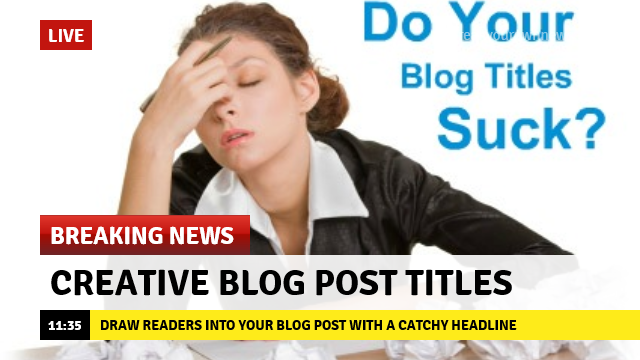
They tell you the first sentence draws you in. After that the first paragraph, and then the first page. I believe however that the real first is the title of the blog post itself. While it may not be ultra extremely important, blog titles do carry weight. This is, after all, still the headline of your post when you decide to publish the article, video, quote, or whatever you are publishing today. It is the teaser that will either pull others in or scare them away. Titles are so important that some people will decide not to tune into a blog post at all because they do not agree with whats in the title (which is too bad for them. Didn’t your mothers ever teach you not to judge a book by its cover?)

Any who, the more I blog the more I learn. As I watch those with years of experience, I have learned a little about what makes for an acceptable blog post headline. Not only have a learned from watching others, but I’ve learned from paying attention to my own reading habits. Below is a list of the blog post titles that usually catch my attention.

#1. Keep It Simple Short

The blog titles that often catch my attention are those that are short and to the point. It is not a good idea to make your blog post titles too long. If posting a quote, it is also not a good idea to post the entire quote as your title. People get bored easily and do not want to read a paragraph before getting to the actual article. Instead, look at your title as if it were a tweet that must be restricted to 140 characters. Ask yourself what the post is about and what key words are important to include. For instance, whenever I write a post about self-publishing I always include Self-Publishing before the title of the post so that those Indie Authors looking for insight can easily find it. I then follow it up behind what the post is about: Self-Publishing: The Workflow, Self-Publishing: ISBN Numbers for example. Short and sweet titles are also those that don’t take much brain power to decipher. “I Hate Coffee” or “This Dumb Computer” is just as likely to attract attention. Both of these titles leads me to my next bullet point.

#2. Something Catchy!

Blog titles that are creative also catches my attention. This reminds me of a cold open in a movie script. Cold Open is a term screen writers use to indicate that you are coming in on an action scene. It is when you come in smack down in the middle of all the drama. Right when the husband walks in and catches his wife pulling her jeans on next to an unidentified figure in the bed. Its the look on his face when she pauses and scans the room as if an excuse is going to pop up in the corner. It is the camera zooming in on a street fight right at the moment when fist meets chin. Ouch. That is what catchy titles can do for readers. It makes us wonder what the rest of the article is about. For example: “Doctors Are Gods”. From the onset, you have no idea what this blog post is about. You don’t know if I actually believe Doctors are Gods, if this is a poem, or if I’m setting out to criticize the profession. In either event I know that I would want to check this post out! Even if I don’t make it through the article, if your blog post said “Doctors Are Gods” it would be enough to peek my interest and I would click on your blog to see what you’re talking about (or if you actually know what you’re talking about).

#3. Shock and Awe

People, for some reason, love drama. If your blog post is controversial or has the potential to spark a heated debate, try a title that will shock your readers into curiosity. This will guarantee some attention and strangely, the weirder the better! If I saw a post that headlined: “Homosexuals Are Taking Over The World” I’d be headed right on over to see what juicy details the blogger has included and if there is any truth there. This is also an example of a title that some may utterly ignore because it offends them. I wouldn’t worry about that. Of course its offensive, your post is controversial! And yet, lots of people will tune in to see what you have to say. Why? Because people looovveee drama! (Speaking of which, exclamation marks in a blog post title is also a good way to get readers attention!)

#4. Current Events

If your blog post is about current events, news, sports, politics, or celebrity drama, include some of that in your blog post title. The only exception here is that it is more effective if your post on current events is well, current. If you want to spark conversation over the latest news be sure to do it right when the action happens. A blog post about Rachel Dolezal would spark some fire but not merely as much as when the story first broke. Kim Kardashians nudity may be today’s distraction, but next week is a different thing. Still, there is another way to play with this: You can make your post historical in nature. For instance, this year would be the 15th anniversary of 9/11. If your post said: “Remembering 9/11” or “Looking Back: When The Towers Fell” that may attract some attention. But, if you published this post on the anniversary it will attract even more attention. Why? Because its a reminder in people’s minds. They will hear about it all day on CNN and everywhere they go. In fact, 9/11 is such a historical, life changing event that you can just title your post: “9/11” and people will tune in. This is yet another way to play with titles. What’s important to world history? Use it.

#5. Questions

And finally, I have also noticed my curiosity peeked on blog post with titles that ask questions. What better way to get someones attention than to ask them a question? This doesn’t have to mean you are actually looking for answers in the article, but it is another way to spark interest. “Is Orange The New Black?” is a creative spin on a title that doesn’t actually have to have anything to do with the TV show. Maybe its a title about race and ethnicity. Maybe it is about the TV show and has nothing to do with race. Just be creative. (Oh and when writing a post that includes a list, like this one, include that number in your blog post! People love advice: “10 Simple Ways to Clean Your Computer” is likely to get some action. Notice that I went a step further and added “Simple” so that people know this article is not just for the technologically advanced).

Writer’s Quote Wednesday – “Passing Pebbles”

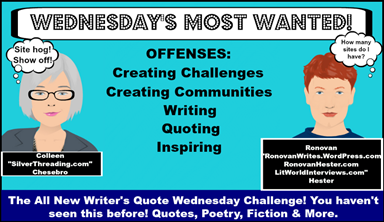
Welcome back to another episode of Writer’s Quote Wednesday as hosted by Colleen of Silver Threading and Ronovan of Ronovan Writes. It feels good to be back I must say. In my country voice “How yall?”

It also appears I have returned to a new challenge! Here are the new rules:

Each week we will include a theme for anyone who needs additional inspiration. You don’t have to follow our theme if you don’t want to. It is optional.

In fact, Ronovan and I will alternate each week with a themed prompt post written on Silver Threading. This will give you a different perspective weekly to keep your inspiration flowing. Make sure and join us. You never know what we will come up with!

So what do you do?

You select a quote that inspires you. Then, write a short piece of flash fiction or poetry to share with us all using the quote either in your story or as the title of your masterpiece. You can include photos, photo quotes, or anything else that helps to highlight your quote. – Colleen

****************

Sounds exciting!

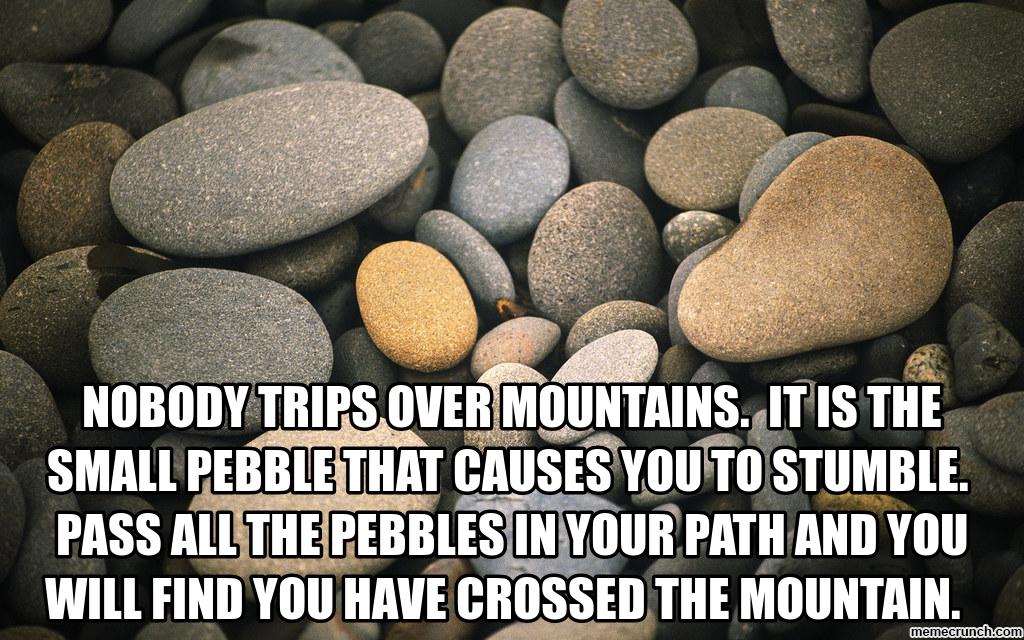
My writer’s inspiration today comes from an unknown author. I have decided to include a poem with my quote:

image

Huge mountains
and great hills
They tower above our heads
Like mothers to sons
The intimidating weight
Of experience
To our youth
Like a father’s instruction
Heavy with discipline
Is the carved stone
The frightening rock
But it is true
We can move mountains
If we tried
If we faith-ed
One pebble at a time
One pen to a rhyme
One stuttering syllable
And leaking ink
We scatter stumbling blocks
Like children at play
Except
There are no toys
No plastic dolls
Or wind up cars
Just similes
And metaphors
passing pebbles
And conquering mountains

***********

030816_1826_writersquot1

And that’s it for my contribution to Writer’s Quote Wednesday New Challenge Edition.

Dear Self-Publishers: You Are Not JK Rowling

stop-comparing-yourself-to-others

The rain sounds like marching footsteps on my roof. Yes, it is pouring out. So, I thought I’d take the cozy time spent underneath the covers to devote time to my laptop which means sharing another thought that recently crossed my mind concerning Self-Publishing. As always, my thoughts are based on my own experience. Will you get something out of it? It is always my hope that you will.

There is always something we can gain from one another. Always something we can add to our Self-Publishing arsenal of sorts. However, while each self-publisher is similar, each is also different. There is no one answer to self-publishing a book. There is no one way that it is done. In this post, JK Rowling is not merely representative of herself, but she is representative of others who have succeeded in the business of book publishing. Thing is, I am not JK Rowling and neither are you.

Using Rowling as a platform of discussion, I’ve viewed her countless outlines available online for her books in the Harry Potter series. They are very nice layouts and tend to be very organized but it was also very confusing to me. Rowlings outlines are, again, well organized but it is not something I could have followed. For me, to follow an outline for writing books would just confuse me and I will probably never finish it. It is just not the way that I write. I and me are key terms here.

What makes your book special? In a world where people are Self-Publishing books everyday (and often coming out with them at the same time) what makes yours worth the time? Wrote a Historical Novel? So what, so did the next guy. Wrote a Young Adult piece? Who cares, so did she. Her over there. Yes her, she wrote a Fantasy, Horror, Young Adult novel too. In a world where there are seas and seas of Self-Published books, it is not the concept of the story itself that is so different. I believe there are tons of books with similar themes. I also believe that every book has a question that needs to be answered, a message it is trying to deliver, or a problem that it attempts to solve and each author has to answer that question or reveal that message or provide a solution to that problem in his or her own unique way. This, the answer, is what makes him or her stand out. It is the unique combination of that authors own persona as well as his or hers approach that is different and that makes that author either stand out or blend in with the sea.

I’m sure authors whose names we all know have been influenced by others, of course. But they have also become known for their individuality. There is always something slightly different about how one author approaches a subject as compared to another. Terry McMillian and Sista Souljah are both talented writers, but Souljah can’t write like Terry and Terry can’t write like Souljah. For each to be successful, each will have to bring something to the table that is different in order to become their own name brands.

Dear Self-Publishers: You Are Not JK Rowling

It is not up to us to write like those who’ve become successful financially and globally. It is up to us to write in a way that works for us, according to our individual personalities and our individual styles.  It appears that everyone wants to have the answer to how to Self-Publish a book. The truth? There isn’t one. At the end of the day we have to write stories that people want to read and lets just say the JK Rowlings are already taken. I’d be willing to bet that a book written with less than desirable grammar and poorly promoted can still be read IF it’s an engaging story. Writing is, after all, story telling which is not something everyone can do.

This, the skill of writing, tends to be overlooked when it comes to advice or discussion on self-publishing. I’ve seen tons of advice on how to promote, why it is important to get a story edited, why book covers should be appealing, ISBN Numbers, the list goes on and on. I’ve spoken myself about the importance of these factors, why they are important and so on. Except, I do not hear much about the actual skill of writing; the craft of story telling. Poor books is not always because the book cover is bad, the editing is crappy, or that the marketing skills are poor. No. It is because not everyone can write a book. I’ve read Traditionally Published books with tons of grammatical errors and yet people love the stories because they are told well. There is a skill there that draws readers in. Toni Morrison said it best when she said that obviously some aspects of the field can be taught, but you can’t teach skill or talent. I love to sing, but I am not going to walk into someone’s studio and record an album. While I’m sure my voice is decent, singing is not a skill that I have. I would much rather let the Alicia Keys and Whitney Houston’s have at it. As for my voice? Well, that is what showers are for.

As for the purpose of this post? Well, we’ve all heard it before: Be yourself, everyone else is taken.