Black History Fun Fact Friday – Beyond Selma: The Civil Rights Movement in Jacksonville, Florida by KE Garland

When you think of the civil rights movement, what cities come to mind? Mobile? Birmingham? Atlanta? some place, Mississippi? How about Jacksonville, Florida? Probably not, but this southern city and its leaders were just as influential as Selma.
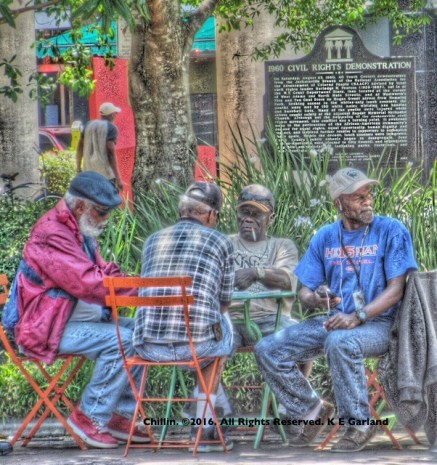
I found this out four years ago, when I posted this photo to my blog.

A fellow blogger noticed the background and sent it to her friend, Rodney L. Hurst Sr. Mr. Hurst contacted me about purchasing a copy and explained the meaning of the sign behind the gentlemen’s heads.

That sign is actually a historic site marker commemorating an important civil rights event in Jacksonville called, Ax Handle Saturday.

I was excited to hear about this little-known Black history fact and asked Mr. Hurst to a breakfast interview to understand more.

KG: Can you describe a little bit about what Ax Handle Saturday was and what happened? 

RH: I was president of the Youth Council NAACP and I led the sit-ins at the ripe old age of sixteen. My mentor was a guy named Rutledge Pearson.

KG: A school is named after him?

RH: Yes. One school is named after him. In fact, he and Earl Johnson were inducted into the Civil Rights Hall of Fame earlier this month (2016) in Tallahassee. He taught me eighth-grade American history. When I went to his class, he told me about the textbook and had other class members to talk about the textbook and then he said leave it home.

Mr. Pearson would not teach American history from the slanted and racist viewpoint of white textbook authors and historians. Our study of American history did not revolve around a book that only had the names of Booker T. Washington and George Washington Carver. We studied John Hope Franklin, Althea Gibson, and Thurgood Marshall.

The first book report I did was on a guy named Toussaint Louverture, who fast became one of my favorites. He led the only successful slave revolt in this hemisphere, eventually became the Father of Haiti, and because of what he was able to do in Central America in fighting Napoleon, and controlling the shipping routes, Napoleon had to sell Louisiana territory to this country. You will never read his name in an American history book and he is inextricably bound to the history of this country.

In Mr. Pearson’s history class, it was Black history every day in his class. He also said, freedom is not free; if you’re not part of the solution, you are a part of the problem. He encouraged us to join the Youth Council of NAACP. American history teacher in an eighth-grade class encouraging his students to join the Youth Council NAACP?

KG: You would get fired today doing that. 

RH: Sure. And I joined when I was age 11, became president when I was 15, and led the sit-ins when I was 16. The sit-ins in Jacksonville were led by high-school students, which is one of the reasons we did it during the summer, as opposed to college students who were able to do it year-round.

We sat in Woolworth’s, where the federal courthouse is now. We sat in at the lunch counters: Kress, Woolworths, Grants, and McCory’s, which were downtown stores. And every downtown department store had a white lunch counter. Some had colored lunch counters, like Woolworths, which was at the back of the store. Others didn’t have colored lunch counters, but you would go to the end of the white lunch counter to order.

KG: But you couldn’t sit down?

RH: You couldn’t sit down. If the waitresses would come and take your order, then okay. So, we said, “No!” During my senior year we sat in. We sat in for two weeks. Woolworths closed the lunch counter. There were whites who stood behind us yelling, jungle bunny, nigger, go back to Africa ‘cause they couldn’t get their fresh lunches.

Two weeks later on August 27th, we were sitting in at Grants, which was on the corner of Adams and Main Street. And there were other incidents leading up to that. We had a white student, Parker, who joined us from Florida State (University) and the whites who were behind us thought he was the leader. Some white construction workers were standing behind him with big construction tools and these guys picked him up and formed a circle around him and walked him out to safety. All this time there were no police in downtown Jacksonville.

One guy had whittled off the end of his walking cane and would walk behind each of us and stuck all of us in the back with his walking cane. Again, no police. When we were attacked, we were attacked by 200 white men with ax handles and baseball bats. Black downtown was attacked. If you were white and tried to protect those Blacks downtown, you were attacked, too. When the word finally got out, then police came from everywhere.

Mr. Hurst described what happened to Parker, the white FSU student who supported the sit-ins and also Leander Shaw, Florida Supreme Court judge’s role in enacting justice. The details are outlined in his historical memoir It Was Never about a Hot Dog and a Coke! 

But I want to stop here and emphasize a few points about meeting and talking with Mr. Hurst.

Understanding Black history in your city is important. I’m not from Jacksonville, but I’ve lived here for approximately 20 years. Prior to our happenstance meeting, I’d never heard of Rodney L. Hurst Sr. Subsequently, before our conversation, I was ignorant to the role Jacksonville played in the Movement. I’d heard of Rutledge Pearson Elementary School, but I didn’t know the significance of the person for whom it was named. I wonder if the 95% Black student population knows the rich history to which they’re connected?

Living history is important. Ax Handle Saturday occurred August 27, 1960. That’s 60 years ago. Mr. Hurst is old enough to be my father, not my grandfather or great-grandfather, my father. Sometimes, grainy documentaries make racial oppression seem as if it was eons ago. My conversation with Mr. Hurst reminded me that it was not. Luckily for the K-12 and college students he speaks to, he’s able to authenticate a perspective of a time period that is linked to our country’s history.

Teacher autonomy is important. As a former high-school English teacher, I have to highlight the autonomy teachers had in the 60s. Mr. Hurst’s history teacher was able to make an informed decision about his students and what resources they needed in order to be successful, in not only understanding history in America, but also in transforming their communities. Mr. Hurst was directly influenced by Rutledge’s off-script lessons and push to join an organization specifically with their best interests at heart. Hurst possibly would have never been a part of Ax Handle Saturday had Rutledge stuck to a scripted curriculum.

The takeaways from our interview are endless. But if nothing else, I hope these words inspire you to learn more about the influential Black people in your area because, after all, Black history is American history.

Dr. KE Garland
Katherin is a First Place Royal Palms Literary Award winning writer for Creative Nonfiction. Her work has been featured in the South Florida TimesTalking Soup and For Harriet. She typically writes in order to inspire social change. Other examples of her work can be found on her personal blog.
 
Website: kegarland.com
Instagram: kegarland
Twitter: @kegarland

The Effort Will Release It’s Reward (If You Do Not Give Up)

Copyright 2018 | Emily Rose Photography

I published my first book in 2008 and the first book I ever sold in 2010. But it wasn’t until 2015 that I learned to define what my author’s voice was, to establish an author platform, to reach people, and to truly understand what it meant to be an Independent Author. In the beginning, my books were poorly edited and formatted. I didn’t know anything about Amazon, reviews, buying my own ISBNs, imprints, nothing. (I wasn’t even on Social Media, so I couldn’t take advantage of this free platform).

I was green, inexperienced, and made no money. It took me five years (2010-2015) of publishing poor quality books to learn, and even now, I am still learning how to publish books the right way. Whatever fruits I reap now are the result of years of work, study, research, and doing it wrong repeatedly until I understood that practice only makes perfect if I am doing it right. It took me years to realize that publishing book after book (the wrong way) was doing nothing for my growth until I was ready to put in real work. It took me years to learn that this was a marathon and not a sprint. My point? It took me years to get here.

Dear Future Author, why do you want to publish a book? 

This question seems simple, but the answer is a lot deeper. The answer will require you to first define who you are, who you are writing for, and why what you are writing is important to those people. Are you writing to make a difference in the world? To educate, empower, lift, heal, and inform? Or do you just like the idea of being a published author?

One means chasing the “prestige” that comes with publishing books.

The other means putting in real work even when sales are low when you want to give up, and when no one is clapping, liking, or supporting you.

One means wanting to appear glamorous for the gram…

…and the other means doing the work in private, not just in public.

IF you are willing to do this and IF your intentions are genuine, then the effort will release its reward as long as you do not give up. 

Visions of a Historical Writer

I always get excited when I return to Historical Fiction writing. A little history and a spill of black ink, and I am gone. I am floating between centuries and languages and culture clashes. My heart races to the images still all muddled and exciting and pacing footsteps in my head. Historical figures are brushing passed me on the street and staring me down back alleyways. Don’t know if I’ll have time to whisper to A.D. King* that his brother’s not forgotten, but also, neither is he. I am speeding passed him and drifting further. I caught a glimpse of “Satchmo’s” face and a hanging tree in the same wind. Covered my mouth, though, that couldn’t stop the taste of death on my tongue. Almost choked on Billy’s voice. These fluctuations of pitch are giving me chills, that and the horn screaming at me from across the tracks where the Jazz club is housing The New Negro Movement, soon to be known widely as The Harlem Renaissance. I better catch the next train back to 2020. Jean Toomer is headed this way, and I am dangerous with this pen.

*A.D. King (Alfred Daniel Williams King) was the brother of Dr. Martin Luther King Jr. He drowned in the family’s swimming pool 15 months after MLK, but his death is largely forgotten. As his body was being taken to the morgue on July 20, 1969, Neil Armstrong and Buzz Aldrin were walking on the moon. 

Caution: Careful Not to Share Black History Memes with False Information

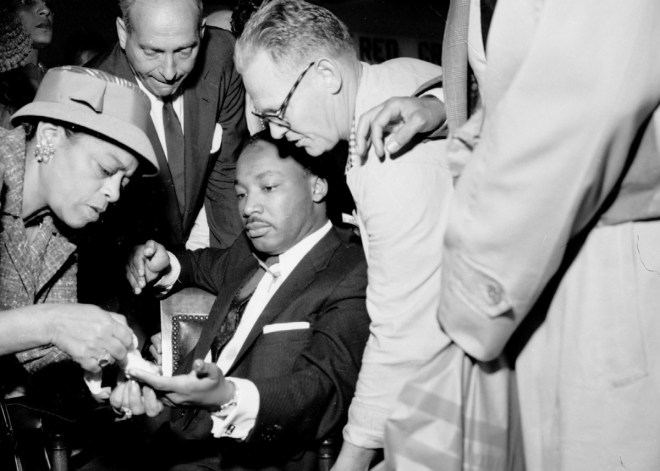
Martin Luther King Jr. recovers from surgery in bed at New York’s Harlem Hospital on following an operation to remove steel letter opener from his chest after being stabbed by a mentally disturbed woman as he signed books in Harlem. (John Lent/AP)

I am reposting this because February is approaching and we will see a lot of false information attached to Black History memes, same as always.

According to a famous Facebook post, King was not killed during an April 4, 1968, assassination attempt, but survived that shooting and was later “smothered by someone in the hospital.”

Is this true?

Let’s see.

Updated 1/28/2021

It’s Throwback Thursday so let’s go back in time a lil bit.

September 20, 1958

The year is 1958 and we are in Harlem, baby. Dr. King is signing copies of his first book “Stride Toward Freedom: The Montgomery Story,” at the Blumstein’s Department Store, on 230 West 125th Street.

It’s a nice afternoon and young King is just twenty-nine years old, releasing his first book and feeling good. And we are feeling good too because we are ready to get our copy. The line is long but before we get bored a voice makes us all stop and look in their direction.

“Is this Martin Luther King?” shouts a well-dressed black woman wearing rhinestone glasses and a matching necklace and earrings but carried an ugly brown bag and an even uglier scowl. The woman stepped out of line, causing groans from the people in front of her.

We don’t know this yet, but she is forty-two-year-old Izola Ware Curry, the black daughter of sharecroppers.

King nodded, “Yes, it is.”

“I’ve been looking for you for five years,” says Curry while pulling a letter opener with an ivory handle from her purse, which we don’t really know is a letter opener because we don’t use those anymore.

“Ooh, snap!” We gasp, placing our hands over our mouths. “Why she come so dressed up for if she was trying to kill somebody?”

“What is she doing?” says another one of us.

“Yea, man. Doesn’t she know this is Martin Luther King?”

“He not all that popular yet,” says a young black boy wearing chino pants and a white polo shirt. He put his hand in his pocket when he said it, smiled and then tilted his head like he was better than us. “Ya’ll not from here, are ya?”

Before we could answer, the sound of screams forces our attention back to the direction of the strange woman. She swings the letter opener at King, and sliced his finger then plunges the seven-inch blade into the left side of his chest.

“Oh, my God!” someone screams and just like that, the store is in an uproar. We are all screaming and running as someone apprehends the woman.

We look at King secretly hoping she didn’t get him because we still kinda want our book.

But when we see somebody who looks like our Grandma rush to his side, we know that’s not going to happen.

Dr. King is sitting in this chair all calm and cool like he ain’t just been stabbed. Meanwhile the letter opener’s ivory handle is still protruding just below his collar.

The police arrive. “Don’t sneeze, don’t even speak,” says Officer Al Howard, fearful of the blade’s proximity to King’s heart. Because of how the letter opener hit him, if King had sneezed, he would have died.

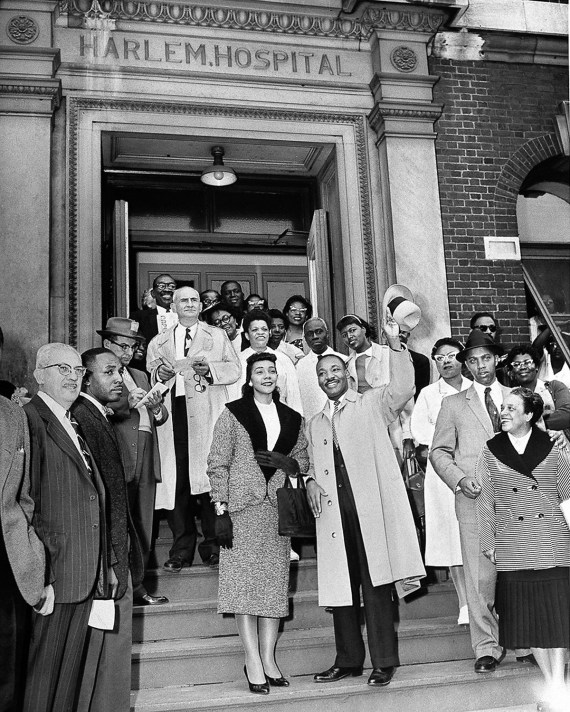
So, they move King slowly and carefully and take him to Harlem Hospital, and he undergoes emergency surgery.


Then, we jump in our time machine and head back to 2021 because it’s wild out here in the 50s.


Oct. 3, 1958
King leaves the hospital almost two weeks after the stabbing

The photo at the start of this post is not of Dr. Martin Luther King Jr. after being shot in Memphis, Tennessee in 1968.

That is a picture of Dr. King ten whole years earlier in 1958 at a New York Hospital after being stabbed at his book signing. He spent almost two weeks in the hospital recovering.

“If I had sneezed, I wouldn’t have been around here in 1962, when Negroes in Albany, Georgia, decided to straighten their backs up. And whenever men and women straighten their backs up, they are going somewhere, because a man can’t ride your back unless it is bent.” – Martin Luther King Jr., “I’ve Been to the Mountaintop.” April 3, 1968

I hope this creative backdrop added some perspective. Although I wrote it like a short story, everything I said here is the truth. Izola Curry, really did attack Dr. King at his book signing in Harlem.

Now to the original post…

There are tons of Black History memes circulating on the internet and this number has increased even more due to it being Black History Month. However, many of these memes are not historically accurate. Please be sure to double check your facts before sharing. Otherwise, you are guilty of spreading disinformation.

Black people have contributed to the world so that we don’t have to make stuff up. If you see a meme with a fun fact on it, just open the internet on your phone and type the name or fact into the search bar. You can tell from there if the material is accurate or not. Sometimes it will even come up that the information is an opinion or cannot be verified by any trusted source.

Use not only your phone to log into Facebook, Twitter, and Instagram. Use it to research these things and educate the people right.

Look for scholarly, peer-reviewed articles on .gov, .edu, or .org sites and trustworthy blogs. Peer-reviewed means information from a reputable source, information that shows that other professionals have reviewed and deemed it worthy of publication.

Wikipedia is not a credible source alone. Other trusted sources should support anything gained from Wiki.

And on the Monday of MLK day when everyone takes off and celebrates his legacy, remember that he was born on January 15, 1929, not whatever Monday you take off.

3rd Annual Poetry Contest Spotlight 2019: Introducing Dondi Springer

Dondi A Springer is a happily married man and has been writing for a lifetime. At 43-years-young he never took writing seriously until his wife told him he should do something with it. “I was mostly inspired by the strength of my mother,” he says, “and also my own life experiences. As a champion of the underdogs, I strive to constantly grow, and show that through personal growth anything is possible.”

We are certainly glad you kept writing Dondi!

“Faith has already brought you farther than you can see
You crawled before you walked, bumped your head, and scraped those knees
Tears burning, blurring your vision, and yet wiped from your cheeks..”

-Excerpt from “Look Within”

Springer’s submission, Look Within is a short inspiring piece about looking within to find the strength that we need.

Dondi, please tell us what inspired your poem.

“My personal mantra is Ignorance Does Not Open Doors (I.D.N.O.D.), and ignorance did not overcome me. You can find plenty of positive energy, and motivation on my social media pages, and stay tapped in for what’s coming next for me.”

Copyright©Dondi A Springer

Springer has had poems published by the National Library of Poetry and is working hard on several projects.

Keep in touch with Dondi by following him online at the Social Media handles below!

Instagram: @napalmjax

Facebook: @DSpringer76

Twitter: @MrSpringer76


Kiyana Blount is up on Wednesday! Hit the subscription button so you don’t miss it!

Peace and hair grease!

14 Things Writers Miss When Building Their Author Platforms | Christa Wojo.

Authors, this is a must-read. I’ve known Christa now for a few years. She knows her stuff. Personally, I am not a big fan of automation (#11) and I can work on #12 myself (I am pretty good being consistent on Twitter and the Blog but I need to work on Insta and Facebook) but pay special attention to #1.

It’s well worth the extra money to invest in a domain name for your website/blog. No matter how you spin it, sites with yourname.wix, yourname.wordpress, yourname.weebly, etc. will never be as professional as yourname.com. Even if you are not an author reading this, if you have a business invest in a domain name. You may have to pay a little extra a year but you’ll make that back in sales because it is easier to find your site. It also becomes easier for media personnel to find you too for other projects. An interested reader will most likely Google your author name dot com so try for that before getting a dot net.

👇🏿Click on the link Below 👇🏿

14 Things Writers Miss When Building Their Author Platforms