James Shober was an African American doctor and the first Black doctor in North Carolina. James was born on August 23, 1853, in what is now Winston-Salem, North Carolina. James father Francis Edwin was a white businessman and politician who served in the North Carolina state legislature and the United States Congress. His mother was an 18-year-old enslaved woman named Betsy Ann.
Betsy was of mixed race who lived in Salem and passed away in 1859 when Shober was between six and seven-years-old. He was sent back to the Waugh Plantation near Waughtown, North Carolina, where his grandmother lived with other family relatives.
Educated at Lincoln University in Oxford, Pennsylvania, Shober then enrolled in the Howard University School of Medicine in Washington, D.C. where he was one of the forty-eight graduates in 1878.
Image from Library of State, James Shober
After graduation, he began practicing medicine in his home in Wilmington, then the state’s largest city. Shober was the only Black doctor in a city of more than 10,000. There were only a handful of licensed black doctors across the United States following the Civil War. Shober now joined those ranks in 1878 and became the first professionally trained Black physician in North Carolina.
On June 28, 1881, James married Anna Maria Taylor, an educator who taught at the Peabody School in Wilmington, and they became the parents of two daughters, Mary Louise and Emily Lillian. His daughters both graduated from Fisk University and pursued a number of professions. James Shober died young, at just 36 years-old on January 1, 1889.
I have always enjoyed looking at book covers. Choosing a cover is my favorite part of the Indie Book Publishing process. In the beginning, I didn’t care too much about the cover and that was cool. But then, as I matured, I started to look at my writing differently. I stopped looking at my writing alone and started looking at the book as a complete package. In doing so, I’ve learned that the best chances of a book succeeding is not just one thing, but a collection of things. Not just a nice cover alone or a well-written story alone, but everything together. That is what I’ve learned, and that is how I will look at book publishing from now on. I will look at the process as a complete piece, a body that I must dress not just outwardly but inwardly and not just inwardly but outwardly.
I have had a little success with I am Soul so I thought I’d talk a little bit about the evolution of the cover and how I think it has played a major role in that success.
To start, I wasn’t going to even release this book when I did. I was supposed to release book two of Nora December 20, 2017, my mothers birthday. Instead, I pushed that book back (it wasn’t ready) and released I am Soul.
I am Soul is a collection of poems from this blog as well as my personal journal, collected, compiled and edited into what is now my 4th collection of poetry. I call it I am Soul because some of the poems are personal, some of them are centered around the African American experience (a people of Soul) and also because people have always said that I have an old soul. Even as a kid people have said that I was mature for my age. For these reasons, I am Soul.
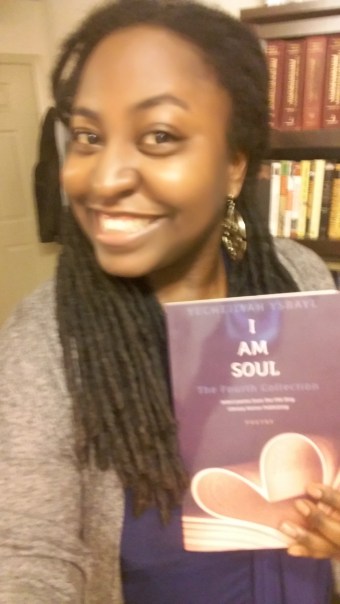
Grainy pic of me and I am Soul with old cover.
The first cover was decent. I liked it a lot. A purple book with a heart-shaped bible page. It was nice enough to land me the #7 spot in the African Literature category of Amazon before release day. It started at number 17, then dropped to number 9 and then number 7.
But…
I liked the cover a lot but I didn’t love it. I couldn’t help but notice that the cover looked better electronically, to me, than it did when the paperback arrived. It also didn’t stand out very well on Amazon.
I still think this is a cute cover but it doesn’t look all that great offline. Once the book printed it didn’t look the same. The dark blue on top the purple didn’t pop. In fact, this is still the cover on Goodreads. I don’t know how to change it. At first I didn’t care but after awhile I had to follow my heart and change the cover. (A privilege of publishing books Independently. You can change what you want, when you want.)
I decided to try something that matched the name of the book and the content in full. When you think of Soul you think of something deeply personal and connected to that individual.
Soul is something Israelites (Blacks) have always had (think Soul Train), from our hair styles to our creative way of dance, the way that we dress, the way that we sing, and the way that we speak. We set the trends and nothing was more trendy than the Afro at the peak of the Civil Rights and Black Power movements. From the practice of shaving the head to pass as a free person in the antebellum south, to the Afro of the 60s and 70s that said that Blacks were proud of who they were and free to be so openly, natural hair had made a comeback.
Young, beautiful Cicely Tyson.
In the 1950s-60s it was common for Black women in Africa to wear their hair in small bushes. In America, Black women stopped straightening their hair. Women like Nina Simone and Abbey Lincoln are examples. And then Miriam Makeba (“Mama Africa”) emerged with a fro in the January 1960s issue of Look Magazine and Cicely Tyson wore her hair in a fro on episodes of the CBS drama East Side, West Side. And as college students and political activists like Jesse Jackson and Angela Davis started wearing fros, the fro had eased on into the mainstream.
Before and After
It wasn’t just about hair no more than Samson’s locs was about being trendy. Those locs were a representation of power and strength and so the Afro was a representation of the social-economic and political era of the time. A time when Black men and women were gaining strength and reclaiming parts of their lost heritage, one hairstyle at a time. A similar revolution is taking place today. Black men and woman are embracing more of their natural selves and waking up to the true knowledge of who they truly are.
For all of these reasons, I felt an image of a Black woman wearing a fro spoke volumes concerning the kind of messages I was seeking to give with the poetry inside of the book. Not just the soul of one woman but the soul of a people. The soul of an era.
I still think both covers are nice in their own right but the one that sticks out the most and which embodies a much more clear message; the one that will not just appeal to those who are biblically conscious but reach a larger audience; the one that makes people stop in their tracks, is the new cover.
When I uploaded this to social media, readers responded immediately. This had not happened with the first cover.
The new cover got me new reviews…
I submitted this book to two different bookstores. One using the old cover and one using the new cover. The one with the new cover got a call back and the book is beginning to sell at the store. I am still waiting on a response from the store using the old cover.
I’ve learned that book covers really are important because I’ve experienced how important they are. Don’t get me wrong, content is just as important. At the end of the day if there’s nothing special to read there’s nothing special about the book. I am Soul still had to be edited and get through the bookstore’s professional reviewers to be stocked.
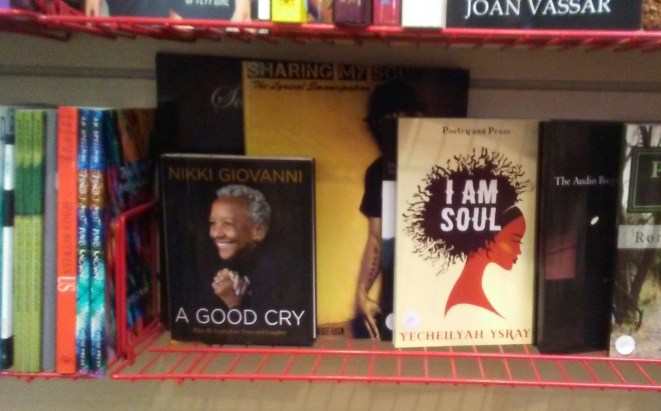
But, when I walked into the store yesterday, I couldn’t help but notice that because of the cover, Soul stuck out more than some of the other books that I could tell, as an Indie Author, were also self-published. In fact, to my surprise, Soul was sitting right next to Nikki Giovanni’s A Good Cry. Whether someone just sat it there or not, I cannot be sure. But, I was sure enough proud. I wasn’t going to taint the moment with thoughts of how it got there. It was there nonetheless.
Today is the Release Day for Yecheilyah Ysrayl’s latest creation! I have been looking forward to this one since I read Book 1 – Renaissance: The Nora White Story back in June of last year.
The story of Nora White continues where it left off from book 1 in the series. As expected it was a whirlwind of excitement.
The story once again toggles between New York, Nora’s new haven and Mississippi, her roots.
I found myself enthralled with this story. The way the author blends the actual events of the past with her fictitious interpretation is compelling. The visual depictions of the surrounding had me inside the room when Nora was waking from one of her spells. I could smell the open air of the South and feel the breeze on my face at the lake. I had the feeling that if I took a step, I would enter…
Kanye West, Waffle-House, Childish Gambino, Roseanne, and elderly Black women being manhandled by police is but a snippet of what’s going on. I can turn on my television or more precisely, open my computer, and see a similar scene as a 1960s protest march. I see people sitting in again at restaurants, I see people marching down the streets, I see cops fighting young black boys, and I hear of black bodies being found hanging from trees again (often ruled as suicides.)
This is America.
They say a people without knowledge of its past are doomed to repeat it. I wonder how many of us realize that the past is repeating itself? And I am reminded this is why I write the kinds of stories that I write and why I think Black Historical Fiction is important (and also maybe a tad bit underrated). Often, I see Romance, Urban Fiction and Street Lit praised as the epitome of Black Literature among many Self-Publishers / Indie Authors and Indie readers. But let’s not forget that black history is important too, and should not be left out of the Indie Author revolution.
After my most recent book release, I was amazed at how many people (Israelites, so-called African Americans, Blacks) didn’t know who Marcus Garvey was, what the Universal Negro Improvement Association was, or could make the Marcus and Malcolm connection in the book. (More on this later but briefly,Malcolm X father was a follower of Marcus Garvey and Malcolm’s nickname was Red among other names. I named Nora’s boyfriend after Malcolm X in his honor and gave him some of his characteristics.)
I know that many of us have been awakened to the true knowledge of who we are and have reclaimed parts of our lost, ancient and biblical heritage. We are waking up in droves and understanding the important role that identity plays in the state of Black America today. I am talking about the Hebrew Israelite movement and the number of people returning to the bible as a source, not of religion, but of black history and instruction on how to live on the earth. But that does mean we should toss aside our history in this land as unimportant since it has all played a role in who we are and where we stand today.
To be a true educator, you must first be educated and with extensive knowledge of what you’re teaching and if this is history, it’s even more critical to understand it all. (I am no one special and I don’t know everything. I am only repeating what I have already told myself about how important it is that I study history. All of it.)
Yes, it’s important to know who Moses was, King Solomon, Queen Esther, King David, and all the prophets, prophetesses and servants (who were all Black). But, it’s also important to know who Mansa Musa was and his influence in Timbuktu, Queen Yaa Asantewaa (Phonetic spelling Yah asante wah), Haitian Revolutionary, Toussaint L’Ouverture, Hannibal, Nat Turner, Marcus Garvey, Ida B. Wells and so on. These are the people whose shoulders we stand on and knowing their stories are still important. As well as other facts. If we talk about the European Slave Trade let’s also talk about Islamic slavery. If we talk about white slave owners, let’s also discuss Jewish and Native American slave owners as well.
History is important in general because if you don’t know what happened before, how can you properly arm yourself against ensuring that the bad things do not happen again? You cannot focus on repeating only the good things if you don’t know what is good.
Dear Black Indie Readers, African American Historical Fiction is important too.
“Once you change your philosophy you change your thought pattern. Once you change your thought pattern, you change your attitude. Once you change your attitude, it changes your behavior pattern. And then you go on into some action.” – Malcolm X
“A people without the knowledge of their past history, origin and culture is like a tree without roots.” – Marcus Garvey
———————————————————————————————————–
For more Black History Fun Facts, be sure to visit the Black History Fun Fact Friday page and to follow this blog for Black History all year around! Revolution, part 2 in The Nora White Story is also now available on Amazon. Free with Kindle Unlimited.
On June 1, 1921, the systematic destruction of years of building was made manifest in less than 24 hours. Also known as “Little Africa,” the black business district of north Tulsa, Oklahoma lay fuming—a model community destroyed, mansions melted down to the ground, hope stretching its mournful arms forward in a desperate attempt to hold on to its dear Greenwood.
It began the same way it always has, with a black man accused of accosting a white woman. On May 31, 1921, “the Tulsa Tribune reported that a black man, Dick Rowland, attempted to rape a white woman, Sarah Page. Whites in the area refused to wait for the investigative process to play out, sparking two days of unprecedented racial violence. Thirty-five city blocks went up in flames, 300 people died, and 800 were injured.” (Fain, Kimberly, 2017)
This was the beginning of what culminated in the destruction of the Greenwood community.
Greenwood is a neighborhood in Tulsa, Oklahoma. It was one of the most successful and wealthiest black communities in the United States during the early 20th Century. It was popularly known as America’s “Black Wall Street” because its financial success mirrored Wall Street. During the oil boom of the 1910s, which gained the town such titles as “Oil Capital of the World,” the area of northeast Oklahoma around Tulsa flourished, including the Greenwood neighborhood. Home to several prominent Black business people, the community held many multimillionaires.
Greenwood boasted a variety of thriving businesses that were very successful up until the Tulsa Race Massacre. Not only did blacks want to contribute to the success of their own shops, but also the racial segregation laws prevented us from shopping anywhere other than Greenwood, forcing us to be in support of our own people and thus contribute to the success of our own people.
Greenwood became the mecca of opportunity to build up what Black people had been denied access to. Instead of complaining, we were not included in the all-white Newspaper we created our own (two). Blacks were discouraged from using the new Carnegie Library downtown for whites, so they built their own smaller all Black branch libraries. Not stressing over being left out of restaurants, grocery stores, and public schools, they made their own on the backs of a drive toward honest entrepreneurship.
Clothes bought at Elliot & Hooker’s clothing at 124 N. Greenwood could be fitted across the street at H.L. Byars tailor shop at 105 N Greenwood, and then cleaned around the corner at Hope Watson’s cleaners at 322 E. Archer. The dollar in this community rotated 36-100 times, taking as long as a year before it left the community (today, the dollar leaves the black community in less than 15mins).
These were not people who started wealthy; they were neither businessmen nor businesswomen, but being locked out the whole of society (stripped from employment in the oil industry and from most of Tulsa’s manufacturing facilities), these men and women toiled at troublesome, often dirty, jobs. They worked long hours under trying conditions, but their paychecks built Greenwood, and their hard work helped build Tulsa.
Following the massacre, the area was rebuilt and continued to thrive until the 1960s, when integration allowed blacks to shop in once restricted areas.
“By the 1940s, the Greenwood District was rebuilt, but due to integration during the Civil Rights era, never regained as much prominence.” – Kimberly Fain, 2017
This community is one example of the power of support, not just for black businesses but for entrepreneurship in general. While liking social media posts is beautiful, it is financial support, dedication, and consistency that ultimately helps small businesses grow into larger companies, support and hire their own, thrive, and empower a community.











 of the past with her fictitious interpretation is compelling. The visual depictions of the surrounding had me inside the room when Nora was waking from one of her spells. I could smell the open air of the South and feel the breeze on my face at the lake. I had the feeling that if I took a step, I would enter…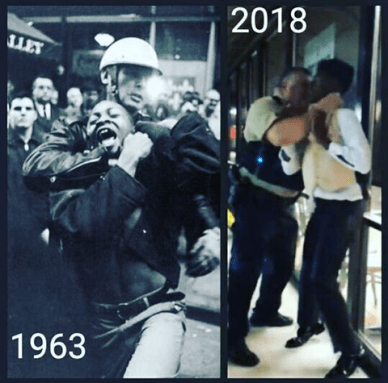


 The PBS Blog