When I was ten years old, my family moved to Milwaukee, Wisconsin, just months after learning to walk again after the car accident. It was the only time we did not live in Chicago during my childhood.
Shortly after moving into a big, beautiful home, we were evicted. With only a few family members in the state who decided we could not live with them, my mother and her three daughters went to a woman’s shelter. My brother was welcomed to stay with an older cousin, but she didn’t have room for the girls.
I’ve gone days without food, months without a roof, and years without the kind of nourishment most people take for granted. So watching people mock families who are about to lose their SNAP benefits isn’t just sad — it’s cruel, and it reminds me how easily empathy gets lost in comfort.
In a matter of days, many American families face the risk of losing their food stamp benefits as the Trump Administration intends to cut payments, affecting about 42 million individuals across the nation. What people are feeling and witnessing is not about lazy parents who are not working to put food on the table. This is about a trash economy that has forced even the hardest-working families to rely on assistance. You might not need it today, but that doesn’t mean you won’t need it tomorrow.
Before the stock market crash of October 1929, there was a time of optimism. Many families prospered as cars and new technology grew. People did not expect to go to their banks and be locked out without warning. Families didn’t expect that they would have to stand in bread lines. It happened suddenly, and it could happen to you, too.
“The loss of SNAP benefits leads to food insecurity, hunger, and malnutrition, which are associated with numerous negative health outcomes in children, such as poor concentration, decreased cognitive function, fatigue, depression, and behavioral problems.”
“Food stamps fed all of us. Medicaid paid them hospital bills. WIC kept formula in our baby’s bottles. Free lunch stopped our stomachs from growlin in class. The projects gave most of us a roof when we ain’t have one. Financial Aid got a lot of ya’ll them degrees you flexin now. We’ve all had help at some point, so quit looking down on folks still getting it. You just forgot what struggle felt like. Don’t get too high up…the ground still waiting if you fall.”
Contrary to popular belief, self-published books can get into brick-and-mortar bookstores.
Ask me how I know…
Here Are Three Easy Ways to Prepare Your Self-Published / Indie Book for a Store:
1. Have a professionally designed cover with your name and title on the spine.
Usually, I will tell you to ensure it’s edited first (do that, please), but I want to highlight book covers here because they become even more important offline.
Imagine you are in Barnes and Noble (or anywhere) looking for your next read. The cover is going to attract you first.
Also, because you see it from that point of view, the book becomes easier to notice if the name and title are on the spine.
Some bookstores also take your book through a review process, where their team has to vote on the book. If the cover is poor and the editing is not up to standard, they’ll reject stocking your book.
2. Buy Your ISBN from Bowker
You can get your book into Independent stores with a free ISBN on consignment. However, having your book registered under your or your company’s name is a plus if your target is larger chains.
It’s a plus because bookstores hate Amazon’s guts. As soon as they see you are published with Amazon, they are judging you and already trying to come up with a way to let you down easy. It’s almost an instant no.
Publish with Kindle Direct Publishing for Amazon only. Do not choose the expanded distribution. This option puts your book into Ingram Spark’s system but under Amazon.
Instead, you will opt out of this and create your own Ingram account.
Then, you are going to publish your book there as well.
This will allow bookstores to order your book directly from Ingram Spark through you instead of Amazon should they decide to carry your title. It also prevents you from bringing copies in yourself, which you would do under consignment.
High achieving authors (Indie, Trad, or otherwise) tend to fall into a few categories:
They publish high-quality books (well-edited, dope cover art, and well-formatted, to name a few).
They collaborate with other authors and business people.
They use their book to create additional income streams through businesses and services.
Today, I want to focus on that last one, although all these are important.
No matter the route, book publishing is hard work, and most of the work happens after the book is written and published. Most of us find ourselves saying, “Dang, now what?”
Depending on what your book is about, there are so many creative things you can do to leverage your self-publishing career.
Here are a few things I do based on the kinds of books I write:
From writing black historical fiction, I lecture at schools.
and so on…
Some authors even have high-ticket courses based on the chapters in their books. Podcasts and workshops based on the book are also ways people leverage their books.
The key point is to look at the book not as the end but as the beginning. Let it (the book) stretch you to new heights!
First, you want to determine how much the event host will charge you to be a vendor and what that fee entails. My requirement to vend at any event is that the fee includes a table and two chairs. Some businesses demand that you supply your own table and chairs. That feels like renting space with no space to me, but everyone’s different.
Whatever you decide, ensure the cost is reasonable and within your budget. So, if you have to bring a table (which you’ll probably have to buy), the vending fee should not cost an arm and a leg.
There is an exception to high ticket vending costs based on the influence of the event. See bullet point #3.
2. Travel / Lodging
This is a must if you decide to vend at a location outside the city/state where you live. This means the cost of vending takes on a more significant role because now you will have to consider: the cost of vending + travel + hotel.
This is where you should keep in mind that you are a business, not just an author, and that choosing to sell your goods at events is a business decision. Take into account the event’s quality if you must travel and do other things.
3. Consider the Influence of the Event Host / Audience
We talked about this last time, but I want to discuss it from a different angle.
Events that offer a chance for people to become vendors come in all shapes and sizes. Some events are hosted by first-time event hosts, and some by larger influencers and celebrities. Both are wonderful growth opportunities.
When deciding where to put your money, consider whether there will be a sizable enough crowd for you to conduct business outside of the vendors. The one con to vending at an event that can only produce a crowd within the vendors is that it will be difficult to conduct any commerce because we are all there for the same reason.
Vending is also about connecting with powerful influencers who could help propel you to the next level. In this case, the cost to vend might be pricey, but the event’s influence makes up for it because of the people and powerful connections you can make. (Think Essence Fest and Invest Fest)
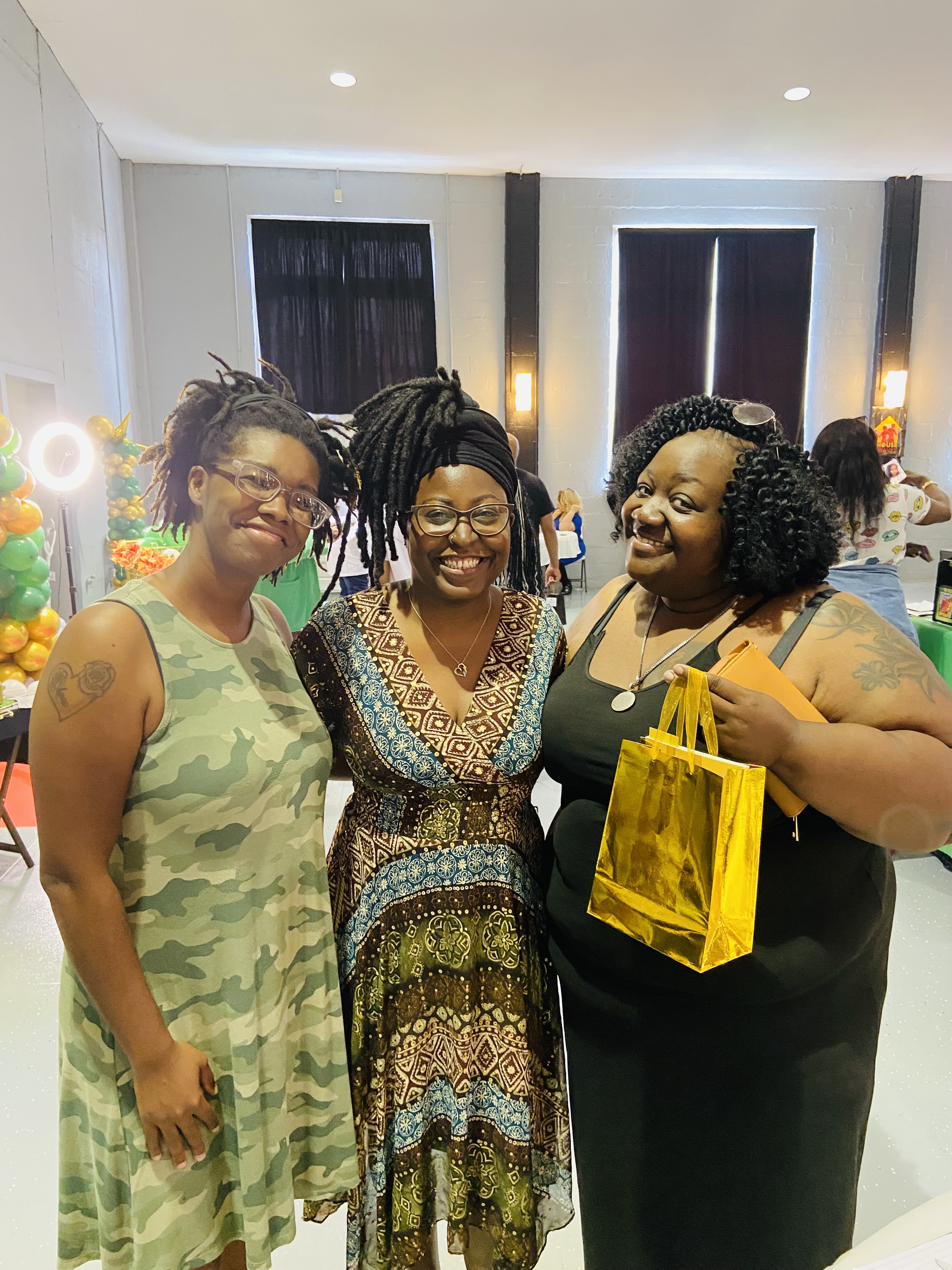
Excited supporter!
While vending at Black Writer’s Weekend last year was a bit costly, here are some things that made me decide to give it a try:
BWW and its founder Tamika Newhouse are pretty well-known in Atlanta. I knew the event would bring out a large enough crowd for me to engage people beyond the vendors, and it did. I made my vending fee back.
Included my mandatory table and chairs.
I did not need to travel far since I am in the Atlanta area, so no funds were needed for hotel or travel.
4. Engagement and ROI
If you are just going to sit behind your table looking mean, scrolling through your phone, and waiting for people to talk to you, vending might not be for you. If you intend to make a return on your investment, you will have to engage with people.
Here are some things that have been helpful for me.
Stand up and stay off the phone during high-traffic moments.
Bring a helper/assistant (hence the two chairs I always require when I vend) so you can leave your table now and again to talk to the other vendors and guests, take bathroom breaks, etc. My helper is my husband, who is fully trained (lol) on how to talk about my books in my absence. However, I am never too far away from my table.
Try not to look bored and mad (even if you are). Smile and speak. I always give people an excited “Good Morning!” or “Good Afternoon!” You’d be surprised by the people who will stop at your table just from you being friendly and pleasant. I also take note of certain non-verbal clues that people might be interested. Staring at my station but not speaking, walking away but turning for another look, studying my banner (because, how do you pronounce this name?) are all signs I use to engage people further.
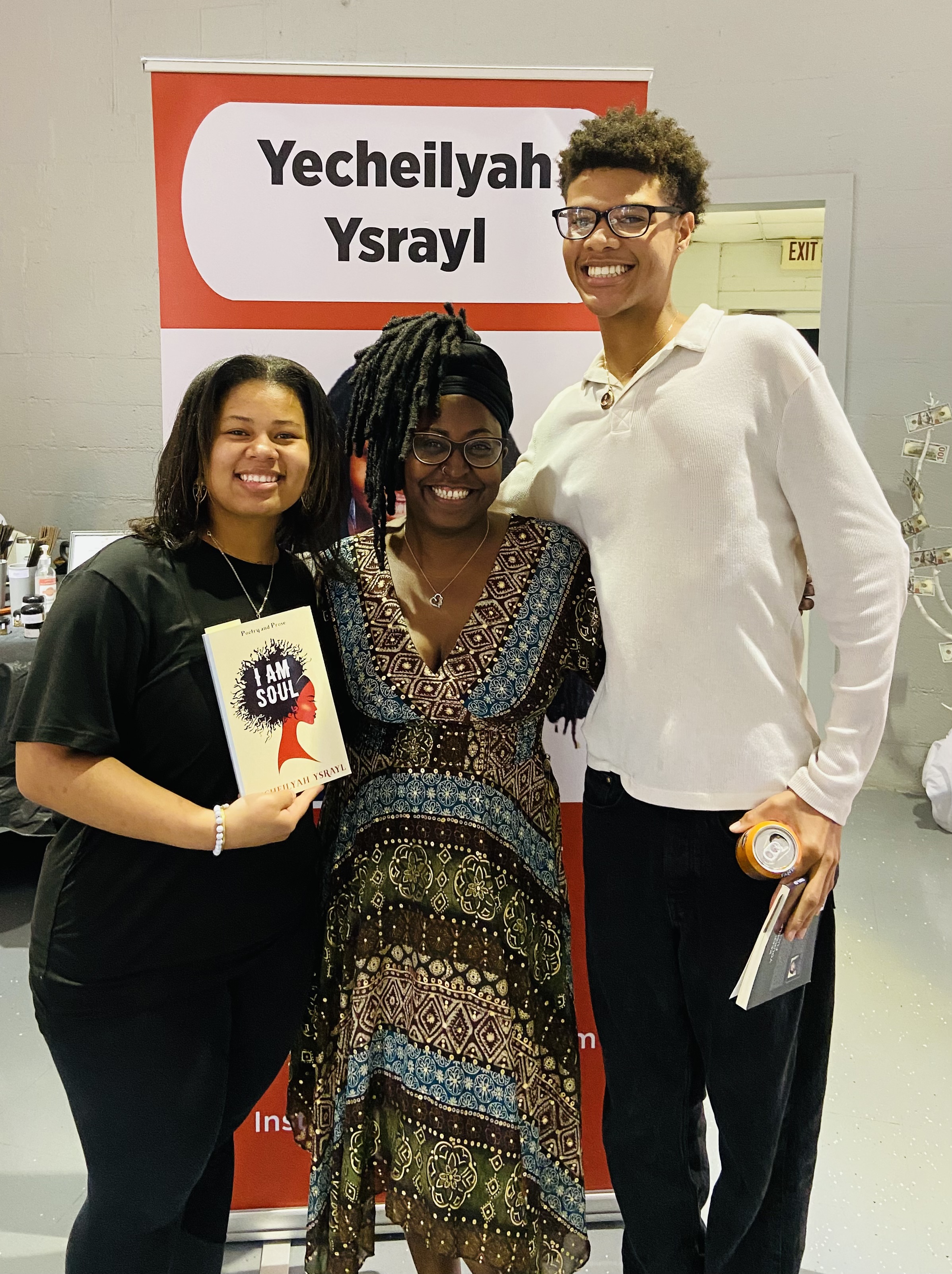
I sold these two books from calling them over when I saw them do a double take!
5. Inventory
Last but certainly not least is your inventory!
Do you have enough books to go?
Business cards and bookmarks?
Marketing materials?
Give yourself enough time to get all your tools together before the event and include that in the cost! Remember, as Indie Authors, we have to buy author copies.
Bonus: New Lessons
In part one, I joked that authors should vend at events focusing on books to avoid competing with the lady selling shea butter.
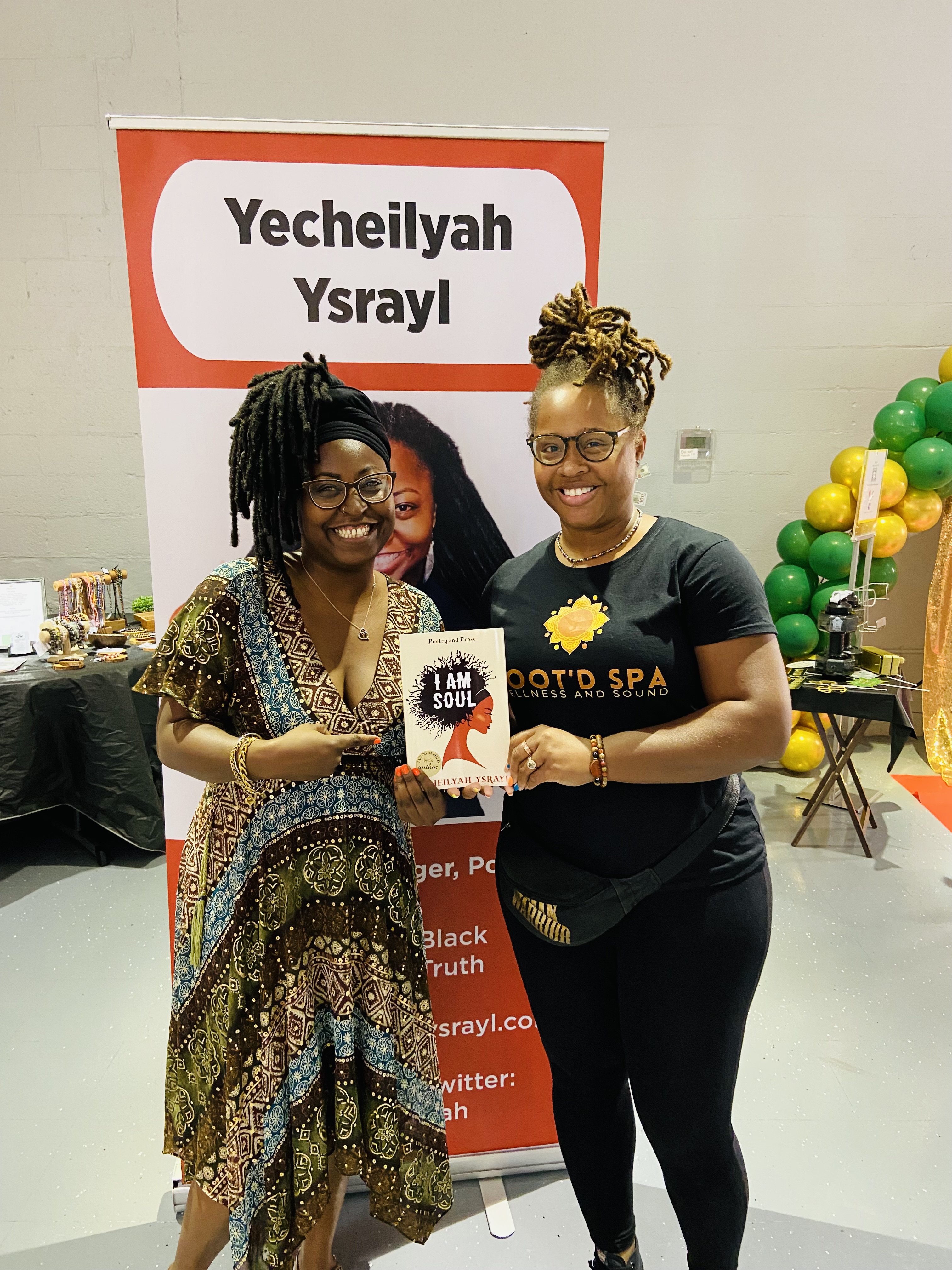
Well, I did meet a lady selling Shea Butter!
And her table was right next to mine, she also has locs, and wears glasses.
I learned a new lesson:
Of everyone at the pop-up, I was the only one with books. This set me apart and made people feel like I was the bookstore part of the event. And I did pretty well!
Even if it’s not an event focusing on books, you can do well as the only person with books or one of a few.
The Shea Butter woman’s name is Jenesis, and she runs an alternative and holistic health service business called Root’d Spa with various wellness products.
She bought a copy of my book, and I bought a bracelet from her! We are now following each other on social media.
Shea Butter Lady Jenesis!
Recap:
Consider not just the fee but also: vending fee + travel + lodging + inventory
Be ready to work
Bring a helper/assistant
Speak up and be kind
Consider the event influence for high-ticket vending opportunities
Always be on the lookout for new lessons and perspectives. You might just find your next business partner!
I once paid $300 for a book cover. At the time, I couldn’t afford to spend that kind of money on a cover. Not only did I not have the money, but even if I did, I couldn’t afford to invest it into a book cover when there were, as I saw it, much more severe priorities in front of me. But, I was young and excited, and I wanted to publish this book, and I wanted that cover.
But I was broke, broke.
So, what did I do?
I set up a GoFundMe.
I went around to people I knew and explained my vision and why I was raising the money. I (and get this) talked to people.
And I don’t like talking to people.
Not only did I make enough to purchase the cover I wanted, but I also made that money right back at a Book Signing in Chicago.
It was 2014, and we were at the Doubletree Hilton Hotel. I had just released my first screenplay, which, interestingly enough, is the book that inspired The Women with Blue Eyes: Rise of the Fallen.
I made that $300 back and then some.
You might be thinking, “But, EC, if you couldn’t afford to pay for a book cover, how did you cover editing?”
I didn’t. I had a friend edit the book, which is why it is retired today.
Photo by Annelies Geneyn on Unsplash
Self-Publishing is an area where the term, Proper preparation prevents pissed poor performance holds much weight. We don’t talk about it enough, but financial planning is part of the basics of Self-Publishing.
Self-Publishing requires a mindset shift regarding how you feel about yourself and how you look at your finances. One of the first things I’ve noticed in my journey is that most first-time Self-Publishers haven’t decided if they are publishing this book for themselves or publishing the book for others to read.
Did I confuse you there? Read on.
Publishing for Yourself vs. Publishing a Book that Sells
Photo by Jp Valery on Unsplash
Publishing a book for yourself means you fulfill your dream of becoming a published author and want to give copies away to family and friends. It means you are not selling the book or wanting to create a business out of it; rather, you want to satisfy a desire for something you’ve always wanted to do.
In this case, it would not be necessary to put a lot of money into this project, mainly because you are not getting the money back through sales since you are not selling the book. You may decide to get your book cover made using a cover template from KDP or Lulu or a homemade cover from Canva. You might choose to have a friend edit the book for you or use free software for formatting. This would be sufficient for a book you don’t want to sell. There are tons of economical ways to publish a book for this purpose.
But, suppose you are publishing this book because you want to leverage your business, spread your message and get it into as many hands as possible. Suppose you are a speaker and want to sell copies at your event, see your book on Amazon and Barnes and Noble or get the book stocked at bookstores, libraries, and schools.
What if you are writing this book because you want other people to read it?
In this case, you must prepare for this journey from the mind of a business person and not only an author.
When you publish a book you intend to sell, you consider other factors outside of what you want from the book because this book isn’t only for you. You think about building a platform, the market, and you consider the financial obligation necessary to bring the vision forward.
This isn’t to say write a book that doesn’t speak to your soul. It means you publish a book that speaks to your soul and the soul of others. It means you are publishing a book you see is needed in your community.
“You may have a robust knowledge of quantum computing but if everything the audience wants from you is how to use Microsoft Excel, give them just that. You write no book about quantum computing until you are able to build an audience around it.
Most self-published authors don’t do this. They do the exact opposite. They write what they like and try to figure out how to shove it down people’s throats.”
-David O, Entrepreneurs Handbook
Publishing a Book You Want to Sell Requires A Financial Investment
Photo by Michael Longmire on Unsplash
Spending money on your book is only an investment if you have put a strategy in place designed to ensure how you will sell this book. This, in my experience, is the difference between publishing for yourself and publishing a book for other people to enjoy as well. Many authors who venture into Self-Publishing ignore the market, so the book doesn’t sell outside of close family and friends because they have written a book no one wants to read.
When was the last time you bought a book by an author you have NOT been following for some time, on a subject you really don’t care about?
This is called Indie Author Basics because we focus on laying a strong foundation (a well-written and packaged book) to make it easier to build everything else on top of it. Too many new Indie Books are not attractive, not well-written, poorly produced, and is about topics no one cares about. As a result, the average self-published author makes less than $1,000 per year, according to a survey by Guardian in 2015, and a third of them make less than $500 per year.
What does this have to do with preparing financially?
When authors publish books they intend to sell for reasons outside of themselves, they are mentally prepared to invest the time and money to produce a high-quality product because they know they will get a return on their investment if done right.
Again, an investment isn’t just putting your money into something. Investing is putting your money into something you know will yield a return, either financially, mentally, or spiritually. It is the act of allocating resources with the expectation of generating an income or profit.
That’s why we had to talk about if you want to even publish this book to sell it first because not everyone wants to publish a book to sell it, but for those who do, financial investment is necessary.
My dope $300 cover for my first screenplay
My books do not sit on the shelves with major traditionally published books (and sell) because I’m the best writer or because I have the best books or even the best marketing strategy. I also put good money into producing my books, among other things. I wasn’t going to say this, but it needs to be said that I practice what I preach.
It also needs to be said I am on a budget just like most of us, but I prepare early for this so that what I do invest into publishing my book isn’t coming from the money I need to grocery shop or pay bills. It is coming from the money I have saved and put away specifically for this project since I first decided I will publish the book. That’s how seriously I take my writing.
I am not saying spending lots of money on your book will guarantee sales. It won’t. You first have to publish a book people want to read. (Although I got my money back from what I spent on the cover from the screenplay, the book did not continue to sell after that.) But, after that, making sure the book is well packaged plays its part too.
I am also not telling you to sell a leg to publish your book. There is nothing wrong with finding economical ways to publish (premade covers are cheaper than custom made), but if you try to find the cheapest way possible or skim on editing because you don’t want to put in the work, it will only cost you more in the end.
Due to how the royalties are structured, an author with a 99cent ebook on Amazon will only get about 35 cents per sale. For books priced between $2.99 and $9.99, there is a delivery cost for the ebook file (based on the size) for each book sold.
You also pay Amazon a sales commission based on your royalty rate.
35% royalty: the Amazon sales commission is 65% for books priced below $2.99 and above $9.99
70% royalty: the Amazon sales commission is 30% for books priced between $2.99 and $9.99
What about taxes?
You pay that too.
These are just a few reasons why it can benefit you to sell your book directly to readers from your website.
While I have only made a few dollars in ebook sales from my new book, my print book preorder sales from my website are doing far better, and I am close to making money back from the cover art. By the time the book releases next month, I expect to make back what I paid for editing.
I am going to make this post real short because it’s real simple.
The hard truth is that if you are not selling books through your website or worse, you don’t have an author website, you are leaving money on the table.
While some authors have chosen not to deal with Amazon at all, it’s smart to make sure your book is on Amazon for a few reasons.
To start, Amazon is a giant. To have your book available there is just good sense. People trust Amazon, so some people will look for your book there before they look anywhere else. And with the pandemic, people use Amazon regularly. It’s all about making it easy for your readers, and being able to tell them to go to Amazon isn’t only super cool, but it’s also super easy.
But while Amazon is easily accessible to your readers, the relationship between Amazon and you as the author is a bit different.
There are tons of authors making good money from Amazon, but they are not the majority.
Here is an example from an author about his Amazon royalties:
“One month, I sold 5 paperbacks at a list of 13.99 each. The report stated the manufacturing cost was 5.33 (I assume each), and I’m on the 70% royalty. I got a total of 1.30 cents. That’s 26 cents a book. The next month I sold 1 paperback at 13.99, and I got a 3.13 royalty on it.”
The 2021 Guide to Amazon Fees and Royalties for Kindle eBooks and KDP Print, 2019, Comment Section
This is where your author website comes in to pick up the slack.
What if he had sold five paperback copies of this book from his author website? Since he would have to calculate shipping, let’s just round it up to a cool fifteen dollars per book. That’s $75 in his pocket. If he sells 20 books, that’s $300.
It might not sound like much, but it adds up if he sells books at this rate daily.
Even with website transaction fees, authors can still add more to their bank accounts by having their books on their websites alongside Amazon.
In closing, if you are a Self-Publisher, you can buy your books in bulk and sell them in bulk to companies and corporations like schools and independent bookstores.
Heck, you can sell the books out of the trunk of your car if you want.
The sky is not the limit of what you can do when you control the distribution of your own work.
Considering you are not signed to a publisher or are not restricted to any outside contracts that may otherwise prohibit you, you don’t have to be exclusive to Amazon. Instead, you use Amazon as one of many options.
For digital, you can set your book up on Draft2Digital to distribute it to several digital platforms outside of Amazon. For print, you can set your book up on Amazon KDP but also Ingram Spark for distribution to bookstores and libraries.
When Tina’s nephew, Ronnie is killed, she is left to care for his siblings and to solve a series of mysterious murders involving only black men. Investigating each murder thrusts her and her team into a world of deities, demons, and fallen angels, leading Tina to battle a serial killer beyond this realm.
I have had this post sitting in my drafts since October 2019. I didn’t want to publish it until I had tightened up my own business structure and then Corona hit and I thought, “Maybe this isn’t appropriate right now” and I put it off.I have a habit of meditating on what I have to do throughout the day before I get up from the bed. This morning I thought,“Wait a minute, this could actually be the perfect time to present this information.”
Even though there aren’t many people working and the world is sick, this could be the perfect time for us to plan, organize, and restructure some things. The other day we cleaned out a closet that had served as the junk closet since we moved in, and Moshe (Husband) organized the garage. These days, we are paying attention to things we have neglected to give much attention to. Why not include our writing business too? Whether you will use this information now or later, this is an excellent time to give it some thought.
In the Beginning
For Self-Publishing a book, things are relatively easy in the beginning. You create a KDP account, connect your bank account (so you can get paid your royalties) and you are set. You can also create a PayPal account to collect funds from books bought through your website or blog and get a card reader to accept payments on the go, such as at book signings.
UPDATE: Card readers are becoming more outdated as apps like Cash App and Zelle become increasingly popular. I highly recommend authors to have a Cash App for book signings and festivals.
Next Level
Depending on your financial situation, it may be necessary to level up if you’ve been at this awhile.
How do you level up from this basic structure? How do you go from author to authorpreneur?
An authorpreneur is an author with entrepreneurial practices.
If publishing a book is like opening a business, you can do things to make sure you are running it like one.
It’s not 2008 and Self-Publishing is not what it used to be. The standards are higher.
Anyone can publish a book today (even if they aren’t good writers), by uploading a Word Document or PDF to Amazon’s Kindle Direct Publishing. In the past, this has brought down the quality of the prestigious process of book publishing and, specifically, Indie Book Publishing. Today, though, the stigma attached to Self-Publishing is fading, and authors who publish top-quality material are being separated from those who do not.
With the current Pandemic ravaging the world, realizing the value of Indie Publishing, social media, and doing business online is apparent now more than ever. A lot of brick and mortar bookstores are closed, and some will not reopen.
The basic system I started this post out as is good initially, but the Indie Author who goes beyond the bare minimum will set themselves apart from the pack.
Create a business name/structure that is legal and connected to a business bank account.
When your business grows, you will discover how important it is to have a legal business structure. It has done wonders for me and helps me keep up with how much is coming in and going out, which helps me have a realistic picture of my ROI or return on investment. You work hard to write these books, publish them and spend good money to get them out into the world. Don’t let all this hard work go to waste.
You can get away with using a Pseudonym or creative business name at first, but if you are serious about using that name for specific projects, you will need it to be legit. What happens if someone sends you a check in your fake business name and you have not made it legal? Without a business bank account in that name, you will not be able to cash it.
Decide if you want to be a Sole Proprietorship, LLC, Corporation, Non-Profit (if you publish books for charity) or any other structure that suits you.
* Most people do not recommend a Sole Proprietorship, but it will work just fine. I am all about keeping things simple.
Set up a business bank account – You can set up your bank account once you have your business structure in place and monitor just how much is coming in from your book sales and other author endeavors separate from other forms of income. You will get a business debit/bank card and checks to use for your business. You can even establish a line of credit.
Creating a business structure can motivate you because you get to see your writing as a real business and not just a fancy play-name. You can get logos made if you want and do transactions under this name which comes in handy when completing W-9 forms and other paperwork that may be required for you to get paid.
Stay Legally Compliant
With a business structure, you will need to keep your business compliant with state and federal business laws. The requirements will vary based on your business structure. (For instance, the conditions are more strict for corporations than LLC’s). An example is that you may have to file once a year with a filing fee of maybe $30 to stay in compliance. The process is not tedious, and you may even be able to do it online. For details on staying compliant, you can visit the small business administration website here.
If you don’t stay compliant your business will fall into an inactive status.
Publish Your Books Under Your Own Imprint
Once you have your legal business structure and business bank account in place, it is time to publish your books like you own your business.
Buy Your ISBNs – The ISBN is a unique identifier for a book issued by an ISBN registration agency. In the US, this agency is Bowker.* In some other countries, the ISBN is free, but in the US they are not. They are expensive, so it’s best to buy them in bulk if you can. You can buy a block of ten which would cover ten separate paperback or hardcopy books. KDP, Lulu, and other POD (Print on Demand) companies do provide ISBNs for free if you absolutely cannot afford to buy one
But…
Free assigned ISBNs belong to the company that issues it, such as KDP or Lulu. This means they (KDP/Lulu/Other said company) are listed as the publishers of that book, not you.
*There are tons of fake ISBN companies out there. If you are in the US, be sure you purchase your ISBN from Bowker.
Once you have your own company, you will want to have your books listed under your company name. If you are the publisher, you should be listed as the publisher. If ownership is important to you, buying your own ISBNs is something you might want to look into.
With your company name legalized, your business structure secure, your EIN in hand, your bank account set up, and books under your ISBN, you have positioned yourself as a serious business person. It is now easier than ever for high-profile people to do business with you.
It’s easy to go the free route, but free is limiting, and it does not always set you apart. Creating an actual business complete with the necessary paperwork makes it easier for you to stay organized, file taxes, rise above the crowd, and stand out as a professional author.
Extra Tips
Your work is under copyright protection the moment it is created. Don’t let scam publishing companies fool you by saying “Keep 100% of Your Copyright.” This means they are promising you something you already have. For publishing rights (different from copyright) all you have to do is buy your own ISBN. If you want to go the extra mile and register a copyright with the copyright office you can do that inexpensively at copyright.gov.
When tightening up your writing business, be sure you have both a paperback and a digital version of your book available.
I talk a lot about paperbacks because a). I have personally done better with paperbacks and b). authors can sell paperbacks through their own author website along with cool author swag and things instead of relying only on Amazon. However, that doesn’t negate the importance of having digital versions of your book available too. We are living in a digital age, and with everything being online, authors without digital books will be left out. Brick and Mortar bookstores without an online presence are struggling right now.
For those who sell paperbacks, consider lowering your print book price if you do not see sales. I love buying paperbacks from Indies, but a lot of them are also costly. I am not saying you can’t raise your price (I have a separate post about that here), that there aren’t people who will buy at that price, or that your book isn’t quality enough to sell that price.
I am only saying to be realistic.
Who is buying a $30 (plus s&h) 100-page paperback from an unknown first-time Self-Published Author?
Do what works for you, but make sure you are being practical.
Photo by LinkedIn Sales Navigator on Unsplash
When I first drafted this post, I watched a video of Tyler Perry advising entrepreneurs. I am not a big Perry fan, but when people are advising about business, I listen. Perry talked about entrepreneurs learning when to let go. Here,he meant letting go of business practices that no longer serve you once your business grows. He spoke of not being so used to how it has always been done that we are not open to change. For example, Perry’s sister used to keep receipts in a folder, but as Tyler’s business grew, that kind of accounting system no longer worked for taxes. Not when you have over 400 employees.
As professional Indie Authors, we must have the same mindset. This may not be ideal for everyone, but if you fit one of these categories a legal business name and account may be worth it:
You’ve been publishing awhile and you are making a significant income from your books and services.
You want to separate your personal funds (finances from your day job or other income) from your book business.
Want more Indie Author Tips? Visit the Indie Author Basics with EC page here!
My Author Presence online now looks like this. Please take note of the new twitter handle and Facebook Page.

















 The PBS Blog