

YO! AUTHORS! Check it out. This is what I mean by attending FREE online webinars and conferences to aid in your education when you cannot afford to pay for a live one. This is a FREE, online global conference for authors, run fringe to the major book fairs: London, BEA & Frankfurt Bookfairs, broadcasting 24 sessions of author education over 24 continuous hours, so that authors around the world attend some live sessions, no matter where they’re located.
Tag: education
Why I Read

Because I can create peace in my mind
Even if the world is not all that peaceful
Because people write their truths
And when the heart is contextualized
hidden gems are found
waiting to be resurrected
and valued
I read because reading is valuable
And because books are the only place
where you can learn for free
I read because books are the only schools
I can carry with me
I read to learn from people
who came before me
I read to hear voices
through words
written down
to understand others
to listen to hearts
I read to find the person between the lines.
I read because not everyone can.
Let’s Talk Education
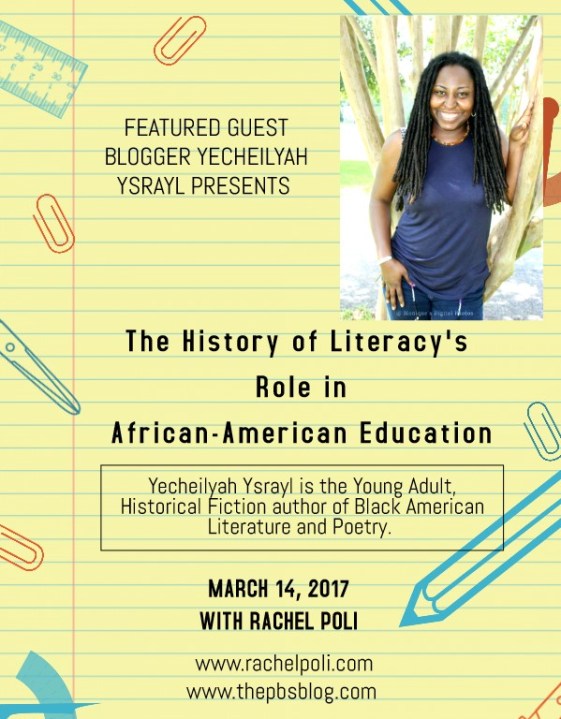
That’s right, Rachel is giving me the keys to the house (I hope she has coffee??!). My topic of discussion is on the education of blacks in America and how reading and literature came to be such an important part of the learning process in the transition from slavery to freedom.
When: Tuesday, March 14, 2017
Where: Rachel Poli’s Blog @ http://www.rachelpoli.com
Reminder: You can find all my Guest Blog posts and upcoming features under the Media Page!
>> https://atomic-temporary-72317077.wpcomstaging.com/author-interviews-guest-blog-posts/ <<
Black History Fun Fact Friday – The First Black Public High School
In 1870, the first Black public High School opened in Washington, D.C. or rather, the first recorded school (Aside from Tuskegee Institute–one of the first schools for African Americans financially sponsored by Blacks and Whites but headed by a Black President, the late Booker T. Washington–I do not believe Dunbar was the first High School just as Rosa Parks was not the first to refuse to give up her seat on a bus (LEARN MORE HERE) there is a lot of things that just aren’t recorded.)
The Preparatory High School for Colored Youth (renamed in 1916 to M Street Public School when its location was changed from M Street), was founded in the basement of Fifteenth Street Presbyterian Church by William Syphak, the first chair of the Board of Trustees of the Colored Public Schools in the District of Columbia. According to Dr. Thomas Sowell in an article (100 Years After Dunbar) in 1899, when it was called “the M Street School,” a test was given in Washington’s four academic public high schools, three white and one Black. The Black High School scored higher than two of the three white High Schools. Of course, this isn’t about color or race but is used as an example to highlight the success of all Black Schooling at that time.

Blacks during Segregation were more unified considering many of us had to stick together in order to build communities and schools. For this reason, many all-Black communities, as well as all Black schools, did well. There was a communal spirit among blacks during segregation that sadly deteriorated once we were capable of going outside of ourselves.
Before Brown vs. Board of Education, Dunbar acquired only the best teachers, many of them with Ph.Ds. and graduated 80% of its students. Among its students: the architect of school desegregation, Charles Hamilton Houston, Elizabeth Catlett, the artist, Billy Taylor, the jazz musician, the first Black general in the Army, the first Black graduate of the Naval Academy, and the first Black presidential Cabinet member, according to Journalist Alison Stewart, author of First Class: The Legacy of Dunbar, America’s First Black Public High School as told to NPR host Cornish on All Things Considered.
In addition, many more, including the first Black woman to receive a Ph.D. from an American institution, the first Black federal judge, and a doctor who became internationally renowned for his pioneering work in developing the use of blood plasma.
The Downfall of Dunbar
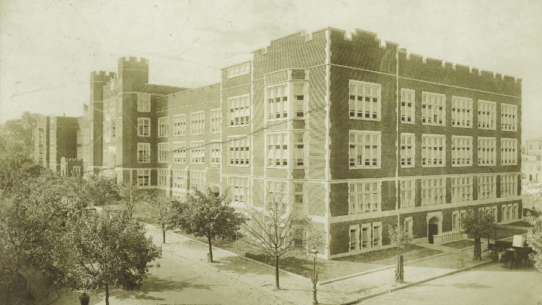
Unfortunately, like many Black experiences after integration, Dunbar declined. According to Sowell, senior at the Hoover Institution, Stanford University:
“For Washington, the end of racial segregation led to a political compromise, in which all schools became neighborhood schools. Dunbar, which had been accepting outstanding Black students from anywhere in the city, could now accept only students from the rough ghetto neighborhood in which it was located. Virtually overnight, Dunbar became a typical ghetto school. As unmotivated, unruly and disruptive students flooded in, Dunbar teachers began moving out and many retired. More than 80 years of academic excellence simply vanished into thin air.”
I agree with Sowell only to an extent. I do not think that “unruly and disruptive ghetto students” are responsible for the downfall of Dunbar, but rather the decline in Blacks students being taught by Black teachers concerning Black lives and Black history.
I remember a video interview Maya Angelou gave where she testified that her school was “grand” and many others of the era who described their schooling as a positive experience. Though not given the same quality of learning materials, I believe Blacks got a better education before integration. Not merely because of segregation itself, but rather because it forced us to unify in a way that does not exist today.
In short, we were educating our own. Without teachers and faculty who actually understand them, their struggles and experiences, students can find it harder to adjust. In Angelou’s words, “blacks used what the West Africans in Senegal called ‘Sweet Language'” which is still used today. For example:
“Hey, there” is used as opposed to, “Hi, how are you?”
The Hey is drawn out and spoken with a certain tone of familiarity as sweet language is dependent entirely on tone. The way that Angelou spoke herself was in a sort of sweet language where every word, even if she didn’t mean it to, sounded like poetry.
“Hey, how you?”
This is not grammatically correct or what may be referred to as “proper” and it’s not meant to be. It is the lengthening of the word, the dragging it out and using a loving tone of voice, a caring voice: “Hey.” It is something that Blacks have been doing their entire lives without effort and is something that is mostly understood by other Blacks and while deemed sweet language, I call it a language of love.
This is just one example of the kind of History Israelite, so-called Black, children do not learn in today’s schools.
As the Black teachers moved on, so did Black students interest in learning, or so it seems. Over time, at least three more schools would be named after Dunbar: Paul Laurence Dunbar High School in Baltimore, Maryland, Fort Worth, Texas, and Chicago, IL.
While segregation allowed for inferior educational experiences in some respect (such as torn and used books as opposed to new ones) who is to say that the education itself was inferior? I am more interested in what was being taught behind closed doors. The historical, archaeological, and biblical history of Blacks that I am sure to have never made it in the history books. What really made these students prosper as opposed to the students today?
Dunbar now graduates only 55% of its students according to the 2016 values based on student performance on state exit exams and internationally available exams on college-level coursework, and AP®/IB exams are unranked in the National Rankings. But what do we expect? How do we expect the people who oppress us to also teach us the truth about who we are? If you weren’t being treated right, how do you think that you were taught right?
One thing is for certain, to assume that integration made education for Blacks better is up for debate.
Yecheilyah’s Book Reviews Special Edition: Introducing William Spivey’s Strong Beginnings
Title: Strong Beginnings
Author: William Spivey
Publisher: TBA
Facebook: https://www.facebook.com/StrongBeginningsaNovel/
Blog: https://enigmainblack.wordpress.com/
E-mail: wspiv001@aol.com
Facebook: https://www.facebook.com/william.spivey1
Twitter: @wspiv001

This is the last book review of the year, and what a way to go out. Today’s review is a special one.
I’d like to welcome William Spivey, who frequently writes about politics and popular culture for the Inner-City News. Also, he writes under the name “Enigma in Black” about various socially significant topics, including politics, religion, and poetry. He is the creator of the Facebook sites Enigma in Black and Ordinary Citizen Forum. While attending Fisk University, William won the “The Importance of a Liberal Arts Education” Essay Contest, open to all students. He lives in Orlando, Florida, and graduated from Fisk with a B.A. in economics.
His goal now is to make his voice heard and make a difference, and he has given me the honor of advanced reading his soon-to-be-released Political Fiction/Romance novel Strong Beginnings.
When Frederick Douglass Strong witnessed the murder of four African Americans on the Moore’s Ford Bridge in Covington Georgia in 1966, he set into motion a string of events that would influence his family’s actions for years to come. After all, Frederick wasn’t the only one to witness what would be known as The Moore’s Ford Bridge Four but so did Chris Lee Thomas, the teenage friend of his son Roosevelt and the son of one of the white men who just murdered the four.
Gripped with anxiety, Frederick goes home and is unable to sleep. With a thorough understanding of the time, he is drenched in fear of what could happen next. Neglecting to reveal the details to his pregnant wife, he suffers silently until a knock is heard on the door. It’s Chris Lee Thomas and he wants Frederick to step outside. Frederick does and is faced with a lynch mob. Meanwhile, his son Roosevelt is peeking through his bedroom window, watching as the men chase his father.
However, Chris also sees Roosevelt just as his father, and the family is panicked with a decision of a lifetime. After Frederick’s death, it is clear, they must leave Covington if Roosevelt is to survive.
The story follows the life of Roosevelt and his family fifty years after The Moore’s Ford Bridge Four in Orlando Florida. His daughter, Voncelle Strong is one of the foremost voices of the novel. She is a passionate teacher and blogger. We watch as she positively influences her students, battles the unfair school system, juggles relationships, and comes face to face with relatives she didn’t know she had.
As for the incident, can the Strong family outrun their beginnings? What will happen when they come face to face with their past?
I recommend Strong Beginnings to anyone passionate about the plight of African Americans, those concerned about education politics, and those with a love affair for strong families.
Ratings:
Plot Movement / Strength: 4/5
Entertainment Factor: 5/5
Characterization: 4/5
Authenticity / Believable: 5/5
Thought Provoking: 5/5
Overall Rating: 4.5 / 5
Strong Beginnings is not yet available. Stay tuned.
Don’t forget to Follow this Author online!
Facebook: https://www.facebook.com/StrongBeginningsaNovel/
Blog: https://enigmainblack.wordpress.com/
E-mail: wspiv001@aol.com
Facebook: https://www.facebook.com/william.spivey1
Twitter: @wspiv001
I have many more authors to come so be sure to return to The PBS Blog after the new year.

Yecheilyah’s Book Reviews Special Edition: Introducing William Spivey’s “Strong Beginnings”
Title: Strong Beginnings
Author: William Spivey
Publisher: TBA
Facebook: https://www.facebook.com/StrongBeginningsaNovel/
Blog: https://enigmainblack.wordpress.com/
E-mail: wspiv001@aol.com
Facebook: https://www.facebook.com/william.spivey1
Twitter: @wspiv001
*I received a free copy of this book in exchange for an honest review*
This is the last book review of the year and what a way to go out. Today’s review is a special one.
I am honored to introduce to you William Spivey, a regular contributor to the Inner-City News where he writes about politics and popular culture. He also blogs as “Enigma in Black” where he explores poetry, religion, politics and all manner of things socially relevant. He is the founder of the Facebook pages Average Citizen Forum, and Enigma in Black. William is also the winner of a University-wide Essay Contest while at Fisk University titled, “The Value of a Liberal Arts Education”. He holds a B.A. in Economics from Fisk and resides in Orlando, FL.
His goal now is to make his voice heard and make a difference, and he has given me the honor of advanced reading his soon to be released Political Fiction/Romance novel “Strong Beginnings”.
When Frederick Douglass Strong witnesses the murder of four African Americans on the Moore’s Ford Bridge in Covington Georgia in 1966, he set into motion a string of events that would influence the actions of his family for years to come. After all, Frederick wasn’t the only one to witness what would be known as The Moore’s Ford Bridge Four but so did Chris Lee Thomas, the teenage friend of his son Roosevelt and the son of one of the white men who just murdered the four.
Gripped with anxiety, Frederick goes home and is unable to sleep. With a thorough understanding of the time, he is drenched in the fear of what could happen next. Neglecting to reveal the details to his pregnant wife, he suffers silently until a knock is heard on the door. It’s Chris Lee Thomas and he wants Frederick to step outside. Frederick does and is faced with a lynch mob. Meanwhile, his son Roosevelt is peeking through his bedroom window, watching as the men chase his father.
However, Roosevelt is also seen by Chris just as his father was and the family is panicked with a decision of a lifetime. After Frederick’s death, it is clear, they must leave Covington if Roosevelt is to survive.
The story goes on to follow the life of Roosevelt and his family fifty years after The Moore’s Ford Bridge Four in Orlando Florida. His daughter, Voncelle Strong is one of the foremost voices of the novel. She is a passionate teacher and blogger and we watch as she positively influences her students, battles the unfair school system, juggle relationships and come face to face with relatives she didn’t know she had. As a former teacher, I enjoyed Voncelle’s fight for the student’s well-being.
As for the incident, can the Strong family outrun their beginnings? What will happen when they come face to face with their past?
There were many things to love about this book, such as the History, the family bonds, and education. Most of all, I loved how the title to this book is appropriately titled. Not only in its relation to the Strong family and the symbolism of new beginnings, but the beginning of this novel also starts out strong. I was nervous for Roosevelt as the family was deciding what should be done before making the decision to leave Covington. I also enjoyed the relationships, how they were tied into the story in a realistic way. For instance, when Voncelle travels to Europe she meets two young men who have more in common with her than she thinks and when a family member contacts Roosevelt all those years later for a family reunion, it sets in motion a string of revelations that would impact the family for a lifetime I am sure.
I recommend Strong Beginnings to anyone with a passion for the plight of African Americans, for those concerned about the politics of education and those who have a love affair for strong families.
Ratings:
Plot Movement / Strength: 4/5
Entertainment Factor: 5/5
Characterization: 4/5
Authenticity / Believable: 5/5
Thought Provoking: 5/5
Overall Rating: 4.5 / 5
Strong Beginnings is not yet available. Stay tuned.
Don’t forget to Follow this Author online!
Facebook: https://www.facebook.com/StrongBeginningsaNovel/
Blog: https://enigmainblack.wordpress.com/
E-mail: wspiv001@aol.com
Facebook: https://www.facebook.com/william.spivey1
Twitter: @wspiv001
I hope you enjoyed our final review of the year! It’s been amazing and I am truly honored to be in the company of such a talented group of individuals. Don’t forget that you can contact all of the authors on the new Indie Author Page HERE. It’s a new page so there isn’t much going on right now but over my break (which started about…5 seconds ago) I intend to update it so it looks more “authorly” (whatever that means lol).
I have many more authors to come so be sure to return to The PBS Blog after the new year. If you’re an author in need of more reviews, be sure to register your book HERE for consideration. Also, do not forget to update me on any special occasions or anything exciting you have going on! I love supporting the authors I review so let’s stay in touch. Each one, reach one.
Its Not Just Because Your Black
You were pulled over because your taillight is out, your license is suspended, and you were speeding.
The reason you’re in the condition that you’re in is not because of the white man and its not just because your black. We are in these conditions as a people largely because of our own lack of accountability for our actions.
A nine year old boy is murdered on the south side of Chicago because of his father’s dealings. Where are the marches at Jesse Jackson? Where is the protest Al Sharpton? Where’s the movement against black people killing black people?
John Singleton said that he will never put another movie out like Rosewood again because black people don’t support it. Rosewood for those who don’t already know is a movie based on a true story, a dramatization of the 1923 horrific lynch mob attack on an African American community.
The Tragedy of Rosewood
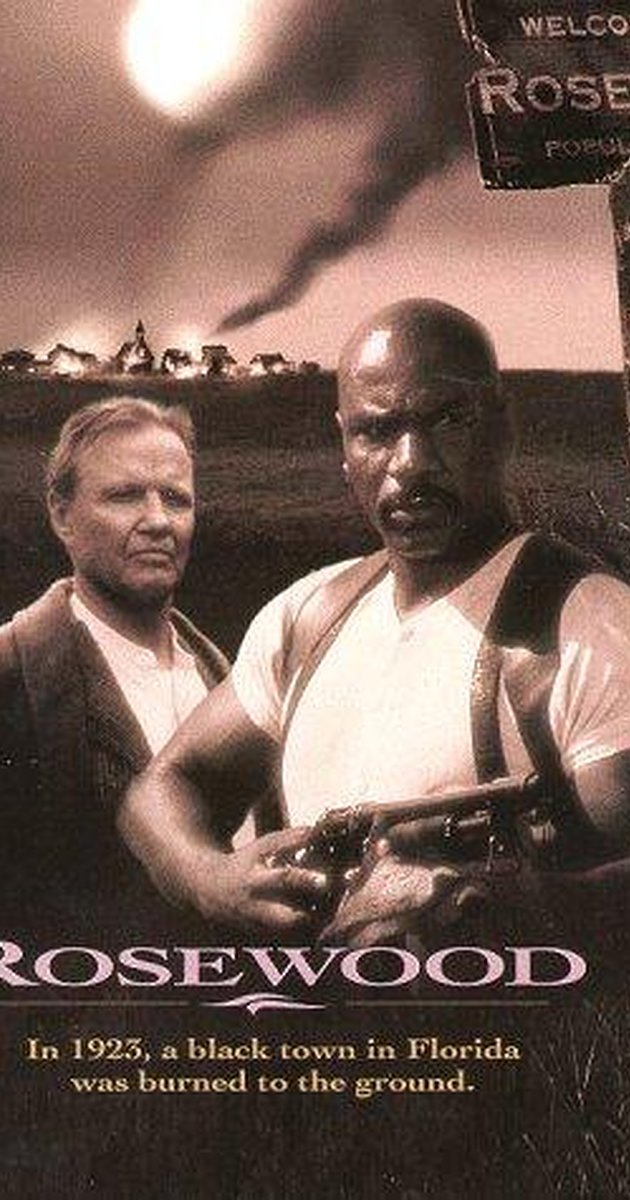
In an article written in The Baltimore Sun, Stephen Hunter lists some reasons why the movie Rosewood did not excel calling it “a fundamentally immature, undisciplined work.” He goes on to say “Singleton probably over-romanticizes Rosewood.” Another major criticism was the cowboy theme, something we also see in Quentin Tarantino’s Django Unchained but if you understand history you would know that blacks were the first cow-boys. The term comes from the plantation where black boys were in charge of tending to the cattle. They were quite literally “cow boys”. So not only do I disagree with Hunter, but critics are missing a key element that contributed to why the movie did not do well.
The conversation always comes back to the Rosewood-Booty Call debate. Rosewood came out a week before Booty-Call and almost destroyed Singleton’s career. Booty-Call on the other hand did extremely well, putting leverage to Jamie Foxx’s career.

The truth is that the black community must start taking responsibility for its actions. You are not pulled over just because your black, sometimes its because your illegal. If you know the system is biased, why would you behave recklessly? Even the bible says to give unto Caesar what is Caesars. So if I know its against the law to speed why would I risk getting caught? Likewise, a lack of black identity in film is not just because Hollywood does not want to see conscious movies about black people, but black people don’t even wanna see conscious movies about black people! As strangers in a foreign land we have been taught to hate ourselves and we tend to operate accordingly. If I hate myself I’m going to hate everything about myself. Yes, some of you hate yourselves but you can’t even take responsibility for that simple truth. Your afraid of your own people and you think dark skin a big nose, thick lips and kinky hair is the ugliest thing in the world.
Part of Rosewood’s failure is the fact that many blacks would much rather watch Tyler Perry’s, Medea Goes to Jail. You go to bed wearing a wig and you wake up with a wig. You go to bed with make-up on and you wake up with it on both literally and figuratively speaking. You put on elaborate personas because you hate who you are.

When you hate yourself but you don’t know that you hate yourself, this is a dangerous position to be in because a lack of love turns you into a monster. The stories of Jason and Michael Myers are not horror stories about supernatural beings. They were stories of children who were teased and abused and have consequently learned to hate themselves and it turned them into monsters. Michael Jackson is a real life example of childhood abuse turned horrific. This man was talented and has made great music but he also turned himself into a monster because he hated himself. He hated himself so much that he changed his physical appearance. That’s because when you hate your inside you hate everything outside and millions of dollars ain’t gonna solve it. Money can’t solve hatred only love can. The only way you can conquer self-hate is love, starting with self-love but to love yourself you have to first know yourself and knowing yourself begins with admitting your faults. Take some responsibility for the part you play in how you are treated. It doesn’t exempt anyone for their wrong but it helps you to move forward in yours.
When you know yourself only then can you love yourself and only then can you be yourself.
“This week marks the anniversary of the Rosewood massacre. Hundreds of black people were murdered and lynched and run off their own land and homes. We must never forget the domestic terrorism survived by our people. In 1997 I released a movie on the incident. It wasn’t one of my more successful pictures box office wise but I think it one of the best I’ve done. The same weekend it was released Booty Call came out. I think more black folks were comfortable watching Booty Call that weekend than Rosewood… Which is a shame…. I feel the more we embrace our history the better we can defend against being oppressed in our present. Just my thoughts this morning.”
– John Singleton
 The PBS Blog