REPOST from Good Black News. Please click the link below for the original post.
“The ride-share service Lyft announced Tuesday that passengers can now round up their fare to the next dollar and donate the difference to Chance the Rapper’s fund to support Chicago Public Schools. The New Chance Arts and Literature Fund, devoted to creating and expanding Chicago arts education programs, is the first local organization Lyft is supporting through the “round up and donate” feature.”
When you comment on a post that interests you (or disinterests you) on other blogs, it introduces you to that blogger and everyone else who sees your comment. If they’ve been blogging awhile, rest assured they will click on your name and check out your blog (Do be sure your name is linked to your blog. Jason Cushman explains how to do so HERE.)
Here’s a screenshot of an example. Even though the name of my blog is Pearls Before Swine when I comment what shows up is my actual name and photo so that it is understood immediately who I am and what I look like (in real life). Click on my name and it will take you to my blog.
It’s a Reminder
I follow over 400 blogs over the course of the three years I’ve been blogging. There’s no way I can keep track of them all and I won’t pretend as if I do. I don’t like or comment on everyone’s post. It’s just impossible. Likewise, bloggers that follow me don’t get to see and interact with my every post. I’m not crying about it.
There is a way to remind others that you exist and it is by supporting their blogs.
When you drop a comment on someone’s blog they are reminded of your support and will undoubtedly want to return the favor. I’m not saying be fake with your commentary. I am saying that support begets support. When people I don’t know comment on my blog, I click on their profiles and visit their blogs. I may even decide to follow said blog. In most cases, I do.
It Connects You / Builds Genuine Relationships
Commenting in the world of the Internet is the same as being involved in a conversation. Commenting on other blogs helps you to make a connection with others. It’s good because you don’t just connect with the home blogger, you also connect with their followers. It’s a form of genuine relationship building. You may discover you write in the same genre, both are allergic to something, both love the same foods, colors, both love History, etc. You may even want to join the same groups. I have connected to many of you better because of you commenting on my posts. We have in turn followed each other’s blogs, joined the other’s email list, bought the other’s books, and know more about one another. All because of commenting on the other’s blog.
Adds Value / Authority
When you leave comments on other blogs, it helps to add value and authority to your blog via search engines by way of back-links, which generates traffic. Here is Backlinks explained by the Shout Me Loud Blog:
“Backlinks are incoming links to a web page. When a web-page links to any other page, it’s called a back-link. In the past, back-links were the major metric for the ranking of a web page. A page with a lot of back-links tended to rank higher on all major search engines, including Google. This is still true to a large extent. Here is a glossary of common terms related to back-links that you should know:
Link Juice: When a web page links to any of your articles or your website’s homepage, it passes “link juice”. This link juice helps with the ranking of the article, and also improves the domain authority.
More Subscribers
Commenting on other blogs brings more traffic to your site because of link juice and can lead to more subscribers. This is especially true if you leave detailed, well-thought out comments because it is a glimpse into the kind of content that can be found on your blog. Again, if the blogger is like me he/she will be inclined to click on your name (which you would have connected to your blog site) and check out your blog to discover more about you.
Combined these elements can help your blog to grow by:
Increasing Traffic / Views
Increasing Blog Subscribers
Before we go, make sure:
You don’t go around randomly commenting on people’s post after reading this. There is no right way or wrong way to blog but I have learned that such things as this must be genuine to work so don’t be fake, people can tell.
Your blog name is actually a name. Either your business name, Sara, Ann, Brandon, or Bob. Not 123_T or Princess_456.
Link your name with your blog so that when people click it this will take them to your blog. Learn how HERE.
Add an image to your gravatar. Preferably, a company logo or head-shot. I find human images better because it’s already difficult to trust people over the internet. Being transparent from the beginning by showing an updated image of your real self (Company Logos are good too) goes a long way. This is especially true if you’re an Independent Author. A brand tip is to make sure your author image and author name is the same across all your social platforms. I had to recently update mine so I am only saying this because I’m not very good at branding myself. I am working on it however and my first step was to go back through my social’s and ensure they all have the same image so that I am easy to find. I changed them all to the same picture and will also not keep changing them.
Make sure there’s a FOLLOW BUTTON on your blog so that when people are exploring and they like what they find they can follow you in the easiest and quickest way possible.
Note: The headline to this post has been changed to 5 Ways. When I first drafted it, I only had 4 ways. I’ve just went back over it and see there are five bullet points. I have not changed the link (which still says 4 ways) because this post has already been reblogged. Please excuse the miscount.
REMINDER: I still need your Thunderclap support! Help me reach 100 Supporters before July 15th. It’s free, easy, and only takes a second. We’re almost there!
I love finding the hidden treasure of black communities that existed and thrived that we’ll never know about (until we look). I’ve mentioned several of such communities on this blog in the past and here’s another one.
Seneca Village was settled in the 1820s on the eve of Emancipation in New York. The only community of black property in the city at the time, it was located between 82nd and 87th Street east of what is Central Park today.
The Village was a thriving community of blacks (two-thirds) and whites started to settle there as well. The community had its own school and a population of over 250 people. Houses were also built on the land, some of them elaborate two-story with barns and others a bit more modest. This was an achievement because New York, like the rest of the country, was a place of slave-ownership. Contrary to what you’ll learn in school, the South was not the only place to find blacks who were enslaved but many northern cities did as well. In 1703, more than 42 percent of New York City households held slaves and slavery was a key institution in the development of New York. According to The New York Historical Society:
“As many as 20 percent of colonial New Yorkers were enslaved Africans. First Dutch and then English merchants built the city’s local economy largely around supplying ships for the trade in slaves and in what slaves produced – sugar, tobacco, indigo, coffee, chocolate, and ultimately, cotton. New York ship captains and merchants bought and sold slaves along the coast of Africa and in the taverns of their own city. Almost every businessman in 18th-century New York had a stake, at one time or another, in the traffic in human beings. During the colonial period, 41 percent of the city’s households had slaves, compared to 6 percent in Philadelphia and 2 percent in Boston. Only Charleston, South Carolina, rivaled New York in the extent to which slavery penetrated everyday life. To be sure, each slaveholding New Yorker usually owned only one or two persons.”
The only difference between Southern and Northern slavery was that instead of plantations, slaves in the North slept in cellars and attics or above farmhouse kitchens in the country. Nonetheless, the enslaved population of the city was emancipated in 1827 and many of these freedmen comprised the residents of Seneca Village.
The Village’s demise came with the building of what is now Central Park. The government claimed the land under the right of eminent domain and evicted the residents. Since then, Seneca Village has been pretty much forgotten in history. Well, until now.
_____________________________
Don’t forget, you can find all the Black History Fun Fact Articles
Its the final countdown! Don’t miss out. Meet me in person at The Tampa Indie Author Book Convention this summer. Spread the word! Why am I shouting? ! Because its exciting! Lol.
I have decided to start a new feature on my blog called ‘Indie Shine’. This will begin in February 2017!
The purpose is to shine a spotlight on individual indie artists. It doesn’t matter what your chosen field is as long as you are indie and an artist.
I have received responses so get yours in today. Space is limited, as this is only a monthly feature.
Go to http://rebirthoflisa.wordpress.com & complete contact me form. I will respond with detailed information and a questionnaire. Once I receive the completed questionnaire, I will let you know when your feature will post.
The PBS Blog was not my introduction to blogging. At first, I hosted a blog through Blogger in honor of my first novel The Aftermath. My second blog, A House of Poetry, was dedicated to poetry and hosted here on WordPress. Neither of these blogs went very far. When I transitioned from A House of Poetry to The PBS Blog, I had a different intention. This time around, I enjoyed blogging, and I did not want to miss a day of publishing content. I was relentless and almost obsessive. I posted three times a day for five or six days a week. My routine looked something like this:
Of course, you have to first produce something. This post is about getting your blog to work for you when you are away, but that doesn’t happen unless you have first created something.
My first tip to getting your blog to work for you even when you aren’t blogging is to be consistent in publishing valuable content when you first start your blog so you have tons of content to repurpose later.
My first posts did not do well far as engagement. But what it did was help me get used to writing publicly, posting regularly, and creating content that people will read weeks, months, and even years later. People are still engaging with posts I wrote four and five years ago because blog posts have a long shelf life, unlike a social media post.
I believe in hard work. I also believe that hard work pays off. These are pretty much the basic principles that help me to keep this blog going.
Update: We are now in the era of the COVID-19 pandemic, which we were not in when this post I first published this post in 2016. More people are at home now, which is a wonderful opportunity to engage your audience because people consume a lot of content. Time spent reading blogs and social media posts have increased significantly, with everyone being at home. On the flip side, there are also more distractions which means that you are easily forgettable if you are not showing up regularly.
Another thing to remember is that a post you publish today can blow up a year from now. A post with five likes now can get 50,000 likes in a year, depending on the spirit of the time and how it is relatable to your post. Here’s an example of what I posted in the original version of this post from 2016:
“Last week, a blog post I published two years ago suddenly got lots of attention. My stats were going crazy! Shooting up to over six hundred views within 48 hours, over 3,000 by the end of the day, and over four thousand shares on Facebook. This was an old post that new visitors were just discovering. This is a clear example of your blog working for you. If I wanted, I could have sat back and took an entire week off and made it up in views, likes, and follows coming in from that post alone. This same thing can work on articles that surround certain historical events, like 9/11. Maybe you posted something on 9/11, and two years from now, it gets all of the attention you thought it deserved when you first published it. It’s all about timing.” – Yecheilyah
You won’t have to worry about posting as much once you’ve been doing it for some time, and you won’t have to worry about losing followers when you are not blogging because there is enough content for people who have not yet discovered your blog to read.
Schedule Your Blog Posts
Although I was publishing a lot initially, it doesn’t mean that I was coming up with the content on the fly. I planned my posts out and scheduled them. If you go into your WordPress dashboard, you can schedule your blog posts so that they will go live without you having to sit in front of the computer or phone and do it manually. If you are in the US, I recommend scheduling it to go live at midnight so you can reach people all over the world who are in different time zones. We talked about this in another post already, so as not to be redundant, I will refer you to that post which you can find here.
Download the WP App (Or Whatever App is appropriate for your blog platform)
You can also download the WordPress app, which, once the post is live, helps respond to comments and share to social media on the go.
This is probably one of the best tips of them all because you can grow while you sleep, which is like working while you sleep. And who doesn’t like that?
Support Other Blogs/Bloggers
Publishing posts regularly is good, but it is not enough. It is just as important to follow other blogs, comment on other blogs and interact with other bloggers.
The more I interacted with veteran bloggers, participated in challenges, followed and commented on other blogs, the more I became aware of the little nuggets and tidbits I needed to help my blog, not only to grow but also to keep growing. And consistent growth is a goal that I consistently strive for.
Guest blogging, interviewing others, and being active within the community will help you grow even on days you are not blogging because you are leveraging your platform through others. Someone might not have read the article on your page, but if you were a guest on someone else blog or a more prominent blog reblogged/shared your post, their readers become your readers depending on the subject and how it is relatable to them.
It’s a challenge for authors who write and publish books to be consistent in publishing blog posts while trying to write books because blogging is still a form of writing. Whether you are publishing a poem, short story, article, how-to, research article, giving a testimony, or breaking down how a quote is inspirational to you, it’s all still writing.
One solution is that by frequently posting in the beginning, supporting other blogs when you are not blogging, repurposing content, and scheduling blog posts, authors can continually publish books without neglecting their blog.
The key is a little bit of discipline and networking with others, incorporating blogging into your platform building strategy as a necessary part of the work, and producing quality posts as early and as often as possible in your blogging journey.
Many of us are familiar with the Greenwood Community of North Tulsa Oklahoma where blacks built the most prominent community of their time. Deemed “The Golden Door” of opportunity for blacks, the dollar in “Little Africa” circulated 36 to 100 times, sometimes taking a year for currency to leave the community, hence its nickname “Black Wall Street” along with “Little Africa” before its systematic destruction that left it torn and desolate. But it wasn’t until my trip to New Mexico this past week that I discovered other communities that are also worthy of inclusion in Black Wall Street’s Hall of Fame.
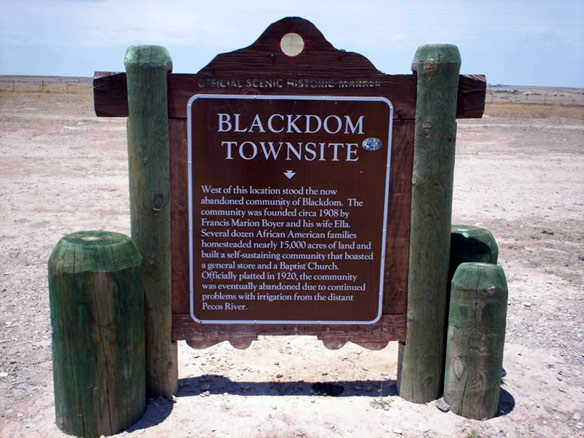
Blackdom
Blackdom was a little known African American community about 18 miles southwest of Roswell New Mexico and was founded by Frank and Ella Boyer. Walking 2,000 miles on foot from Georgia to New Mexico, Boyer left his wife and children behind to cultivate land in the free territory of the West before sending for his family some three years later. At this time in history Blacks had begun migrating from the south in great numbers in a movement called “The Great Exodus” following the Homestead Act of 1862, particularly in Kansas. According to a 2001 archaeological study on the Blackdom region from the Museum of New Mexico, “During the decade of the 1870s, 9,500 blacks from Kentucky and Tennessee migrated to Kansas. By 1880 there were 43,110 blacks in Kansas.”
The Homestead Act gave room for former slaves and free born blacks to reside in the West regardless of race. Here was an abundance of land, free and fertile to anyone who could keep it up. Influenced by W.E.B. Dubois and Frederick Douglass according to historians, Frank was a graduate of Morehouse University and a teacher of Black History which at this time was not very popular. He met his wife, Ella McGruder, a graduate from Haines Institute in Augusta, Georgia, at a teacher’s summer school session. The couple had four children (three sons, one daughter) when Frank set out for New Mexico in 1896.
The desire and influence to build community was first conceived in the mind of Frank’s father, Henry Boyer, a free man. Henry was a wagoner in the American-Mexican war when he first set eyes on the New Mexico land. When he came home, he told stories to his family of the land. Growing up during the Reconstruction Era, after the Civil War, Frank naturally grew up with his father’s dreams in his head and saw the West as the Promised Land to a new start. Ironically, the same life force that made Blackdom thrive as a community was also its downfall. The Artesian Water sprang in abundance as more and more blacks were invited and nourished on the land. Blackdom had its own school, and post office. However, the Artesian Wells eventually dried up and citizens were forced to move to nearby cities such as Roswell to continue their lives. The Boyer family were the last to leave.
After Emancipation, in theory black people were free. They were released from the physical chains of bondage. This freedom however, much like sharecropping, said that one could be self-sufficient by earning a profit, but by the end of the year the amount of debt incurred was a reality check concerning the freedom, or lack therof that actually existed. In the same way, Emancipation didn’t mean anything for a people who continued to suffer spiritually, financially, and mentally from the trials of chattel slavery. For this reason, not all blacks settled to continue occupation in the South but many of them invested in the hard work that slavery demanded and sought to use those skills to work their own lands and build their own communities. These stories fascinate me because it is a part of black history that is rarely, if ever, told. Not all blacks endured economic struggle and poverty after slavery but some, if only for a moment, maintained an air of economic dependency and not only succeeded, but prospered in the process.








 The PBS Blog