
Tag: black
SugarCoated and Springtime

They get tired of hearing it.
Ain’t nobody got to say it,
I know that they get tired.
Tired of these distractions in brown-colored skin
waking up from Valley’s
with muscles and tendons
all conscious-like.
Uncovering the blood in the American Flag—
Tired, tethered, and intoxicated
with his story.
Unraveling the color of bigotry on a beautiful glass,
Smeared fingerprints and fallen stars like
Why they keep sittin’ in?
Between our comfort and a hard place.
America,
This be some kinda hard place
for brown-colored skin
in the springtime.
Strange fruit popping up again on trees,
‘cept Nina ain’t here to sing us a song.
After 400 years
songs just don’t work anymore.
Tired of these guns accidentally going off,
Landing somewhere in my purse.
somewhere in my womb.
Somewhere in my future between lipstick and foundation.
I’ve got to warn my sons
about accidental guns.
Generational homicide got me on my knees praying
the badge
ain’t got his name on it.
Let’s be accurate about it.
Will I be left with the fragmented
pieces of my husband’s shoes
between our front porch and the living room floor?
Will my kiss linger long enough to bring him home tonight?
Or will I suffer a widow’s fate of mistaken identity?
After all, these brown, tan, bronze, and mahogany-colored
skins all do look the same…
Don’t they?
I’m afraid of your guns.
They don’t know the difference
between friend and foe–
or maybe, they do.
Funny how bullets be mistakin’ themselves for judges
that ain’t got names on them.
They say a gun
ain’t got a name on it.
Why are they sugar-coating it?
‘Cause people get tired of hearing about all this black…
All this oppression,
All these curses,
All this power like,
Why we won’t pour sugar on top of these bodies?
Get ’em up off the street.
Don’t want our bullets to get stirred up, ya know.
Getting up outta beds,
loading themselves into chambers
and taking walks at night,
in the afternoon, and especially in the morning,
when it’s springtime.
Fun Fact: I first wrote this poem four years ago (almost to the day). Reposting because it is still fitting for today’s climate. You can find it in my I am Soul poetry collection.
Revising The Stella Trilogy: Crafting Authentic Historical Details
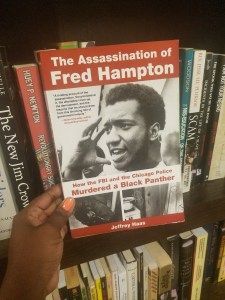
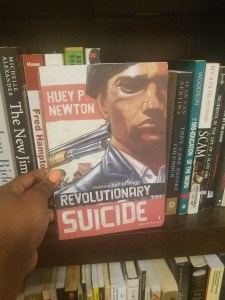
In Beyond the Colored Line, book two of The Stella Trilogy, we meet Noah Daniels who is a member of The Black Panther Party for Self-Defense. There are two books I read that helped me to conceptualize his character in the most authentic way possible: Revolutionary Suicide by Huey P. Newton and The Assassination of Fred Hampton: How the FBI and the Chicago Police Murdered a Black Panther by Jeffrey Haas.
These books helped me to capture the language and the spirit of the movement as realistically as possible. I modeled Noah’s persona after both Huey Newton and Fred Hampton. Noah uses terms like “Pig,” regarding the police like the Panthers did in the 60s, but reading Newton’s story helped me to understand this wasn’t a random term they pulled out of the sky to be derogatory.
Black Panther rhetoric like “All Power to the People,” and the concept of “pig,” came with Newton’s interest in A. J. Ayer’s logical positivism, that nothing can be real if it cannot be conceptualized, articulated, and shared. While I do not agree with this philosophy as a person of faith (because faith is the opposite of this…the belief and expectation of something even when you cannot see it), it was helpful in me understanding the Panthers on a deeper level and thus helped me to make Noah’s story more real.
Not all research needs to be included in the story so you won’t hear Noah quoting A.J. Ayer. The point of research for historical books is to help the writer to better understand the culture of the time so the characters can interact with the setting genuinely.
Historical Fiction is not an easy genre to write because while the story itself is fictional, the dialogue and personas of the characters have to be true to the time. A young person living in 1960 wouldn’t speak like a young person living in 2020. If done right, adding authentic historical details enrich the story by triggering memories of the past.
Excerpt from Chapter Ten:
“That just bugs me. We supposed to march and get hit upside the head by the pigs?” he would say in conversations with his mother when he would visit her. Unlike many young black men raised by their mothers, Noah’s mother had decided early on that her son’s narrative would be different. When he came of age, she would turn him over to be raised by his father. She could provide a lot of things, but she could not teach him how to be a man. She supported most of Noah’s radicalism, but only to an extent.
“Now don’t you go rappin’ ‘bout all that communist jive talk in here boy. Violence and hatred never helped to expand no revolution.”
“But Ma, that’s where you’re wrong. It’s not about violence. It’s about defending ourselves. Violence is only the guilt complex that exists in the minds of America.”
Mama Daniels would lift her head to the ceiling, wishing she’d said nothing.
“To say that a man is violent because he defends himself does not differ from saying a man who is being lynched and thus fighting back is himself violent because he fights back.”
“Boy, what? You know, sometimes I wish you weren’t so smart.”
Noah laughed, “’cause you know I’m right. Mama, white Americans know that they have been violent against Negroes, and they fear that one day the Negro will do unto them as they have done unto the Negro.”
The 1960s presented a new wave of leadership and identity for people of color who went from being Negroes to Blacks. Just the previous year, the heavyweight champion, Muhammad Ali refused induction into the army on both religious and political grounds. The epitome of the black power movement was the Black Panther Party, founded by Huey P. Newton and Bobby Seale. This party organized the use of self-defense in the accomplishment of black justice and was right up Noah’s alley.
Stella: Beyond the Colored Line
Get it Here.
Haven’t read book one yet? Get it here for just $0.99.
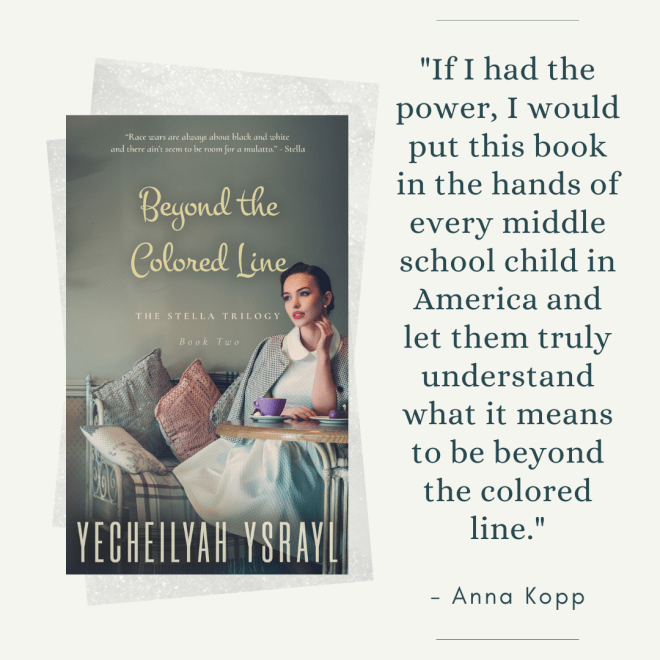
Already read these books? Don’t forget to leave a review!
Revising The Stella Trilogy: A Behind the Scenes Look
Tomorrow will mark five years since I released the first book in The Stella Trilogy. Wowzers! I am celebrating by introducing the new cover to book one and two. If you haven’t heard, I removed the books from amazon for some much needed polish and am re-publishing them. To learn why check out the blog post “Quality Over Quantity: Why I Pulled My Trilogy from Amazon.”
While I changed the cover to I am Soul after its release and got a new cover to The Aftermath, my first novel (2012), I’ve never wholly revised my backlist before. The Stella Trilogy is getting an entirely new makeover, which includes editing, covers, formatting, and ISBNs. Why go through all the work for an old book?

Books do not expire. Every book is new to people who have never read it which is why it benefits Indie Authors to go back and update “older” works every now and again. Here are some things I saw needed work on Stella:
Editing – It wasn’t enough to slap a new cover on the books. I knew these books had to be revamped altogether. Like most newbie Indie Authors, I had a friend to edit the first version of these books because I didn’t have the money to pay someone. This time around, I am getting the books professionally edited.
Song Lyrics – The first book had song lyrics in it—rookie mistake. You need permission to include the words to a song in your books. I promptly removed those lyrics. I can’t afford to get sued.
DIY Covers – I like the cover to book one, but it was a DIY premade from Derek Murphy’s website, offered freely to authors. I added the image of the black woman, but the rest was unoriginal. I cringed every time I saw it on his site. Book two was more original as I purchased the winter lady image, but it was still poorly applied to the cover. I did everything in Microsoft Word, and since I didn’t know that super-thin books don’t need a spine (if there aren’t enough pages to warrant one) when the books printed the spine folded over to the front. Yuck. For this reason, new covers were something I knew I needed to get done.
Free ISBN – I am done with the free ISBN game. Listen, if you don’t include the cost of the ISBN in your book budget, you are still a beginner. Have I always purchased my own ISBN? No. ISBNs are expensive, but having your own is worth it. They (ISBNs) are also cheaper if you buy them in bulk. 10 ISBNs can cover ten different books. Applying your own ISBN number to the book ensures that your imprint name will be applied to the book. In other words, you are the publisher, not KDP, and not Lulu. This time around, all books in The Stella Trilogy will have its own ISBN so I can register the books to me.
BONUS: Alternate Ending – I am excited about adding an alternate ending to excite Stella fans who have already read the books. The conclusion to book one is not the ending of the original book one. Why the change? It is to tighten the link between all the stories for a smooth transition from one book to the next.
Lessons I learned so far:
Work with what you have until you can do better.
You don’t have to know everything to start. I didn’t. Work with what you have until you can do better. (If a free ISBN is all you have to work with right now, use it until you are able to move up. I did.) I do not regret putting Stella or my first books out there, even though they weren’t properly edited, and the covers were DIY. These books gave me my start, and the courage and the freedom to step out on my own. These books gave me my beginning, and I am forever thankful to Yah for them.
Then, when you can do better, please do it.
The other part of this, though, is doing better once I knew better. If I produce mediocrity, I will only get mediocre results. Once you’ve stepped out there, it is okay to go back and change what you see needs work. We may not be perfect, but this doesn’t mean we cannot strive to maintain a level of excellence in all we do, even if the best we can do still falls short. We don’t have to stay at the same levels in the latter part of the journey as the first. We can tweak and correct and improve with time. We have that freedom, to sharpen, and to elevate.
About The Stella Trilogy
Stella is a work of Historical Fiction and is distinctive in its focus on one woman’s road to self-discovery, against the backdrop of the African American fight for justice, racial equality, and freedom. We discover how three individuals living in separate periods strive to overcome the same struggle, carefully knit together by one blood. The three-part series features elements of enslavement, Jim Crow, Passing, and the Civil Rights Movement.
Behind The Original “Friends”

Note: Due to the content of this post I am filing it under Black History Fun Fact Friday.
Erika Alexander (Max/Maxine Shaw/Pam, Living Single) did an interview with The Breakfast Club (I want to say it aired yesterday?? 1/29) that brought out some interesting facts. (Funny because she was not supposed to be a regular on Living Single but…). Like I tell people, Black History INCLUDES music, television, film, art, and much more.
Yvette Lee Bowser created Living Single for Warner Bros and it debuted in 1993. One of the original suggested titles was Friends. Asked if he could have any show on TV, NBC’s President said Living Single. Queen Latifah’s show’s suggested title was called My Girls when they first did their pilot according to Erika Alexander, but it didn’t do well. The networks then chose Living Single, and then the next year they named a separate show Friends. But you got that much from The Breakfast Club. Let’s go a little deeper.
To go further, I wonder why it was decided to call the black show Living Single? Did it have anything to do with black families being largely headed by single women at the time? I am still researching the specifics for 1993 ( the year Living Single debuted) but so far the numbers continue to increase for single-family households in the Black community at the time. In 1991, 68% of Black children were born outside of marriage. In 2011, 72% of Black babies were born to unmarried mothers. In 2015, 77% of Black babies were born to unmarried mothers.
What was really behind the networks naming this show “Living Single?”
Was it the stereotype or assumption that Black men weren’t present that led them to the decision that the black show should be called Living Single? (“We are living Single…”) instead of Friends? (Because I mean, the sistas on Living Single were Besties, you hear me? They were really Friends. Sooo I got questions…)
I know ya’ll probably think I’m reaching so …if you think this is too far-fetched, consider Good Times.
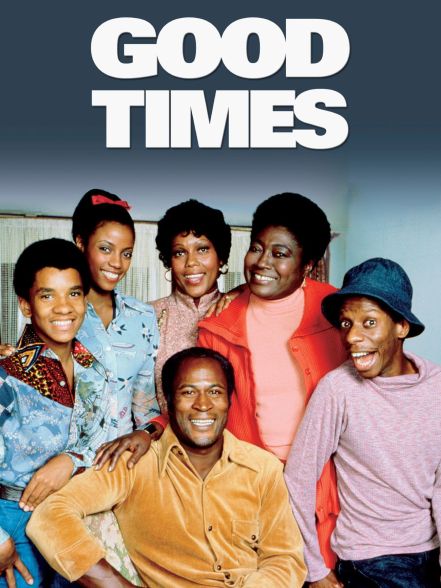
Good Times only had a father figure because Esther Rolle fought for one.
Originally, the show would be based on a single woman raising her kids in the projects in Chicago (I am from Chicago AND I grew up in the projects, trust… we know these things). Rolle said no, she wanted a father for her children and she became a pioneer in fighting for a black father on TV: George Jefferson (played by Sherman Hemsley) on The Jeffersons, Cliff Huxtable (played by Bill Cosby) on The Cosby Show, Phillip Banks (played by James Avery) on The Fresh Prince of Bel-Air. The list goes on and on but one woman opened the door for a complete black family to be shown on television and her name is Esther Rolle.
Good Times was revolutionary because it broke ground not only by showing a low-income family on television but also, a COMPLETE black family. The list of shows Good Times inspired is too numerous to mention, including NBC’s 227 in 1985, Regina King’s first breakout role. Then, in 1989, ABC launched Family Matters as their answer to 227. UPN sought to create the magic of the Cosby Show with Moesha in 1996. It goes on and on and down hill from here…
“I just thought it was a poor representation of what Black women were being able to do. And frankly, if you didn’t fit in that mold, there was nothing you could do. It was like watching a train wreck. I actually didn’t think it was real at first. Took me a long time to sort of get that, no this is real, and yet, it’s not real.”
– Erika Alexander on the Reality TV Shows, The Breakfast Club

The black father was the hardest legacy Rolle fought for. She grew up with one and an intact family; she wanted that to be shown on television. “I had a wonderful father,” said Esther Rolle, “and I couldn’t bear that television virtually ignored black fathers. I could not compound the lie that black fathers don’t care about their children,” she said previously in media reports. “I ruffle a lot of feathers. And I’m also selective–that makes you a troublemaker, but so be it. I laid a cornerstone for black actors, and that makes me happy.”
Although Rolle worked hard for a black father, they still eventually killed James off. So, I ask, what was the real reason behind naming the “Black” show, Living Single Hmm? That is the question.
Caution: Careful Not to Share Black History Memes with False Information

I am reposting this because February is approaching and we will see a lot of false information attached to Black History memes, same as always.
According to a famous Facebook post, King was not killed during an April 4, 1968, assassination attempt, but survived that shooting and was later “smothered by someone in the hospital.”
Is this true?
Let’s see.
Updated 1/28/2021
It’s Throwback Thursday so let’s go back in time a lil bit.
September 20, 1958

The year is 1958 and we are in Harlem, baby. Dr. King is signing copies of his first book “Stride Toward Freedom: The Montgomery Story,” at the Blumstein’s Department Store, on 230 West 125th Street.
It’s a nice afternoon and young King is just twenty-nine years old, releasing his first book and feeling good. And we are feeling good too because we are ready to get our copy. The line is long but before we get bored a voice makes us all stop and look in their direction.
“Is this Martin Luther King?” shouts a well-dressed black woman wearing rhinestone glasses and a matching necklace and earrings but carried an ugly brown bag and an even uglier scowl. The woman stepped out of line, causing groans from the people in front of her.
We don’t know this yet, but she is forty-two-year-old Izola Ware Curry, the black daughter of sharecroppers.
King nodded, “Yes, it is.”
“I’ve been looking for you for five years,” says Curry while pulling a letter opener with an ivory handle from her purse, which we don’t really know is a letter opener because we don’t use those anymore.
“Ooh, snap!” We gasp, placing our hands over our mouths. “Why she come so dressed up for if she was trying to kill somebody?”
“What is she doing?” says another one of us.
“Yea, man. Doesn’t she know this is Martin Luther King?”
“He not all that popular yet,” says a young black boy wearing chino pants and a white polo shirt. He put his hand in his pocket when he said it, smiled and then tilted his head like he was better than us. “Ya’ll not from here, are ya?”
Before we could answer, the sound of screams forces our attention back to the direction of the strange woman. She swings the letter opener at King, and sliced his finger then plunges the seven-inch blade into the left side of his chest.
“Oh, my God!” someone screams and just like that, the store is in an uproar. We are all screaming and running as someone apprehends the woman.
We look at King secretly hoping she didn’t get him because we still kinda want our book.
But when we see somebody who looks like our Grandma rush to his side, we know that’s not going to happen.
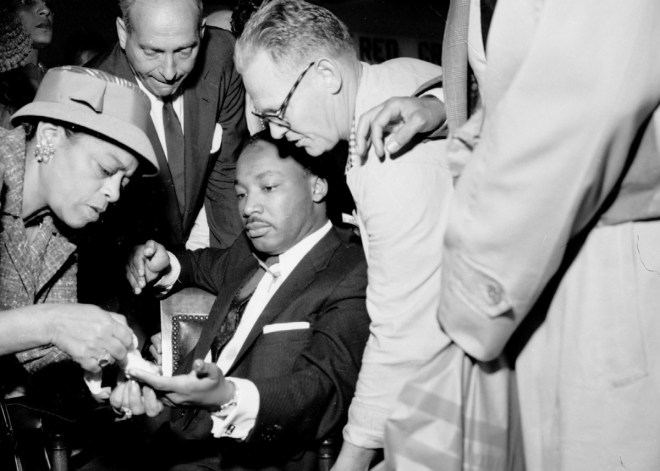
Dr. King is sitting in this chair all calm and cool like he ain’t just been stabbed. Meanwhile the letter opener’s ivory handle is still protruding just below his collar.
The police arrive. “Don’t sneeze, don’t even speak,” says Officer Al Howard, fearful of the blade’s proximity to King’s heart. Because of how the letter opener hit him, if King had sneezed, he would have died.
So, they move King slowly and carefully and take him to Harlem Hospital, and he undergoes emergency surgery.
Then, we jump in our time machine and head back to 2021 because it’s wild out here in the 50s.
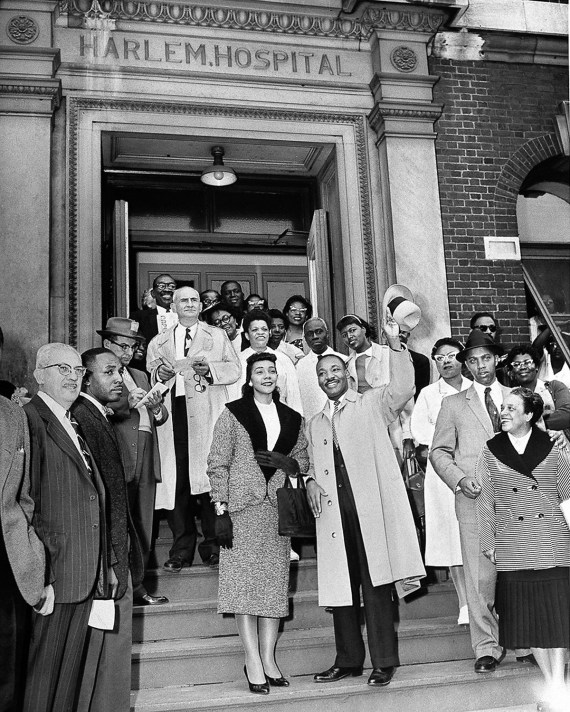
King leaves the hospital almost two weeks after the stabbing
The photo at the start of this post is not of Dr. Martin Luther King Jr. after being shot in Memphis, Tennessee in 1968.
That is a picture of Dr. King ten whole years earlier in 1958 at a New York Hospital after being stabbed at his book signing. He spent almost two weeks in the hospital recovering.
“If I had sneezed, I wouldn’t have been around here in 1962, when Negroes in Albany, Georgia, decided to straighten their backs up. And whenever men and women straighten their backs up, they are going somewhere, because a man can’t ride your back unless it is bent.” – Martin Luther King Jr., “I’ve Been to the Mountaintop.” April 3, 1968
I hope this creative backdrop added some perspective. Although I wrote it like a short story, everything I said here is the truth. Izola Curry, really did attack Dr. King at his book signing in Harlem.
Now to the original post…

There are tons of Black History memes circulating on the internet and this number has increased even more due to it being Black History Month. However, many of these memes are not historically accurate. Please be sure to double check your facts before sharing. Otherwise, you are guilty of spreading disinformation.
Black people have contributed to the world so that we don’t have to make stuff up. If you see a meme with a fun fact on it, just open the internet on your phone and type the name or fact into the search bar. You can tell from there if the material is accurate or not. Sometimes it will even come up that the information is an opinion or cannot be verified by any trusted source.
Use not only your phone to log into Facebook, Twitter, and Instagram. Use it to research these things and educate the people right.
Look for scholarly, peer-reviewed articles on .gov, .edu, or .org sites and trustworthy blogs. Peer-reviewed means information from a reputable source, information that shows that other professionals have reviewed and deemed it worthy of publication.
Wikipedia is not a credible source alone. Other trusted sources should support anything gained from Wiki.
And on the Monday of MLK day when everyone takes off and celebrates his legacy, remember that he was born on January 15, 1929, not whatever Monday you take off.
Black History Fun Fact Friday: “In Africa they Didn’t Teach about the Period of Enslavement of Our People.”

I thought this quote was an interesting and thought provoking one to share considering the crisis going on today.
What Crisis?
The one where schools are trying to remove Black History Courses from their Curriculum.
The one where today’s kids only know about Slavery and the Civil Rights Movement.
The one where the only Historical Black people most people can name are Harriet Tubman, Rosa Parks, and Martin Luther King Dr.
What about Toussaint Louverture, general and leader of the Haitian Revolution?
Or Florence Mills, nicknamed “Queen of Happiness,” and one of the most successful entertainers of the 1920s Harlem Renaissance Movement? You know Zora Neale Hurston and Langston Hughes, but what of the people mainstream society doesn’t speak of?
THAT Crisis
To the quote…
“In Africa, they didn’t teach about the period of enslavement of our people. They forbade us from speaking about it. They would kill people for speaking about that history. So we were not allowed for hundreds of years to speak about what was happening and to teach what was happening.”
– Queen Diambi: The Queen of Congo
My people across the water, is this true? Not hard to believe with the history they restrict here in America.
Now, for our first atrocity of the week…

A public school in Biloxi Mississippi is trying to pull To Kill a Mockingbird from the eighth grade curriculum because the language is “uncomfortable.”
If the language in To Kill a Mockingbird makes thirteen-year-olds “uncomfortable,” then I assume the school district is also insisting they stay off Twitter and never listen to rap music. – Julia Dent
“The book is about life in the South during the Great Depression, specifically the life of a black man named Tom Robinson who had been framed for raping a white woman. Local lawyer Atticus Finch agrees to defend the innocent man, angering the racist white community who subject him and his children to abuse. Despite proving Robinson’s innocence, the jury still convicts him because of the color of his skin. I won’t spoil the ending for you if you haven’t read it, but it is even more violent and sad (but with a bit of a happy ending).”
And if you haven’t read the book yet, do that (and I do not mean watch the movie. Read the book).
>>Click Here to Keep Reading<<
Next up is the Winston-Salem School Board who voted SEVEN to ONE AGAINST a Black History Course
“Black American children need to know their history “not later, but now,” Winston-Salem City Council Member D.D. Adams said after a mandatory African-American history course for the district was rejected by the school board.
>>Click here to Keep Reading<<
and this one goes in depth
I shared these same articles with my email list and I am sharing them with you too because I am seeing more and more instances of Black history removed. This is one of several reasons why I write Black Historical Fiction. Who will restore what was lost? No greater person can do it than writers. Someone has to write it down even if through Fiction and Poetry.
The little crumbs of black history they have allowed to exist is being erased bit by bit. As the so-called Black man, woman, and child is being awakened to the knowledge of their true heritage, even what they thought they knew is being removed. A few weeks ago, I was watching Michael B. Jordan’s Raising Dion series on Netflix. Dion was being singled out by a white teacher during an altercation Dion had with another student, a white boy. His aunt told his mother it was time for her to have “the talk” with him. When she told him, Dion said he thought “Dr. King fixed all of that.”
Huh? Dr. Martin Luther King Jr.?
MLK is recent. The 60s was not that long ago and Black History did not begin with The Civil Rights Movement (The NAACP wasn’t even created by Black people. It was founded by Jewish white men.)
Black people, ask yourself why our children are only being taught about the Civil Rights Movement. Chicago Public Schools have been on strike for about two weeks ending today. Maybe parents should consider teaching their own children. It can’t be any worse than the school system.

February is around the corner but you don’t have to wait a whole year to research your history. Here are a few good articles for you.
For The Origins of Black History Month revisit that fun fact here, which I published to this blog a couple years ago.
Here’s an article I found earlier this week written by William Spivey. He was featured on the blog a few years ago about his upcoming book. He wrote an excellent piece on Breeding Farms during slavery.
This young woman is getting a lot of attention of Social Media for being the first Black Teen Author Ever To Write 3 Books Being Used By School Districts Across The Country. She is an excellent example of how Black writers can change things through writing.

For more Black History Fun Facts visit the Black History Fun Fact page here. If you are interested in submitting a Black History Fun Fact as a guest post on this blog let me know! That would help me to be more consistent with this if I had help. I am putting together something now to promote that but until then, comment below if you’re interested or email me at yecheilyah (at) yecheilyahysrayl dot com. (The post on Roots has been added to the Black History Fun Fact page.)
Next week we are talking about Nina LittleJohn (Yah Willing) who opened a medical facility to treat Blacks in Spartanburg, South Carolina.
 The PBS Blog