Revising The Stella Trilogy: Crafting Authentic Historical Details

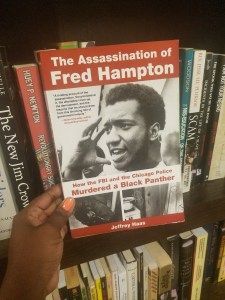
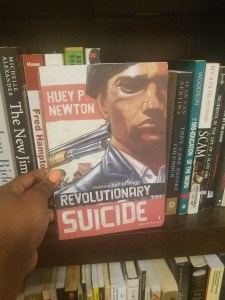
In Beyond the Colored Line, book two of The Stella Trilogy, we meet Noah Daniels who is a member of The Black Panther Party for Self-Defense. There are two books I read that helped me to conceptualize his character in the most authentic way possible: Revolutionary Suicide by Huey P. Newton and The Assassination of Fred Hampton: How the FBI and the Chicago Police Murdered a Black Panther by Jeffrey Haas.

These books helped me to capture the language and the spirit of the movement as realistically as possible. I modeled Noah’s persona after both Huey Newton and Fred Hampton. Noah uses terms like “Pig,” regarding the police like the Panthers did in the 60s, but reading Newton’s story helped me to understand this wasn’t a random term they pulled out of the sky to be derogatory.

Black Panther rhetoric like “All Power to the People,” and the concept of “pig,” came with Newton’s interest in A. J. Ayer’s logical positivism, that nothing can be real if it cannot be conceptualized, articulated, and shared. While I do not agree with this philosophy as a person of faith (because faith is the opposite of this…the belief and expectation of something even when you cannot see it), it was helpful in me understanding the Panthers on a deeper level and thus helped me to make Noah’s story more real.

Not all research needs to be included in the story so you won’t hear Noah quoting A.J. Ayer. The point of research for historical books is to help the writer to better understand the culture of the time so the characters can interact with the setting genuinely.

Historical Fiction is not an easy genre to write because while the story itself is fictional, the dialogue and personas of the characters have to be true to the time. A young person living in 1960 wouldn’t speak like a young person living in 2020. If done right, adding authentic historical details enrich the story by triggering memories of the past.

Excerpt from Chapter Ten:

“That just bugs me. We supposed to march and get hit upside the head by the pigs?” he would say in conversations with his mother when he would visit her. Unlike many young black men raised by their mothers, Noah’s mother had decided early on that her son’s narrative would be different. When he came of age, she would turn him over to be raised by his father. She could provide a lot of things, but she could not teach him how to be a man. She supported most of Noah’s radicalism, but only to an extent.

“Now don’t you go rappin’ ‘bout all that communist jive talk in here boy. Violence and hatred never helped to expand no revolution.”

“But Ma, that’s where you’re wrong. It’s not about violence. It’s about defending ourselves. Violence is only the guilt complex that exists in the minds of America.”

Mama Daniels would lift her head to the ceiling, wishing she’d said nothing.

“To say that a man is violent because he defends himself does not differ from saying a man who is being lynched and thus fighting back is himself violent because he fights back.”

“Boy, what? You know, sometimes I wish you weren’t so smart.”

Noah laughed, “’cause you know I’m right. Mama, white Americans know that they have been violent against Negroes, and they fear that one day the Negro will do unto them as they have done unto the Negro.”

The 1960s presented a new wave of leadership and identity for people of color who went from being Negroes to Blacks. Just the previous year, the heavyweight champion, Muhammad Ali refused induction into the army on both religious and political grounds. The epitome of the black power movement was the Black Panther Party, founded by Huey P. Newton and Bobby Seale. This party organized the use of self-defense in the accomplishment of black justice and was right up Noah’s alley.


Stella: Beyond the Colored Line

Get it Here.

Haven’t read book one yet? Get it here for just $0.99.
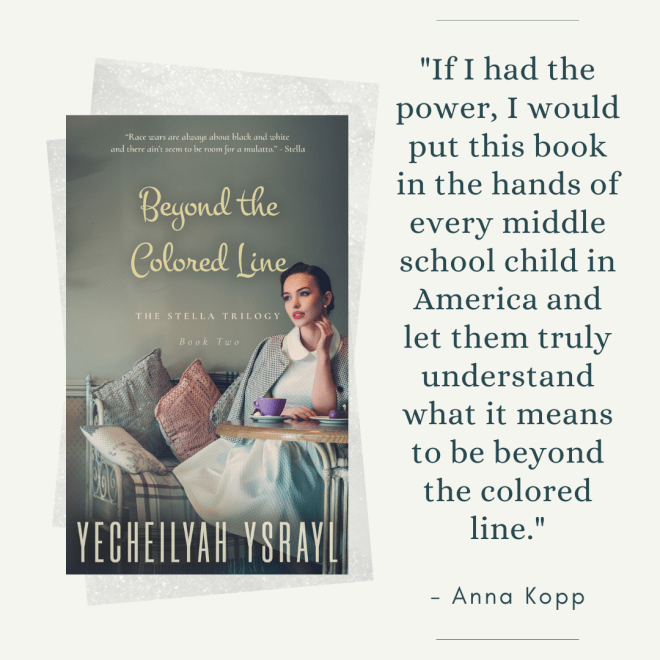
Already read these books? Don’t forget to leave a review!

African American Images on Book Cover Premades!

If you’ve been following this blog for the past five years you know one of my biggest complaints has been the lack of African American/Black themed premade book covers. And guess what? I found a few!

Beetiful Book Covers

“Launched in 2013 by Stefanie Fontecha, Beetiful Book Covers offers African American premade book covers.”

Cover Your Dreams

This one is not exclusive to AFAM but I’ve seen several covers featuring black men/women. The prices are low so this may be useful for Indie Authors on a budget.

Marion Designs

This one looks a bit more upscale with professional photos.

Designs by Rachelle

It appears this site also occasionally features diverse photos in its premade covers.

Learn more about how to get the best out of premade covers and what to look for HERE


Do you know of any more we can add? Drop a comment on the table if you do and let us know!

Revising The Stella Trilogy: Book Two – Beyond the Colored Line

Book one is out and we are on to book two!

My main challenge for book two is making sure that it stays consistent with book one. This is important for any series, but for Historical Fiction, it is even more critical.

Since writing Historical Fiction is writing set in a time that has already occurred, the details of the past must be realistic to what was going on. A good Historical Fiction book places fictional characters somewhere in a world that has already existed in a way that reads authentic. Readers should be able to reimagine what that world was like by immersing themselves in the life of the characters and the world around them. I like to think of it as a time machine, which is also what makes writing #Histfic fun to me.

Style, Language, Dialogue

Like book one, book two opens in 1996 and picks up where we left off at Mama Sidney’s house in book one. But book two also takes us back into the life of Mama Sidney, and we revisit history from the 1920s through the 60s. My focus for book two was to make sure the dialogue, language, racial and political events occurring during this time were realistic to what was happening in the world. We talk about The Great Depression and touch on the reoccurring lynchings taking place in both the north and south. We look at the brutal murder of Emmett Till, the shooting of Dr. King, Jim Crow Laws, and The Black Panther Party. While I immerse Stella in her own world, there is still the larger world to deal with and we watch how she navigates both. How does Stella’s personal identity crises correlate to the identity crises plaguing her larger community?

Racial Terminology

The biggest thing to deal with for book two is the racial classifications of blacks during this period. African Americans are the only people whose racial terminology has changed with the census. We have been “Niggers,” Negros, Coloreds, Blacks, and African Americans, and this can get confusing when trying to use the right term for the right year. This is also not to mention other racial “nicknames” we called ourselves, such as Afro-American and The New Negro.

The challenge of using the right term for the right years is because there were terms that blacks preferred to call themselves and terms used discriminately by the wider society. Although by the 60s Black Americans were preferring to be called blacks or Afro-Americans (as Malcolm X used a lot after leaving the Nation of Islam) white separatist signage still referred to us as coloreds. “Whites Only / Coloreds Only,” or “Welcome to the Colored Zone,” banners and store signs could have read.

Credited to W.E.B. Dubois and Booker T. Washington, blacks advocated for a switch from Colored to Negro in the early 1920s. As blacks redefined themselves, terms like “The New Negro,” became popular and sparked a movement that later became known as The Harlem Renaissance.

By the 1960s, though, African Americans had transitioned from being “Negros,” to “Blacks.” (Malcolm X specifically didn’t like the term Negro).

During the Black Power movement when sayings such as “I’m Black and I’m Proud,” were popular (think James Brown “Say it loud, I’m black and I’m proud!”) blacks wore their hair natural, read and published black literature and did what they thought would reconnect them with their lost heritage. In this process, many black political leaders of the time, such as Kwame Ture or Stokely Carmichael, helped to shift the terminology away from Negro and toward Black. Black publications like Ebony followed by switching from Negro to Black.

While a large majority of people still preferred Negro, “Black“ was becoming the preferred term with the New York Times and Associated Press abandoning “Negro” in the 1970s.

By the 1980s, Jesse Jackson called for a shift from Black to African American and while the change is still not as accepted or monumental as black was during the 60s, it is the term most socially acceptable when referring to black Americans.

I had to consider these changes when referring to blacks throughout this part of the book. What did they call themselves? What did society call them? How do I integrate this into the dialogue and setting realistically?

Setting, language, and dialogue is the backbone of Historical Fiction because the setting makes the story seem real and determines the character’s beliefs and actions. Not only do I strive to make the characters stand out but the culture of the time in which they live.


About Book Two:

In book two, we dig deeper into the McNair family’s legacy. Named after her great-grandmother, Stella has a very light complexion causing her to be the tease of her classmates. Unable to find solace among her African American contemporaries, Stella finds it challenging to adjust to a world where she is too light to be black.

After The Great Depression of the 1930s forces Stella’s family to move to Chicago, a conversation with Aunt Sara provokes Stella to do something that will dramatically affect not just her life but the life of her children and grandchildren.

Stella: Beyond the Colored Line will be available through my website and back up on Amazon in digital and print by April 24th. I am not putting the rest of the books up for preorder, so you’ll be able to order it immediately on 4/24.

If you have not already read book one, click one of the links below.

Amazon Kindle

Signed paperback

https://www.yecheilyahysrayl.com/bookstore/stella-between-slavery-and-freedom

Stella: Between Slavery and Freedom (Book One)

Book one in The Stella Trilogy is officially back on Amazon and my website and book two is on its way!

Stella is a work of Historical Fiction and is distinctive in its focus on one woman’s road to self-discovery, against the backdrop of the African American fight for justice, racial equality, and freedom. The three-part novella series focuses on the history of one family in their struggle for racial identity. We discover in this trilogy how three individuals living in separate periods strive to overcome the same struggle, carefully knit together by one blood.

In book one, Cynthia McNair and her boyfriend, Alex, express some racists’ feelings toward blacks. They visit Cynthia’s Grandmother Sidney McNair, who recounts the story of her ancestor, a slave named Stella Mae. Cynthia has no idea of her African ancestry or how deep this rabbit hole goes.

“Yecheilyah Ysrayl takes us on a colorful and thought-provoking journey through the eyes of a mulatto slave woman Stella. Generations later, Stella’s descendant Cynthia McNair has no idea of Stella’s life as a slave, nor the true identity of their bloodline. Since Cynthia is a racist she is in for a rude awakening. Stella is reminiscent of a wonderfully written slave narrative, a story of history and pain, it is a brilliant opener of the Stella series.” 

– Kathryn Reed

Order the Kindle Ebook for 99cents

Order a Signed Paperback from my Website 

Mark as Want to Read on Goodreads

(Already read Stella? Mark as read and leave a review)

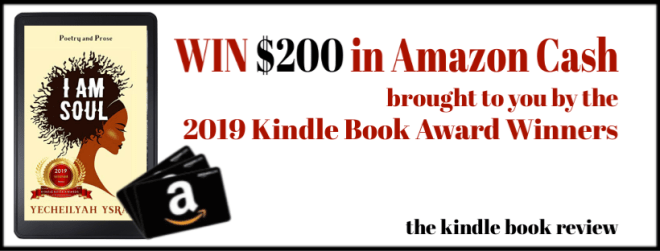
Win $200 in Amazon Cash: From The 2019 Kindle Book Award Winners

Attention Readers!!!

I am so excited to collaborate with the winners of the 2019 Kindle Book Awards to award one of you a $200 cash prize, sponsored by Amazon. Please read on for instructions on how to enter. We can all use an extra $200!

For a chance to win a $200 Amazon eGift Card from The 2019 Kindle Book Award Winners, click the link and enter (every day if you want). It’s easy & fun. If you love #reading, you’re going to LOVE these BOOKS. Enter now; giveaway ends Feb. 29, 2020. Click here for details ~>  http://ow.ly/VlqT50ylWG6

WHAT: $200 Reader Giveaway
WHEN: Feb.15-29, 2020

Again, here’s the link!!

https://www.thekindlebookreview.net/200-reader-giveaway/

The fun kicks off on

February 15, 2020 

(The link won’t work until 2/15. I am posting it now because I won’t be available to post it then.)

“But My Family Don’t Support my Writing”

Popular Complaint: “My family don’t support my writing.”🤷🏾‍♀️

Umm. How can I put this, your family and friends will be the least supportive of your writing (as is the case for most businesses). That’s not a bad thing entirely because they are not really your targeted audience.

New Writer:  *Smacks lips, rolls eyes.* “Okay, so what that mean?” 🙄

It means you have to find those people who are most likely to read the kinds of books you write and often, they are not family members. This specific group of people is called a targeted audience. You are not targeting everyone but focusing on one specific kind of reader. Here’s an example from words from Tyler Perry:

“I clearly believe that I’m ignored in Hollywood for sure and that’s fine. I get it. My audience and the stories that I tell are African American stories specific to a certain audience, specific to a certain group of people that I know that I grew up with and we speak a language.” – Tyler Perry

Say what you want about Perry but he has a keen understanding of his Target Audience. That’s what he is speaking of here. A specific group of people who his films/movies/TV shows are specifically for. That’s why his movies are all along the same lines in the theme. We can see that Tyler Perry makes the same movies because he is targeting a specific audience.

Personally, I am not much of a Tyler Perry fan. There are only a few of his movies I like but that’s not the point.

We can agree or disagree with his movies, but he is an excellent example of someone with knowledge of his Target Market.

When you are targeting a specific group, you are not trying to reach everyone or garner everyone’s support. Your purpose is to appeal to that specific group.

(Feel like I’m saying “specific” a lot but that’s kinda important). 

How many people at Michelle Obama’s book signing were related to her?

New Writer: “What? But those was her fans tho.” 🧐

And you have fans too if you look beyond the praise of family members who will probably never buy.

New Writer: “So you saying my mama can’t buy my book?” 💁🏾‍♀️

Your mom will probably buy your book first, but she’s not the seventeen-year-old black boy with peer pressure issues you wrote it for is she?

New Writer: “I mean naw but…”🤨

…and she’s probably not gonna leave a book review on Amazon, follow you on Goodreads, Twitter, Instagram, or subscribe to your email list and if she does, she probably won’t remember to read it.

New Writer: *smacks lips* “Dang why you gotta be all negative for?” 😒

Because the truth will set a lot of writers free from unrealistic expectations about what it means to be an author.

Loyal family/relatives may buy a book or two and they may be there to cheer you on, lift you, and support you in various ways. Families are good at heaping praises.

They love to like your posts, root you on and tell you repeatedly how they intend to buy your book and how proud they are of you. This is helpful from an encouraging point of view and it feeds the ego, but praise doesn’t sell books. How many of these people follow up? Every year the same family member asks, “where can I buy yo book?” But they never buy.

It is those non-relative readers who your book is specifically written for who will buy with consistency and read your every release, becoming avid readers and fans.

(…and I hate to use the word “fan,” by the way. *Shudders* Be a fanatic for no one.)

👉🏾How many of your genetic relatives have bought your book?

New Writer: “Lemme see, my mama got one, my cousin, boo boo nem, lil Chris…”

So what, all five of them..?

New Writer: “Oh, so you being funny?”🤔

No. I’m being real. Put it this way, would a company whose buyers don’t watch TV, make a commercial to push their product?

New Writer: “Naw that’s stupid.”🙄

🤷🏾‍♀️ So why would authors focus the bulk of their efforts on trying to sell to people who don’t read the books they write?

New Writer: “I guess I see what you saying.”😩

Now, take out some paper. You’re gonna have to write this down.

…wait, what are you doing? Put your phone down this is important. 🤦🏾‍♀️

New Writer: “Imma type it in my notepad.”

Okay but don’t be on Instagram this is important.

New Writer: I’m not dang. 🤳Go. I’m ready.”

Okay, here are a few questions you can ask yourself to help you find your readers. 

  • Who are my current readers/Who am I trying to reach? How old are they? What do they like? Where do they hang out?
  • What’s the #1 thing my readers love/need the most?
  • What problem does my book solve? What are my readers’ pains/issues/struggles/challenges?
  • What do readers gain from reading my book? What do I have to offer?
  • Who would benefit most from reading my book?
  • What makes my book unique?

My Responses to Common Complaints from New Writers is something new I am adding to this blog based on common writing and publishing questions from new Indie Writers. I thought it would be fun to answer them here in the form of dialogue. You will know the posts by the quotation marks around the complaint to differentiate it from other posts.

Did you like this first post? Do you have a common complaint I should address?

Find more articles under the Writing Tips and Resources page here.

Yecheilyah’s 3rd Annual Poetry Contest Winners: Friday is the Day!


Friday, November 1st is here and we are announcing the winners of this year’s poetry contest. The winners are notified ahead of time so we can prepare their interviews, but I will swear them to secrecy (lol) until we make the announcement.

We have selected 2 winners (1st and 2nd place) and four honorable mentions.

But that’s not all.

Please be sure to check your email if you entered a poem for the 2019 contest to learn more and for further instructions on what to do next.

As a reminder:
The 1st Place Grand-Prize Winner will be awarded the following:
  • $50 Barnes and Noble Giftcard
  • Publishing in the 2020 2nd Edition Literary Korner Publishing Magazine for Poets
  • Publishing and Author Spotlight Interview on Yecheilyah’s Blog (over 2900 subscribers, 70k views a week)
  • Spotlight across Yecheilyah’s social media
  • Spotlight in Yecheilyah’s email list
  • Signed copy of I am Soul with matching bookmark


2nd Place Awarded the following:

  • Publishing in the 2020 2nd Edition Literary Korner Publishing Magazine for Poets
  • Publishing and Author Spotlight Interview on Yecheilyah’s Blog (over 2900 subscribers, 70k views a week)
  • Spotlight across Yecheilyah’s social media
  • Spotlight in Yecheilyah’s email list
A digital version of the 2020 Literary Korner Publishing Digital Magazine will be available February 2020 featuring the winning poems. The Print version will be available fall of 2020. We will not feature the winning poems on the blog this year because they are featured in the magazine.

If you have not already purchased this year’s LitMag of our 2018 winners you can do so HERE. Your support helps to sponsor this and future contests. Thanks to everyone who contributed so far!

Okie dokie. We will see who wins on Friday! 


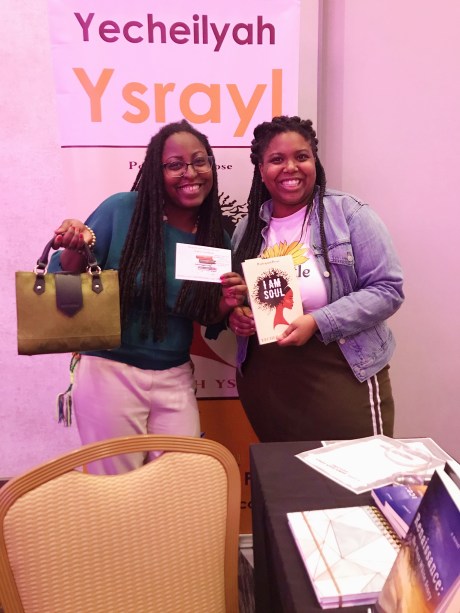
MogulCon 2019 | Atlanta Marriott Perimeter Center Ballroom

I learn something new every time I vend. This weekend’s MogulCon event was about learning, networking and allowing things to flow. It also further solidified my belief that vending is more about discoverability than profit. I met two wonderful ladies and we proved to be a good fit for helping each other in an area I had been praying about for some time. To learn more about the pros and cons of author vending click here.