7 Common Sense Reasons You Should Build an Email List

  1. Direct Communication

Many Indie Authors don’t see the immediate need for an email list until after a book is born. That’s because after a book is published we come to see the pertinent role emails play in driving traffic to our blogs, websites, and increasing revenue. According to The Direct Marketing Association, email marketing on average sees a 4300 percent return on investment (ROI) for businesses in the USA and according to The WordPress Beginner Guide, in our business, email lists get 10 times higher conversions than social media campaigns. One reason is because of direct communication. Also known as Electronic Mail, e-mail has been around forever as a way to directly communicate over the web.

While it’s unrealistic to think all (place number of subscribers here) of your blog followers are going to be reading your content and providing feedback, the hope is that at least half of them are. How do you know? Sure, someone may like your blog post and comment but that’s not a genuine system of measurement. A blog can have lots of followers with only a handful of views or lots of views and only a handful of feedback, and so on down the rabbit hole that is blogging. But then, ahh but then!

But then there’s the email list. Briefly, the email list is not the same as someone subscribing to your blog. When someone follows our blogs via email, they are opting in to receive email notifications of new blog posts. This is not an email list. This is someone following your blog. An email list is literally a list of email addresses and names of people who are highly interested in your content and thus gave you permission to add them to your list. The good thing about the blog is that many of those same blog subscribers can easily turn into email list subscribers. The email is essential for gazillion reasons but mainly, here is a direct line of communication. You can even monitor the open rates of your emails and see which of your subscribers are opening your mail consistently and which of them are not.

  1. Your email list subscribers are your real supporters. This means that they are the people who will actually invest money into your business

I’m not saying that the people who follow your blog or who support you already won’t support you because they’re not on your email list. I am also not saying that every email list subscriber will purchase your product(s) or open your emails. Not at all. What I am saying is that emails are personal. People get flooded with tons of emails a day and for them to give you permission to send them one is a BIG deal. How is it that some authors have people waiting for their next book? Fingers on the Buy Now button? There are many reasons but one of them that I’ve come to notice personally is the email list. I’ve noticed that many of the people on my email list are the same people who put their money where their heart is.

When people give you their email address, they are giving you permission to contact them and to connect with you on a deeper level. As a result, they are more than likely to actually purchase your next book. Not to say you should build one just for that reason, but email lists really narrow it down far as who is really true about their support and who is just doing lip service.

  1. An email list is the only communication asset that you actually own online.

I’m sure we’ve heard this a million times but its worth repeating. Of all the faith we put into Facebook, Twitter, SEO, and other things, email is the only true source of electronic communication. If all of these social networking sites come crashing down, email will prevail.   True story:

Before I really got into social media, before Facebook and before blogging I would send email shouts out to my email list of family, friends, and people who bought my books before. Many of you already know because you are one of them! Remember those days I’d email you on the release of my poetry books? Ahh, the memories.

Anywho, back to the story.

I didn’t know anything about landing pages, Lead pages,  Mailchimp or any of that. Though I’m still learning, I didn’t know a thing. Nada. Zip. Targeting those people already in my email was just common sense. It was the only way I knew to get the word out. I was green to selling books online but sometimes simplicity is wisdom. So, in not having all of the big brain marketing insight, I did the only thing that made sense: I sent promotional shouts out to my email contacts and was unknowingly doing what many email marketing services have you to pay them for.

The only difference is that I was doing it the hard way. It was  my first real stab at getting serious about my work. Once people started to email me for orders consistently (back then I was strictly paperback), I decided to create a website for the first time.

  1. Social Media is the traffic driver to your email list.

One thing I’ve admittedly not done is take as much advantage of my social media pages as I should have. Social Media is not about selling books directly, in my opinion. Obviously, we all want to sell more books online (don’t be phony, you know you wanna sell more books!) but consistently pushing buy my book links gets old eventually. Social Media is about building relationships and making connections. New relationships = visibility and reach. Visibility and reach = readership and readership is the platform.

  1. Feedback

When people subscribe to your email list they can respond to your emails just by clicking reply and give you valuable feedback. Why is it valuable? Remember, these are your real supporters. They can let you know what works and what doesn’t, helping you to create better and consistent content that targets your audience interest.

  1. Every Successful Business Has One

Name one successful business, entrepreneur or otherwise, that does not have an email list opt-in or use the old fashion style of emailing in some capacity, in general? I’ll wait. There are two reasons for this that I’ve identified in my experience dealing strictly with emails (again, before I got into social media and blogging):

#1: Email is the best form of marketing. It’s low-cost and allows companies to easily and effectively spread information about their products and services, both to existing customers and potential ones.

#2:  Our email subscriber list is the real deal. It lets you know if your business is growing or not and for Independent Authors this is massively important. Of all of the Facebook Friends, Twitter Followers, IG followers, AND blog followers your email is the truth. Why is it the truth even more so than your blog numbers? Because its targeted. Meaning, these are the group of people who are specifically interested in your content. Really interested. They didn’t just follow your blog but they took it a step further and subscribed to your personal email list.

If I had 8,000 Twitter Followers (which I don’t lol hee hee), and 1,000 email subscribers, you know what? My real number is closer to that one thousand! This isn’t to say the 8,000 aren’t genuinely interested but that these one thousand are highly likely to support versus the 8,000 because they are already tuned into the content on a personal level. You can even break it down further when you  look at open and click rates. If 1,000 people are subscribed but only 500 open the emails on a consistent basis  then those 500 are even more likely to support. But…

It’s less about the open and click rates and more about the conversion rates. That is, how many of those supporters have we converted into buyers, and how can we  aim our marketing strategies and focus toward the activities that’s going to not just increase open and click rates, but also generate revenue. Again, this isn’t to say its all about the money (because its not, its actually all about the relationship and connection) but keeping this in mind will remind you why you should never buy an email list. Apparently that’s a thing? I didn’t even know what buying an email list was but apparently instead of building a list on your own you can buy one. I’ve even read that you can rent email lists! That’s just lazy. Click Here to learn more about buying email list and why you shouldn’t because I’m getting a headache just thinking about how stupid that is.

But I digress…

So you see, email also makes it easier to track interest and thus, create relevant content:

“According to research conducted by the Direct Marketing Association, 93% of email users have opt-in relationships with a consumer brand, as opposed to 15% on Facebook and 4% on Twitter (according to Chris Brogan, president of New Marketing Labs).”

The point is that email lists remain one way to make it easy to gauge the reach of your support system. Interestingly enough, with all of the advice (and carefully strategic opinions) out there I’m surprised there isn’t more talk concerning how to build and maintain the email list.

  1. An email list gives you the opportunity to connect with people who are not active online or who are technologically deficient

“It’s true that email is fighting with other services for online communication, but it is still ubiquitous in a way that other social media networks are not. If you want to reach the majority of your audience, email is still the safest bet.”

– Smashing Magazine

I talk to my husband all the time about the differences in how I saw technology when I was just a student in Chicago versus being an adult running my own business. Back then Facebook didn’t exist, (Myspace didn’t even exist!) and I didn’t know anything about blogs. Granted, I’ve taken computer courses but although I enjoy technology, I was at a time in my life where I wasn’t into the social media thing. It was just a different world for me on so many levels. However, even though that was years ago, I am always surprised to discover how many people are still not into social media.

Aside from updating their Facebook posts, you’ll be surprised to discover that a lot of people are just unaware of how to browse the web in its basic form, and not just browse the web, but are aware of its many uses. This is where your email list can make a huge difference. Back in the day when I didn’t know much about the online scene one thing I did have was email. It was a big thing back then and guess what? It still is!

“It’s worth noting that people tend to be members of multiple social media websites simultaneously, with varying degrees of involvement, but they usually have only one or two active email addresses. The email address remains the unique identifier online; you use it to log into almost everything, so it would take a lot for it to become obsolete.” (Smashing Magazine)

People who don’t spend their lives on Facebook, Twitter, and other social outlets will have an email address for sure. (I’ve also found that people who are not online are more interested in getting hardcopy, paperback books as well as opposed to digital. It’s always wise to have your books in both formats).

Well, I am off to find something else to do but I sure do hope these tips have helped you. So, go on. Start that email list!

But wait, EC I’m not an expert…

Secret #1: Worried about what to include in your email list? Don’t! You don’t have to know EVERYTHING. No one person knows everything but we all know in part. If you’ve ever been good at something or done something that got you positive results, then you’re an expert at that thing and don’t let any so-called professional tell you any different. Expertise just means knowing more than the person you’re targeting and no one should know more about you than you.

Tidbit: You can always just start with updates as your first few emails if you’re not sure what to provide to your list. Or you can release free exclusive chapters of works you haven’t done yet or just talk about something fun like how you got started writing. Just make sure that you’re offering something of value.

Nugget: Just like with your blog posts, compose your emails in a conversational manner and avoid “preaching to the choir”. Just be cool, calm, collective, and professional. People aren’t stupid so we don’t have to speak to them like they are. Your email subscribers are special and should be handled with care. One negative of emails is that they’ve been around so long that they are easy to ignore. People unsubscribe and delete emails everyday so when we can build an email list (no matter how small), our supporters deserve all of the value we can give them. Showcase your real self. OK wait, some of you shouldn’t do that! I mean your real polite self.  I like to keep my emails fun. At the same time, there is a level of professionalism that must be maintained as well. Obviously, we don’t want to just lose all common sense  ; )

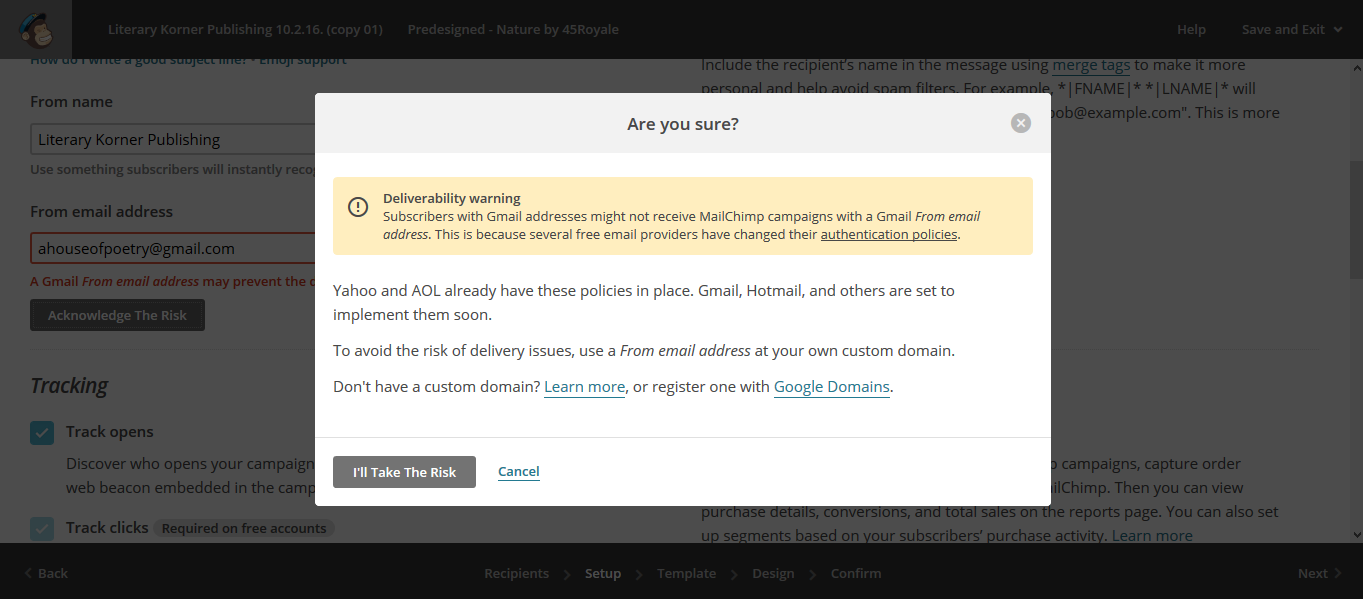
Secret #2: As much as I didn’t want to, I recently upgraded my email. I now use my own personalized business email for my email list instead of my Gmail account. Here’s why you should too if you get the following message:
 screenshot-75

In case you can’t see the words, it says:

“Subscribers with Gmail addresses might not receive Mailchimp campaigns with a Gmail from email address. This is because several free email providers have changed their authentication policies. “

What It Means

This means that if you’re using a return email address like Gmail or Yahoo and you’re also using an email service that has upgraded their authenticity policy (like Mail Chimp but not just Mail Chimp), Gmail and Yahoo may not allow those emails to go through because a lot of Spam users create bogus emails using Gmail and Yahoo email addresses (I know, boo). This may account for your low open rates as many people are probably not getting the emails.

*****

These secrets are usually reserved for my email list, but I wanted to give you the opportunity to see what you’re missing. I’m considering writing a memoir and you know what? Friday, my subscribers  received the first potential chapter! They are the first to see the unedited, raw, and uncut first chapter to what can become the book about my life (if I so decide). In fact, I’m releasing the first five chapters. (On my list? Didn’t see it? Check your email!)

I’ve talked some time ago about doing video tutorials and I’ve officially started production on my first video. I am releasing these tutorials to my email list ONLY so don’t miss out.

Just click on the image below to subscribe. You’ll be taken to my landing page where you can enter your name and email address. Easy Peezy.

Note: Entering your email means that you’re subscribing to my email list for more secrets, nuggets, tidbits, novel excerpts, sneak peeks, resources, spiritual and writing encouragement, the list goes on and on.

ATTN. I HAVE UPDATED THIS PART SINCE SOME OF THE INFORMATION, LIKE THE TUTORIAL SERIES, IS NO LONGER RELEVANT. TO SUBSCRIBE TO MY EMAIL LIST, CLICK HERE.

Be my guest: Yecheilyah Ysrayl – Platforms Made Easy – A Simple Look at Platform Building for Aspiring Authors

My guest post on building platforms. (I am off today. Will share across social media tonight).

*Comments disabled here. Meet me on the other side!*

Sue Vincent's avatarSue Vincent's Daily Echo

a-simple-look-at-platform-buildingNote: This article can apply to ANYONE just starting a business, not just writers, who would like to understand more about platform building. Just replace writer / author with your profession.
Platform building is not something we writers want to hear about AGAIN. Honestly, we all really just want to write books, publish them, and then crack open bottles of wine to celebrate. Next, we wait. And wait. And wait. What are we waiting for? We’re waiting for the readers to come of course, isn’t everyone? No. Some people have readers before they even come out with a book flocking to their Amazon pages or Author websites to buy. Some people do not have to build a fan base after they’ve published a book, tweet until their fingers ache, or spam their family and friends on Facebook. Some people seem to just have thousands of readers already lined up at…

View original post 1,014 more words

Basics Every Indie Author Needs Before Publishing a Book – Guest Post…

I need to get my time zones right! Lol. The Story Reading Ape has surprised me once again with the publishing of my Guest Post. *Comments disabled here. Meet me on the Ape’s blog!*

Chris The Story Reading Ape's avatarChris The Story Reading Ape's Blog

Blog Post 2

When I published my first book, I didn’t see my writing as a business. It was just me doing what I’ve always wanted to do. However, as I began to learn and as I continue to learn, I quickly discovered why Self-Publishing requires so much work: It’s a business.

That doesn’t take away from the fun of it, but the realization did help me to become more organized. I quickly learned why no one was buying: I wasn’t working! Writing is working, technically, and I was doing plenty of that. However, I was not working on the skill of writing, researching my industry, understanding tips to help me to write better books, promoting, marketing, and everything in-between. I was writing, sure. But the business of writing? I didn’t even know it existed. I was a writer and that was all. When I got into the business of writing however, that’s…

View original post 848 more words

Self-Publishing – Laying Bricks Ep 5: Decorating

Laying Bricks(1)

I want to be clear that this series does not intend to explain how to become a best seller, how to market and promote like a pro and all of that. I named this series Laying Bricks to demonstrate the importance of laying a proper foundation for producing a book. However, we are officially passed the ground work and are now ready to decorate a little bit.

I don’t have to tell you how important book cover design is. In fact, many of your favorite author blogs have already said as much a gazillion times. For this reason, I am not going to spend a lot of time on this topic. Hopefully, what I can provide instead is something a bit different than what you’ve already been told. Hopefully, we can spend this precious time of yours talking about something a bit more unique.

When it comes to Book Cover Design you have 3 choices. You can purchase a high priced professional book cover, purchase an affordable pre-made, or have someone you know who specializes in graphic design to do it for you.

Paying More

My first experience with paying more than I’d like to on a Book Cover design happened when I was tired of my books looking bootleg and I invested in 99 Designs, an online graphic design contest marketplace. The program sells all kinds of designs from Book Covers to Logos. The process is set up like a contest where you pay a certain amount of money to have more than one graphic designer to compete to design your perfect cover. As the days go by and the designers are working and submitting cover designs as if your their personal client, you’re reviewing and eliminating designs at various stages. Each designer is working to edit the cover to your liking at each step and you are eliminating them as you go on. I really enjoyed the process and it was a fun experience that I wouldn’t mind doing again.

What I loved about the experience was having talented graphic designers to work on my book covers. The reason I highlight this aspect is because when someone who is not a professional designer chooses a design for a book (let’s say an Independent Publisher / Self-Publisher designing their own book but is not a designer) they won’t necessarily have the same eye for those little things that can make a big difference in the design like a professional will have. We may not be familiar with elements, background, proper typography and all of that. I mention this because this can be one huge benefit to paying a little money for the right cover (That and y’all know how serious I am about investing in your business. Don’t always look for everything to be free or low cost and then expect the same quality).

However, 99 Designs was also too expensive.

Budgeting

The reality is that I’m broke. Many of these super professional covers, the ones that we’d all like to have are very expensive, priced anywhere from $300-$700 dollars’ minimum. Surely, I don’t have the kind of money to purchase a book cover at the same price I did for the 99 Designs (which I only made back by hosting a live event and selling paperback copies). This is where creativity comes in and with creativity comes pre-mades.

The benefit of having a pre-made Book Cover design is numerous. To start, you can purchase a cover for as low as $45 or even lower if you go through such places as Fiverr (which I wouldn’t really recommend getting anything too cheap, just saying).

Pre-mades are professionally designed Book Covers pre-designed by, for the most part, professional designers. They can be edited to fit the authors needs and some even give you options for changing colors and fonts to fit the style of your book.

I do have a concern about pre-made covers though that I cannot leave without warning you about. I have not yet heard anyone speak about this and while I’d highly recommend pre-mades (I use them myself), be sure you are on the lookout for covers that are a little too similar.

What am I talking about? Well, all pre-made book covers will have a disclaimer that sounds something like this:

“Once a cover is sold it is never sold again!”

Technically, this is true. Once you purchase a pre-made it cannot be sold again. The designer will remove it from their site and that design will be marked as sold. There is a loophole in this, though. That loophole is this: As long as the design is not exactly the same, the designer can sell a cover that is quite similar in taste. As long as there is something slightly different, the cover can be sold as a separate cover. It could even be as minimum as the font or maybe the person is standing on the chair instead of sitting in the chair.

This doesn’t always mean the similar cover is available I must add. Sometimes the designer will add the finished cover to the portfolio so we can see how the final version looks. However, there are many websites that are literally offering a similar cover for sale as the one that was sold with only minor changes. Just an adjustment here and there and it is literally the same cover.

If you purchase a pre-made, be sure it’s a truly unique one that is not like any of the others on that designers’ website. Check the bottom text of those that are similar and make sure it is only similar because the designer is showcasing the look of the final version.

When ordering premades try and look for exclusive premades or ask the designer if they make them. An exclusive premade is a pre-designed cover designed using photos from photographers who will only sell the photo used in the premade once. Otherwise the premade is pre-designed using photos from stock photos or from photographers who will sell the used photo in the premade again to other clients and covers. Although the premade cover is only sold once, the stock photo can be used again and again in other slightly different covers.

Either way, just find something that is unique.

An additional concern with pre-made covers is that rarely will you find pre-mades with anyone of a diverse nature. Rarely do I see pre-made book covers with Asians on them, Chinese, Blacks, Latinos, or Hispanics. For this reason, I often have to look into a custom made design or get a bit creative on my own if my cover will feature an African American person on the cover. (If you know of  designers who specialize in diverse covers, let me know!)

A Friend Who Designs

I’d just say here to make sure that this friend actually knows what they’re doing. Not all book cover designs (including pre-mades) have that professional look. Book Cover designers are everywhere now and graphic designer or no graphic designer some of these covers look like something you can just do yourself (free does not always mean quality).

Below are some pre-made book cover places to check out for those of you who are looking for covers. Many of them are really professional looking and the prices are reasonable:

The Book Cover Designer

https://thebookcoverdesigner.com/product-category/premade-book-covers/

The Cover Collection

http://www.thecovercollection.com/

Go On Write < Go On Write is currently running a sale on covers

http://www.goonwrite.com/

Self-Pub Book Covers

http://www.selfpubbookcovers.com/

Paper and Sage

http://paperandsage.com/site/

The Book Cover Machine

https://bookcovermachine.wordpress.com/

EBOOK Indie Covers

https://ebookindiecovers.com/

Remember, it’s not just about a cute design. Be sure that this design is also a visual representation of your book.

***********

Disclaimer. Everything I share on Self-Publishing is always based on my own experience and research because I believe you can’t advise people on stuff you haven’t really tried. It’s just best if you’ve walked those shoes. So, that said I do not profess to be an expert. There are too many of them out there for you to glean from. Now, should you find information on this blog useful? Whoo hoo! Go for it.

Missed the first four episodes of laying bricks? Check them out below:

Laying Bricks Ep 1: Guide The Bricks

(About Focusing on the Story)

Laying Bricks Ep 2: Mortar

(About the Revision)

Laying Bricks Ep 3: Cutting The Excess

(About Editing)

Laying Bricks Ep 4

(About Advanced Reviews, Pre-Launch)

Hot PBS Self-Publishing Topics to Date:


Yecheilyah Ysrayl is the YA, Historical Fiction author of The Stella Trilogy. She is currently working on her next book series “The Nora White Story” about a young black woman writer who dreams of taking part in The Harlem Renaissance movement and her parents struggle to accept their traumatic past in the Jim Crow south. “Renaissance: The Nora White Story (Book One)” is due for release spring, 2017. For updates on this project, sneak peek of chapters and the pending book cover release for this project, be sure to follow this blog and to subscribe to Yecheilyah’s email list HERE.

Self-Publishing – Laying Bricks Ep 4: The Pathway

Laying Bricks(1)

People lay bricks for many different reasons. Whether you are building for a brick home, a drive through, or storefront, the process is the same. Like mathematics, as long as you have the basic formula for masonry you can succeed in brick laying. As long as you remember to add, subtract, multiply, and divide you can solve any seemingly complex mathematical equation. Unless of course you’re like me and you hate math.

Nonetheless, Self-Publishing is the same way. Once you’ve established the basics of building a book, you can do so repeatedly and that is what this series is all about. Everything else is just an add on. You may have built a house but it doesn’t have to stay the way you built it. You can add rooms, roofing, or extra bathrooms if you want.

Now that we’ve written a well written story, gotten it edited, beta read, and critiqued, now what?

Advanced Reviews, Pre-Launch

This episode took me a little longer. It took me longer because writers can do this in many different ways. Self-Publishing doesn’t have any official rules and for that this step can in fact also include marketing and promotion. To keep things simple, let’s just focus on building the book first. So, in this episode of Laying Bricks it is time to pull out your multipurpose hat.

Advanced Book Reviews

Once your book is the way it was meant to be, it is time to send it off for advanced reviews. This process is most important as it helps you to garner reviews in advanced. In this way, by the time the book is released, your reviews can help the book to sell. With Indie’s doing everything themselves, reviews give us room to depend on some outside help.

When deciding who you want to review your book, there are a few things to keep in mind:

Genre – Not a neccessity, but can be very helpful. When someone reviews your book who is actually part of that books genre— let’s say a fan of Historical Fiction reviewing your HistFic masterpiece—you have a better chance at expanding your audience. This isn’t to say anyone can’t review you at all, just that those of your genre makes it that much better. When you desperately send your book out to anyone, you increase your chances of marketing your book to the wrong audience.

Desperation – Speaking of desperation, don’t be desperate. I know, desperate times cause for desperate measures! However, take some time and be a little strategic about who you send your books out to. Target people who are not only in your genre but who have a passion for books with a genuine love for reading. Visit their websites and blogs to make sure they’re a real person, that they’ve reviewed books before, and that their subscriber number is decent. Listen, don’t get the wrong idea here. I’m not saying it’s all about the numbers because its not. I’m saying you want to get the most of the experience.

While we all have to start from somewhere, quality attracts quality. The whole point of reviews is to help the author. That said, make sure there’s enough of that reviewers’ blog traffic to make a difference for your book in some way. If you choose to pay for a review, make sure the prices are reasonable and that the person or company is well-established. There are lots of frauds out there and people taking advantage of Self-Publishers and you wouldn’t want to cause any unwanted attention to your Amazon account.

Follow The Rules – Every serious Book Reviewer has a list of rules and regulations to accompany their services. Paid or not paid, Reviewers must have a policy in place. This is important because books take up a lot of time. As much as I love to read, I cannot possibly read every single book that comes my way. In addition, though reading books is personal, even it requires some order.

  • Research the reviewer < Make sure they are real people and not weirdos. Yes, weirder than me.
  • Submit your request exactly as their policy states.
  • Pay special attention to the books they do not accept so you don’t get an email back and become that guy. Or girl.
  • Address the reviewer by name, make it personal. Try not to sound thirsty or in other words, desperate (even if you are).
  • Follow their blog, follow their social media. Make sure this reviewer’s energy and the vibe is fitting for your book. This isn’t to say reviewers don’t read a wide range of material, it’s just about you the author being strategic and getting the most out of the experience.
  • Consider the reviewers time. Yes, they are agreeing to read books for free but you aren’t the only person in the world. Reviewers get tons of emails a day from Indie Authors requesting reviews. Keep in mind that there may be a line. As such, if your book is 300 or more pages, don’t expect that reviewer to finish it in two weeks. If you have a deadline, be sure to contact the reviewer far enough in advance to meet your deadline and be realistic about it. Reviewers may read fast on their own leisure time, but to review a book is to study it enough to give sensible feedback. No, it’s not an academic assignment or anything but it’s not a race either. Give people time to really read it if you want to get the most logical feedback. If you want us to scan it and throw some stuff together, we can do that too. Your choice.
  • Don’t be rude. With the exception of a few because I know there are some, most of us to include yours truly, do not promise 5-star reviews. In fact, we are not reading your book in exchange for a glowing review at all. If the book is not up to par do not expect to be lied to unless of course, that’s your thing. If a reviewer gives you a low rating, don’t curse them out. Try to understand that whether the book was good or not they invested something they can never get back: Their time. They’ve done you a great service. Take the advice and use it to further perfect your work.

Pre-Launch Strategy

First, what is a pre-launch strategy? According to The Marketing People:

“Premarketing is the foundation stage of any marketing plan to enable business development. Prior to any marketing, SEO or social marketing, this step ensures that you have the right brand. The right website, stationery, brochure/catalog and other related sales and marketing tools in place. To ensure you capitalize on your ongoing marketing and sales team activity.”

In addition to garnering advanced reviews, you need something to do while your book is being read. This is a great time to start pre-launch strategies.

I hope that by now you’ve already established a few things:

  • Blog / Website
  • Email Newsletter
  • Social Media Accounts

If you do not already have these stop writing right now. Yes, step away from the computer, put the pen down and grab the laptop. Now go to your room young man / lady. Yes, you. Close the door and don’t come out until you have social media accounts up, a blog or website, and an email newsletter.

When I first started publishing, I followed the following trend:

  • Write book
  • Publish Book
  • Tell people about book (quietly)
  • Wait for people who I didn’t tell about the book to find me

This isn’t wrong necessarily (well, the last one is), it’s just out of order a bit. It’s not how you promote, it’s when. Marketing and Promoting your book when it comes out should just be one aspect of it. In last week’s article Planning Book Releases in Advance, we spoke a little bit about this. That is, planning for your books arrival at least six months to one year in advance. Plan for your books release before, during, and after the book is written.

If you haven’t done so, no worries, there is hope.

If you have not taken the time to plan pre-launch strategies for your book, do so now while your book is being read.

  • Build a Fan Base

OK, so your book isn’t out yet but what are you doing to prep people for it? This is a question I ask myself every day.

Social media is not really about selling books even if you’re like me with an online bookstore. Social media is about building relationships. As a result, these relationships lead to sales in an indirect kind of a way. Writers of books are supposed to be experts on the subject matter in which they are writing. This means that writers can utilize other writing methods to help draw attention to their book without constantly talking about the book itself.

No matter what your area is, sharing insight on that topic helps to build trust and interest in people. Writing flash fiction or sharing excerpts helps people to get used to your voice and style, posting articles, news clips, and other things help people to understand your passion and focus as well. As a result, they’ll be interested to see what that book is about.

There’s no guarantee they will want to buy the book but a relationship has formed and relationships are what you want.

  • Special Offers

While your book is being read, you can also offer something exclusive in preparation for your books release. Let’s face it, everybody wants to be exclusive and official (lbs). Make people feel special by giving something away ahead of time. Though a pre-order of your book is nice (especially a signed hardcopy), try to do something different. Give away a small journal, amazon gift card or Starbucks gift card. Whatever it is, put some effort into it. Let your genuine love for the people shine through (people can tell if you’re just being phony because you want them to buy your book). If you give away a book, make it an exclusive super-duper official one. Make sure we know that only the best of the best can qualify for this baby here.

  • Book Cover Design

We’ll speak more about this next week, but this is a good time to get started on that book cover design!

Remember: Pre-Marketing is the first stage to business development. As an Indie Author, you are that business.

I know its not much, but I sure do hope that this information has been helpful. As always, I am following my own advice and am passing along information in my journey as I learn. I am always humbled at whomever wishes to join me.

Be sure to subscribe to my email newsletter for more tips, updates on my upcoming projects, free excerpt chapters and articles not yet published to this blog, book promotions, and more.

Next– Let’s Paint the House!

Next, we’ll talk about decorating your brick house. 

Disclaimer. Everything I share on Self-Publishing is always based on my own experience and research because I believe you can’t advise people on stuff you haven’t really tried. It’s just best if you’ve walked those shoes. So, that said I do not profess to be an expert. There are too many of them out there for you to glean from. Now, should you find information on this blog useful? Whoo hoo! Go for it.

Missed the first three episodes?

Laying Bricks Ep 1: Guide The Bricks

(About Focusing on the Story)

Laying Bricks Ep 2: Mortar

(About the Revision)

Laying Bricks Ep 3: Cutting The Excess

(About Editing)

Hot PBS Self-Publishing Topics to Date:


Yecheilyah Ysrayl is the YA, Historical Fiction author of The Stella Trilogy. She is currently working on her next book series “The Nora White Story” about a young black woman writer who dreams of taking part in The Harlem Renaissance movement and her parents struggle to accept their traumatic past in the Jim Crow south. “Renaissance: The Nora White Story (Book One)” is due for release spring, 2017. For updates on this project, sneak peek of chapters and the pending book cover release for this project, be sure to follow this blog and to subscribe to Yecheilyah’s email list HERE.

Show and Tell – The Show vs Tell Debate Critiqued

A wise man once asked a simple question: “What is water?”

A few people gave their answers. Some said “H2O”. Some said, “a transparent liquid found in lakes, oceans, and seas.” Other’s said, “a chemical substance.”

The man smiled. “None of the above.”

The people’s brow buried deeper into their foreheads and their mouths twitched, “what?”

“Don’t give me the name or what you’ve been told it is made of,” said the man.

“Tell me what it is.”

writing-desk2

****

Self-Publishing is a lot like life, there is a question behind everything we think we know. There’s a lot of advice in the Indie Author community. What if I told you that not all of it was good advice? Or shall I say, not all of it is wise advice? It may be useful advice, but is it wisdom? Do we actually know what water is? We do not.

What is the most talked about thing in this community? What is that thing that people just can’t stop talking about? Yes, the Author Platform is one, but what’s another? That’s right, “Show, Don’t Tell.”

Hold on to your seats. A lot of you are not going to like this:

What if I told you this was not very good advice?

I didn’t say it wasn’t useful advice. Advice is subjective like that.

Let’s establish the facts. New authors indeed tend to lean more toward telling than showing and this is a problem for readers because it makes the story difficult to get into. The author’s purpose is to make the reading as easy and as effortless as possible.

Please, for the love of all that is set-apart, make sure your script does not read:

“I walked up to the coffee machine. I grabbed the pot. I walked over to the sink. I filled the pot with water. I put the pot back and turned on the machine. Brandon calls me from the other room. What does Brandon want?”

Everyone say it with me:

“Don’t tell me the moon is shining; show me the glint of light on broken glass.”

Anton Chekhov

Great advice.


I sympathize with staunch “Show, Don’t Tell-ers” because I’ve come into contact with many books that sound just like that example. All the author did was told me what was happening (like one big summary) and bored me to death. My brains shifted in my skull, turned into liquid and oozed from my temples. Gross, right? You don’t want to gross your reader’s people.

Here is wisdom: Show AND Tell.

  • Showing – Writing vividly with detailed images, sensory information, and/or dramatized action
  • Telling – Writing in abstract summaries or simple statements

It is the secret no one is talking about.

Or, almost nobody.

Kristen Kieffer wrote a most excellent post on balancing show and tell and I will quote her in this post because ya know, no need to reinvent the wheel. Though I’d already written this article as a newsletter for my email list long before I read Kristen’s article, I am glad I eventually came across it as it further solidifies my point and now I can use some of her examples as a reference. Kristen Lamb says:

“As writers we are often guilty of too much brain-holding, of coaching the reader. We want to control every emotion, perception and description yet often less is more. When we leave blank space for the reader to fill in, the fiction can have room to blossom into something unplanned for. The story becomes richer and the experience more visceral because it transforms into an echo of the audience’s self-projection. Thus instead of one fixed interpretation, we get countless.” – Kristen Lamb

Aside from both Kristen’s and a few others, few people are talking about this aspect of balancing show and tell. Because of the show vs. tell debate authors are now showing us everything but their booty cheeks. That’s not what show means and makes the story sound just as boring as too much telling. It’s called Storytelling for a reason. You are supposed to tell a story.

The difference is not eliminating telling. You don’t want to show and not tell. You want to balance the amount of telling and showing. The straight action works no more than no action. Your characters just can’t be running all over the place, they need quiet, emotional times too. Balance is key.

Storytelling came from the oral traditions of passing along information by word of mouth. It is the days where your grandmothers and great-grandmothers told the stories of their childhoods. It’s when you sat at their knees to learn of the world that existed before you.

The easiest way to understand this is remembering that Telling gives us the statement, in other words, tells us something is done. Whereas showing is the demonstration of how something is done. That said, why is Anton’s example so popular?

“Don’t tell me the moon is shining; show me the glint of light on broken glass”.

 –Anton Chekhov

When I first read this quote, I pictured a triangular piece of glass that fell from a window and is now sitting on a street corner under the moon. It rained earlier, so it sprinkles the glass with droplets of water. I can tell by the position of the glass and the tiny pieces of gravel because something bad happened. This caused the glass to shatter and yet, there is the light shining through all the brokenness. The story is not over because there is hope.

The moon is shining, tells me what is happening, but the glint of light on broken glass shows me how it happened. (Or at least how I imagine it happened.) It is a demonstration versus information. Don’t tell me they shot the woman in a restaurant. Show me the sweat on the palms of her hands and underneath her armpits, the perspiration sliding down her temples; the tears rolling down her cheeks, and the shakiness of her hands as the pistol is pointed at her head.

Telling is Just as Important

In the words of Steven Moore, who left a comment on the article 5 Examples of Bad Writing Advice from Great Authors:

“You should only provide enough detail so the reader can participate in the creative process by forming their own ideas about characters.”

Telling is just as important as showing and it is because of this being left out that makes “Show, don’t tell”, strange advice. It just doesn’t explain the entire matter. I need not know every single thing that is happening in the restaurant. You don’t have to show me the fly on the windowsill if it’s not relevant to the story.

A general rule of thumb is to show only when it has something to do with the story. Bernice McFadden does a most excellent job at this in This Bitter Earth. Everything mentioned in this book connected somehow. There is nothing mentioned that is insignificant to the story and no question that is not answered by the end of the novel.

Telling is making a statement without the drama. “She touched the pillow.” That’s telling. We don’t learn how she touched the pillow or what she thought when she touched the pillow, we are just told she did and it’s enough. We need not overdramatize her touching of the pillow.

It’s a matter of knowing when to show and when to tell.

Let’s refer to an example in Kristen Kieffer’s article:

Too much showing:

“His eyes were like the sea during a storm, dark blue and tumultuous. His jaw was chiseled like marble, his nose sharp and strong. His golden locks glimmered in the sunlight as he carried the boxes, ropy arm muscles rippling beneath the crimson fabric of his t-shirt.”

I enjoyed reading that actually, but, I am learning something as well. Because I love poetry, I can sometimes show too much! Good thing we have beta readers and editors. Moving on…

Too much telling:

“His eyes were dark blue. His shirt was crimson red. He had a prominent jaw and big muscles. I watched him as he walked into the office, holding a box with his name on it.”

As you can see, too much telling is BORING. My brain is shifting…

Showing and Telling:

“His eyes were dark blue, as tumultuous as a storm at sea, a stark contrast to his cheery crimson shirt. He had that classic Adonis look so many girls admired. Chiseled jaw, strong nose, ropy muscles, I admired them all as he carried his box of belongings into the office.”

“His eyes were dark blue (statement), as tumultuous as a storm at sea (description), a stark contrast to his cheery crimson shirt (description). He had that classic Adonis look so many girls admired (statement). Chiseled jaw (description), strong nose (description), ropy muscles (description), I admired them all as he carried his box of belongings into the office (statement).”

Now that’s a tasty description. Want to create the same in your writing? Kristen advises we use the following formula:

1 Statement + 2-3 descriptions = Balanced writing

I love this advice and will be incorporating this nugget of wisdom in my own writing.

Yecheilyah’s Book Reviews – All Good Stories by Linda G. Hill

Title: All Good Stories

Author: Linda G. Hill

Print Length: 62 pages

Publication Date: August 10, 2016

Sold by: Amazon Digital Services LLC

Language: English

ASIN: B01JQWMQAE

Familiar with Linda through her blog, Life in Progress, I expected humor. What I didn’t expect was to finish the book in two hours. Everyone knows I love a good laugh, and Linda did not disappoint. All Good Stories is a romantic comedy about friends Jupiter and Xavier and takes place mostly at the bookstore where Xavier works. From the onset, we can tell there’s a bit more heart invested on Xavier’s part. The cute way Jupiter shortens his name, the way he dreams of being with her, and the added bonus of being her best friend.

However, Jupiter’s got a new novel. It wouldn’t be so bad if it didn’t lead her to Bob the Blogger, a novelist and blogger obsessed with alliterations whose profile picture looks nothing like the real him. After a steamy three hours of commenting back and forth with Jupiter, Bob has agreed to critique her novel. He has written her three love poems with the added warning that he will not use the first letter of her best friends’ name (because he’s a Serial Alliterator and X just wouldn’t go well with his alliterations) and has given her his phone number.

Bob’s weirdness causes Xavier’s growing love and concern for Jupiter to thicken into a hilarious investigation. Plus, what’s Jupiter’s book about anyway?

I enjoyed the pacing of the read and that it continued toward the end. It’s a short read, but it didn’t need to drag on beyond what the author gave us. It’s like a literary treat if ever you’re waiting at the doctor’s office or airport and could use a good chuckle or two.

This book is not only a comedy but also has an important message. The seriousness of meeting people online and of rushed relationships has been the focal point of many books I’ve been reading lately. All Good Stories is definitely a good story and well-written.

Ratings:
Plot Movement / Strength: 5/5
Entertainment Factor: 5/5
Characterization: 4/5
Authenticity / Believable: 4/5
Thought Provoking: 4/5
Overall Rating: 5 / 5 stars

All Good Stories is available  now!

AND we’d like to give special highlight to Linda’s amazing Cover Artist Belinda Borradaile!

Check her out here!

Book Cover For Linda G HIll

Please also follow Linda on the web!

******

For free short stories and poetry: https://lindaghillfiction.com

bitmoji889657576

Did you just write a book? In need of more reviews? Check out my book review policy here.