Its author, Andy Weir, said he didn’t think the book had mainstream appeal and was surprised anyone was interested.
It began as a series on Weir’s website, and when readers complained it was hard to read the stories sitting at their computer, Weir listened to his audience and put it out as an ebook and then on Amazon’s Kindle.
It then got picked up by a small Canadian audiobook company.
Then Random House was interested, and before he knew it, Weir had a movie based on a book he started writing on his website that he went on to Self-Publish.
The Martian would later be nominated for several Oscars.
Photo by RF.
Self-publishing doesn’t just benefit authors who wish to go Independent, but it could also help authors who want to attract the attention of publishing houses.
Everyone’s publishing journey is different, and there is no telling where yours might take you.
Going the traditional route doesn’t make you a sellout, and self-publishing doesn’t mean your book is trash.
If you take the time to craft a well-written, high-quality book that people just can’t stop talking about, the sky is not even the limit of where it could take you.
For a more personal example, I didn’t intend to give the platform much attention when TikTok launched. I thought it was for kids, I don’t dance, and I didn’t think I had time to learn another app.
But I took a chance and have grown my account to over 18K followers (updated: We are now at 23.6K!) went viral at 1.3million views, started a TiKTok shop, and have over 20 new email sign-ups that came directly from TikTok.
I am not telling you to start a TikTok account. I am telling you not to limit yourself.
In the words of Maya Angelou: “Pursue the things you love doing and then do them so well that people can’t take their eyes off of you.”
I was away spending time with family when the now-viral Montgomery Riverboat brawl occurred.
When I finally logged into social media, I saw hilarious memes of folding chairs and pictures of Louis Farrakhan clamping his hands together proudly with the words: “Black people across America watching that video today…and ya’ll know what video I’m talking about.”
But I did not know what video they were talking about.
And then I saw it, but the fight video did not draw my attention as much as a specific viral meme.
This meme is inaccurate and should not be shared!
The meme identifies Nathaniel Alexander as the inventor of the folding chair, but the picture is of a different Black inventor.
The man in this picture is not Nathaniel Alexander. It is Lewis Howard Latimer who worked with Thomas Edison and helped make the light bulb possible.
Latimer is responsible for many of Edison’s patents because he worked as the original draftsman at Edison’s research laboratory.
Latimer also worked with Alexander Graham Bell on the telephone.
I cover more about Latimer in the upcoming book.
As for Alexander, he was not the first to patent the folding chair, which had already been used going as far back as ancient Egypt.
In the US, an early patent for a folding chair was by Jordan Cram in 1855.
Alexander’s invention improved the folding chair featuring a book rest which he patented in 1911.
“The purpose of my invention is to furnish a chair with a book rest or support that will be immediately placed in position when the seat of the chair is lowered…Another purpose of the invention is to provide a folding chair with a book holder and rest…”
Fredric Arnold also patented a folding chair in 1947.
The memes are funny, but historical context is important. A child somewhere now thinks Lewis Latimer is Nathaniel Alexander and that he invented the folding chair because it’s all over Google.
While both were Black inventors, the meme is decontextualized and could lead many astray.
Cause really, neither man invented the folding chair.
Let us do our part to ensure that we are not spreading disinformation. Black history is too rich and extensive for us to have to make anything up.
When the Power series was first hot, my cousin said to me: “You should write books like on Power! The way we grew up, I know you can put some stuff together.”
That bothered me for two reasons:
I am not that kind of writer. Yes, I grew up around drug dealers and addicts, but I don’t write those kinds of books. (TWWBE was the closest book I’ve written with those themes.)
I interpreted it to mean the kinds of books I write already aren’t good enough for my Black audiences. In my mind she may as well have said: “We Black people wanna read books like the Power TV series.”
Self-Publishing is a lot of work, and not feeling supported by our family and friends can be crushing.
However, consider these facts, with a focus on point two:
Family and long-time friends don’t know the author you. They are only focused on who you’ve been to them growing up and will probably only jump on the bandwagon if you make the New York Times Best Seller and are introduced by Oprah.
More seriously, family, relatives, and long-time friends who don’t read the kind of books you write are not your targeted audience anyway.
Meaning you didn’t write this urban romance novel for your auntie.
You wrote it for the 34-to-44-year-old single Black woman who spends her time sharing relationship memes on Facebook, analyzing the breakups of celebrities in the Shaderoom, and devouring novels by Ashley Antoinette Coleman.
This is called appealing to your target audience, or the specific group of people within your market that your marketing is trying to reach.
Put simply: the strangers most interested in the kind of book you write who will likely go from strangers to book besties.
This is why worrying about why your relatives aren’t supporting your writing career is a waste of time.
Because you didn’t write the book for them in the first place.
Not unless they are part of your intended group.
So if auntie is within that wheelhouse, she will be a fan of your books.
But if she is more interested in the Power TV series, she should probably find an author who writes books like that.
Contrary to popular belief, self-published books can get into brick-and-mortar bookstores.
Ask me how I know…
Here Are Three Easy Ways to Prepare Your Self-Published / Indie Book for a Store:
1. Have a professionally designed cover with your name and title on the spine.
Usually, I will tell you to ensure it’s edited first (do that, please), but I want to highlight book covers here because they become even more important offline.
Imagine you are in Barnes and Noble (or anywhere) looking for your next read. The cover is going to attract you first.
Also, because you see it from that point of view, the book becomes easier to notice if the name and title are on the spine.
Some bookstores also take your book through a review process, where their team has to vote on the book. If the cover is poor and the editing is not up to standard, they’ll reject stocking your book.
2. Buy Your ISBN from Bowker
You can get your book into Independent stores with a free ISBN on consignment. However, having your book registered under your or your company’s name is a plus if your target is larger chains.
It’s a plus because bookstores hate Amazon’s guts. As soon as they see you are published with Amazon, they are judging you and already trying to come up with a way to let you down easy. It’s almost an instant no.
Publish with Kindle Direct Publishing for Amazon only. Do not choose the expanded distribution. This option puts your book into Ingram Spark’s system but under Amazon.
Instead, you will opt out of this and create your own Ingram account.
Then, you are going to publish your book there as well.
This will allow bookstores to order your book directly from Ingram Spark through you instead of Amazon should they decide to carry your title. It also prevents you from bringing copies in yourself, which you would do under consignment.
A 48-year-old might say, “Sheesh. I am almost 50.”
Rarely do we appreciate where we are without becoming anxious about where we are going.
I wonder why this is and if it keeps us from being grateful for where we are. Sometimes I wonder if I fully appreciated my twenties when I was in it.
I guess that’s why they say hindsight is 20/20.
My twin sister and me talk about this often because we don’t like to rush our age. When we turned 36 this year, we didn’t say, “We are almost 40.” We said: “Yay, we are 36!”
This doesn’t mean we haven’t thought about approaching 40 (cause like, do it hurt?), but we don’t like to rush our age time.
I am not 37 until I am 37 and not forty until I am 40.
I hope to keep this outlook on life as I age into my 40s, 50s, 60s, or however long I have left.
Instead of saying how much older we are getting, perhaps we can enjoy every minute of where we are now.
I wouldn’t say going viral is fun. I find it overwhelming. However, it could be less stressful if you are prepared. Here’s what I am learning.
Proper Preparation
When I first joined TikTok, I made my account a business account. I didn’t wait until a bunch of people followed or anything like that because I knew I wanted to use it to increase awareness about my poetry and black history book. I added my website link, which I customized for TikTok like I did on IG.
This made it easier for people to sign up to my email list and visit my website to order books once my videos took off. Without this seemingly small act, I would have been stressed about where to direct all these people. Thankfully, I had somewhere for them to go if they wanted to learn more about me.
Don’t Worry About the Numbers, Just Post Your Content
I immediately noticed that once a video goes viral, people binge the rest of your content. This means that even if your posts aren’t doing well (regarding numbers), you should continue to post! This way, you are not frantic about what to post next after your viral moment.
I had tons of other black history videos, and poetry content people could watch while I worked on creating more videos.
Every post on my page averaged over a thousand views after that one viral video. I followed this up with a welcome video, directing people to my email list, and then I posted again today (7/19) a whole week later.
The viral video is on its way to a million views, and I have reached 15K followers, up from the 3K I had when I first posted.
SN. I have never used ads or paid anything to boost my videos on TikTok. All my growth is organic.
Changes to My Account
After 5K follows, you can no longer see who views your posts. I don’t like this change because I enjoyed being nosy. (lol) I like to see who is just watching versus who is taking action.
You now have the option to create a playlist to organize your posts. I like this because I can now separate my poetry videos from the Black history ones. Even though the black history is more popular, I still do poetry and I don’t want my audience confused. You will get black history but you gonna get these poems too.
You can now have people subscribe to your page instead of just following it, apply to TikTok’s creator fund to start making money and sign up for the TikTok shop.
That’s it so far!
Authors, Are You on TikTok? Do You like it or Nah?
Once upon a time in Alabama, there was a racist white man named Charles Agustus Lamar who was angry with Northern states and their desire to end slavery. He devised a plan to send a ship to Africa to buy Africans for $100 and sell them for $1,500. His ship, called the “Wanderer,” made national news in 1858 that it had successfully imported 370 people from Africa who would be enslaved.
However, the slave trade had been outlawed, and Lamar was arrested for illegal slaving.
That’s when another racist white man, steamboat captain Timothy Meaher, made a bet that he could do the same thing but not get caught.
Photo: Yecheilyah
On July 8, 1860, the ship (called the Clotilde / Clotilda) sailed into waters near Mobile Bay carrying 110 men, women, and children stolen from Africa under the cover of night.
They were bought from the Dahomey tribe at $100 each.
After dropping the people off, they burned the ship to hide the evidence, and it was thought to be gone forever.
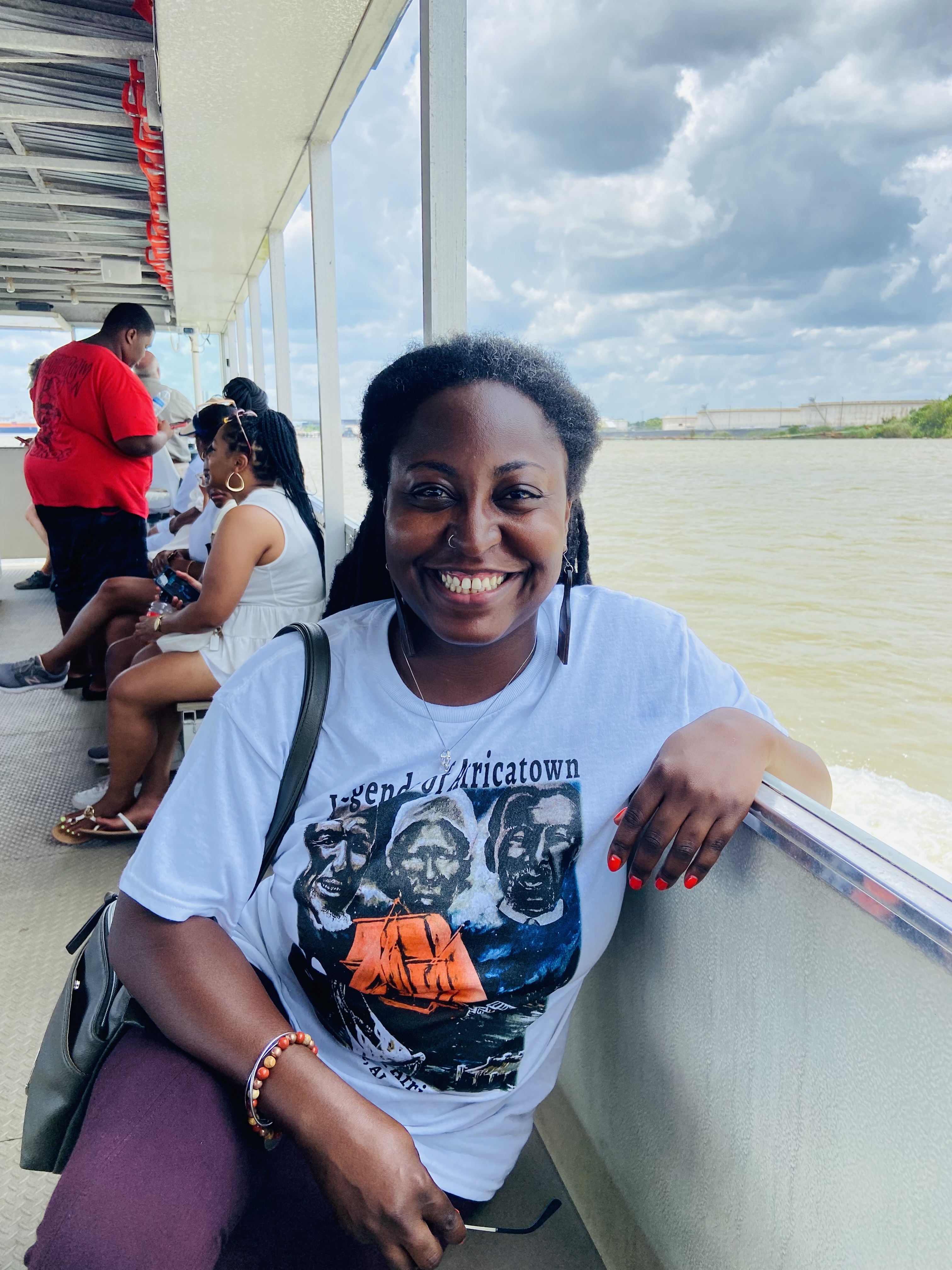
On Saturday, July 8, 2023, I and a group of others had the opportunity of a lifetime on the 163rd anniversary of Clotilda bringing our people into this land.
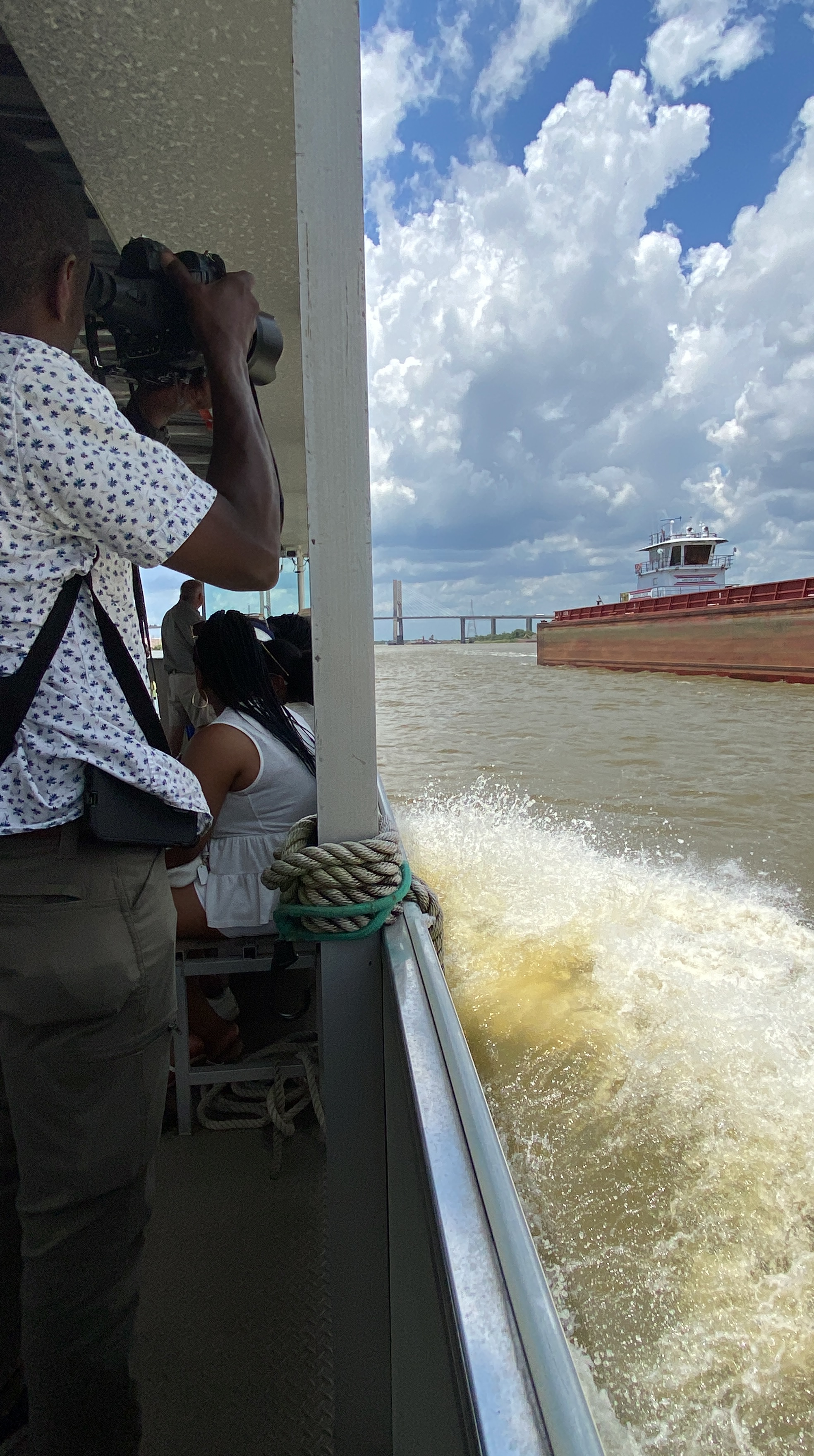
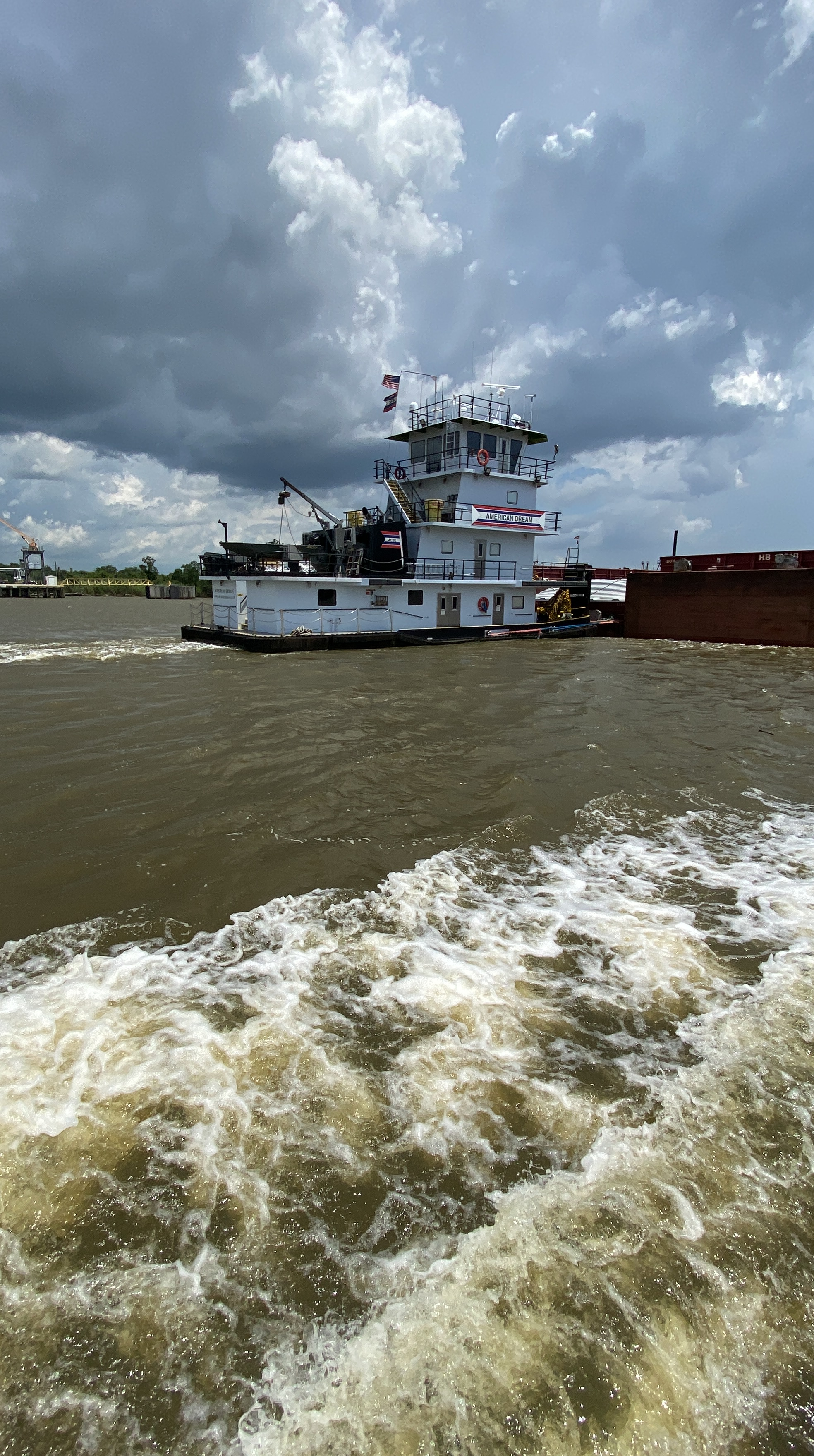
We met and talked with Raines about his journey and findings and sailed to the location of the wreckage, still buried underwater.
It was a humbling experience that filled my heart with much gratitude.
We saw the swamps our people had to walk through once they were let off the steamboat, and it made me truly not want to complain about anything ever again.
A festival was also taking place to celebrate the opening of the Africatown Heritage House.
It felt like 150 degrees out there and ya girl put this scarf on me. Imma let it slide cause she from Kenya, lol.
Once our people were freed, they built their own community and called it Africa Town, which was the original name because the founders ruled it according to the laws and customs of their African homeland. By the early 1900s, Africa Town (later spelled Africatown) was the fourth largest community in the nation governed by African Americans, attracting the attention of Booker T. Washington and Zora Neale Hurston.
Today, Africatown is on the brink of disappearing, though it is a huge part of why this story has been preserved, as the Clotilda prisoners passed it down to their descendants.
More on Africatown and the Clotilda will be covered in the book!
What’s Next?
On our way back from the site, we discussed hopes that there is more focus on preserving the community of Africatown and providing it with the resources needed to thrive. With the money pouring in from the Heritage House, the fear is people might want to come in and gentrify the area. The hope is there is money going into the community to help the people too.
We also hope they do not remove the Clotilda wreckage from the water. Not only will it cost millions of dollars just to remove it, but it might also decrease the value of the wreck and the area.
We propose that instead, a replica of the ship can be made. Again, this will bring resources to the community as everyone wants to see the actual ship. There could be tours conducted to view the replica, the Heritage House, and finally, a boat tour through the location (the same as the one we took this weekend). It can be an exciting three-day or full-day adventure with resources going toward rebuilding the Africatown community.
Photo: Yecheilyah
Africatown is the only known Black community that still exists today that was founded by Black people who had come straight from Africa.






 The PBS Blog