
…and quitting.
…and quitting.

Freedom Writer
I like to write books that challenge people to think beyond what they know (think) exists; releasing people from the limited ways in which we tend to think and feel. So I strive to produce content that is thought provoking and cultivates the mind. My goal is to free the minds of all people through truth, using digital technology to create unique reading experiences. I do this because the mind is where the spiritual is, and it is my belief that if a people are not spiritually and mentally free in truth, then they are not free at all.
*********************
Your Turn!
I thought this would be a fun exercise for writer’s to outline their writing goals by asking themselves what kind of writer they are, and from there to list the reasons why they write. Who would like to play?
So….yall game or lame? Don’t leave me hanging, let’s have some fun 🙂 !
For today’s segment of Writer’s Quote Wednesday, I take inspiration from George Orwell:
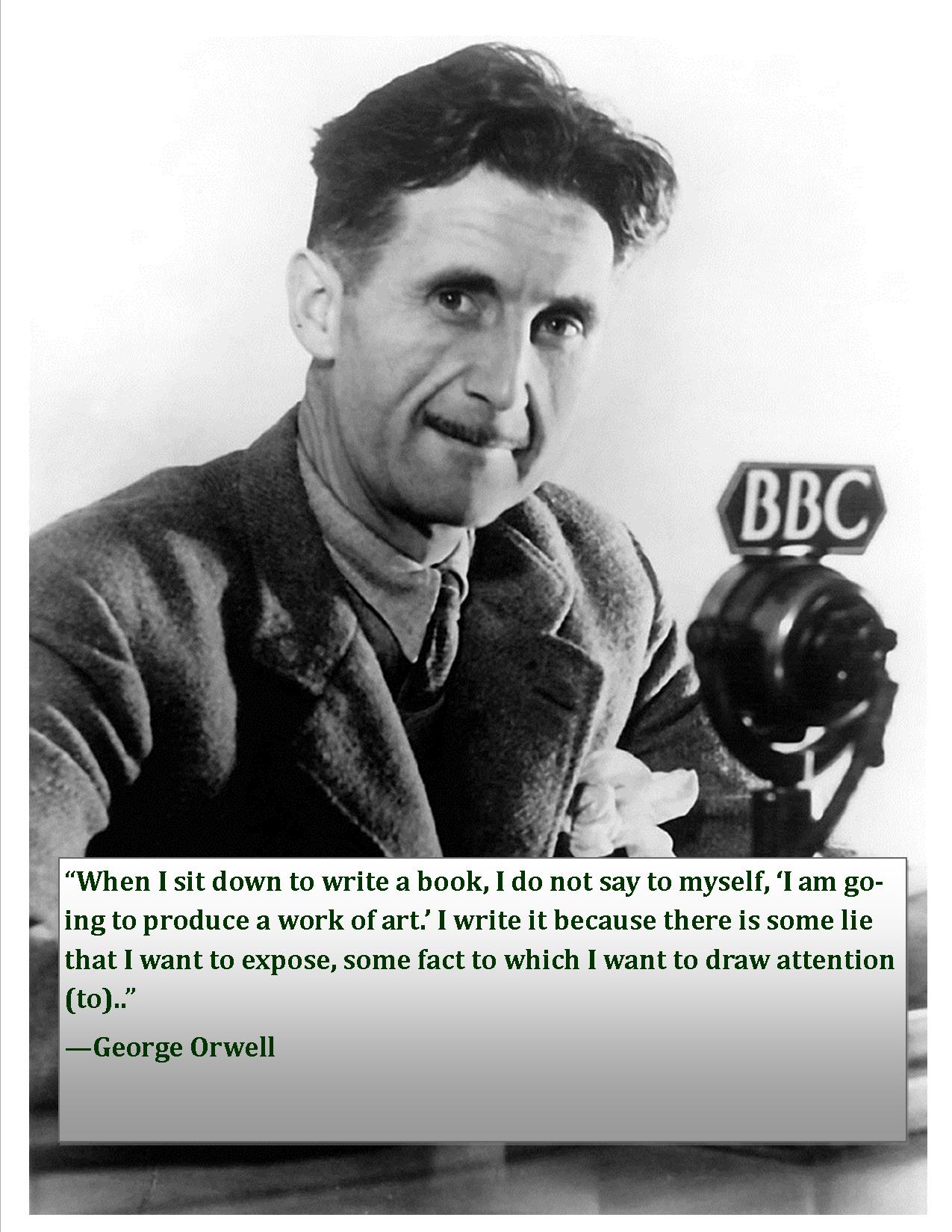
“When I sit down to write a book, I do not say to myself, ‘I am going to produce a work of art.’ I write it because there is some lie that I want to expose, some fact to which I want to draw attention (to)….” —George Orwell
I think this is a great way to sit down and write a book or article or poem. If you think more about your purpose for this particular piece, or you engage and have fun with the writing process in general, then I think you will unintentionally create something unique. Because you’ve put your all into it, you have the potential to create something really beautiful and powerful for readers. I do not believe the best songs were built under the notion that they will become hits, they were just written from the heart and that’s what makes them great. Anyone can write a book, poem, or sing a song, but when you can feel the passion, really feel it, and you know that it’s truly coming from the heart, that’s what makes it art.
About The Author:
I was first introduced to Orwell about seven or eight years ago when I read his book, 1984. I wouldn’t say he’s my favorite author but I did enjoy the book. At a time where I was just coming into a proper understanding of both myself and the world around me, it was an enlightening read.
Orwell was born June 25, 1903 in Bengal, India. His birth name was Eric Arthur Blair in Motihari, and he was a novelist, essayist and critic who went on to become best known for his novels Animal Farm and Nineteen Eighty-Four. Speaking of Nineteen Eighty-Four, the title sounds like a throwback to us, like something old but for Orwell it was the future. He wrote 1984 back in 1949. In short, it is a look into the future of the world which is divided into three nations. In the story, Orwell gives us a look into what would happen if the Government controlled every aspect of a person’s life, all the way down to his private thoughts. It was the first time, before Minority Report (the movie), that I had ever heard of something called thought crime.
************************************
And that’s it for my portion of Writer’s Quote Wednesday. As always, don’t forget to check out the links or the pic to see how you can join the fun. Don’t forget to also Like or Comment on the post of other participants. You get support by giving it :).


Saw this on twitter, thought I’d share. These are some good points:
The Following is by Laurence O’Bryan:

Self publishing is a golden opportunity. For the first time in history authors can reach readers without going through the traditional publishing system.
But many self published authors are making horrible, beginner-type-mistakes, which will cripple their book sales. Here’s my take on these mistakes:
1. Not getting outside help. Writers can’t generally be editors, cover designers and marketing experts, as well as being writers. Not if they want to do these jobs well. And asking a relative or close friend to do these jobs for you is probably worse than doing it yourself. Your judgement typically goes out the window when someone close to you does something for you. If you won’t spend money on getting experts your sales will be poor. I know there are occasional exceptions to this, but they only prove the rule.
2. Having unrealistic expectations. Most books, up to ten years ago, sold hundreds of copies. Only 1 in 300 traditionally published books, which got good editing, covers and marketing support, became bestsellers in the past. Publishing became a giant game of throw-it-up and see-what-sticks. With printed books it became ever growing and almost criminally wasteful, when you consider the dirty secret that most of the books you see in book stores are destined to be pulped. Now that game is in decline. If you do get editing, covers and marketing right, you might expect reasonable sales, but publishing is always a gamble, so never risk more than you can afford to lose. Great books don’t always sell well. And Print on Demand is way better than ordering books to store in a front room and then a back room – forever.
3. Not building an email list of people who might be willing to read and review your book on Amazon. This is one of the main reasons traditional publishers take so long to publish a book. They often send review copies out to a large group of their reviewers three months in advance of publication. This policy ensures that positive reviews will be posted day one after the book goes up on Amazon. Self-published authors should consider the day a book goes live on Amazon as a soft launch. The day you have five reviews is the day your book gets launched. The day you have ten is when it can hold its head up. The day it has fifty is the day you can expect Amazon’s algorithms to start presenting it to readers near the top of a list of books someone searched for. Congratulations!
4. Not focusing on what makes your book different. Whatever you write, you need to find something unique about your book. That you’ve written a good me-too book, like many others in its genre, is simply not good enough, unless you are happy with poor sales. Sensational writing, words that jump from a page, a heart-stopping plot, and real recipes from your grandmother in a village in Sardinia, where many people live to be 100, are all potentially unique aspects of a book, which will help you find readers.
5. Not believing in yourself. Self-belief is critical to long-term success as a writer, as in many walks of life. Writing is a profession where those who believe they can and who don’t give up, succeed. Perseverance and a willingness to learn, to edit the whole book again, for the twenty-seventh time, are necessary characteristics for a writer who is determined to become a success. Adopt these characteristics and your path will open up. In the past, it took most writers about ten years to find a publisher, from starting to write. Each year was spent improving, honing, learning. Be prepared for a long journey. If you love being creative with words, don’t give up because the road is hard. Use the journey to prepare for what lies ahead.
Finally, when you have done all of the above, you will know that you can move on. To the next book. And then the one after. Most books lead to another. One of the joys of writing is discovering what else lies inside us, waiting to be born.

10 weeks ago, in Charleston North Carolina, an unarmed black man (Walter Scott) was shot in the back. The footage was caught on video. Today, his murderer sits in a cell next to last weeks Charleston Shooter, as many are now calling him. After killing 9 people, Dylan Roof went on the run and was caught 16 hours later by Law Enforcement. Once captured, FBI began to question Roof. Shortly after that, according to a statement given to the Charlotte Observer, they took Roof to Burger King because he said that he was hungry.

Two months ago, 25 year old black man, Freddie Gray, was arrested by police, taken into custody, and critically injured in the transporting van. He fell into a coma and died due to injuries to his Spinal Cord. His death would lead to ongoing protest in downtown Baltimore. Pending further investigation into the incident, the six suspected police would be suspended… with pay.
*****
I know it annoys a lot of people, the constant conversations about blacks and race. The constant eruption of discussion concerning racist whites against blacks. The constant pushing forth of articles and posts concerning the relationship between these groups of people. At some point in History, every nation of people have experienced some form of racism within the context in which we know it. Specifically, when we talk about blacks in America, the subject of slavery often accompany the explanation concerning our captivity and struggles here. You’d be hard pressed to sit in on a conversation that does not include that part of history. What people who are not black, however, must understand is that it is not just about slavery. The institution itself was very traumatic for our people and has had, as a result, a dramatic effect on us so much so that it leaves a mental stain even until this day. However, this alone does not make our story unique, though it plays a pivotal role. Just as other nations have been discriminated against, other nations too have seen some form of slavery (though not to the extent of our confinement). This is the commonality of our servitude. The difference however, is this:
The reason you will always hear of blacks when discussing racism is not just because they have been slaves, nor is it simply because they have been mistreated once or twice. But in addition to slavery, being black in America also has to do with our affliction in America. We have not been slaves for 400 years, but we have been afflicted for nearly 400 years. Since 1619, when the first blacks were brought through the ports of Jamestown Virginia to begin what we know as the Trans-Atlantic Slave Trade, we have been mistreated and afflicted for the entire time that we have been in this land. Meaning there has not been a let up; not one moment of peace and it has been nearly 400 years, this is what makes our captivity unique. From slavery, to Jim Crow, to police brutality, racism and discrimination, high prison population, drugs, disease, you name it, we’ve seen it. Name one instance in History, from 1619 forward, where blacks have not experienced some form of humiliation.
I’ll wait.
Others have been, and are mistreated, but none outside the so called African American can produce documentation that will prove that their people have endured one continual stomping, blow by blow by blow for nearly 400 years straight. Blacks were not part of the U.S. Constitution, they are an add on; an amendment if you will. And this is the difference between having been a slave and having endured a continual affliction even after that slavery has ended. Thus, while we have not been in physical chains this whole time, we have been afflicted this whole time (aside from the affliction of chains) more than any other people. Our psychological troubles then, and the anger built up among many of our lost brethren, is because they have seen their people as constant targets.
Do as much as you can today. Tomorrow, do as much as you can then, but don’t focus on tomorrow until you are finished with today.
Award-Winning Texas Author
Rest is Resistance
goodies from my mailbox and camera
I am more than breath & bones. I am nectar in waiting.
virtually travel with us
Dr. Andrea Dinardo, Ph.D., Psychology
Supporting and Promoting Indie Authors
Adventures in Writing
Writer, Reviewer, Activist
The best Mommy advice on all things kids
Writing Advice from a YA Author Powered by Chocolate and Green Tea
Parenting Blogger, Poet & Storyteller, and Children's Book Author.
Changing the World one Article at a time
where all emotions are cared for!
Entertaining Stories and Motivational Quotes
Sweet As Honey Among The Pages.
press on to know the lord
Changing the world, one word at a time.
Featuring books written by authors of color.
essays, poetry and art
Leaving it all on the page because we are all shattered mirrors looking to mend our images.
Casting Alerts. Podcast series and talent directory about Blacks in Hollywood
Let's Talk About Books
Always on the hunt for a good story
 The PBS Blog