Mistakes Self-Publishers Make When Publishing Print Books (And How to Avoid Them)

We often talk about how attractive the book cover should be, and for good reason. Poor cover art is the #1 mistake Self-Published authors make when publishing print books.

But we know that already.

Let’s go inside of the book this time.

When preparing your manuscript for publishing in a print book, the formatting should be done in a way that is different from a college essay, research paper, or blog post.

Here are the top print book mistakes I see self-published authors make and how to avoid them.

Disclaimer. I am not a lawyer. Nothing beyond this point should be taken as legal advice.

No Copyright Page

The copyright page of a book is one page that lets people know who owns the rights to the book and that, generally, the author’s intellectual property cannot be copied without permission.

You do not need to register your book with the copyright office to add this page except if you want to. In this case, register the copyright at copyright.gov. You can do it after you publish the book to Amazon since it takes about 6-13 months (of this writing) to go through.

However, know your book is automatically under copyright when creating it.

The copyright page discourages theft, such as plagiarism, and announces you as the book’s owner. It is like a “No Trespassing” sign; every book should have one.

If you own a software program such as Atticus (PC) or Vellum (Mac), they have copyright templates already designed for you. If you don’t have these programs, creating one is easy. All you need is a copyright notice and a rights reserved.

© 2024. Yecheilyah Ysrayl. All rights reserved.

You may also add additional information. Below is an example of a basic, full copyright page.
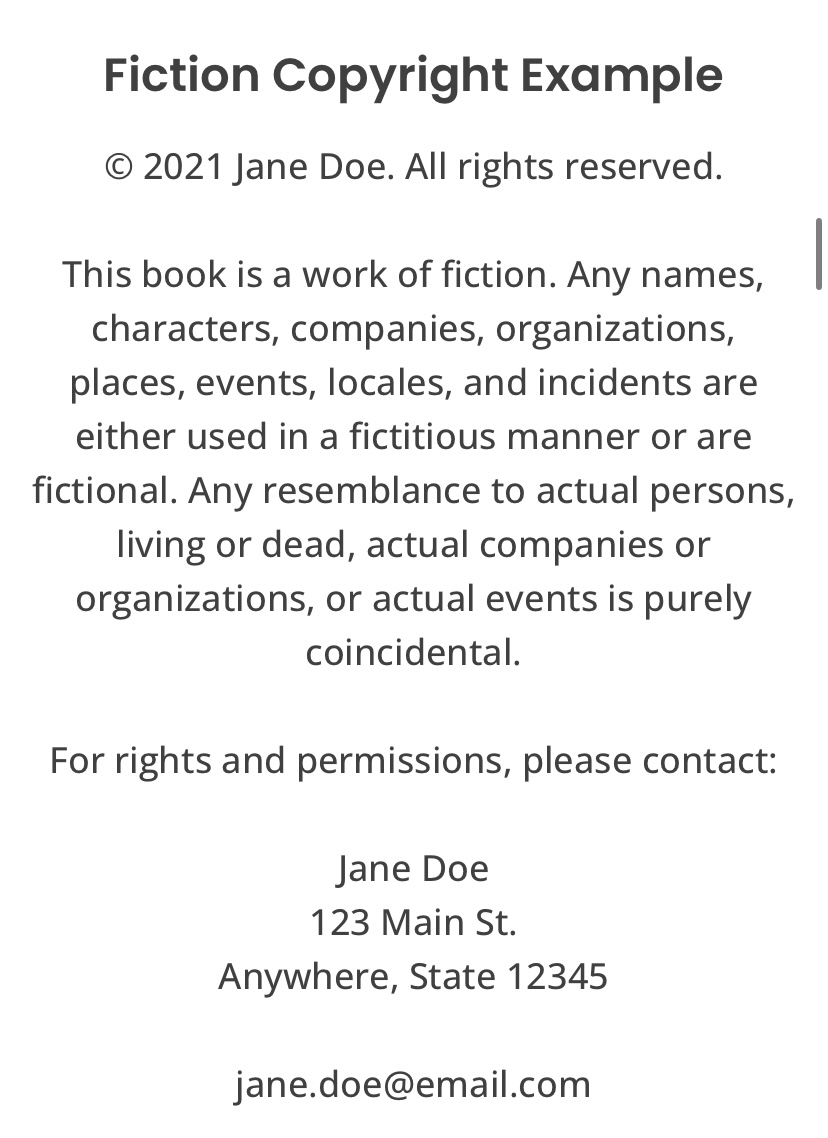
It should also include your ISBN. For more on ISBNs, click here and here.

This page should appear at the beginning of the book, also known as the book’s front matter, after the title page. The title page is one page that looks like the cover but without the artwork. It includes the book’s title and the author’s name. This title page may appear twice, depending on the publisher. Once at the book’s opening and once more before the opening chapters.

The Author’s Name and Title are Not on the Spine

This is easily avoidable with a professionally designed book cover, but let’s touch on it a bit.

Some books do not need a spine because they are too thin. Otherwise, you will want to have your author’s name and title on the spine of your print book.

The spine binds the front and back of the book and is also important for bookstores.

With the author’s name and title on the spine, a book is easier to find for someone skimming the titles on shelves. Since self-published books are already underestimated, a book without a spine can easily get lost, and the author misses out on sales.

The first thing a potential customer will see is the outward-facing spine, so if the book does not have a title or author name, readers won’t even notice the book.

No Chapter Headings

A chapter heading is how you organize your book so readers know when a section begins and ends. It is literally as simple as adding Chapter One….Chapter Two…Chapter Three.

Chapter headings can also have subtitles or names instead of numbers. In Black History Facts, I use chapter headings and subtitles.

Chapter One (Chapter Heading)

What You Didn’t Learn About Sundown Towns

(Subtitle)

The purpose of chapter headings and sections is to organize the book to make it easier to read and follow. Without it, readers might get confused about where they are in the story. Believe it or not, there are so many authors who make the mistake of not including chapters, making the book look more like an essay.

If you have a software program or professional who formats books, this is easily avoidable as they can add them for you.

Fancy Text

One of the most common mistakes of first-time self-published authors is using fancy text.

Times New Roman, Arial, Helvetica, Calibri, and Cambria are great fonts for books that make them easier to read!

Cursive writing and other fancy text, including colored fonts, make them harder to read.

Too Much Space and Not Enough Words…

Indie Authors who self-publish should also be aware of too much spacing, making the book look like it was written for children (unless it was). An adult-level book should not have so much space between it and the next section that you could write a short bio about your life in between.

Be sure to fill blank spaces with words or shorten the book’s length.


Plan to publish a print book? Don’t forget to add a copyright page, spine, chapter headings, text that is easy to read, and a book with enough words to fill it out.

Investing in professional cover design and interior formatting will help with all of this!
Click here for more Indie Author Basics to encourage you through the Self-Publishing / Indie Author Process!

Dear Indie Author, Remember to Guide Your Readers to Your Own Platforms

None of us can deny the power of social media to impact businesses, big and small. As we’ve seen repeatedly, what we post to our accounts can have positive and negative real-life effects, destructive and groundbreaking. With it, we can reach people worldwide without leaving the house. It is no longer just about posting family photos. People are making real money and establishing real connections.

However, an over reliance on social media to hold up the core of our business can prove disastrous since we do not own them. Lately, I have heard many complaints of Instagram pages being hacked, Facebook jail, and TikTok suspensions.

And these are not complaints from people with small accounts. People with tens of thousands of followers have had to start from zero.

People who operate systematically, moving their tribe (those genuinely interested in their content because everyone isn’t), over to their own platforms, do not lose when their accounts are hacked or when IG decides to glitch.

They do not lose because they understand a basic principle:

Social Media is the vehicle, not the destination.

Photo by cottonbro studio

Social Media is a powerful tool for socializing and networking with your target audience. Still, you want to always be moving them along your funnel.

This looks like adding them to your blog, email/text list, website, or membership site.

To do this, use a call-to-action at the end of your posts to tell people what you want them to do.

The call-to-action or CTA is when you give your people direction. What do you want us to do after seeing your post?

  • Do you want us to visit your website by clicking the link in your bio?
  • Do you want us to leave a comment? Are you asking for feedback?
  • Do you want us to buy something? Are you having a Black Friday sale?

The goal is to avoid getting too comfortable with the followers you get from these social media platforms. Only some people following you are interested in what you have to offer. You can ensure they know where to find you outside Instagram and Facebook. This allows you to nourish relationships and build stronger bonds with those who care.

In a matter of seconds, your thousands of followers can be gone if someone hacks you or your account is deleted for whatever reason.

Protect yourself by establishing an online home.


Indie Author Basics simplifies and streamlines the Self-Publishing Process so authors can Self-Publish high-quality books without pulling out their hair.

5 Lessons I Learned from In-Person Networking

Owners / Founders of Upscale Foot Spa

With back-to-back events, it’s been a busy few weeks. Here are some networking lessons I learned so far:

Wear Your Brand

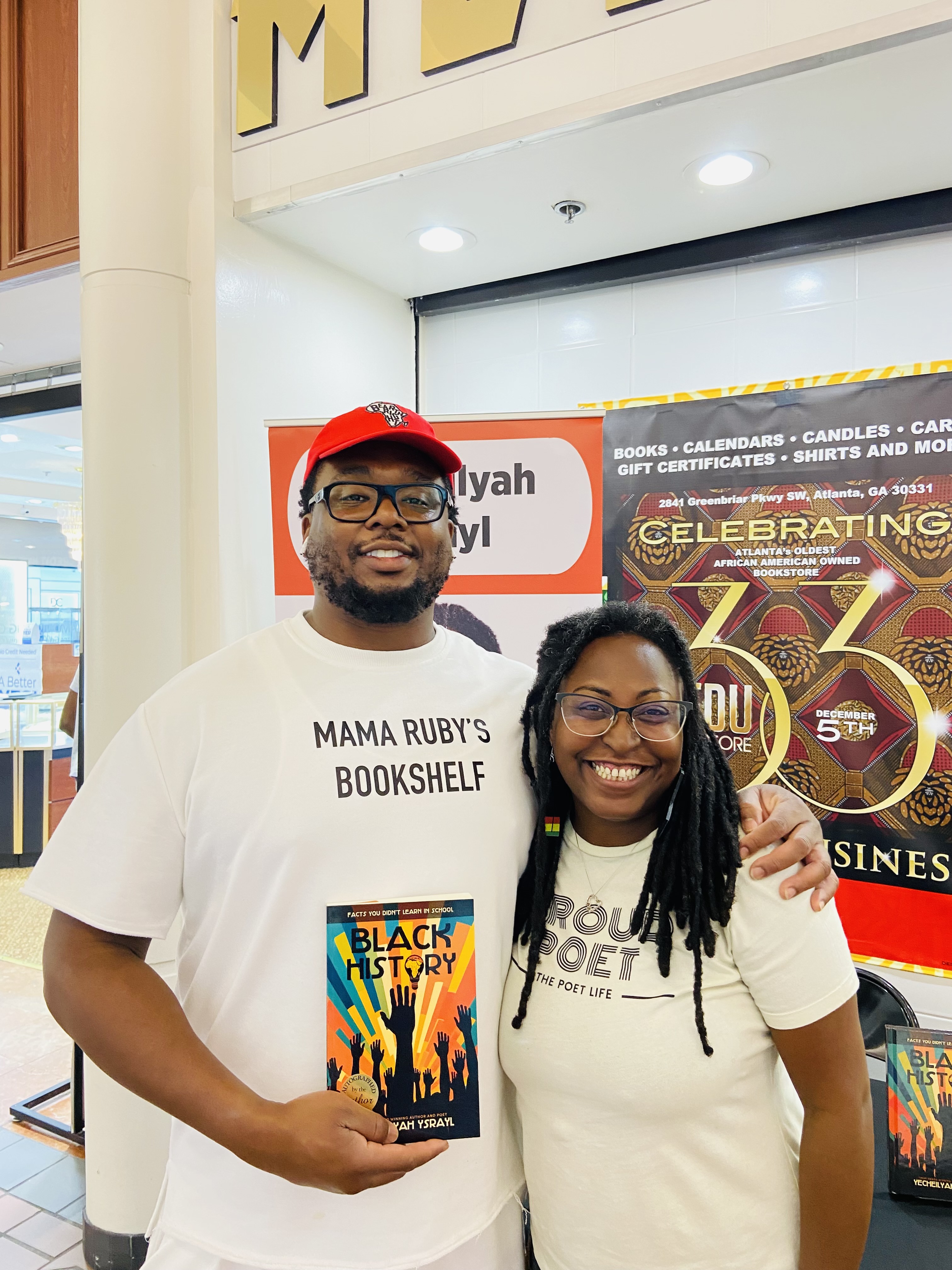
One of the first things I noticed at the AOD (Accountability on Demand) Live business conference was that many people wore their logo, slogan, or tagline on their shirts and clothing. At Poet Fest, one poet even had her name written down her pants leg.

It was a great marketing technique that I had missed. Here I am with a Calvin Klein shorts set on, and everyone else is wearing their own name brands. I went home vowing to get some t-shirts done.

But then, I realized this is not about t-shirts or wearing your name on your clothes.

I probably won’t do that.

Whether you wear your logo figuratively or literally, this is about intentionally showing up for yourself.

Message received.

My shorts set was still cute, though.

Email / Text Marketing Is Prime Real Estate

More than selling books and gaining more social media followers, I have increased my email list substantially over a month.

But why is this important?

Keeping in touch via email and/or text marketing helps you to stay connected to readers you might have otherwise never seen again.

During your book signings, speaking events, and other things, keep either a notebook and pen on your table or a tablet.

Write Email List Sign-Up somewhere and put name and email so they know where to write it.

If using a tablet, have the spreadsheet already open where people can type their information.

People will walk by and just write their name and email, sometimes even before talking to you or buying a book. How is this a good thing?

It gives you the chance to build a relationship with them later. And then, they might just consider supporting your work.

This is also why I encourage Indie Authors to sell books from their author website, to stay connected with readers: because you have no idea who bought your book from Amazon unless they tell you or leave a review you can see.

Social Media is Still King

In 2022, people do not ask for your business card. They ask for your IG handle.

The first draft of this said, “Business Cards Are Still Useful,” and that’s still a lesson I learned as it made it easier for me to give out my contact information and served as a great conversation starter.

And, while I wouldn’t say business cards are dead, they are used differently in the age of social media.

If you are old school, you can take all your social handles and put them on a card. And although people will probably stash these bad boys away in their office drawer like I did when I got home, not before they follow your Instagram, Facebook group, and Twitter.

Social media is not only King but essential considering the current pestilence situation we got going on with Covid and Monkey Pox.

I don’t take pictures wearing my mask because I think it’s weird, but I always have it and my mini hand sanitizer. Please believe it.

The bottom line is, people are online all day, every day more than usual.

This means not being online and using social media is tragic for anyone looking to grow a business in 2022.

How to Actually Network

First, I am introverted. Walking up to strangers and talking to them isn’t my thing. However, I learned that is only a small part of real networking. The other part is to discern how (or if) we can best serve each other.

How can what you do and what I do become a bridge? How can we build on what we build?

That’s what networking is, making connections and building relationships.

Practical example: You are a writer, and there’s someone in your social circle who edits. It would be a good idea to connect with that person. 

But it doesn’t have to be someone who does something similar to what you do, either.

Michael Q. Lau helps you on your journey to health by optimizing your relationship between fitness and food.

Let’s say you have been trying to lose weight, work out and eat better. There is a nutritionist specializing in fitness in your midst. It would be best if you connected with that person and tried to see how to combine your personal goal of being fit with your business goals.

How can ya’ll turn this collaboration into something more?

Follow-Up

Communication is the cornerstone of all good relationships, so keep in touch with people.

Engage with their social media, follow their blogs, check out their services, ask them questions, subscribe to their email list, and so on.

Be present.

Stay safe folks


Dear Bloggers, Remember to Edit Your Blog Pages and Sidebar Text

Before we tuck in for the weekend I wanted to give some quick heads up to those who may either be new to blogging or still trying to find your way around the WordPress platform.

If you are at all serious about blogging, whether that is to build an author platform or just to share your thoughts, be sure that your pages are all filled in and that your sidebar is as well. What do I mean “Fill in?”

There is nothing that screams amateur more than:

“This is a text widget, which allows you to add text…” and so on.

You would want to ban these words from anywhere on your blog! GET RID OF THEM. Why?

bitmoji-2000907637

To put this as nice but as real as I can, it makes you look lazy. It only takes a few minutes or maybe even a few hours to fill in the text on your blog.

There aren’t rules to blogging exactly but there are things that are common sense. This is one of them.

To get rid of those dreadful words, you will need to be sure those words are replaced with images or text. No, you don’t have to get super fancy but if your blog theme is one that requires you to fill in an area, such as an about page, you may want to go ahead and do that. Or else these words will speak to readers before you do. When I see them I think maybe that blogger just started out. If you started your blog a year or more ago, that’s not exactly the impression you want to give.

Go to your WP Dashboard. To edit a page, go down to Page > All Pages and edit the pages you have there. If you don’t want to show pages then it is best to delete them, although I am not sure why anyone wouldn’t want an About page. Either way, it is your prerogative. If you want the page to show to viewers, please fill it in with something. Do not leave it blank.

This is especially  important if you are an author looking to grow your audience through blogging. I mean, come on. You are a master of the written word (Yes, you are! Say it and then believe it). Anything that has to do with words should be taken seriously, even if it is text on your blog! If there’s no effort put into these words, then what are we to think about your books?

To edit sidebar Widgets, go to: WP Dashboard > Appearance > Widgets

This will show you the widgets that come with your blog’s theme and give you the chance to add more if you like.

You don’t have to be extra fancy. (We actually prefer you be your relaxed and funny self), but do put something there. Unless you don’t want your blog to grow, in which case, leave it how it is.

Now, run along now and enjoy the rest of this beautiful day.

bitmoji594883210