6 Self-Publishing Myths That Need to Die | Kristina Adams

I wasn’t gonna share this article (except to my Facebook and Twitter page), but I loved what Kristina was saying so much I just had to share it here as well. If you’re still trying to decide on Self-Publishing or not this  article should clear some things up for you. I am always talking to new Self-Publishers about the importance of platform so I found the following statement an important one to share:

The assumption that traditional publishers will do all of your marketing for you is one of the biggest myths when it comes to traditional publishing. The more a publisher pays for a book, the bigger the marketing budget. Unfortunately, unless you already have a big platform, it’s pretty unlikely you’ll get a fat cheque or a decent marketing budget. Publishers pay more for celebrity books—and market them heavily—because they already have an audience. They know the books will sell if they reach the right people. The lower the risk, the happier they are to invest.

I think it’s a good idea for Indie Authors (myself included) to seek to learn more about the publishing industry as a whole (to include Traditional Publishing even if we aren’t seeking that route) because it can help us to better understand the business of publishing, such as the importance of having a platform, and can possibly help us to better sell and market our books. For example, “Most agents and publishers—particularly the bigger ones—won’t even consider you unless you already have a social media following of a few thousand. This shows them that you already have a fan base that will buy the book, and there’s already a market out there for you and your book(s).” (source: https://www.writerscookbook.com/indie-publishing-vs-traditional-publishing/)

I think Self-Publishers can benefit from this same kind of information. We may not be seeking agents but we do still need readers and the bigger the platform, the better our chances of finding those readers. Just a thought.

Read through to the ORIGINAL article HERE.

Beta Reading VS. Editing #amwriting

Very well said. Fav. Post Quote: Beta Reading is not editing, and the reader should not make comments that are editorial in nature. Those kinds of nit-picky comments are not helpful at this early stage because the larger issues must be addressed before the fine-tuning can begin, and if you are beta reading for someone, the larger issues are what the author has asked you to look at. *Comments disabled here. Please comment and share the original post*

conniejjasperson's avatarLife in the Realm of Fantasy

Once again, the question of the difference between beta reading and editing has arisen in one the many forums I frequent on Facebook. So, I feel the need to revisit a post from 2015, Beta Reading VS. Editing. If you’ve already seen this post, nothing has changed in the world of editing and beta reading since this first appeared. But thank you for stopping by!


Indies rely heavily on what we refer to as beta readers to help shape their work and make it ready for editing. But in many online forums, authors use the term used interchangeably with editing, and the two are completely different.

And unfortunately, some indie published works are clear examples of work by authors who don’t realize the importance of working with an editor, although it is apparent that they have had assistance from beta-readers.

What is quite disappointing to me, is the many traditionally published works that seem to fall…

View original post 600 more words

Exclusive Renaissance InstaGiveaway!

As you all know Book 2 of The Nora White Story is on its way out! (Pre-order it here). In honor of this, I am hosting a giveaway for Book 1! Visit the link below to snag your copy! Hurry. This exclusive offer won’t last long.

CLICK THE LINK and THANK YOU!!

https://claims.instafreebie.com/free/hCg2Pcj9

About.

When seventeen-year-old Nora White successfully graduates High School in 1922 Mississippi and is College-bound, everyone is overjoyed and excited. Everyone except Nora. She dreams of Harlem, Cotton Clubs, Fancy Dresses, and Langston Hughes. For years, she’s sat under Mr. Oak, the big oak tree on the plush green grass of her families five acres, and daydreamed of The Black Mecca.

The ambitious, young Nora is fascinated by the prospect of being a famous writer in The Harlem Renaissance and decides she doesn’t want to go to College. Despite her parent’s staunch protest, Nora finds herself in Jacobsville, New York, a small town forty-five minutes outside of Harlem.

Shocked by their daughter’s disappearance, Gideon and Molly White are plagued with visions of the deadly south, like the brutal lynching of Gideon’s sister years ago. As the couple embarks on a frightening and gut-wrenching search for Nora, they are each stalked by their own traumatic past. Meanwhile, Nora learns that the North is not all it’s cracked up to be.

Can Gideon and Molly overcome their disturbing past in time to find their daughter before it’s too late?

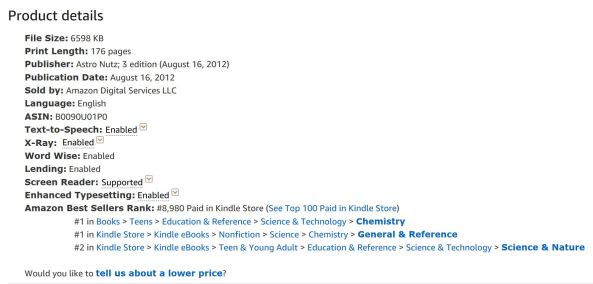
How Does Amazon.com Sales Rank Work?

Good breakdown.

chrismcmullen's avatarchrismcmullen

AMAZON.COM SALES RANK

Amazon assigns a sales rank to every product that has sold at least one time.

The lower the number, the better the product is selling.

For example, a sales rank of 2500 is better than a sales rank of 375,000.

The product that sells the best in its category has a sales rank of 1.

CATEGORY RANKS

Amazon has different ranks for different types of products.

Books are ranked independently from sports equipment and video games, for example.

For a given type of product, there are also category ranks.

For example, a few Books categories include Romance, Children’s, and Science.

A great overall rank is more impressive than a category rank.

For example, a book has to sell quite frequently to rank 500 overall in Books, but can sell much less frequently and still rank 500 in Romance.

A good rank in a broad category is more…

View original post 2,918 more words

Let’s Congratulate Don! Introducing DSM Publications!

Guys, help me to congratulate my author friend Don Massenzio on his new business endeavor. DSM Publications offers Editing and Formatting services to Indie Authors at a reasonable rate with advice and networking with other authors. Don is a big supporter of this blog so I am delighted to return the favor! Be sure to like his new Facebook page HERE and to follow his new blog HERE and subscribe to his email list HERE. (If you sign up for DSM Newsletter, you’ll receive a free copy of Don’s book, The Ultimate Guide for Independently Published Authors.) To learn more, visit his post HERE . Remember, we are in this together! Whoo hoo.

A New Generation of African-American-Owned Bookstores

After a steep decline, the number of black-owned independent bookstores is growing.


Mahogany Books opens in Washington D.C.

When Troy Johnson began tracking the number of black-owned bookstores in the U.S. in 1999, there were more than 325. By 2014, that number had dwindled to 54, a decline of 83%.

“They were closing left and right, and the major ones were struggling,” said Johnson, who runs the African American Literature Book Club, an online book database. Today, Johnson estimates, there are at least 108 black-owned independent stores, a number of which have opened in the past six months, marking a substantial reversal. “Last year was the first year I added more stores to the list than I took away,” he noted.

The surge in black-owned indie bookstores is notable at a time when both bookselling and publishing are wrestling with issues of workforce diversity.

Read through to the ORIGINAL article HERE.

The Secret Behind Disappearing Amazon Reviews? | Tina Reber

bitmoji-20180404031630

I came across this article a few months back but I want to share it now because, for the first time in my career, I have noticed that one of my reviews on Amazon (for Renaissance) is missing. Because of how hard it is to get reviews, this is obviously disheartening. I have never bought a review or forced anyone to leave a review and none of my reviews are from family members and the like. To my knowledge, I have followed all of Amazon’s rules for book reviews so to have one missing is weird to me. I have set a personal goal (that I haven’t mentioned before except for now) of reaching at least 20 Amazon reviews for Renaissance before releasing book two. I was at 19 and now I am at 18. My only hope is that those who bought books at the signing will also leave reviews. Just in case, I have disconnected my blog feed on Amazon. My Goodreads page is also not connected to Amazon. Check out the article below for more tips on how to decrease the chances of your reviews being removed.

Yesterday, Love Unscripted had 1145 reviews.

Today, Love Unscripted had 1144 reviews.

This is not the first time reviews have disappeared. Several weeks ago, the number of reviews on all my novels were much higher.

And then, overnight, something mysterious happened. Poof, about 75 reviews disappeared into the nether.

So what’s causing some reviews to disappear while others remain untouched?

Keep reading by visiting the ORIGINAL article HERE.