Black History Lives

Meeting Mrs. Sarah Collins Rudolph, the lone survivor of the 16th Street Baptist Church Bombing, 1963

The more I study Black history, the more I am humbled by how close it still is to us, and how often the past breathes in the same rooms we do. It lives in the hands of my elderly aunts and uncles, in my husband’s great-aunts now in their eighties and nineties, in the quiet authority of people who remember a world entirely unlike the one we inhabit today.

When I look at them, I am struck not just by their age but by the eras they have survived. Even my late parents, born in the 1940s and 1950s, moved through a country so different from the one I know that it feels almost unrecognizable. I used to think that world was gone, and in many ways, it is. And at the same time, it is also sitting across from us at dinner tables, folding laundry, telling stories we don’t always ask to hear.

This is what makes Black history (and history in general) so accessible and so urgent. It is not only found in textbooks, memorials, museums, or the names etched into stone. It is carried by people who are still alive. People whose memories collapse the distance between then and now. It reminds us that history is not just the past, but it is also inextricably connected to the present. Those who made history were simply living their lives, never knowing their present moment would one day be named.

This weekend is the perfect example of this.

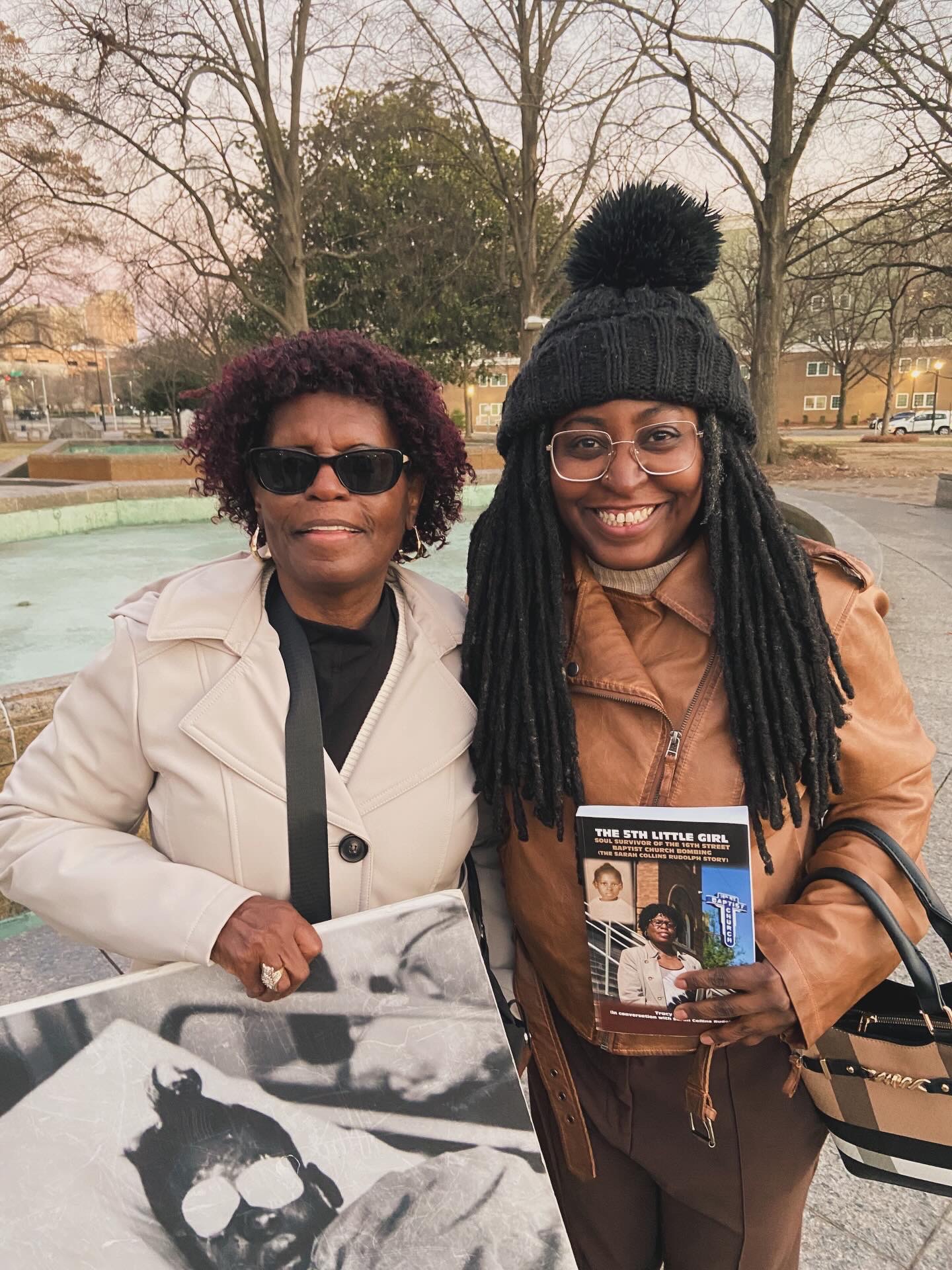
On February 7, 2026, I had the esteemed honor of meeting a woman whose story should have been in our history books, but the world barely remembers her name.

On September 15, 1963, the distance between past and present collapsed in the basement of the Sixteenth Street Baptist Church in Birmingham, Alabama. A bomb exploded beneath the church steps, ripping through a space that had long been a place for organizing and for Black resistance. In 1963, Sixteenth Street was the largest Black church in Birmingham, a heartbeat of the Civil Rights Movement.

History often tells this story in a single, devastating sentence: four little girls were killed. Addie Mae Collins, Denise McNair, Carole Robertson, and Cynthia Wesley (between the ages of eleven and fourteen) lost their lives in an act of white supremacist terror. Their names are remembered, mourned, and rightly so.

What is mentioned less often is that there were five girls in that basement lounge that morning. Addie Mae’s sister, Sarah, was also there. She lived, but survival came at a cost that would follow her for the rest of her life.

Twelve-year-old Sarah Collins Rudolph was standing nearby when the bomb went off. The blast hurled shards of glass into her body, leaving her immediately blind in both eyes. Though she eventually regained partial sight in her left eye, her right eye was so severely damaged that it had to be removed and replaced with a prosthetic. Tiny fragments of glass remained embedded in her skin, even in her eye.
“If a single strand of hair got into my right eye socket, the pain was unreal,” she says, “The skin around my eye was very sore and still healing. It felt like something was cutting my eyes whenever hair or anything sensitive brushed over this area. The hair itself felt like tiny particles of glass stuck inside my eye socket all over again.”

– Mrs. Sarah Collins Rudolph

Sarah did not die in that basement, but she carried September 15, 1963, with her into adulthood, into older age, into the present we are still living in.

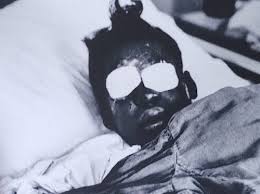
With no counseling or therapy, Sarah was forced to return to school as she struggled to heal, grieve the loss of her sister, and her old life. The world moved on. Dr. King spoke at the joint funeral for three of the girls, and it attracted over eight thousand people. Photographer Frank Dandridge took a picture of Sarah while she lay in the hospital, with patches over both eyes, and it was published in Life Magazine on September 27, 1963.

However, despite this searing image, Sarah Collins Rudolph and what happened to her faded from public consciousness, limiting her story to nothing more than a historical footnote.

It was only when Mrs. Rudolph herself felt compelled to share this story that the world began to learn about the part of that tragic day that had not been told before.
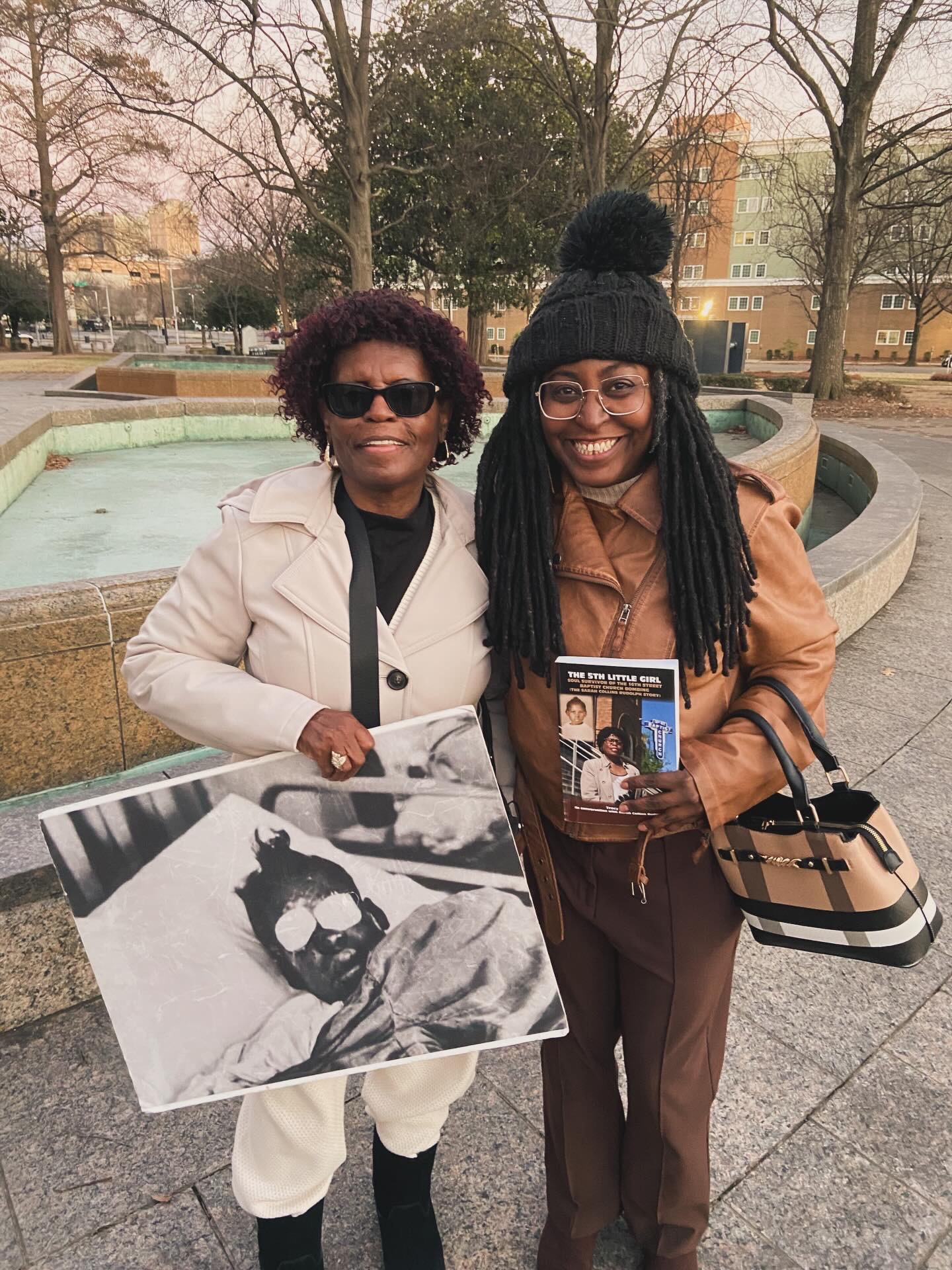
Today, Mrs. Rudolph is a social justice speaker, author, and activist speaking to people all over about what happened to her and why stories like hers matter.
Don’t forget we have Black History articles on this blog under Black History Fun Fact Friday and on Substack at substack.com@yecheilyah!

A Month and A Mirror

A hundred years ago, in 1926, Dr. Carter G. Woodson planted a small but deliberate marker in time—Negro History Week—never knowing it would one day swell into a month, a memory, a reckoning.

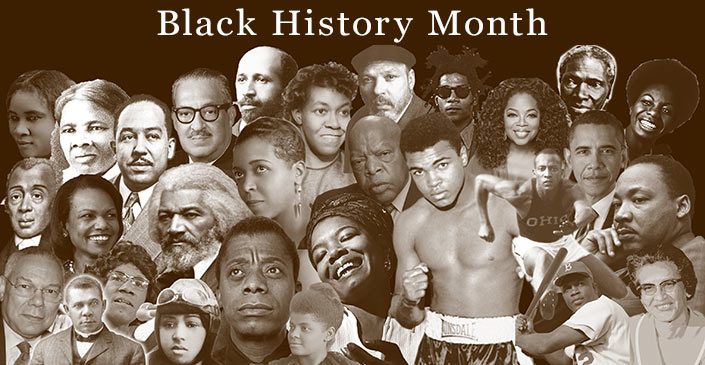
February has carried that weight ever since, in what is now known as Black History Month. It is a month crowded with remembrance, with names spoken loudly and moments replayed until they feel familiar.

But February also carries the ongoing debate over whether Black history should be relegated to a single month, primarily since Dr. Woodson himself never intended the week-long celebration to be permanent, let alone to encompass a whole month lasting 100 years.

For Woodson, he wanted Black history integrated into the mainstream curriculum, not restricted to a single week or, in our case, a single month.

For me, two things can be true.

If you’ve been following me for any amount of time, you know I spend 90% of my time reading, researching, documenting, and sharing Black historical facts year-round. Thus, I am for incorporating Black history into the mainstream curriculum and reducing its focus to a footnote or an elective.

But I do also love the idea of keeping it separate, special, and set apart, as we are.

Additionally, it’s a great time to promote reading. The harsh reality is that American reading levels are still declining. (2024 NAEP data show 12th-grade reading scores at their lowest level since 1992.) I’d bet that your average adult had not read a full-length book since High School, if even then.

Therefore, if February is a time when the minds of the people are not as distracted, then let us use it to do some good.

To quote Bob Marley, “The people who were trying to make this world worse are not taking the day off. Why should I?”

So while Black History Month is not the movement itself, I do see it as a mirror history placed in our hands. When we look into it, we do not see the past frozen in black-and-white—we see ourselves.

Our language. Our resistance. Our contradictions.

The mirror does not lie.

It shows us who we’ve been bold enough to become and who we’ve been too afraid to remember.


Don’t forget we have Black History articles on this blog under Black History Fun Fact Friday and on Substack at substack.com@yecheilyah!

Will There Be a Fire Next Time?

“I am very worried about the state of the civilization which produced that photograph of the white cop standing on that Negro woman’s neck in Birmingham in 1963.”

– Lorraine Hansberry


Fifty years from now, when you do not see protests on the news,

sixty years from now, when George Floyd’s blood has dried up,

and Ahmaud Arbery is nothing more than a Google search,

when you no longer see your brothers and sisters marching and protesting in the streets for justice,

forty years from now, when there are no more hashtags

on which to hang your consciousness

and no Instagram to snapshot the revolution

when “black,” is no longer “trending”

will there be a fire next time?


When the news goes back to its regularly scheduled program

and the American flag is still soaked with the blood of the saints

their memory etched into the concrete we walk on

who will walk on?

When the history books forget to mention Breonna Taylor’s name, will we?

Did you know there were five little girls injured during the bombing of the 16th Street Baptist Church in 1963?

Did you know that the fifth little girl, Sarah Collins Rudolph, lived?

twenty years from now, whose legacy lives?

Who will Emmett Till Trayvon Martin’s memory?

When America’s anger sizzles into complacency

will there be a fire next time?


“History is not the past. It is the present. We carry our history with us. We are our history.” – James Baldwin

There is a Movement in Stillness

I saw a sunflower bow to a bee without moving. It arched its stem, its petals already stretched wide and willing. There it waited for the wind to whistle the way it does when it pushes the flower forward, and here, the flower bowed. Beautiful and with grace, this sunflower let itself go in the wind’s direction, its sweet liquid substance sending the scent of fresh Nectar floating into the air. I couldn’t smell it but it wasn’t for me to smell so I looked down in my notebook and wrote a reminder: “what’s for you is for you.”

I looked up and noticed a bumblebee was already singing its way to our area and the whole time the flower did not move; it waited. The flower was only moved by the wind, the invisible force that guides it, and so this I wrote in my notebook: “do not chase, attract. What is yours will come to you. Put out the right scent and let the invisible force guide you.”

I looked up, and the bee seemed much more anxious and excited, but I knew better than to kill it. This creature was on a mission, so I didn’t swap him away because this wasn’t my business. I was here only as a witness to the meditative buzz of togetherness. I saw a sunflower bow to a bee without moving, so I bowed my head too and wrote: “there is a movement even in stillness.”

The Evolution of a Book Cover

I have always enjoyed looking at book covers. Choosing a cover is my favorite part of the Indie Book Publishing process. In the beginning, I didn’t care too much about the cover and that was cool. But then, as I matured, I started to look at my writing differently. I stopped looking at my writing alone and started looking at the book as a complete package. In doing so, I’ve learned that the best chances of a book succeeding is not just one thing, but a collection of things. Not just a nice cover alone or a well-written story alone, but everything together. That is what I’ve learned, and that is how I will look at book publishing from now on. I will look at the process as a complete piece, a body that I must dress not just outwardly but inwardly and not just inwardly but outwardly.

I have had a little success with I am Soul so I thought I’d talk a little bit about the evolution of the cover and how I think it has played a major role in that success.

To start, I wasn’t going to even release this book when I did. I was supposed to release book two of Nora December 20, 2017, my mothers birthday. Instead, I pushed that book back (it wasn’t ready) and released I am Soul.

I am Soul is a collection of poems from this blog as well as my personal journal, collected, compiled and edited into what is now my 4th collection of poetry. I call it I am Soul because some of the poems are personal, some of them are centered around the African American experience (a people of Soul) and also because people have always said that I have an old soul. Even as a kid people have said that I was mature for my age. For these reasons, I am Soul.

Grainy pic of me and I am Soul with old cover.

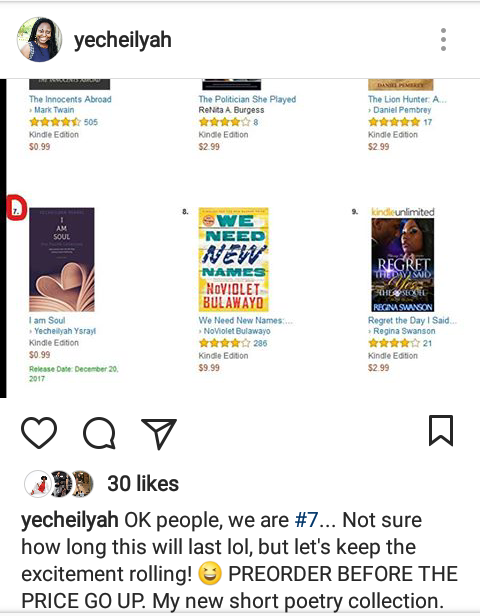
The first cover was decent. I liked it a lot. A purple book with a heart-shaped bible page. It was nice enough to land me the #7 spot in the African Literature category of Amazon before release day. It started at number 17, then dropped to number 9 and then number 7.

Screenshot_2018-06-24-11-14-59-1

But…

I liked the cover a lot but I didn’t love it. I couldn’t help but notice that the cover looked better electronically, to me, than it did when the paperback arrived. It also didn’t stand out very well on Amazon.

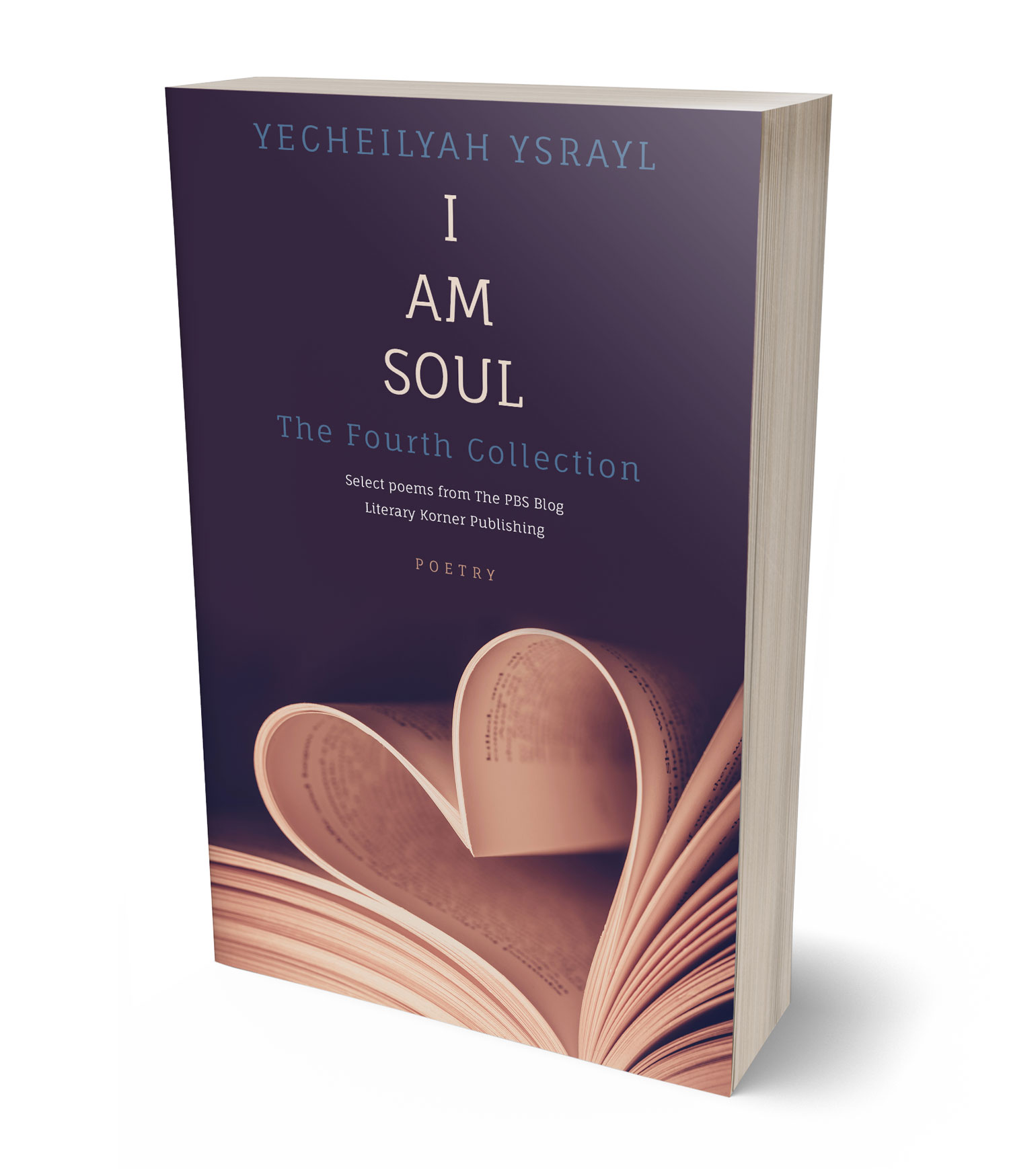
I AM SOUL- 3D

I still think this is a cute cover but it doesn’t look all that great offline. Once the book printed it didn’t look the same. The dark blue on top the purple didn’t pop. In fact, this is still the cover on Goodreads. I don’t know how to change it. At first I didn’t care but after awhile I had to follow my heart and change the cover. (A privilege of publishing books Independently. You can change what you want, when you want.)

I decided to try something that matched the name of the book and the content in full. When you think of Soul you think of something deeply personal and connected to that individual.

Soul is something Israelites (Blacks) have always had (think Soul Train), from our hair styles to our creative way of dance, the way that we dress, the way that we sing, and the way that we speak. We set the trends and nothing was more trendy than the Afro at the peak of the Civil Rights and Black Power movements. From the practice of shaving the head to pass as a free person in the antebellum south, to the Afro of the 60s and 70s that said that Blacks were proud of who they were and free to be so openly, natural hair had made a comeback.

FFxG
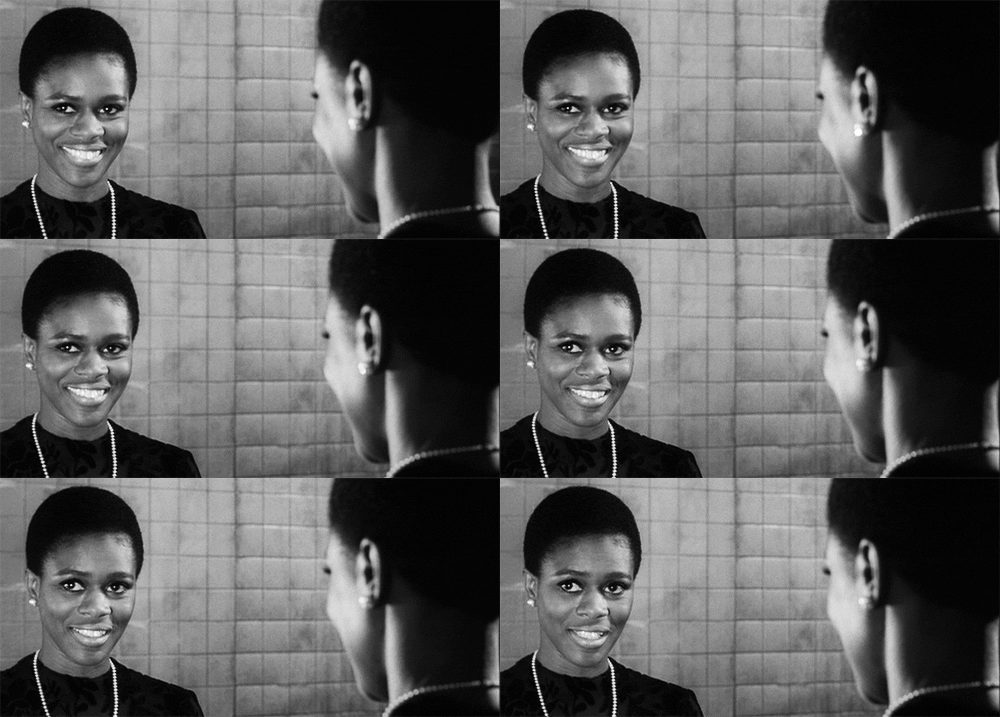
Young, beautiful Cicely Tyson.

In the 1950s-60s it was common for Black women in Africa to wear their hair in small bushes. In America, Black women stopped straightening their hair. Women like Nina Simone and Abbey Lincoln are examples. And then Miriam Makeba (“Mama Africa”) emerged with a fro in the January 1960s issue of Look Magazine and Cicely Tyson wore her hair in a fro on episodes of the CBS drama East Side, West Side. And as college students and political activists like Jesse Jackson and Angela Davis started wearing fros, the fro had eased on into the mainstream.

Before and After


It wasn’t just about hair no more than Samson’s locs was about being trendy. Those locs were a representation of power and strength and so the Afro was a representation of the social-economic and political era of the time. A time when Black men and women were gaining strength and reclaiming parts of their lost heritage, one hairstyle at a time. A similar revolution is taking place today. Black men and woman are embracing more of their natural selves and waking up to the true knowledge of who they truly are.

For all of these reasons, I felt an image of a Black woman wearing a fro spoke volumes concerning the kind of messages I was seeking to give with the poetry inside of the book. Not just the soul of one woman but the soul of a people. The soul of an era.

I still think both covers are nice in their own right but the one that sticks out the most and which embodies a much more clear message; the one that will not just appeal to those who are biblically conscious but reach a larger audience; the one that makes people stop in their tracks, is the new cover.

When I uploaded this to social media, readers responded immediately. This had not happened with the first cover.


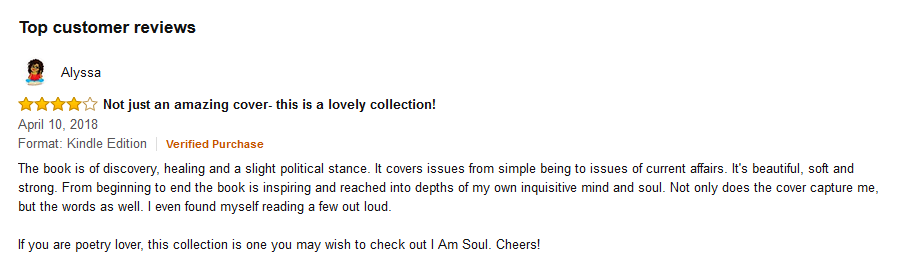
The new cover got me new reviews…

Screenshot (42)

I submitted this book to two different bookstores. One using the old cover and one using the new cover. The one with the new cover got a call back and the book is beginning to sell at the store. I am still waiting on a response from the store using the old cover.


I’ve learned that book covers really are important because I’ve experienced how important they are. Don’t get me wrong, content is just as important. At the end of the day if there’s nothing special to read there’s nothing special about the book. I am Soul still had to be edited and get through the bookstore’s professional reviewers to be stocked.

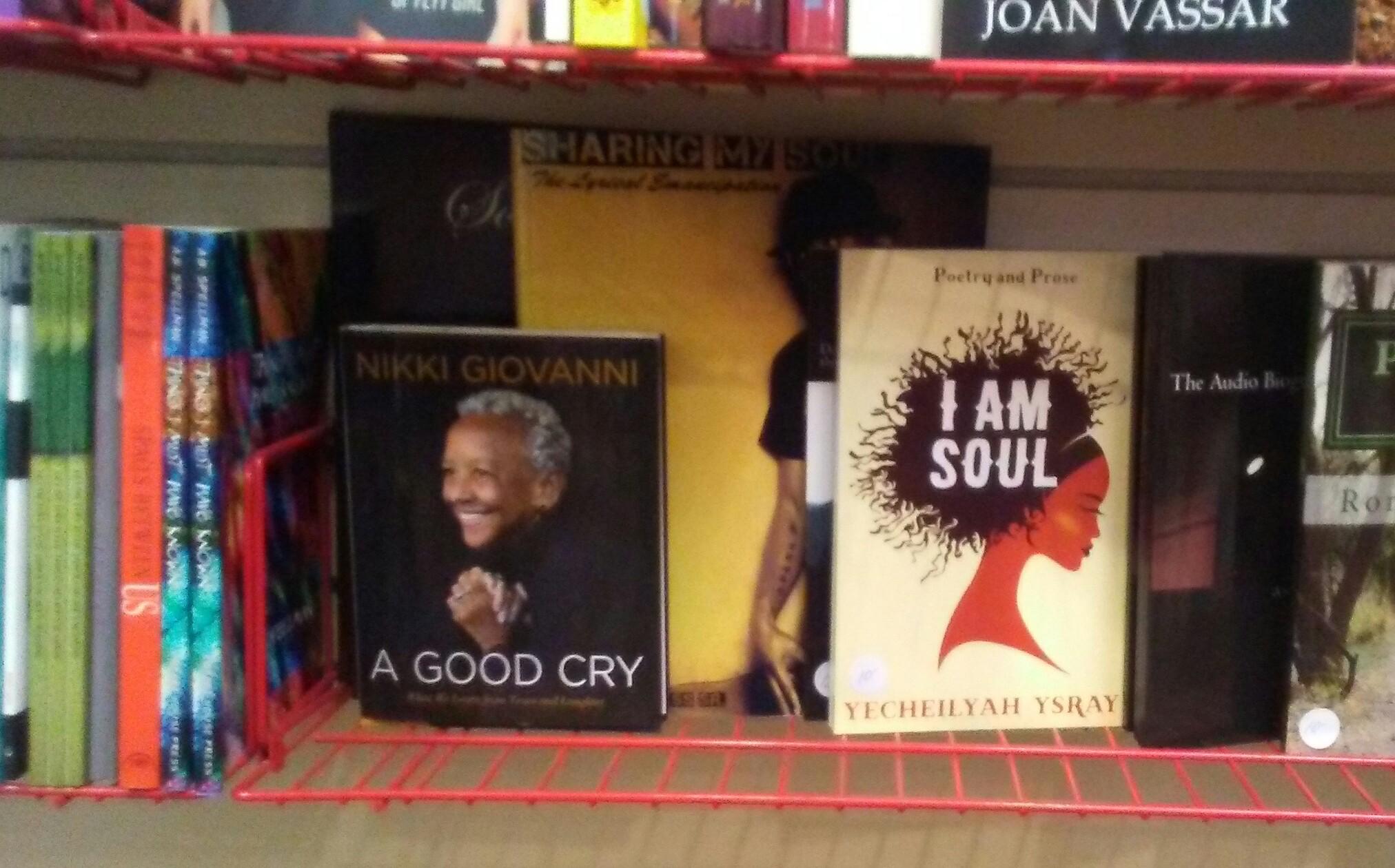
But, when I walked into the store yesterday, I couldn’t help but notice that because of the cover, Soul stuck out more than some of the other books that I could tell, as an Indie Author, were also self-published. In fact, to my surprise, Soul was sitting right next to Nikki Giovanni’s A Good Cry. Whether someone just sat it there or not, I cannot be sure. But, I was sure enough proud. I wasn’t going to taint the moment with thoughts of how it got there. It was there nonetheless.

20180623_135158-1


Get I am Soul Now on Amazon

or Choose Your Retailer

Everything Must Move – What Watching Movies Taught Me About Writing

My dream Deskspace

This post was conceived while watching one of my favorite movies. Thus, as usual, it is based on my personal experience. So anyway, to the point…

I found myself paying attention to what was going on in the background of this particular scene in this movie instead of what the leading characters were doing. To better understand this, I challenge you to do the same. Choose one of your favorite movies, what’s going on in the backdrop? An old man is laughing with his wife. The waiter is walking away from a table, she looks down at the notepad before walking away. Behind her, the bartender throws a bottle into the air before catching it with his other hand and pouring the liquor into the long line of glasses in front of him. The waiter walks up to the bar, picks up two of the many glasses and walks them over to her table. The old man and his wife smile while nodding thank you.

What just happened? What happened is that there’s an entire event taking place in the backdrop of what’s happening in the forefront. Though not the center of attention, everyone in the scene moves. Though not the primary characters, everyone in the scene is doing something.

While working on my next project, I’ve found it helpful to make sure  that everyone in the scene from the smallest to the greatest has something to do, or has a goal they want to achieve (despite how small). There shouldn’t be any stick men and women. If we are at dinner, the people behind Nora’s table should be laughing or talking. Not so that it’s overwhelming, she is the leading lady after all, but they shouldn’t just be sitting there. There should be movement. For instance, in A Beautiful Mind, John Nash sits on a bench in front of the University. With him is his old roommate and together they sit there and talk. As they are speaking, there are people walking by, students, professors, and faculty members. And as the camera zooms in and pans around, we notice the people  are looking at John oddly.

For those of you who’ve seen the movie or who are familiar with the man John (this movie is based on a true story, Nash just passed recently matter of fact) you know that John Nash suffered from a severe case of schizophrenia. His college friend does not really exist. From the first time viewer’s perspective, John is just sitting there talking to an old friend. But if you notice the people in the backdrop, they are not just walking by, they are walking by and staring.  Why? You assume its because John has always been a little, well, off kilter. Weird. Odd. By the end of the movie however, you realize that the people are staring because John is sitting on a bench  talking to himself. They are staring because there is really no one there. Though not the center of attention, even these people have a purpose for being. In this case, they are hints that help lead up to the end of the movie so that it all makes sense.

I’m not saying writing fiction and writing a movie script is the same thing because its not. What I am saying is that everything around us can be useful to help us in our writing. Who says we can’t use non-conventional means to build on creativity? After all, that’s what creativity is anyway, inventing new ways to do things.

Since working on The Renaissance (my 2017 novel project) I’ve been using this technique (making sure everyone in the scene has a purpose) and its really been helping in my development of the story. It helps me to ensure that everything is accounted for and that there are no loose ends. From the protagonist, to the lady swatting at a fly standing behind her, everyone has a goal or a reason for being. Everyone and everything moves.