
This song is so appropriate for this time. I pray everyone is doing well, feeling good, and staying optimistic!
Tag: blogger
Black History Fun Fact Friday – Madison Washington by Joseph Ward

Today’s Black History Fun Fact Friday is from Joseph Ward.
Ward has prepared for us the inspiring story of Madison Washington, a formerly enslaved man who had escaped successfully and fled to Canada. Washington returned to Virginia to free his wife but was recaptured and put on a slave ship in Richmond, Virginia. Guys, Washington is the real-life Django Unchained! Not only does he free his wife, but many others.
Madison Washington was a man born into slavery in Virginia who escaped but risked his freedom to help free his beloved Susan. Washington is described as having extraordinary African features, superb leadership qualities, and a fierce spirit. They considered him a fugitive for escaping slavery and heading north to Canada, eventually finding work with a farmer named Mr. Dickenson. Even as a small child Madison would rebel against the inhumane treatment of him his slave masters, but rebellion eventually earned Washington his place in history.
Around the age of twenty Washington would meet the love of his life, the beautiful Susan, who he would make his wife. He planned to escape from slavery to free himself and his wife, but his plans didn’t work out. To prevent himself from being sold away from his wife, Madison escaped from the farm and hid in the surrounding woods for months. While in hiding he could keep an eye on his wife, he also began planning to lead a rebellion. His plans once again failed, and he eventually traveled north to Canada to live in free lands.
While in Canada Washington’s plan was to get a job and save enough money to buy the freedom of his wife Susan. He was becoming discouraged in carrying out his plans because he realized it would take five years to raise the money needed to free his wife. Washington made his mind up that he would return into the grasp of slavery to free his Susan. Mr. Dickenson the farmer tried his best to persuade Washington to take another course of action. He eventually left Canada with his wages and his freedom papers, heading south to Virginia. He could reach an area close to the farm where his wife was held but had to conceal his identity to prevent him from being captured.
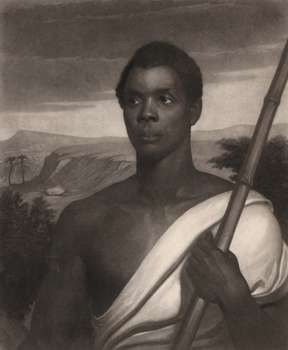
Washington was still considered a fugitive, and anyone who recognized him would have blown his cover. Being a man of tact and organization, Washington carried miniature files and saws within the lining of his coat; these would help him break out of any chains used to restrain him. “Liberty is worth nothing to me while my wife is a slave,” said Washington as he held conversations with fellow travelers who tried to convince him to abandon his plans.
As Washington traveled closer to the farm that held his wife, he was forced to travel at night for fear of being recognized by someone. He found temporary shelter in the woods near the farm and tried to get information about her but was unsuccessful. One night while in hiding, he heard singing off in the distant woods; the singing was coming closer and closer to where he was hiding. As he investigated the singing, he became a part of the singing, there he learned that he stumbled upon a “corn shucking.”
A “corn shucking” was a mass gathering of slaves who pealed loads of corn, and after pealing the corn they were able to have a huge dinner with whiskey and dancing, which was provided by the owner of the plantation where the corn shucking took place. Washington refused to eat the food for fear of being discovered. He also was very careful to ask only a few questions and remain in the shadows. At the corn shucking, he learned that his wife had not been sold and was still on the old farm.
Being too eager to see his wife, Washington entered the parameter of the farm but was spotted by an overseer. The overseer then alerted the other white overseers on the farm. The first three men to approach Washington was struck in the face and knocked to the ground unconscious. Eventually, Washington was subdued, shipped to Richmond, Virginia, and sold to the slave owners Johnson and Eperson. New Orleans was the destination for The Creole, a slave ship controlled by Captain Enson and owned by Johnson and Eperson.

Washington and one-hundred and forty-four other slaves were loaded upon The Creole along with other cargo the men were shipping to New Orleans. As they loaded the slaves upon The Creole, the men were placed in one cabin and the women were placed in another. For fear of rebellion, the men were heavily chained, and Washington particularly was chained to the floor of the cabin. The women were not chained and were able to roam their cabin freely.
As Washington lay chained to the floor, his attitude was rather jovial than the expected gloom the other slaves displayed. The overseers didn’t know that while Washington was displaying a docile and cooperative attitude; he was secretly picking the men he would use to overthrow The Creole. They also didn’t know that Washington still carried his mini saws and files within the lining of his coat to use when the time was right.
In 1841, on the ninth day of the voyage, The Creole encountered rough seas which made several slaves very sick. Because some slaves were sick, the overseers did not watch them properly, this created the perfect opportunity for Washington and his men to attack. Washington used his mini saw and file to free himself and at least eighteen other men. Once free, the slaves found weapons and made their way to the deck where the ship’s crew was stationed. When the slaves attacked the ship’s crew it was unexpected, and it startled the crew, the men barley moved to make them easy targets for the slaves.
Hewell, the Black slave driver, and others from the crew drew their guns and shot some slaves. Washington spotted Hewell shooting his gun, approached him from behind, and struck him in the head, wounding him severely. Washington led his men into battle with iconic flair, fueling his men to earn their victory; the slaves then dominated the crew and gained control of The Creole. Washington’s men wanted to kill the remaining crew members who were still alive, but Washington allowed no more killing. He was not interested in killing the men, only gaining the freedom of his people and his wife.
The next morning, Madison Washington was named “Captain Washington,” commander of The Creole, by his men. That same morning, Washington requested that the cook prepare a wonderful meal for the men and women who were once captives on the ship. This meal would be the first time the men and women would see each other. Little did Washington know his beautiful wife Susan was one of the women held in the cabin on The Creole. As they served the meal, enslaved men and women mingled for the first time as free human beings. Washington and Susan spotted each other and shared a passionate, tearful reunion. After years of being separated because of slavery, Madison and Susan Washington were once again husband and wife.

Madison Washington and his men defeated the crew of the Creole, and Washington ordered that the men not be killed and their wounds treated. Once the wounds of the white men healed they tried to regain control of the ship but were defeated once more. Because of the bravery and brilliance of Washington, one-hundred, and forty-four, people could gain their freedom upon The Creole. The Creole didn’t make it to New Orleans, instead, Washington and his men landed in Nassau, Bahamas because they learned it was a free island. Washington was determined to free his wife, and his determination and love for his wife led to him freeing others he did not know.
The Story of Madison Washington and The Creole is a story many of us have never heard before; a man of African lineage who embraced freedom could not only change history but change the lives of others. This story is important because it shows that once organized black people can gain their freedom. It also exemplifies the commitment of a black man to his black wife, which is counter to the normal narrative which usually degrades the black family. If we unite and trust each other we can make the impossible, possible.

Mr. Madison Washington, we proudly stand on your shoulders.
– JA Ward
References:
https://en.wikipedia.org/wiki/Madison_Washington
https://newsone.com/2762407/the-creole-slave-revolt-1841/
https://loa-shared.s3.amazonaws.com/static/pdf/Brown_Madison_Washington.pdf
Website: www.ontheshoulders1.com
IG & Twitter: @Joseph Ward
YouTube: https://www.youtube.com/watch?v=FxJI7ykLdNA
Facebook: On the Shoulders of Giants
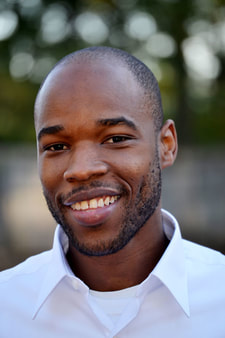
Joseph A. Ward is a graduate of Florida A&M University (FAMU) and holds a Bachelor’s degree in Psychology. Ward is a graduate of the “New Hope Program” with the Florida Department of Health (DOH) in Leon County and has served as a co-facilitator of the program for over seven years, teaching life and professional skills to underprivileged persons. In addition to co-facilitating this program, he also helped establish the FAMU chapter of Men of Strength (MOST) and currently serves as its co-facilitator.
Over the past 14 years, Mr. Ward has dedicated himself to studying the history and the culture of the African diaspora. He is the founder of On the Shoulders of Giants, Inc., author of On the Shoulders of Giants Vol: 1 North America, and On the Shoulders of Giants Vol: 2 Central America. He is also the host of The Freedom Train Podcast Series and The Fix Sports Podcast.
Mr. Ward’s commitment to his community has proven him to be a reputable teacher, coach, trainer, and motivator. He is dedicated to uplifting and educating individuals around the world while helping to create mindsets and environments which foster greatness.
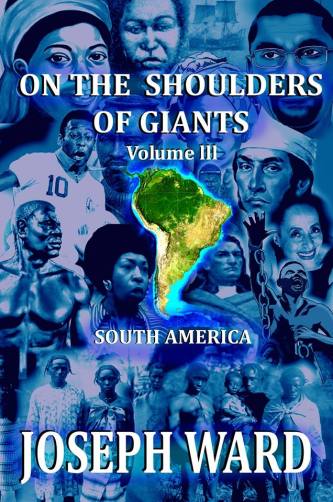
Click here to learn more about the On the Shoulders of Giants book series!!
Check out more Black History Fun Fact articles here. Want to be featured on this blog? Write and submit your own Black History Article! Click here for submission guidelines.
Book Reviews Needed For The Stella Trilogy


Hey guys!
I am gearing up to release the last book in The Stella Trilogy, The Road to Freedom. After this book drops the series will be complete. Whoo hoo!
But what’s that saying? The real work begins after you release the book? Yea, that.
I don’t know who said it first, but there are no lies told here.
As book three is on its way out, I would like to draw more attention to books one and two by getting some book reviews in. As you guys know, these books were originally published in 2015-2016 but due to major editorial and formatting issues, I have had to take them down and relaunch them. One major risk of taking them down was losing the little reviews the books had. That was a risk I was willing to take if it meant a better reading experience. There are over three thousand followers of this blog. I am hoping I can get a few of you to help.
I just thought I’d ask. What’s that other saying? “Closed mouths don’t get fed.”
- If you have read any of these books, it would mean everything if you could review them on amazon. Review book one here. Review book two here.
- If you have never read these books and would like to receive an ARC copy, it would delight me to send it to you.
Comment below, contact me through the contact form or email me directly at yecheilyah@yecheilyahysrayl.com.

Throwback Thursday Jam – A Change is Gonna Come: Sam Cooke
SugarCoated and Springtime

They get tired of hearing it.
Ain’t nobody got to say it,
I know that they get tired.
Tired of these distractions in brown-colored skin
waking up from Valley’s
with muscles and tendons
all conscious-like.
Uncovering the blood in the American Flag—
Tired, tethered, and intoxicated
with his story.
Unraveling the color of bigotry on a beautiful glass,
Smeared fingerprints and fallen stars like
Why they keep sittin’ in?
Between our comfort and a hard place.
America,
This be some kinda hard place
for brown-colored skin
in the springtime.
Strange fruit popping up again on trees,
‘cept Nina ain’t here to sing us a song.
After 400 years
songs just don’t work anymore.
Tired of these guns accidentally going off,
Landing somewhere in my purse.
somewhere in my womb.
Somewhere in my future between lipstick and foundation.
I’ve got to warn my sons
about accidental guns.
Generational homicide got me on my knees praying
the badge
ain’t got his name on it.
Let’s be accurate about it.
Will I be left with the fragmented
pieces of my husband’s shoes
between our front porch and the living room floor?
Will my kiss linger long enough to bring him home tonight?
Or will I suffer a widow’s fate of mistaken identity?
After all, these brown, tan, bronze, and mahogany-colored
skins all do look the same…
Don’t they?
I’m afraid of your guns.
They don’t know the difference
between friend and foe–
or maybe, they do.
Funny how bullets be mistakin’ themselves for judges
that ain’t got names on them.
They say a gun
ain’t got a name on it.
Why are they sugar-coating it?
‘Cause people get tired of hearing about all this black…
All this oppression,
All these curses,
All this power like,
Why we won’t pour sugar on top of these bodies?
Get ’em up off the street.
Don’t want our bullets to get stirred up, ya know.
Getting up outta beds,
loading themselves into chambers
and taking walks at night,
in the afternoon, and especially in the morning,
when it’s springtime.
Fun Fact: I first wrote this poem four years ago (almost to the day). Reposting because it is still fitting for today’s climate. You can find it in my I am Soul poetry collection.
If My Books Shall Die

I read James Baldwin today
and realized I was carrying his bones
in the crooks of my arms,
and that if my books shall die,
then I have labored in vain.
I have swam through centuries
and ran years in someone else’s shoes,
I have climbed mountains
and crawled under valleys
only to bleed death.
I have wasted my time
carving obsession into paper
with invisible ink,
Words fallen like stars
on deaf ears.
If my books shall die,
then let me not be born.
Take me back to the safety
of my mother’s womb,
the privacy
of not yet existing
if my works have been in vain.
If my books shall die,
then I do not exist.
Not on the tops of your shelves,
or faced down on kitchen counters,
or underneath your children’s beds.
Honor me
in the palms of your hands
and not standing next to Grandmother’s old picture in the living room—
Grandmother is dead
and I do not wish to die.
Give me my flowers today
and accept the life I offer you
in the form of metaphors
On silver platters,
For I am feeding you
with silver spoons
and all you’ve got to do is eat…
I offer you
the best of me.
And when I am dead,
no longer among the living
crack open a book written by me
and feel my breath on your skin.
Hear my voice resurrect
from inside an ancient pen,
Watch my tongue dance,
See my lips move
and witness passion soar from beyond the grave.
If my books shall die
then my words did not really contain life,
But if my books shall live…
What are you waiting for?
Go to your bookshelf,
Resurrect me
and carry
my bones.
Revising The Stella Trilogy: Crafting Authentic Historical Details
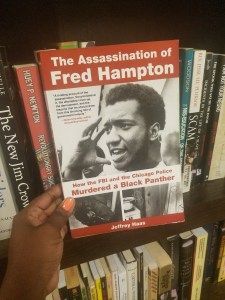
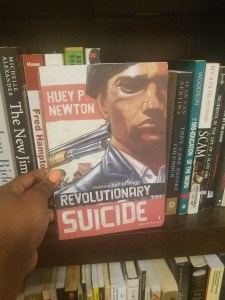
In Beyond the Colored Line, book two of The Stella Trilogy, we meet Noah Daniels who is a member of The Black Panther Party for Self-Defense. There are two books I read that helped me to conceptualize his character in the most authentic way possible: Revolutionary Suicide by Huey P. Newton and The Assassination of Fred Hampton: How the FBI and the Chicago Police Murdered a Black Panther by Jeffrey Haas.
These books helped me to capture the language and the spirit of the movement as realistically as possible. I modeled Noah’s persona after both Huey Newton and Fred Hampton. Noah uses terms like “Pig,” regarding the police like the Panthers did in the 60s, but reading Newton’s story helped me to understand this wasn’t a random term they pulled out of the sky to be derogatory.
Black Panther rhetoric like “All Power to the People,” and the concept of “pig,” came with Newton’s interest in A. J. Ayer’s logical positivism, that nothing can be real if it cannot be conceptualized, articulated, and shared. While I do not agree with this philosophy as a person of faith (because faith is the opposite of this…the belief and expectation of something even when you cannot see it), it was helpful in me understanding the Panthers on a deeper level and thus helped me to make Noah’s story more real.
Not all research needs to be included in the story so you won’t hear Noah quoting A.J. Ayer. The point of research for historical books is to help the writer to better understand the culture of the time so the characters can interact with the setting genuinely.
Historical Fiction is not an easy genre to write because while the story itself is fictional, the dialogue and personas of the characters have to be true to the time. A young person living in 1960 wouldn’t speak like a young person living in 2020. If done right, adding authentic historical details enrich the story by triggering memories of the past.
Excerpt from Chapter Ten:
“That just bugs me. We supposed to march and get hit upside the head by the pigs?” he would say in conversations with his mother when he would visit her. Unlike many young black men raised by their mothers, Noah’s mother had decided early on that her son’s narrative would be different. When he came of age, she would turn him over to be raised by his father. She could provide a lot of things, but she could not teach him how to be a man. She supported most of Noah’s radicalism, but only to an extent.
“Now don’t you go rappin’ ‘bout all that communist jive talk in here boy. Violence and hatred never helped to expand no revolution.”
“But Ma, that’s where you’re wrong. It’s not about violence. It’s about defending ourselves. Violence is only the guilt complex that exists in the minds of America.”
Mama Daniels would lift her head to the ceiling, wishing she’d said nothing.
“To say that a man is violent because he defends himself does not differ from saying a man who is being lynched and thus fighting back is himself violent because he fights back.”
“Boy, what? You know, sometimes I wish you weren’t so smart.”
Noah laughed, “’cause you know I’m right. Mama, white Americans know that they have been violent against Negroes, and they fear that one day the Negro will do unto them as they have done unto the Negro.”
The 1960s presented a new wave of leadership and identity for people of color who went from being Negroes to Blacks. Just the previous year, the heavyweight champion, Muhammad Ali refused induction into the army on both religious and political grounds. The epitome of the black power movement was the Black Panther Party, founded by Huey P. Newton and Bobby Seale. This party organized the use of self-defense in the accomplishment of black justice and was right up Noah’s alley.
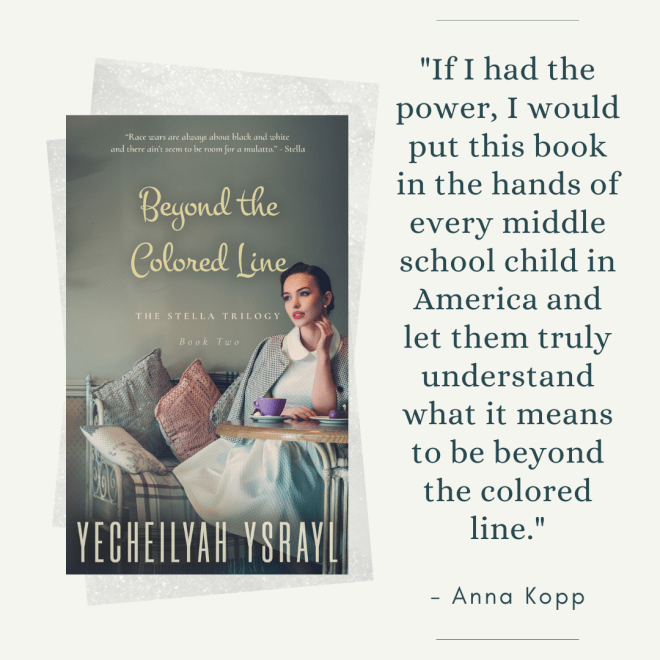
Stella: Beyond the Colored Line
Get it Here.
Haven’t read book one yet? Get it here for just $0.99.
 The PBS Blog