My one and only classic 1976 original version of Roots: The Saga of an American Family
It took Alex Haley 12 years to finish Roots: The Saga of an American Family, known widely as simply, Roots. The book shot straight to the top of the bestseller charts, and the twelve-hour mini-series (Jan. 1977) was watched by 130 million people. They translated the book into 37 languages; it won a Pulitzer Prize and National Book Award, and sales soared to over 5.5 million.
This was not without controversy. No success story is. Haley had to settle a plagiarism suit out of court—that part of his story was copied from a 1967 novel, The African (The Guardian). It was also said there was no documented evidence that the alleged elder he spoke to in the Gambia had been accurate in his account of Kinte. Critics said that if Haley had written Roots as a fiction novel, there would not have been a cause for alarm. “Most of us feel it’s highly unlikely that Alex actually found the village whence his ancestors sprang”, Henry Louis Gates Jr said in 1998, calling Roots “a work of the imagination.” (But if you listen to Haley here, his story is very detailed. It is also consistent with many of his other interviews and speeches about the story of how Roots came about. This is hard to do if you are lying).
Roots is now part of history and the original 1977 TV series awakened a new generation of young Blacks to the horrors of enslavement when movies and television shows about slavery were few and far in-between (both in books and film). While it may seem an over-saturated topic now, in 1977 this was groundbreaking.
Enslaved persons had little knowledge of what Haley referred to as “family continuity.” They were sold so much that as adults they came to know little about their family lineage, where they came from and who they were. Roots was therefore something special because Blacks had come out of the Black Power movement of the 60s, had just seen the deaths of Medgar Evers, Martin King, and Malcolm X. Roots was not just the story of one man’s family but the family of all Black people who had been taken captive and robbed of their family tree and any connection to it. It would become a history lesson, a recommended educational film that Black parents will watch with their children with just as much seriousness as their parents forced them to watch The Ten Commandments. Some would even name their children Kunta Kinte.
After Roots, Octavia Butler used time travel to explore slavery in Kindred (1979), Alice Walker used an African subplot (Nettie’s life in Africa) in The Color Purple (1982) which also went on to win a Pulitzer and National Book Award, and Toni Morrison made a fugitive slave her protagonist in Beloved (1987). Beloved was voted the most influential African-American novel of the 20th century in a poll of PBS viewers. But as Frances Smith Foster has pointed out, “in terms of actual audience and effect on politics and policies, Roots has been the most influential such story in the modern era.”
As I listened to the entire 2hours of the clip linked above, I wondered why I was doing this when I had (seemingly) much more important stuff to do. That is until I came to the final hour and fifty something minutes. Here, Haley speaks about how the father’s name the babies at eight days old. In the villages, the people would not see much of the father for seven days because he was spending time with the baby to come up with a good meaningful and significant name. On the eighth day the people would gather at the family’s home. The mother would come out once hearing the signal and sit on the stool and hold the eight-day-old baby. The father would walk over, lift the infant, and whisper the name into the infant’s ear three times.
He would do this so that the infant would be the first one to know who he/she was. This resembles, to me, the ancient practice of circumcision of the male child, and naming of the child, in ancient Israelite culture (Gen 17:12) which I believe is also Black culture. For example, the Ashanti Empire was a powerful Akan empire and kingdom in what is now modern-day Ghana. Ashan was the name of a city in southern Israel. The word Ashan in Hebrew means “smoke” “smoke city” or “burning city” so that Ashanti means “the people of Ashan or the people of the smoke city”. This was a reference to the city of Ashan after the Israelites took it over during the conquest of Canaan (1 Ch 4:32, 1 Ch 6:59). The Ashanti people had many Hebrew customs and traditions as part of their way of life. For eight days after the birth of a child, it is only on the eighth day that the child receives his/her personal name.
It was here that I had discovered the purpose of my listening to this piece in its entirety. I believe this to be such a powerfully subtle telling of who we, so-called Blacks in America, truly are. For the customs of the Hebrews is something that can still be found among many African cultures such as the Ashan.
Roots is a powerful example of why we shouldn’t give up on whatever we are striving toward. It inspires me as a writer and as a person of the fruits of patience and of perseverance. While Roots has had (and continues to have) much success, remember that it took Haley 12 years to complete (one whole year from Kunta’s birth to capture… which could be a book by itself).
Think about that the next time you worry about that book taking too long to finish.
I have been MIA on social media lately and I’ll return to my regular blogging soon. In the meantime, the Even Salt Looks Like Sugar is available now in audiobook. If you are a first time audible user this book is free with the 30 day trial.
Texas, I’ll be at the Trill Healing and Wellness Space in Stafford TX (about 40min from Houston) on November 30th for a signing and book reading of Keep Yourself Full. If you are in the area, I would love to have your support. This is our chance to meet/catch up. Don’t have this book? No worries! Grab your copy now from my website by clicking on the link in my bio. See you soon. Special thanks to Trill Monday Night Markets, Enlightened Souls, and B Infused Natural Detox Waters and more.
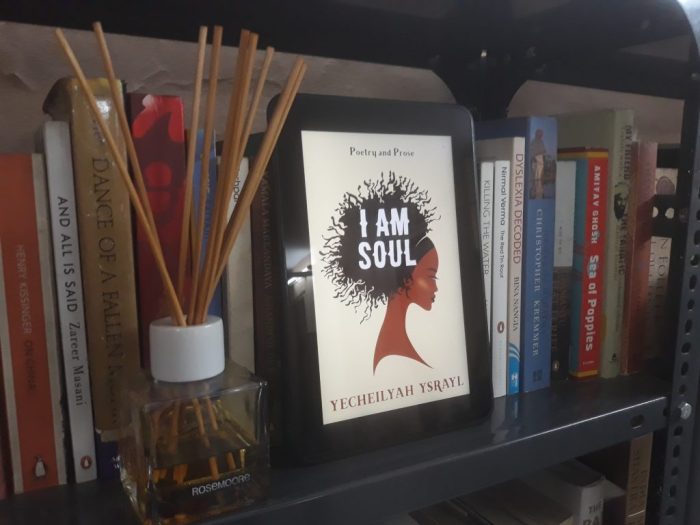
If you have not already, please be sure to head on over to this post and check out Fiza Pathan’s touching review of I am Soul. I’ll be quoting her review throughout this post but reading it in full will help you add context to what I say here (there is also an audio version of the review on her blog).
“I have read many books and articles about the way a woman of color is treated in society, especially in Indian society. I have studied History and Sociology throughout my college career which gave me a lot of material to study about the situation of colored people in Indian society. But to be frank, I’m not that well equipped to talk or speak about Black American History or the Black American contemporary views on life, culture, society, history, politics, education, et al.” (Pathan, 2019)
Pathan is not the only reader to have confided she is not well versed in Black American History. People have told me on more than one occasion of their lack of extensive knowledge in this area. This does not surprise me. It is why writing on the experiences of Blacks in America is important to me. Like Paul of the bible, I am sent to the nations (Acts 22:21) to bring light to what America has tried to keep hidden for too long.
Americans underestimate how information is disseminated across the world. The news and the information we are exposed to in America is not necessarily the same information that is exposed to people in other parts of the world. Historically, news traveled through radios, television, books, and newspapers. What mainstream media wanted you to know is what you knew. If America didn’t want other countries to see how it treated Black Americans, those countries didn’t see it.
“I have started reading Black American literature in general after I turned 28 years of age in 2017, because of the poems and writings of Toni Morrison, Maya Angelou, Langston Hughes, Alice Walker, James Baldwin and Dorothy West. Yes, you’d wonder where I was and what I was doing with my life, but the fact is that, all said and done, I have just begun to realize the richness and depth of the Black-American experience. ‘I Am Soul’ by Yecheilyah Ysrayl is one book among many that are educating women of color like me from far off countries like India, especially recluses like me, and I’m glad I am being educated.”
– Pathan, 2019
Today, Social Media is a significant catalyst for uncovering the truth about what Blacks have endured and the many businesses and products blacks have invented and how those inventions have been credited to other people. While we must be cautious not to spread disinformation (See this post here), there is still a lot of good that has resulted from the social media revolution. Information is coming out at a rapid speed of both the good and bad historical facts so that there is a desperate need of keen discernment. One such example is the testimony from notable black writers that Blacks could not eat vanilla ice cream in the Jim Crow south, and that they only allowed us to eat it on Independence Day.
“People in Stamps used to say that the whites in our town were so prejudiced that a Negro couldn’t buy vanilla ice cream. Except on July Fourth. Other days he had to be satisfied with chocolate.”
– Maya Angelou, I Know Why the Caged Bird Sings
While visiting Washington D.C. with her parents around Independence Day, poet Audre Lorde’s mom wanted to treat her to some vanilla ice cream, but they refused the family:
“The waitress was white, the counter was white, and the ice cream I never ate in Washington DC that summer I left childhood was white, and the white heat and white pavement and white stone monuments of my first Washington summer made me sick to my stomach for the rest of the trip.” – Audre Lorde, Zami: A New Spelling of My Name
The “White Ice Cream,” rule is said to be more folklore than truth. But why? This is an example of a history hidden and then revealed because of the widespread use of Social Media. Prohibiting blacks from eating vanilla ice cream is not far-fetched, considering the pettiness of Jim Crow law. If blacks couldn’t swim in the same water as whites, it’s not so hard to believe they couldn’t eat white ice cream.
Fun Fact: The vanilla bean is brown and was cultivated and improved by an enslaved black man named Edmund Albuius. In ice cream, a small amount of vanilla is used compared to the other ingredients so that it still looks white (from the milk, cream, white sugar). If a larger quantity of vanilla is used, it would probably be more colored. Take these bars of soap.
“The soap above is scented with Vanilla Sandalwood Fragrance Oil, which discolors dark brown. The tan color will continue to darken over time.” – Bramble Berry, Soap Queen (3 days later, the vanilla in the soap turned it even darker…)
But let’s not digress. The point is, vanilla bean is brown, not white. Joke was on Jim Crow…
“While Jim Crow laws, extensively documented in print and historical record, are fairly well known, less well known are the unspoken etiquette rules for Black people, largely forgotten by anyone who didn’t have to live under them. During Jim Crow, Black people could pick up food at establishments that served white people, but they often could not eat in them. When custom demanded that Black people be served separately from whites, they were often required to have their own utensils, serving dishes, and condiments. So it was customary for Black families who were traveling to carry everything they might possibly need so that (with the help of the Green Book, the guide that helped Black travelers eat, sleep, and move as safely as possible) they could navigate America in relative comfort.”
– Mikki Kendall, Hot Sauce in her Bag, 2016
Black history has been just as raped and stolen and manipulated as her people. Black American History is more than slavery and Civil Rights, but slavery and Civil Rights is still part of that history and must never be forgotten. Black history is the birth of a nation, its upbringing, its captivity, and its overcoming. It is all of it. The good, the bad, and the ugly. We were not only slaves but also soldiers. Not only captives but also captains. We were/are a wealthy people, royal, smart, salt. We are seasoning and soil. But where were we born? How did we begin? What happened once we got here? These are the questions I seek to answer in my literature and articles so that the voices unheard in mainstream media can speak through me and prophesy the truth.
“‘I Am Soul’ to me is a book about being a part of a history that none can forget, but that slowly is changing the way we look at this race of people past, present and to a bright future, God willing.”
– Pathan, 2019
There is something special about the plight of the so-called Black American. What is to be revealed about these people stolen and transported to foreign lands in the bowels of slave ships? These people once stripped of their nationality and culture and are now returning to their natural heritage? Because of Social Media, this truth is easier to disseminate and verify. We have eBooks we can download in an instant, online journals and periodicals, and scholarly material at our fingertips. And we have Independent Publishing whereby artists can write and publish these truths without prejudice.
“Lastly, I would like to recommend this lovely and enriching book to everyone, irrespective of race, community, religion, caste and gender. I hope to review more books by Yecheilyah Ysrayl soon and hopefully, when I do so, I will be more capable of giving a more enlightened review as I will be reading more books about Black American history and literature in the future.” – Fiza Pathan
Negroes are born
without name
without record
they are boys despite age
Uncles
Johns
Negroes are sign language
using symbols to communicate
their existence
born without land
without placement
without ownership
what King referred to as
“a degeneration
of nobodyness”
they are sojourners
wandering from person to person
in search of themselves
Negroes are born
without heritage
without honor
without pride
without mothers
their umbilical cords
cut
their screams muffled with injustice
their bodies sold
and bellies stuffed with lies
Negroes bleed death
and cannot recognize their own corpse.
But we are not Negroes.
We are soil and Earth
lips that sing
mouths and song and praise.
We are bodies and flesh
veins and blood and salt
We are salt
of the Earth.
Seasoning.
We are crowns and rubies and pearls
eyes and nose
vision and smell.
We are scripture and fire
and dripping honey
We are blood, teeth, and bone
We are people
brave. proud. strong.
But we are not your
Native Son is a movie based on one of my favorite books out of High School, back when I first started college and began my journey of literally devouring Black Literature. So, the first thing I noticed about this trailer is that it’s a modern adaptation. If you’ve read the book, you know the story was written in 1940 and takes place in the 1930s. Bigger Thomas is a young black man of only 20-years-old and is living in extreme poverty on Chicago’s South Side. The movie appears to have a modern spin and Thomas doesn’t appear to be as poor as he was in the book.
My torn and overly read Native Son book
I won‘t lie. In the first three seconds of seeing the trailer, I was surprised to see the military look of the jacket and beret bigger wears because that is not the persona of the Bigger in the book. Bigger in the book is more so laid back (at least that’s how I pictured him). Like all book adapted films, I am expecting everything not to be exactly the same while hoping the plot resembles the book and that things aren’t too modern even with the modern adaptation. I admit I kinda hoped it did take place in the 1930s. I’m a Historical Fiction writer after all so of course I think they could have left the timeline alone. I guess I fear the whole “black revolutionary” thing is becoming too much of a trend. Like he’s gotta be militant because being “black” is cool now and everybody’s “woke” or whatever.
Anywho, excited to see this though!
Apparently, it has already aired so I’ll be looking for it. I might just reread the book before I do and of course, I’ll be sure to blog my thoughts.
In the meantime, have you seen this? Looks like it premiered two days ago (4/6). How was it?
I was sitting here drafting a Black History Fun Fact about the first black-owned TV and radio stations but as I read I noticed a disturbing trend. A trend we can still see present today. To start, I was researching WGPR-TV, first black-owned television station in the U.S. and W.E.R.D., first black-owned radio station in the U.S. WGPR-TV was run and operated in Detroit and W.E.R.D. was based in Atlanta. We’ll go deeper into their history in a separate post but both stations became a platform for black artists, from Jazz and Blues musicians to Dr. Martin Luther King Dr. using it to broadcast his sermons and later, Civil Rights announcements. There are two things I noticed associated with each of these companies as the inspiration to today’s post:
Jesse Blayton, founder of W.E.R.D., also taught accounting at Atlanta University and tried encouraging young black people to enter the field. He was unsuccessful because the students knew that no white-owned accounting firms would hire them and Blayton’s, the only black-owned firm in the South, was small and had few openings.
WGPR-TV was successful from my perspective but because it failed to reach a wider audience, it was eventually sold to CBS. WGPR-TV ran from 1975 to 1995 under its black leadership.
With, black-owned businesses, I notice a disturbing mindset among many of my people in the African-American community that success is synonymous with white support and that, without it, we aren’t as successful as we could be. Society has deceived many of us into thinking unless they have included us in the mainstream public eye, we are unsuccessful. I compare it to publishing in the sense that Traditional Publishing is still seen as a more successful route than Independent Publishing. It is still seen as a sign of prosperity to be signed to a publisher than to be your own publisher through the Self-publishing route because of the exposure. Although many Self-Publisher’s are making far more money, unless the Self-Publisher can look like a celebrity, he or she has not made it (whatever that means). This is flawed thinking and causes many to chase the temporary pleasures of money and fame over integrity.
The Oscars is a great example of this and for the record, I admire Spike Lee and Regina King most especially. The talent comprised in these two people is beyond words. However, the black community’s reaction to their Oscar win is a great example of how we do not often see ourselves as being enough. Spike Lee and Regina King are and have always been two powerful artists. What Spike Lee has done with Crooklyn, Four Little Girls, Mo Beta Blues, Do the Right Thing, He Got Game, Malcolm X and more is nothing short of genius work. That Regina King can simultaneously bring to life two characters in Huey and Riley Freeman is nothing short of genius work. Not only did she capture the personas of two little boys but two little black boys. Whether that is Poetic Justice, Boyz N the Hood, Friday, Enemy of the State or Down to Earth, King’s roles are always down to earth. She’s got this skill that allows her to be relatable in any role. She‘s hilarious and you feel she can easily be your sister.
My point here is this: Lee and King did not need to win Oscars for me to recognize their brilliance. Yet, as a community, we champion this as the official ceremony to which we have received a piece of the pie. We have a track record of doing this, in which we do not see ourselves as successful except that we are integrated into mainstream societies expectations of what that success is supposed to look like. Angela Basset does not need an Oscar to be great.
There is nothing wrong with receiving support across all nationalities and nations of people. However, it is important for the black entrepreneur to know and understand that to be young, gifted, and black is also a success by itself and on its own terms.
I’ve been swamped in schoolwork which is stopping me from living my best life on these black history posts. Today, I compiled a list of links I found throughout the week and books I recommend since I did not get to complete a full post on one topic. The books are what I really encourage you to look into. Unlike the internet, they provide more detailed and in-depth research and citations from scholars and others useful for deep research.
Descendants of Last Slave Ship Still Live in Alabama Community
The story of the Clotilda and the people who built Africatown.
I spoke about “Africa Town” once before on this blog (See post here). This article shares some insightful information on the descendants of that town. (You may also remember the book recently released on behalf of Zora Neale Hurston of the Clotilda).
South African paramilitary unit plotted to infect black population with Aids, former member claims
Group said to have ‘spread the virus’ at the behest of Keith Maxwell, eccentric leader of the shadowy South African Institute of Maritime Research, who wanted a white majority country where ‘the excesses of the 1960s, 70s and 80s have no place in the post-Aids world’.
Don’t let February be the only time you are interested in your history. From the shelf, here are some of my favorites. I recommend them all:
They Came Before Columbus, Ivan Van Sertima
Jews Selling Blacks: Slave Sale Advertising by American Jews
The Miseducation of the Negro, Carter G. Woodson
The Valley of Dry Bones: The Conditions that Face Black People in America, Rudolph Windsor
From Babylon to Timbuktu: A History of the Ancient Black-Races including the Black Hebrews also by Rudolph Windsor
Negro Slave Songs in the U.S. Miles, Mark, Fisher
Israel on the Appomattox: A southern experiment in black freedom from the 1790s through the Civil War, Melvin Patrick Ely
Medical Apartheid: The Dark History of Medical Experimentation on Black Americans from Colonial Times to the Present, Harriet A. Washington
Hair Story: Untangling the Roots of Black Hair in America, Ayana D. Byrd and Lori L. Tharps
The Assassination of Fred Hampton: How the FBI and the Chicago Police Murdered a Black Panther
Bad Blood: The Tuskegee Syphilis Experiment, James H. Jones
Understanding the Assault on the Black Man, Black Manhood, and Black Masculinity, Wesley Muhammad
The New Jim Crow: Mass Incarceration in the Age of Colorblindness, Michelle Alexander
There are so many others but this should be enough to get your started! Be sure to check out the other Black History Fun Facts on the Black History Fun Fact Friday page.








 The PBS Blog