Friday, November 1st is here and we are announcing the winners of this year’s poetry contest. The winners are notified ahead of time so we can prepare their interviews, but I will swear them to secrecy (lol) until we make the announcement.
We have selected 2 winners (1st and 2nd place) and four honorable mentions.
But that’s not all.
Please be sure to check your email if you entered a poem for the 2019 contest to learn more and for further instructions on what to do next.
As a reminder:
The 1st Place Grand-Prize Winner will be awarded the following:
$50 Barnes and Noble Giftcard
Publishing in the 2020 2nd Edition Literary Korner Publishing Magazine for Poets
Publishing and Author Spotlight Interview on Yecheilyah’s Blog (over 2900 subscribers, 70k views a week)
Publishing in the 2020 2nd Edition Literary Korner Publishing Magazine for Poets
Publishing and Author Spotlight Interview on Yecheilyah’s Blog (over 2900 subscribers, 70k views a week)
Spotlight across Yecheilyah’s social media
Spotlight in Yecheilyah’s email list
A digital version of the 2020 Literary Korner Publishing Digital Magazine will be available February 2020 featuring the winning poems. The Print version will be available fall of 2020. We will not feature the winning poems on the blog this year because they are featured in the magazine.
If you have not already purchased this year’s LitMag of our 2018 winners you can do so HERE. Your support helps to sponsor this and future contests. Thanks to everyone who contributed so far!
Okie dokie. We will see who wins on Friday!
MogulCon 2019 | Atlanta Marriott Perimeter Center Ballroom
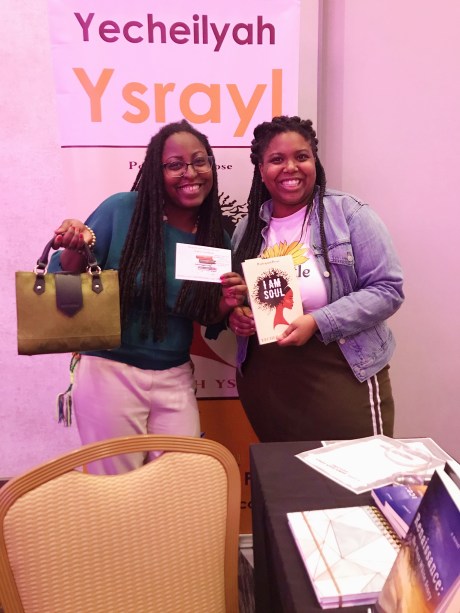
I learn something new every time I vend. This weekend’s MogulCon event was about learning, networking and allowing things to flow. It also further solidified my belief that vending is more about discoverability than profit. I met two wonderful ladies and we proved to be a good fit for helping each other in an area I had been praying about for some time. To learn more about the pros and cons of author vending click here.
My one and only classic 1976 original version of Roots: The Saga of an American Family
It took Alex Haley 12 years to finish Roots: The Saga of an American Family, known widely as simply, Roots. The book shot straight to the top of the bestseller charts, and the twelve-hour mini-series (Jan. 1977) was watched by 130 million people. They translated the book into 37 languages; it won a Pulitzer Prize and National Book Award, and sales soared to over 5.5 million.
This was not without controversy. No success story is. Haley had to settle a plagiarism suit out of court—that part of his story was copied from a 1967 novel, The African (The Guardian). It was also said there was no documented evidence that the alleged elder he spoke to in the Gambia had been accurate in his account of Kinte. Critics said that if Haley had written Roots as a fiction novel, there would not have been a cause for alarm. “Most of us feel it’s highly unlikely that Alex actually found the village whence his ancestors sprang”, Henry Louis Gates Jr said in 1998, calling Roots “a work of the imagination.” (But if you listen to Haley here, his story is very detailed. It is also consistent with many of his other interviews and speeches about the story of how Roots came about. This is hard to do if you are lying).
Roots is now part of history and the original 1977 TV series awakened a new generation of young Blacks to the horrors of enslavement when movies and television shows about slavery were few and far in-between (both in books and film). While it may seem an over-saturated topic now, in 1977 this was groundbreaking.
Enslaved persons had little knowledge of what Haley referred to as “family continuity.” They were sold so much that as adults they came to know little about their family lineage, where they came from and who they were. Roots was therefore something special because Blacks had come out of the Black Power movement of the 60s, had just seen the deaths of Medgar Evers, Martin King, and Malcolm X. Roots was not just the story of one man’s family but the family of all Black people who had been taken captive and robbed of their family tree and any connection to it. It would become a history lesson, a recommended educational film that Black parents will watch with their children with just as much seriousness as their parents forced them to watch The Ten Commandments. Some would even name their children Kunta Kinte.
After Roots, Octavia Butler used time travel to explore slavery in Kindred (1979), Alice Walker used an African subplot (Nettie’s life in Africa) in The Color Purple (1982) which also went on to win a Pulitzer and National Book Award, and Toni Morrison made a fugitive slave her protagonist in Beloved (1987). Beloved was voted the most influential African-American novel of the 20th century in a poll of PBS viewers. But as Frances Smith Foster has pointed out, “in terms of actual audience and effect on politics and policies, Roots has been the most influential such story in the modern era.”
As I listened to the entire 2hours of the clip linked above, I wondered why I was doing this when I had (seemingly) much more important stuff to do. That is until I came to the final hour and fifty something minutes. Here, Haley speaks about how the father’s name the babies at eight days old. In the villages, the people would not see much of the father for seven days because he was spending time with the baby to come up with a good meaningful and significant name. On the eighth day the people would gather at the family’s home. The mother would come out once hearing the signal and sit on the stool and hold the eight-day-old baby. The father would walk over, lift the infant, and whisper the name into the infant’s ear three times.
He would do this so that the infant would be the first one to know who he/she was. This resembles, to me, the ancient practice of circumcision of the male child, and naming of the child, in ancient Israelite culture (Gen 17:12) which I believe is also Black culture. For example, the Ashanti Empire was a powerful Akan empire and kingdom in what is now modern-day Ghana. Ashan was the name of a city in southern Israel. The word Ashan in Hebrew means “smoke” “smoke city” or “burning city” so that Ashanti means “the people of Ashan or the people of the smoke city”. This was a reference to the city of Ashan after the Israelites took it over during the conquest of Canaan (1 Ch 4:32, 1 Ch 6:59). The Ashanti people had many Hebrew customs and traditions as part of their way of life. For eight days after the birth of a child, it is only on the eighth day that the child receives his/her personal name.
It was here that I had discovered the purpose of my listening to this piece in its entirety. I believe this to be such a powerfully subtle telling of who we, so-called Blacks in America, truly are. For the customs of the Hebrews is something that can still be found among many African cultures such as the Ashan.
Roots is a powerful example of why we shouldn’t give up on whatever we are striving toward. It inspires me as a writer and as a person of the fruits of patience and of perseverance. While Roots has had (and continues to have) much success, remember that it took Haley 12 years to complete (one whole year from Kunta’s birth to capture… which could be a book by itself).
Think about that the next time you worry about that book taking too long to finish.
You don’t have to mention my name
Waste, not your resources
Carving my initials into the ground
Or on street signs and buildings
Not near corners
where future Martin Kings
Will sell dope and brawl
Until their quarrels leak
With the accidental stench of death
Over dice games
I’m sure Dr. King didn’t expect his memory
To be synonymous with the street
At which the next ghetto is named
Remember me not this way
Not on the front of your t-shirts
And flyers
And flowers as if my nose can still
Smell them
In your thoughts
You don’t even have to say my name
Build no fancy statues for me
Sing no sad songs
Instead
Remember me in ink
No need to write me down
In history
Just write me down in ink
Admit that every time
I opened my mouth
the earth moved
that I did not sugar coat
the splitting of the sky
when it birthed the rain and that yes,
I drowned a time or two
be sure to mention my mistakes.
But at least you can say that with every base in my voice
I played the truth
and that with the thrashing
of every keyboard my fingers
exposed the secret
behind
why every heart
beats.
I don’t listen to a lot of mainstream music that’s not an early 2000 hit I liked before I stopped, 90s jam or real throwback but I do love me some Alicia Keys and I think her Red Table Talk was the best so far. (The only thing that had me thinking was how the song below was written in dedication to Key’s grandmother, not a man. (Though I do think about my man when I hear it lol… but that’s my point) Why is it, my mind began to think, the video doesn’t reflect that? Most people think this song is about a romantic relationship and the video further perpetuates that. I can’t help but wonder why the video doesn’t showcase the song’s intended purpose).
I’m looking forward to that Alicia and Lauryn Hill collabo! My favorite quote of the evening was:
“I don’t wanna be on nobody’s pedestal. I can just be me. I can be all my flawed, beautiful self, you be your flawed beautiful self and we just hang out and talk and sort it out.” – Alicia Keys
Authors, this is a must-read. I’ve known Christa now for a few years. She knows her stuff. Personally, I am not a big fan of automation (#11) and I can work on #12 myself (I am pretty good being consistent on Twitter and the Blog but I need to work on Insta and Facebook) but pay special attention to #1.
It’s well worth the extra money to invest in a domain name for your website/blog. No matter how you spin it, sites with yourname.wix, yourname.wordpress, yourname.weebly, etc. will never be as professional as yourname.com. Even if you are not an author reading this, if you have a business invest in a domain name. You may have to pay a little extra a year but you’ll make that back in sales because it is easier to find your site. It also becomes easier for media personnel to find you too for other projects. An interested reader will most likely Google your author name dot com so try for that before getting a dot net.







 The PBS Blog