Realistic Character Changes

bai-kiem-tra-huong-nghiep

With the exception of books I read for review, during my regular reading times I have this bad habit of reading more than one book at a time. I’ll start reading a book and then stop and mark it off so I can go think about it. My intention is to come back after thinking about it for a while but I just end up reading something else. I do come back to it, it’s just. I have a problem.

Anyway, so I’m reading a few books, one of which happens to be C.S. Lakin’s Writing the Heart of Your Story (part of The Writer’s Toolbox Series) and for these kinds of books I am never really finished with them because to me they are part of my study material. So, it is while sitting in the bed, pillow prompted up behind me (while trying to sit as straight as possible because my computer cord has a short in it) that I decided to put my kindle down a moment (see? SMH. Get it together EC) and share my thoughts. I am especially excited because my husband is watching the football game while I’m drafting this which means he doesn’t particularly want me in his face. So, I thought I’d write until I feel like bothering him again.

In Chapter 15, Character Arcs (she dislikes that term by the way), Lakin explains how change for characters come in stages. This caught my attention because I come across this a lot. That is, the characters in the story aren’t given enough time to decide or come upon an epiphany that makes sense. What I mean by making sense is that they are too easily convinced, swayed, or compliant at times where they should be pushing back against the grain.

If the character hates ice cream, it’s unrealistic for him to be convinced to eat an ice cream bar after one conversation with his brother (who loves ice cream) taunting him about it. That’s not realistic. In real life, he would not be so compliant, in fact, he will probably get upset that his brother would even offer him such a treat. There will likely be resistance. Lakin explains it so much better than I do:

“Remember, you have to change characters in stages, starting with their opinions and attitudes and eventually changing their core beliefs.”

– Opinions
– Attitudes
– Core Beliefs
– Self-Image
She goes on to say:

“You can’t have a character talking to someone about the death penalty (which he is all for) and just through that one conversation have his belief changed (fully against) right at the heart of his core belief.”

When I read this I had to share it with you all because it’s such valuable advice that I will definitely be heeding.

At the end of the day, everything about our characters has to reflect that of real people. If in real life it will take someone a while to warm up to change, our characters have to resemble the same. We have to get out of the way of the story and let the characters do their thing.

Speaking of getting out of the way I have one more tidbit. There’s something else I’m seeing more and more and that is this: the author who is so passionate about their cause that the tone of the book sounds as if we’re talking to that author more so than the characters in the story. The author’s purpose or mission is so prominent that we can’t separate the author from the characters in the story.

Let me be clear: The author will, inevitably, come through his or her work in one way or the other. That’s not what I’m talking about. I’m talking about deliberately, or inadvertently, creating characters who are just a replica of yourself.

Be sure that when you’re sending a message through books, that you aren’t inadvertently forcing your beliefs on readers. As a reviewer, the author’s personal belief is something I actually do not count toward my rating because  my job is to focus on the story, not the author’s personal life (I’m working on a separate article about my biggest challenges as a reviewer soon) but it is becoming such a problem that I may find myself taking it into consideration while rating if it gets in the way of the story too much. How do you know if you are forcing (or may appear to be forcing) your own beliefs on the reader?  If your manuscript resembles too much of the following:

  • Posting scriptures directly in text
  • Using more than one paragraph for your character to preach or pray in (this will most likely be skipped. No offense, js)
  • Characters who are too young to realistically understand the meaning of certain scriptures
  • Anything that sounds too much like overt religious or political speech

I believe anything can work just as long as it’s done right. The reason I speak so much about symbolism in writing is first because I just think it’s the best way to reach people in writing, but also because I think it’s a great way to write for those who want to send a message specifically but don’t want to be preachy. Fiction is all about the story. People want to be entertained or informed but most of all they want to disappear from this world a moment and get lost in another one: your book.

This means you want to make it their worthwhile. If you’re giving readers sermons and lessons then you’re not (technically) casting down your nets and may do more harm than good. Readers will likely be turned off, your story will fall flat, and you would have reached no one.

Also, by sermons, I don’t just mean religious in nature but any belief system that may seem forced on the reader. It can even be an age difference. Because I write Young Adult, Historical Fiction, I have to take care not to put my own adult voice inside the head of my characters (I know, we don’t like to say characters but work with me here) but to make sure that their dialogue, emotions, and actions are fitting for their age.

To do this, I try to fall back on my years of experience working with children for a reminder of what it was like to be a kid or a young person in general (or OK, a younger person).

What you can do instead is drip feed (introduce drop by drop, here a little, there a little) the message throughout the story, make it a part of the story. Maybe your character was anti that belief but in the end comes upon a revelation. Something like that but don’t make it blatantly obvious.

Remember that fiction writing is, at its core, about entertainment. Even when we do have messages (who doesn’t?), we must still educate through entertainment.

Now, pardon me while I check on Nora.


Yecheilyah Ysrayl is the YA, Historical Fiction author of eight books, most notably, The Stella Trilogy. She is currently working on her next book series “The Nora White Story” about a young black woman who dreams of taking part in The Harlem Renaissance movement and her parents struggle to accept their traumatic past in the Jim Crow south. “Renaissance: The Nora White Story (Book One)” is due for release spring, 2017. For updates on this project, sneak peek of chapters and the pending book cover release for this project, be sure to follow this blog and to subscribe to Yecheilyah’s email list HERE.

How Does Reading Level Matter in Fiction?

This is cool.

Kristen Twardowski's avatarKristen Twardowski

How well do most published authors write? Would you be surprised to hear that Jane Austen wrote at just above a 5th grade level, Stephen King writes at about a 6th grade level, J.R.R. Tolkien wrote at slightly more than a 6th grade level, and Leo Tolstoy wrote at about an 8th grade level?

To find out all of this information, Shane Snow did a readability analysis of the works of different bestselling authors. He based his exploration off of their scores for the Flesch-Kincaid tests, which were developed in 1975 on behalf of the US Navy to assess the difficulty of technical manuals. These tests take into account total words, sentences, and syllables in order to assess a written work’s grade level.

Snow’s analysis found that higher level writing did not necessarily result in successful sales. In fact, the bestselling fiction books that he looked at all fell…

View original post 396 more words

Between Books – When the Blog Comes in Handy

This isn't my PC but this is how it looks. I have sticky notes everywhere! Uhh.
Google Images Pic.

Only a writer would be folding clothes at twelve o’clock at night and contemplating whether they should make a batch of coffee to spend just a few more hours writing, all of this while the History Channel recaps an episode of Pearl Harbor as background noise. It was then that this post was conceived. In fact, I still have a pair of pants under my arm as I am drafting this. What can I say, gotta write when the spirit moves.

As I took a break from my work to finish laundry that could have waited until morning for normal people, I thought about how much this blog has helped to fill in the gaps during my “Between books” stage (thanks for your support BTW!). I like to think I write at a decent speed (six months to complete the first draft) but after that things tend to slow way down as the revision and editing process kicks in. I thus find myself in the waiting room watching as an author after author fangirls over their new release while I’m in chill mode, waiting for my name to be called. It will be awhile before my book is ready. This is when blogging (among other things) helps a great deal.

It helps because while I am in limbo I can keep up with learning new things, reading new books, and keeping myself in tuned with my readers and supporters until the next book is due. It almost feels like teaching but being off for the summer. Some teachers volunteer to teach summer school for some extra funds while others take advantage of the free time. Blogging for me is like a writing summer school, a way to stay active between books. This also helps me to brainstorm on other ways to expand my business beyond the book itself and into other areas of product.

I do admit it’s a challenge to produce blog posts, engage with other bloggers, share content, engage in social media and keep my ear to the Indie Publishing ground all while writing a novel and there are days where I must turn the phone off. It’s either that or pull my hair out. However, I see it all as part of the work and it’s also a lot of fun to me. I’m a worker bee which means that I HAVE to be doing something and while the blog is still a small part of my life in the full scope of things, it does help to keep me active in more ways than one. I guess that’s sort of the point of this post.

It’s important to continue to produce material and sometimes that will take time. The Blog (and the email list) is the answer to how to stay engaged while you wait. Or at least it is for me. The ability to schedule blog posts is a huge time saver and I could sit my butt in the chair and finish what I’d been putting off. Patience truly is a virtue and I am quite pleased with the revelations I’ve been given so far. I can only hope for increased growth. #HWPO is something I try to keep at the back of my mind. That is, hard work pays off. Let’s hope so.

Now, I should probably go ahead and publish this post and get back to these clothes. It is after 1am my time after all. I’m pretty sure I’m somewhere in dreamland when you’re reading this…or not (shout out to my night-owls with the tiny light under the covers scrolling through blog posts).


bitmoji-1051157269


Yecheilyah Ysrayl is the YA, Historical Fiction author of The Stella Trilogy, Blogger, and Poet. She is currently working on her next book series “The Nora White Story” about a young black woman who dreams of being a writer in The Harlem Renaissance movement and her parent’s struggle to accept their traumatic past in the Jim Crow south. “Renaissance: The Nora White Story (Book One)” is due for release spring, 2017. For updates on this project, sneak peeks of chapters, the pending book cover release, and full blurb for this series, be sure to subscribe to Yecheilyah’s email list HERE.

Convicted

think-backward-to-write-meaningful-metaphors

His beauty was biblical. Much more than a body, he was diary. He was journal. A standing column of poetry. From the top of his head to the bottom of his feet, this was prophecy. Thought the teacher was a waitress asked her if I could have another round of him. Let’s be realistic, this thing was futuristic like foresight. Every time he opened his mouth I took road trips into his memories. For my blood racing, I could not hide the joy. Trying to catch my breath after falling into his smile we were connected. Too young to understand this love-at-first-sight thing, I could have been dreaming. Maybe this was just my imagination. I was dancing. Moon-walking into complete relaxation. His last name should have been Jackson cause he was a hit. I couldn’t lie. Ran home every day just to go to bed so I can wake up to the sunrise because it reminded me of him. He didn’t know it but my nose was so open I took notes. I was singing. A sucka to every sound of the harmonious humility that escaped like convicts from his lips I was convicted, because I loved him too early.


Yecheilyah Ysrayl is the YA, Historical Fiction author of The Stella Trilogy, Blogger, and Poet. She is currently working on her next book series “The Nora White Story” about a young black woman who dreams of being a writer in The Harlem Renaissance movement and her parent’s struggle to accept their traumatic past in the Jim Crow south. “Renaissance: The Nora White Story (Book One)” is due for release spring, 2017. For updates on this project, sneak peeks of chapters, the pending book cover release, and full blurb for this series, be sure to subscribe to Yecheilyah’s email list HERE.

Indie Author Page

bitmoji1102164660

I have added a new page to this blog: Indie Authors. There you will find the list of Authors I’ve worked with so far per the Book Reviews published to this blog. As I publish more, the list will grow.

If you’re looking for something good to read, you can find tons of good stories there.

If you would like to be added to my list, register your book for consideration for a Book Review HERE.

Please read my guidelines carefully before submitting your book. Book reviews are free and I have the right to decline any book I am not comfortable reviewing.

If you don’t meet the requirements for my book reviews keep in mind that you can always submit a different book or submit something else that I can promote on your behalf.

Thank you for your time and understanding.

-EC

Talk Yourself into Achieving Your Goals

trainer3

Like many of you, I experience doubt, fear, and all the other emotions that can bring about stress and negativity. I am no different than you in these feelings. I am human and like you, I have emotions. Sometimes I am broken, undetermined, and lack confidence. However, I soon remember that this is not how I want to live my life. It is not that I am “happy go lucky” all the time, fake, or that I do not have feelings of despair, but that I have made the conscious decision not to give my energy over to such feelings. Of course, there are days when I am not consciously strong enough to make that kind of a decision, and that’s when prayer comes in.

So often I hear writers, bloggers, and friends complain about not being good enough without realizing how they’re speaking this into existence. If you truly don’t believe you have worth or value, then that is how it’s going to be. It’s not about being flawless (for we have all fallen short in some way or another) but what it is about is talking ourselves into achieving our goals instead of talking ourselves out of them.

Like learning, self-examination is not a one-time thing, but it is forever constant in our lives. One of the reasons self-reflection is so important is because we often deceive ourselves. Self-Deception means that you are not consciously aware of your true self. The person in the mirror is not reflective of what really exists. There are often two kinds of ways in which we deceive ourselves:

a. The part of self-deception that makes us look at ourselves and downplay everything about us because we know that we are flawed.

b. The part of self-deception where we know everything.

Both of these views are wrong.

Self-examination is not comparing ourselves to others or being mean to ourselves. It does not make it so dark that nothing new can grow. In this instance of Self-Deception we’re just too busy counting our mistakes and being “down and out” to make any real changes. It’s almost as if we want to be in that low place. Walking around carrying the burden of this dark cloud over our shoulders like its a responsibility, and brushing off any inkling of light that wishes to squeeze itself through.

The other one simply leaves no room for improvement. Self-examination is not self-exaltation.

It is possible that the way we perceive ourselves is flawed. If we think we know everything it is possible, then, that we are self-deceived. Likewise, if we believe that we know nothing, then it is possible that we are self-deceived, for everyone has a little bit of something in them. We all know in part and working together we become whole as we all bring something different to the table. No one knows everything, but everyone knows something.

When we have these low moments, we must talk ourselves into those changes we want to happen in our lives and implement a plan that will help us to reach these goals in a practical way. Again, it’s not about having it “all together”, it’s about changing your perspective on life itself and going from concept to execution. Words have power and they do not come back void. Instead of speaking negativity over your life and having a “woe is me” attitude, try being inspired. Try optimism. Try faith. Try something different, for insanity is repeating the same thing over and over again and expecting a different result. You already stressed yourself out about that today. Try something else.

So, your blog isn’t growing the way you want it to, what are you doing to change that? What practical steps are you taking to change what you don’t like? Or are you just complaining about it? So, you’re not where you want to be with your writing, or business, change it. Sit down and outline a plan. So, you don’t like the way your stomach looks right now, change it. Maybe you can’t run a mile starting out. You don’t have to. Run a block. Walk a block.

Anything you don’t like in your life can be changed but first you must change your perspective. In addition, there must be a willingness to be uncomfortable. Only when we are in that place can we really grow. For as the saying goes, “Comfort zones are beautiful places, but nothing ever grows there.” Yes, it’s going to be hard. Yes, it’s going to take persistence, and yes it’s going to take dedication but it begins first with the self-confirmation that yes, IT IS possible. We have to start using words like, “I can”, “I will” and “I will learn” instead of “I can’t”, and “I will never”. Don’t talk yourself out of achieving your goals. Talk yourself into them.

Quick Tips for Paperback Page Numbering

Most valuable tutorial on numbering your print books.

jorobinson176's avatarLit World Interviews

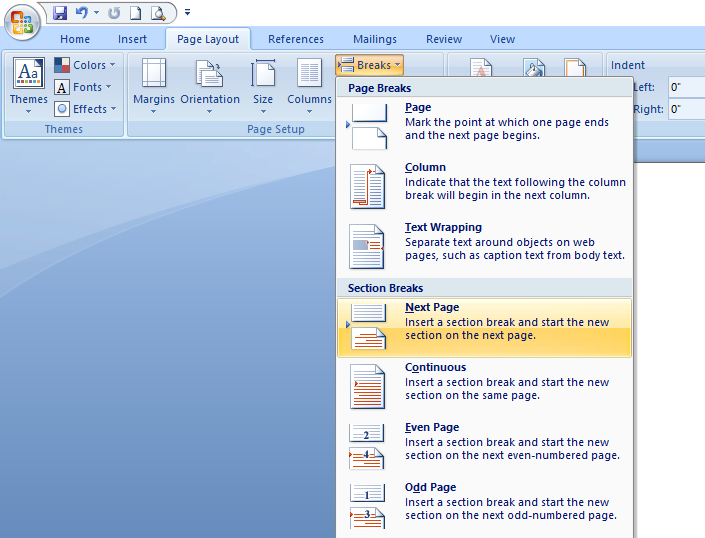
When numbering the pages of your paperback manuscript, the thing quite a lot of Indies have trouble with is that they use Page Breaks rather than Section Breaks. A Page Break is just that—starting a new page within the same section of a book. With a Section Break you can have totally different numbers and Headers and Footers for each section. The way to ensure that your numbering doesn’t bounce back from the first chapter of your book to the front matter is to get rid of all the Page Breaks in first pages and replace them with Section Breaks.

page-break
Section Break after title page, and again after the table of contents, and every other page you have in your front matter.

section-break
Then double click into your Headers and Footers up to and including the first page of your first chapter, and unlick Link to Previous. This will ensure that…

View original post 208 more words