Black Indie Readers: African American Historical Fiction is Important Too

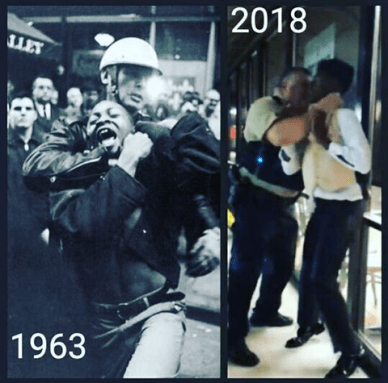
Kanye West, Waffle-House, Childish Gambino, Roseanne, and elderly Black women being manhandled by police is but a snippet of what’s going on. I can turn on my television or more precisely, open my computer, and see a similar scene as a 1960s protest march. I see people sitting in again at restaurants, I see people marching down the streets, I see cops fighting young black boys, and I hear of black bodies being found hanging from trees again (often ruled as suicides.)

This is America.

They say a people without knowledge of its past are doomed to repeat it. I wonder how many of us realize that the past is repeating itself? And I am reminded this is why I write the kinds of stories that I write and why I think Black Historical Fiction is important (and also maybe a tad bit underrated). Often, I see Romance, Urban Fiction and Street Lit praised as the epitome of Black Literature among many Self-Publishers / Indie Authors and Indie readers. But let’s not forget that black history is important too, and should not be left out of the Indie Author revolution.

After my most recent book release, I was amazed at how many people (Israelites, so-called African Americans, Blacks) didn’t know who Marcus Garvey was, what the Universal Negro Improvement Association was, or could make the Marcus and Malcolm connection in the book. (More on this later but briefly, Malcolm X father was a follower of Marcus Garvey and Malcolm’s nickname was Red among other names. I named Nora’s boyfriend after Malcolm X in his honor and gave him some of his characteristics.)

I know that many of us have been awakened to the true knowledge of who we are and have reclaimed parts of our lost, ancient and biblical heritage. We are waking up in droves and understanding the important role that identity plays in the state of Black America today. I am talking about the Hebrew Israelite movement and the number of people returning to the bible as a source, not of religion, but of black history and instruction on how to live on the earth. But that does mean we should toss aside our history in this land as unimportant since it has all played a role in who we are and where we stand today.

To be a true educator, you must first be educated and with extensive knowledge of what you’re teaching and if this is history, it’s even more critical to understand it all. (I am no one special and I don’t know everything. I am only repeating what I have already told myself about how important it is that I study history. All of it.)

Yes, it’s important to know who Moses was, King Solomon, Queen Esther, King David, and all the prophets, prophetesses and servants (who were all Black). But, it’s also important to know who Mansa Musa was and his influence in Timbuktu, Queen Yaa Asantewaa (Phonetic spelling Yah asante wah), Haitian Revolutionary, Toussaint L’Ouverture, Hannibal, Nat Turner, Marcus Garvey, Ida B. Wells and so on. These are the people whose shoulders we stand on and knowing their stories are still important. As well as other facts. If we talk about the European Slave Trade let’s also talk about Islamic slavery. If we talk about white slave owners, let’s also discuss Jewish and Native American slave owners as well.

History is important in general because if you don’t know what happened before, how can you properly arm yourself against ensuring that the bad things do not happen again? You cannot focus on repeating only the good things if you don’t know what is good.

Dear Black Indie Readers, African American Historical Fiction is important too.

“Once you change your philosophy you change your thought pattern. Once you change your thought pattern, you change your attitude. Once you change your attitude, it changes your behavior pattern. And then you go on into some action.” – Malcolm X

“A people without the knowledge of their past history, origin and culture is like a tree without roots.” – Marcus Garvey
———————————————————————————————————–
For more Black History Fun Facts, be sure to visit the Black History Fun Fact Friday page and to follow this blog for Black History all year around! Revolution, part 2 in The Nora White Story is also now available on Amazon. Free with Kindle Unlimited.

Black History Fun Fact Friday – Black Wall Street and the Power of Community

On June 1, 1921, the systematic destruction of years of building was made manifest in less than 24 hours. Also known as “Little Africa,” the black business district of north Tulsa, Oklahoma lay fuming—a model community destroyed, mansions melted down to the ground, hope stretching its mournful arms forward in a desperate attempt to hold on to its dear Greenwood.

It began the same way it always has, with a black man accused of accosting a white woman. On May 31, 1921, “the Tulsa Tribune reported that a black man, Dick Rowland, attempted to rape a white woman, Sarah Page. Whites in the area refused to wait for the investigative process to play out, sparking two days of unprecedented racial violence. Thirty-five city blocks went up in flames, 300 people died, and 800 were injured.” (Fain, Kimberly, 2017)

This was the beginning of what culminated in the destruction of the Greenwood community.

Greenwood is a neighborhood in Tulsa, Oklahoma. It was one of the most successful and wealthiest black communities in the United States during the early 20th Century. It was popularly known as America’s “Black Wall Street” because its financial success mirrored Wall Street. During the oil boom of the 1910s, which gained the town such titles as “Oil Capital of the World,” the area of northeast Oklahoma around Tulsa flourished, including the Greenwood neighborhood. Home to several prominent Black business people, the community held many multimillionaires.

Greenwood boasted a variety of thriving businesses that were very successful up until the Tulsa Race Massacre. Not only did blacks want to contribute to the success of their own shops, but also the racial segregation laws prevented us from shopping anywhere other than Greenwood, forcing us to be in support of our own people and thus contribute to the success of our own people.

300px-Cdm15020.contentdm.oclc.org

Greenwood became the mecca of opportunity to build up what Black people had been denied access to. Instead of complaining, we were not included in the all-white Newspaper we created our own (two). Blacks were discouraged from using the new Carnegie Library downtown for whites, so they built their own smaller all Black branch libraries. Not stressing over being left out of restaurants, grocery stores, and public schools, they made their own on the backs of a drive toward honest entrepreneurship.

Clothes bought at Elliot & Hooker’s clothing at 124 N. Greenwood could be fitted across the street at H.L. Byars tailor shop at 105 N Greenwood, and then cleaned around the corner at Hope Watson’s cleaners at 322 E. Archer. The dollar in this community rotated 36-100 times, taking as long as a year before it left the community (today, the dollar leaves the black community in less than 15mins).

These were not people who started wealthy; they were neither businessmen nor businesswomen, but being locked out the whole of society (stripped from employment in the oil industry and from most of Tulsa’s manufacturing facilities), these men and women toiled at troublesome, often dirty, jobs. They worked long hours under trying conditions, but their paychecks built Greenwood, and their hard work helped build Tulsa.

Following the massacre, the area was rebuilt and continued to thrive until the 1960s, when integration allowed blacks to shop in once restricted areas.

“By the 1940s, the Greenwood District was rebuilt, but due to integration during the Civil Rights era, never regained as much prominence.” – Kimberly Fain, 2017

This community is one example of the power of support, not just for black businesses but for entrepreneurship in general. While liking social media posts is beautiful, it is financial support, dedication, and consistency that ultimately helps small businesses grow into larger companies, support and hire their own, thrive, and empower a community.


Check out more black history fun facts here!

Black History Fun Fact Friday (late post) – William Monroe Trotter


First, I want to say that Birth of a Movement is a good documentary on Netflix and is the inspiration behind this post.

We are familiar with the name W.E.B. Dubois but I do not hear much concerning  William Monroe Trotter and that’s a shame. While I do not agree with his dissension with Booker T. Washington (I admire Washington, obviously), I do admire Monroe’s drive to stop a movement that ultimately led to a resurgence and second wave of one of the most terrorist groups in America, The Klu, Klux, Klan.

William Monroe Trotter was an African American newspaper editor and real estate businessman in Boston, Massachusetts born on April 7, 1872, in Chillicothe, Ohio. Raised in Hyde Park, Boston, his father, James, was a writer and former civil rights lieutenant who worked in real estate. Trotter excelled in academics growing up, becoming his predominantly-white high school’s class president and attending Harvard University in the early 1890s. He was a friend of W.E.B. Dubois who also attended Harvard alongside him. The friends graduated in 1895, the same year that Booker T. Washington delivers the famous 1895 Atlanta Compromise Speech.

Trotter was an early activist for Black Civil rights and produced similar Civil Rights results in 1915 as that of the 1960s marches. He was an early opponent of Booker T. Washington (sigh… I just think Booker had a point but whatever), and in 1901 founded the Boston Guardian, an independent African-American newspaper, as a vehicle to express that opposition.

In 1905, Trotter joins W.E.B. DuBois in founding the Niagara Movement, the precursor to the NAACP. However, Trotter did not agree entirely with the organization. The NAACP’s top officers were white men and it only made sense to Trotter that the National Association for the Advancement of “Colored” People is run and operated by “Colored” people. It was not. The NAACP was founded by Jews and ran by the same. For this, Trotter decided to part with the organization. Instead, he founded his own organization called The National Equal Rights League. He also co-founded the Boston Literary and Historical Association (the oldest nationwide human rights organization founded in Syracuse, New York in 1864 dedicated to the liberation of black people in the United States) with colleague George Forbes and established The Guardian newspaper. The publication pushed for Black equality.

Trotters most famous acts of Civil Rights is his stand against David Wark Griffith’s,  landmark film, The Birth of a Nation, a racists play turned movie by author Thomas Dixon. Originally called The Clansmen, the book turned play became a massive bestseller. It also had the endorsement of The White House as it was screened at the house and praised as “History as Lightening” (Wilson).

Trotter began a campaign against Dixon’s play turned film when it opened in Boston in 1910, which portrayed the Ku Klux Klan as heroes. While his protests succeeded in closing the production, The Clansmen changed its name to The Birth of a Nation and in April 1915 was scheduled to open in Boston. Trotter rushed back to lead protests against the film. In April, the Tremont Theatre was denying African American’s admission, to include Trotter. When blacks refused to leave the lobby, plainclothes police moved in, sparking a fight. Trotter and ten others were arrested; other protests took place both inside and outside the theater. It resulted in a mini-riot. Trotter, united with other African-American community members, could not get the film banned in Boston. Interestingly enough, Booker T. Washington dies later this year, November of 1915 in Tuskegee Alabama.

The KKK had a revival for a decade after 1915, especially in industrial cities and the Midwest. In 1919, Trotter appeared at the Paris Peace Conference in an unsuccessful effort to have the organization outlaw racial discrimination. But, in 1921, Trotter was successful in shutting down new screenings of The Birth of a Nation in Boston. He also led demonstrations against events, plays, and films that glorified The Ku Klux Klan. William Monroe Trotter died on April 7, 1934, in Boston.

Far as finances is concerned, it’s still unknown exactly how much The Birth of a Nation grossed, but it did very well in sales. D.W. Griffith is still recognized as the man who pioneered modern cinematic techniques with his use of advanced camera and narrative techniques. Griffith is also one of the founders of the Academy of Motion Picture Arts and Sciences and  popularized the use of the close-up shot and his skill is still taught in film school. Meanwhile, in the 1920s, his film The Birth of a Nation continued to spark a resurgence of the Klu Klux Klan, which produced a second wave in Atlanta, Georgia, inspired by the film. This terrorist organization would go on to terrorize millions of blacks over the years.

Remembering Martin and Maya

“Darkness cannot drive out darkness; only light can do that. Hatred cannot drive out hatred; only love can do that.”  – Martin Luther King Jr., 1/15/29 – 4/4/68

Martin’s Top 10 Rules for Success

“I’ve learned that people will forget what you said, people will forget what you did, but people will never forget how you made them feel.”

– Maya Angelou, 4/4/28 – 5/28/14

Angelou’s Top 10 Rules for Success

Black History Fun Fact Friday – 3 Facts You Should Know About the Black Panthers

black-history

With the success of the Black Panther movie based on the super-hero comic, I am re-posting this Black History Fun Fact from two years ago based on real-life super-heroes for those of you new to this blog (or who missed it the first time around). To understand our present, we must understand our past so that in the future we do not make the same mistakes. The Black Panther Organization actually did more community-outreach than they did protest. The protest is what we saw the most on television however it is not the bulk of their work. They were not a hate group, they were not supremacists and they were not a “black only” group. The Panthers promoted ALL POWER to ALL PEOPLE with an organization comprised of many nationalities of people.


Has history been accurate in its portrayal of the group affectionately known as The Panthers?

In Whitewashing the Black Panthers, Michael Moynihan argues that PBS’s documentary The Black Panthers: Vanguard for The Revolution, tries to excuse a “murderous and totalitarian cult” saying, “Almost anything that reflects poorly on the Panthers is ignored or dismissed and no critics of the party are included. The story is told entirely through the testimony of former Panthers and sympathetic historians.”

(Umm, so is every European, Western focused story ever made, but we won’t go there).

Often portrayed as a militant, black supremacists hate group, it’s amazing to me that this group of people wrote a ten-point program outlining the details of their belief system and there are still misconceptions about who they were and what they stood for.

For the record, I did not set out to write about The Panthers based on Michael’s article (I came across it much later), or because of the documentary. After doing some reading I decided today’s Black History Fun Fact Friday will focus on three basic principles that everyone should by now, understand about The Panthers. But first, we must cover some additional facts.

Black History Fun Fact Friday – 3 Facts You Should Know About the Black Panthers

The Freedom Movement has always been portrayed as a southern only movement on television and even in some books. Mississippi, Alabama, and Georgia are states where trees no doubt bore the remnants of strange fruit. We could see it on the news, the newspapers, and from the mouths of relatives who grew up there. If we didn’t see it, the whole world did when Chicago native Emmett Till went down south and never came back and the whole world saw the ugly face of America. At that time, I am sure, we all had the same consensus on our hearts (among other things): “If only he would have stayed home, this would not have happened.”

This is because seldom did we then, and even today, hear about the racism and discrimination that took place in Northern cities like New York, Chicago, and California. Many blacks, no doubt, escaped the southern states for better opportunities in the North. Still, even this part of history is only a half-truth as not all blacks left because they did not have.

There were many African American’s who, after slavery, suffered tremendously economically but not all of them. Not every black family had to sharecrop or endure poverty. On the contrary, many families started their own businesses, educated their own people, and founded their own communities. From the Mound Bayou in Mississippi, Blackdom of New Mexico, or the famed Black Wall Street in Tulsa it is clear, not all blacks were financially incapacitated. For this, it is only a half-truth that blacks escaped the south for a better financial and economic opportunity in the North and it is only a half-truth that they all left to escape Jim Crow. In truth, many of us sold what we did have to flee North because we were told (both by whites and black elites) that it was better. Many blacks were told that the North was the land of “Milk and Honey” so we sold our land, packed up our families, and left the Jim Crow South only to run into the police brutality of the North.

MLK
Martin Luther King, Jr., is hit in the head with a brick Marching in an all white Chicago neighborhood

It was Martin Luther King Jr., who said his trip to Chicago’s segregated Cicero was worse than Alabama and Mississippi. “I have never seen, even in Mississippi and Alabama, mobs as hateful as I’ve seen here in Chicago,” King told reporters. That statement is saying a lot considering what we know about the brutality of these states and had I not been born and raised in the city (Chicago), I’d doubt King’s words were true. But as I was born in Chicago and spent the first nine years of my life in the concentrated poverty-stricken projects of The Robert Taylor Homes on Federal Street, the most segregated and poorest urban city in the United States at the time, I can tell you that what King said was no exaggeration.

The truth is that while many segregationist laws were abolished in the South, poverty increased in the North. Black unemployment was higher in 1966 than in 1954, 32% of Black people were living below the poverty line, 71% of the poor living in metropolitan areas were Black, and by 1968, two-thirds of the Black population lived in ghettos, or impoverished communities, also known as slums. And so, it was for this hushed truth concerning the brutality of northern cities that two young men from Oakland California founded what would one day become the most hated black revolutionary organization of its time.

black-panther_huey

Founded in 1966 by Huey Newton and Bobby Seale in Oakland California, The Panthers took notice of the police brutality taking place in their own lives and the lives of members of the black community. They saw black men, and women, being beaten (some of them to their deaths) and nothing being done about it. They saw children who were malnourished because they didn’t have food at home and families denied access to proper medical care and education. Having met at The Meritt Junior College and is active in political movements there, Seale and Newton came together to form the Panthers. Following the passion of men like Malcolm X, and Stokely Carmichael, who were against the passive resistance movements of men like King, Newton, and Seale set out to be examples of what they saw was needed.

This leads me to three basic truths concerning why The Black Panthers were started and while I am not a black panther or black nationalist enthusiast (nor do I agree with their beliefs), I thought this would be a great way to re-introduce to you what this organization was initially built on and the things that they did that rarely made, and rarely make, the news:

Community Protection

1-2-1710-25-explorepahistory-a0l7o5-a_349

One of the first reasons for the organizing of this group was to assist in the protection of members of the black community. Specifically, the Panthers wanted to protect blacks from police brutality, whether it was helping the elderly across the street, being human traffic signals, or standing between police and civilians to ensure the laws of California, of the time, were being adhered to. Being students of history and discipline, The Panthers were aware of the laws governing where they lived and they made sure both civilians and the police understood those laws and acted accordingly. Bobby Seale recounts, in Seize The Time: The Story of the Black Panther Party:

“He (Huey) defended himself in court and had beaten a petty theft case, and he was running it down how he got Olsen. Olsen was the dean of Merritt College. Dean Olsen had got up on the stand and testified to the fact that he had called the police in to have Huey P. Newton arrested, and had the police bring Huey to his office because some paddy boy over in the store had accused Huey of stealing a book. Huey explained to me that Olsen had asked him if those were his books. Huey said:

“Yes, this is my property.”

Olsen: “Well, I’ll just keep these books.”

Huey: “No, you won’t keep those books. That’s my property and I’ll keep them myself. You called me in the office for something. I don’t know what you want me for, but I’ll keep my property.” And Huey snatched the books back out of his hand and said, “If you want to arrest me, you’ll have to arrest me, but I’m not going to stand here talking.” And he walked right on out of the office. So, the same thing came up on the stand, and Huey asked Olsen on the stand, “Dean Olsen, why didn’t you have me placed under arrest if you thought I had stolen the books?”

Olsen: “Well, at that time, I just didn’t know my rights as to whether or not I had the right to arrest you.”

Huey: “Mr. Olsen, you’re a dean at a college; have a Ph.D. in education. Here I am a student in the college, learning my rights, and you’ve got a Ph.D., and you tell me you didn’t know your rights?”

(Caution. I post this excerpt as an example that The Panthers were aware of the laws of their state, not for anyone to mimic. With the number of black men gunned down for nothing, I do not advocate for anyone to try this at home. This was in 1966, this is 2016. I would not want anyone to be hurt for trying to mimic the actions of Huey as stated above. It’s important to obey the governing authorities, diffusing the situation if it is at all in your power to do so).

Free Breakfast Program and Medical Care

In 1966, students were not given free lunch as they are given today. Part of that revolution was due to the free breakfast program set in place by The Panthers where they fed children who would otherwise not have anything to eat. The Panthers had a lot to do with why the Public schools offer free lunches to students today. In addition, they implemented their own schools and system of medical care. The Panthers were, in short, of service to their community for no one knows the trouble we see and no one knows our sorrows. Preaching can only go so far, for if a man is hungry physically he won’t hear you spiritually. There must be physical action to accompany the spiritual and that is what The Panthers instilled in their communities: Physical and practical action.

All Power to All People

black-panthers-ap

I do not want this article to be too long as I believe I’ve said enough, but I don’t want to leave without reiterating that despite all the black, The Panthers were not a black-only organization. Having recruited members of all nations they recounted repeatedly that they stood for restoring “All power, to all people”. In fact, they were separate from the black nationalist groups often associated with them and conflicted often with them. In his own words, Bobby Seale states:

“Cultural nationalists and Black Panthers are in conflict in many areas. Basically, cultural nationalism sees the white man as the oppressor and makes no distinction between racist whites and non-racist whites, as the Panthers do…Although the Black Panther Party believes in Black nationalism and Black culture, it does not believe that either will lead to Black liberation or the overthrow of the capitalist system and are therefore ineffective.”

– Bobby Seale

The truth is indeed stranger than fiction and for that most conscious grassroots organizations are deemed cults and militant to prevent, what Cointel pro deems, “the rise of a black messiah.” The Black Panthers were seeking to empower black people and that in itself is dangerous, for in the words of the poet Brook Yung, “They used to put to death people like me.”


To learn more about The Panthers, Lilly Workneh, Senior Editor of Black Voices and Taryn Finley, Associate Editor, wrote in The Huffington Post 27 Important Facts Everyone Should Know About the Black Panthers.

To read more Black History Fun Fact Friday articles, click here.