Check out this excellent post by Kristen as a response to the “For me, traditional publishing means poverty. But self-publish? No way” article as posted to The Guardian.
Personally, I admire aspects of both Traditional and Self-Pub and I couldn’t have said it better. I really liked Myth #2: “Self-Publish and ALL Time Will Be Spent Marketing Not Writing”. This is actually not true and proves a lot of people judge books by their covers (pun intended). Sure, Indie’s promote a lot and this is what is seen in public, but those Indie’s who do more promo and marketing than they do writing their next book is…umm, doing it wrong and are not staples for the entire Indie Author Community.
One of the things I love about doing what I do is that I have the ability to connect so closely with you guys and speak on the topics that matter to you. Yesterday, a fellow writer shared an article from The Guardian, For me traditional publishing means poverty. But self-publish? No way. She wanted my take on what the author had to say.
All right.
For those who’ve been following this blog for any amount of time, I hope I’ve been really clear that I support all paths of publishing (vanity press doesn’t count).
All forms of publishing hold advantages and disadvantages and, as a business, we are wise to consider what form of publishing is best for our writing, our work, our goals, our personality, etc. But my goal has always been to educate writers so they are making wise decisions based off data, not just personal…
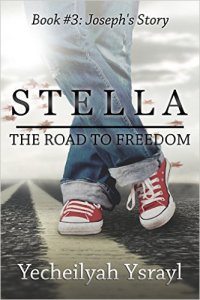
And don’t forget about The Stella Trilogy Spring Giveaway! Enter for your chance to win an autographed paperback copy of The Road to Freedom and the other two books in the series! Between Slavery and Freedom and Beyond The Colored Line!
Check out these 5 common writing mistakes! I’m so guilty of #3! Thanks to one of my dear review buddies, I was made aware of this and am now able to watch carefully of jumping into people’s heads. I mean, how does Sally know what John was thinking? lol
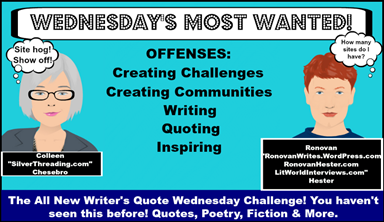
Welcome back to another episode of Writer’s Quote Wednesday Writing Challenge. As you may notice, I have decided to go back to the traditional WQW for now. You can imagine my excitement when Colleen stated this was OK. If you can’t imagine it, below is my happy dance:
Yecheilyah’s Happy Dance
OK, to the point.
My inspiration today comes from James Baldwin:
“All art is a kind of confession, more or less oblique. All artists, if they are to survive, are forced, at last, to tell the whole story; to vomit the anguish up.”
― James Baldwin
I love Baldwin’s last line “Vomit the anguish Up”. At first I thought about struggle literally but then I thought about writing and combining the two. This got me thinking about the struggle of writing and struggles incorporated into writing. This lead me to Baldwin’s quote. It still has me pondering, but what I got out of it for now is how each artist, writer in this sense, have a responsibility to tell the truth and in so doing have the courage to speak whatever struggle that truth reveals. This struggle can be historical, personal, or emotional but at some point a writer has to dig deep. I think this is because good writing is about the struggle and how said struggle has been survived. It could be the villain’s survival, the heroes survival, or the writer him / herself. Why? Well, that’s real life. Struggle makes people strong. Where is the overcoming if not for the struggle?
“James Baldwin — the grandson of a slave — was born in Harlem in 1924. The oldest of nine children, he grew up in poverty, developing a troubled relationship with his strict, religious stepfather. As a child, he cast about for a way to escape his circumstances. As he recalls, “I knew I was black, of course, but I also knew I was smart. I didn’t know how I would use my mind, or even if I could, but that was the only thing I had to use.” By the time he was fourteen, Baldwin was spending much of his time in libraries and had found his passion for writing.
During this early part of his life, he followed in his stepfather’s footsteps and became a preacher. Of those teen years, Baldwin recalled, “Those three years in the pulpit – I didn’t realize it then – that is what turned me into a writer, really, dealing with all that anguish and that despair and that beauty.” Many have noted the strong influence of the language of the church, the language of the Bible, on Baldwin’s style: its cadences and tone. Eager to move on, Baldwin knew that if he left the pulpit he must also leave home, so at eighteen he took a job working for the New Jersey railroad.
After working for a short while with the railroad, Baldwin moved to Greenwich Village, where he worked for a number of years as a freelance writer, working primarily on book reviews. He caught the attention of the well-known novelist, Richard Wright – and though Baldwin had not yet finished a novel, Wright helped him secure a grant with which he could support himself as a writer. In 1948, at age 24, Baldwin left for Paris, where he hoped to find enough distance from the American society he grew up in to write about it.
After writing a number of pieces for various magazines, Baldwin went to a small village in Switzerland to finish his first novel. Go Tell It on the Mountain, published in 1953, was an autobiographical work about growing up in Harlem. The passion and depth with which he described the struggles of black Americans were unlike anything that had been written. Though not instantly recognized as such, Go Tell It on the Mountain has long been considered an American classic.”
************
That’s it for me. I hope you enjoyed this weeks Writer’s Quote Wednesday Segment. Until next week, yall be great.
As it happens, you’re actually thinking about writing. Your tummy feels nervous with excitement and your thoughts scatter ideas across your mind like Webster’s online dictionary. Now, everything is scatter brains and racing blood and completely unorganized but you do know that something’s there. Or at least you think you know. And then it happens. A title. A headline. A poem. A short story. A blog post. Wait? Which is it? You don’t know! Nonetheless, a theme, a topic, a spark of interest squeezes through the ziggly lines in your mind and makes it to the front. Your heart is beating loudly as you scramble for pieces of paper and an ink pen before throwing open the laptop. Yes, home sweet home! There they are: the letters you’ve been looking for! Here you are. You pick up that pen and notepad, that cell phone, that tablet, you wait patiently at the keyboard of the laptop. This is all so exciting! And then it happens. Silence. Nothing comes.
Not a word. You wait. And you continue to wait for an explanation. You stare angrily at the page and beat your fingers against the keys. You search for those ideas over and over again to try to convince yourself you have something. You close your eyes tight praying for a line, just a line! But nothing comes. And then alas, you close the program, shut down the computer, or simply throw the notebook at the wall. Yes, the whole thing. You crumble the paper into a ball, you throw that too before wiping away the tears. No, you’re not crying, you’ve just been at the computer too long and your eyes are all watery and tired as if you’ve done some work. That angers you. You got nothing done and you go to bed angry. This is when writers block has truly set in. Your husband / wife comes in, “Bae, what’s wrong?” You throw them a scowl. “What?” You snap back with attitude. “How dare he / she ask me what’s wrong!” You are out of control. Frightened. Scared. You need air. A relief. A pill. Do they have prescriptions for this?
Social Media has become a glossed over, cloudy place. It is filled with fake persona’s and instant celebrities. People post pictures of their cash and checks on Instagram for instance (something you’ll never see Bill Gates do. Let’s be real, people who make real money are quite about it. Big boys hit hard but move silent) and weigh their worth against the backdrop of numbers and likes. Instead of focusing on the message we have focused instead on the computer screen and have invested instead, not in the voice, but in the marketing and promotional schemes of so called professionals who get rich off the backs of those of us too lazy to be ourselves. Research is all fine and good but what it boils down to is a nice balance between research, advice, and your overall message and the people who care about what you have to say. If you rely too much on research and professional input then you just may miss the message.
A message doesn’t have to mean a religious message. If you have a voice, which we all do, then you have a message. We can define a message as:
When someone writes a book they are sending a message out into the world. It doesn’t really matter what the book is about, every book has a message because every book has a voice. And just like every person with a voice, we all have different sounds and calls to action. Sometimes, we get so into the online aspect of writing that we forget about how important the message is. It is not the marketing plans that will bring readers to you. Though they surely help, ultimately its your message. It’s your voice. Do you have one? That is what will determine your readership.
“Focus on what makes you different, what makes you unique. Being true to yourself is a cliche for a reason — it works. People don’t want to connect with something fake. They want to feel understood and heard, and the only way you do that is honestly and authentically. The last thing you want is to showcase to the world a shadow of your true self.” – Curiouser Editor
What do you want to say to the world? Why does it mater? Why is it different than what the previous person has already said? The sky is blue. Why is the sky blue? Why is it important for us to know that the sky is blue? Is the sky blue?
People who agree with you will flock to you because you sing in a key similar to their own. They are the people who actually want to read your books and who will in turn support your work. The only way to do this, as Curiouser Editing has stated, is to showcase your real self in your writing but not just in your writing, in your overall social media presence.






 The PBS Blog