Joy Lived Here Too

My husband’s cousins came over to get some Italian Beef meat we brought back from Chicago. We had frozen it for them. They stayed for hours, most of the time comprised of us sitting around the table catching up. Although we have been married for almost 14 years, there are still family members of his I am meeting for the first time.

“So you’re from Chicago too?”

“Yes. I grew up in Robert Taylor…”

His wife, the cousin, tilted her head, her eyes widening, “Really?”

“You know how to fight then huh?” The husband says, shaking up with my husband, “You gotta know how to fight growing up in Robert Taylor!”

I laugh with them, but my spirit settles into uneasiness. I don’t want to talk about me anymore. We changed the subject.

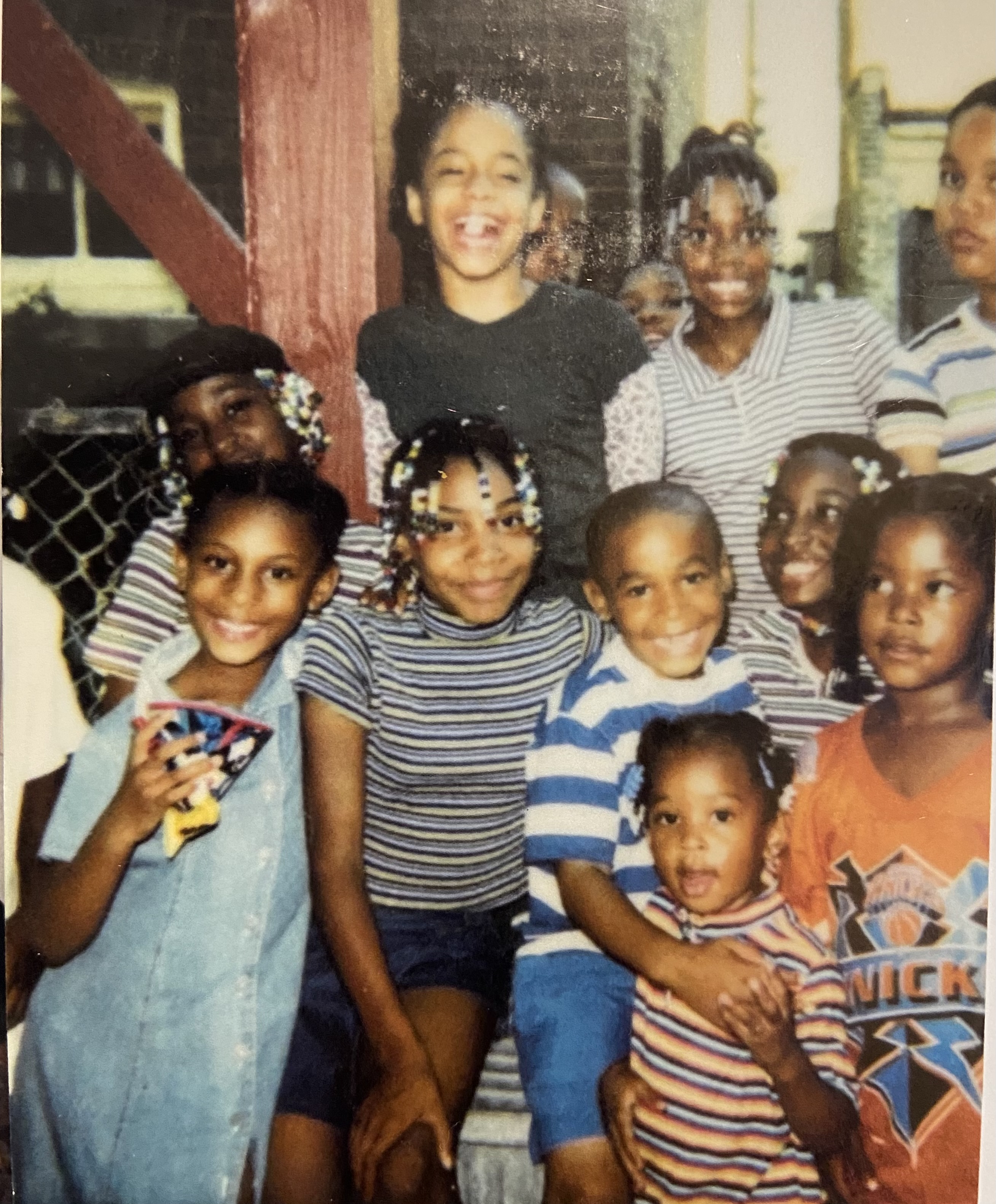
Lil R’s Bday Party. Can you find me in this pic??

People are baffled to discover I grew up in Robert Taylor, and they don’t know what to say. Even those who try to form words still end up saying something that sounds like “sorry.” They look into my eyes as if they can see what I see. They want to know how someone as educated and “put together” as myself grew up in the place their mothers have warned them to stay away from.

But, we were not aliens living on a different planet. We were people, Black people, and where there are Black people, there is joy to be found somewhere. When the first of the month hit, we took advantage of the glints of light that seeped in to offer a reprieve to our distress.

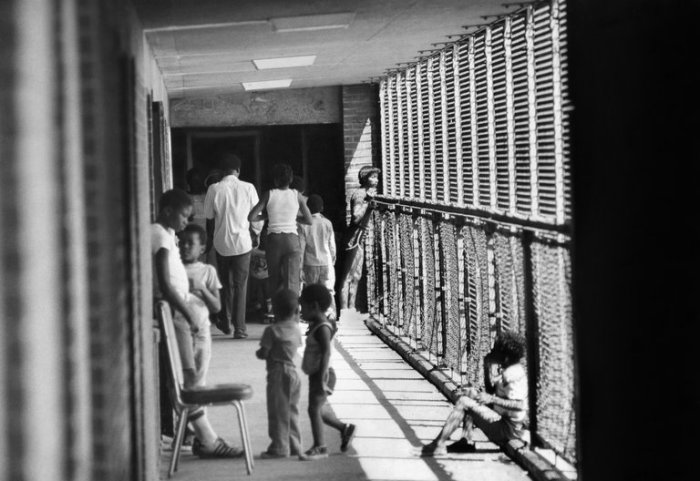
Women sat on the porch laughing and gossiping as their sheets dried on the gates, and children ran back and forth, bellies full of food and hope.

The men and hustlers brought out tables and chairs they carried downstairs to play spades in front of the building. You couldn’t tell them they weren’t sitting on their own front porch instead of in front of a 16-story government building. They talked smack and poured out liquor for the homies they lost.

As for music, it was our salve and savior.

We left our doors and windows open so that the music from the stereo could scream and echo throughout the building. Nobody protested when someone’s entire door was open, and music was blasting. We sang along to Whitney Houston, Mary J Blige, Tupac, Biggie, Queen Latifah, MC Lyte, and many more, grateful for the opportunity to hear these songs while they were young.

Music transformed our pain into power. It didn’t feel like we lived in the ghetto when cousin Rachel blasted The Fugees from her speakers. It simply felt like home.

Where despair tried to rob us of joy, creativity flourished, and we created our own fun, and I think it’s important to talk about this light, too. It wasn’t all gangs, crack addicts, and shootouts.

Joy lived here too.

Dancing Between Two Truths

Photo by Pixabay

I get emotional when I remember the faces of the children I used to teach, who are now young adults. Their formerly round and babyish faces have thinned out to resemble those of young adults. They provide concrete evidence of the passage of time. My nieces, nephews, and students are now in college, studying a trade, dating, and even starting families.

It serves as a sobering and bittersweet reminder of how fleeting life is. How quickly the years fly by. I see their bodies as proof and imagine all the years tucked inside them. I cry happy and sorrowful tears as I watch them grow. I weep both for the lovely persons they are, and for the perilous and cruel world they must endure as they grow up.

I will be thirty-six next month, and after two ectopic pregnancies, a miscarriage, and the removal of my right Fallopian tube, I may not have any children of my own. I have come to both accept and mourn this. I experience thanksgiving and contentment for my life and everything I’ve accomplished, with no sense of the need for anything more. And also a sense of loss for what never was and possibly, could never be.

But then, I look out into the world, see the children wilding in downtown Chicago (I find it interesting the usage of this term by the media, “wilding.” It is the same term used against the five young black boys on this day in 1989 accused and charged with raping the white woman jogger in New York’s Central Park), and see the protests over the shooting of Ralph Yarl, who though he lives, has become yet another hashtag.

And I ask myself, which is better, giving birth to a son or watching that son heal in the hospital after being shot in the head for ringing the wrong doorbell?

Which is better, knowing what it’s like to give birth or knowing what it’s like to mourn the death of a child?

And I dance between these sentiments as I look into the faces of these little ones. I remember them as children, full of innocence, and now see them as young adults, wide-eyed and excited to live in a cruel world.

Freedom Ring – Part One

Photo by Ron Lach from Pexels

The Train

Louis pulled the olive-drab wool service cap down as far as it could go. Why he was hiding his face, he didn’t know. It was not like anyone could see him. Louis’s heart fluttered. After all these years, even the thought of her made him blush. His excitement was quickly replaced by sorrow. He had not been the best husband. Maybe if he were, she would not have asked for that restraining order, he would not have joined the Army, and the terrible future he knew was coming would not happen.

But Louis was on a mission, so now he couldn’t think about that. Life was funny in that way. Sometimes you don’t realize your purpose until after you have already lived.

The scream of the train’s horn startled him out of his thoughts. The 63rd Street Station in Chicago was lively, with travelers. He looked down at his watch as the train’s horn sounded again. They will be here any minute now.

“Now, where do you think you are going?”

Louis looked up and smiled. That tiny voice and round, golden-brown face always did something to him. Then, she had the nerve to have those sexy glasses on. But Mamie wasn’t talking to him and had not spoken to him in years. No, Mamie Carthan was talking to their son.

Louis stopped thinking about her beauty and rushed over to stand next to them. There was not much time left, and although he knew neither one could see him, the whole situation still made him nervous. Nerves. Was that even a thing anymore? Louis brushed imaginary lint from his wool, four-button olive coat. It was the same coat he had been wearing for ten years now. The same uniform he has worn since he died.

“Come on, ma. I’m gonna be late,” whined the chubby little boy.

Louis smiled. He knew Emmett would be a handful the day they discovered he was a breech baby. That’s why he gave him his name because he knew he’d be hard-headed, just like his father. Emmett Louis Till. Bursting into the world wide-eyed and feet first.

“Yea, but you didn’t kiss me goodbye.”

Emmett smiled and gave Mamie a peck on the cheek.

Give her the watch.

Louis cleared his throat. He hadn’t realized how long it’s been since he had said anything out loud. He looked around at the people walking by. It was strange the way they seemed to look right at him.

Give her the watch. 

He repeated the command as he stared down at his son.

You won’t need it where you are going.

He could see the boy thinking the words over in his head. He knew he thought they were coming from his own mind. Louis had come to learn that sadness was different in the after-world, but if he could, he would shed a tear. He stood watching his son remove the watch he was wearing and give it to his mother, and his heart ached at the future.

“Here,” said Emmett, “take my watch.”

Mamie frowned as she put it on, “Why?”

“I won’t need it where I’m going,” he said, turning his back to his mother and dashing off in the direction of the train where his cousin Wheeler and great Uncle Moses were waiting.

“Bobo, wait! What about your ring?”

Louis turned away from Emmett to look admirably at his ex-wife. She was the one and had always been the one. He thought she was chosen for him to be his wife this entire time. But the truth is she was chosen to be Emmett’s mother.

He pulled himself away from her face. He was running out of time. Emmett had to be on that train.

Show it to the fellas.

Emmett turned around and pulled the ring from his pants pocket, and put it on, rubbing his fingers across his father’s initials. He lifted his head and stared straight ahead, like someone who had just discovered a new world or happened upon a new invention, and flashed a big grin.

“I’m gonna show this to the fellas!”

Mamie laughed and waved her handkerchief.

“Alright then, boy. Go on ahead now.”

Louis watched his son jump on the train and Mamie staring after him. He remembered the day he got the thing made in Europe, just one year since he had been drafted into the Army. But it was not his ring anymore. Soon, the whole African American community would wear that ring. 

No. This was no longer LT’s ring. Now, it was the ring of freedom.

The quietness of the station alarmed him, and Louis looked around in awe of the now dark, empty station. The Master warned him that time moved differently here. He had better get a move on it if he was going to make it to Money in time.

Louis inhaled deeply as his body disintegrated into the wind for his next mission.


After watching ABC’s “Let the World See” about the role of Mamie Till and how she handled Emmett Till’s death, I was happy to see some discussion about Emmett’s father, Louis. Since grade school, I have been studying the Emmett Till story, when I first learned about it, heard many versions of the story, and have seen countless documentaries. My favorite is the one that aired in 2005, “The Untold Story of Emmett Louis Till,” on YouTube. I like it mostly because Mamie Till was still alive and could tell it the way only she could.

But in all the docs, even my favorite one, there was never anything about his father. This had me thinking.

What if we tell both of their stories at the same time? 

Louis Till died at the young age of twenty-three when he was accused of assaulting some Italian women in Europe while serving overseas in the Transportation Corps of the U.S. Army during World War II. He and a friend were found guilty and lynched in 1945. 

What if our story doesn’t end here? 

What if the spirit world informs Louis about his son’s death and its necessity to jump start The Civil Rights Movement? 

And what if it becomes Louis’s responsibility to make sure Emmett wears his ring so that they can identify his body? 

And what if his soul isn’t allowed to rest until he does? 

What if we can tell both stories through the power of the ring that binds them?

No Whining Wednesday – We Are Each Other’s Harvest

NWW(1)

Welcome back to another episode of No Whining Wednesday! Today, you cannot whine, criticize, or complain.

If you are new to this blog or new to this segment please visit the NWW page here for past episodes.

This week, I kept thinking about teamwork, network, and community. As such, I was inspired by the following quote from Gwendolyn Brooks.

IMG-4242I did something different this week. I asked my audience on Instagram what the quote meant to them. This was part of my quest for us to be each other’s harvest. As a result, I got a lot of good feedback, and I want to share some of it with you.

But first, a little history:

Gwendolyn Brooks poem from which this quote derives is about the Black singer, and activist Paul Robeson. In fact, the poem is called Paul Robeson.

“The poem from which the text ‘we are each other’s is drawn is one example of Brooks’s commitment to civil rightsa poem she wrote in testament to Paul Robeson. Robeson was a Black actor and activist, a famous baritone who was blacklisted during the McCarthy era for his political commitments. Brooks celebrates his leadership at his death writing, “That time, we all heard it…The major Voice. The adult Voice…warning, in music-words devout and large that we are each other’s harvest: we are each other’s business: we are each other’s magnitude and bond.”  – Interfaith Youth Core

Gwendolyn Brooks was a poet whose family moved from Topeka, Kansas, to Chicago during the Great Migration, the massive movement of Blacks from the south to northern cities. Brooks loved Chicago, as I do, and she drew on her experiences in the city to tell the stories of Black urban communities. Brooks called Chicago her “Home Base.”

“We are each other’s
harvest:
we are each other’s
business:
we are each other’s magnitude and bond.”

Gwendolyn Brooks lived these words, becoming the first Black Pulitzer prize winner, the Poet Laureate of Illinois, the Poet Laureate Consultant for the Library of Congress, and the first African American woman to be inducted into the American Academy of Arts. She also dedicated time to teaching the next generation of artists in Chicago.

We Are Each Other’s Harvest

In farming, a harvest is a season for gathering crops. (Come on, Queen Sugar fans) One of the reasons I felt this was such a powerfully timely quote is because Fall is harvest season:

“Harvesting is the process of gathering ripe crops, or animals and fish, to eat. While not all crops are ready for harvest in the Fall, apples, winter squashes like pumpkins and acorn squash, and potatoes are!”

– American Farm Bureau for Agriculture

If we are each other’s harvest, we nurture one another. In that spirit of collaboration, we can illustrate the lyrics of this poem by supplying one another with the strength we gather from the positive words of others.

That’s what No Whining Wednesday is about, working together to cut down on our complaints and criticisms by adopting a spirit of gratitude and thankfulness.

Here are some of my favorites from the post, and I would love to hear what you think of the quote as well!

Take it away, guys!

IMG-4243

IMG-4245IMG-4248

Black History Fun Fact Friday – Dr. George Cleveland Hall

This week, I spoke briefly on Dr. George Cleveland Hall, for whom the Hall Public Library in Chicago is named. I talked about the Hall Branch as the place I got my first library card and all the historical things I didn’t know that happened there. To read this post, click here.

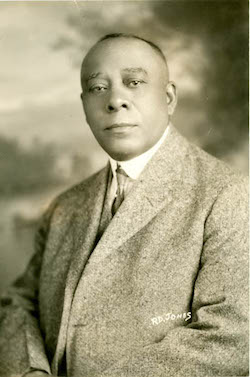
Today, we are digging a little deeper into this man’s background, Dr. George Cleveland Hall.

As I dug into his story, I found Hall was a pretty big deal, and I am surprised there isn’t more information on him because this man was phenomenal and a significant influence on Chicago.

Dr. George Cleveland Hall was born on February 22, 1864. Not only was Cleveland a doctor, but he was also head of the Urban League and “one of the five founding members and the first president of the Association for the Study of Negro Life and History (ASNLH), currently known as the Association for the Study of African American Life and History (ASALH).” (William Smither)

In 1886, Hall graduated from Pennsylvania’s Lincoln University and studied medicine at Bennett Medical College and in 1896 graduated from Harvey Medical College.

Cleveland was a surgeon at Provident Hospital, the first private hospital in the state of Illinois to provide internship opportunities for black physicians, the first to establish a school of nursing to train black women, one of the first black hospitals to offer postgraduate courses and residences for black physicians, and the first black hospital approved by the American College of Surgeons for full graduate training in surgery.

Okay, Chicago!

George Cleveland Hall
Public domain image

In 1911 Cleveland founded the Cook County Physicians’ Association of Chicago, the organization of black doctors in the city.

But Dr. Hall’s significant influence on Chicago was not just about his expertise in the medical field. He is actually most known for his civic duty and grassroots work. In 1915, he joined Carter G. Woodson and others in the founding of the ASALH at the Wabash YMCA in historical Bronzeville.

Just wow.

I cannot believe I have not heard of Dr. Hall before. His contribution to black history and medicine is groundbreaking. He is right up there with Carter G. Woodson and then some. Hall also had a close relationship with Booker T. Washington.

Cleveland received two honorary degrees, one from Lincoln University for Doctors of Laws and another from Howard for Doctor of Science. He became the first black Chicagoan appointed to the board of directors for the Chicago Public Library.

Dr. George Cleveland Hall died at sixty-six in 1930.

On January 18, 1932, Chicago city officials dedicated the George Cleveland Hall Library to Dr. Hall, the first full-service library on the city’s Southside.

This is the same library where I received my first library card.

Yass.

For More Black History Fun Facts, click here.

No One is You And That is Your Power

Langston Hughes and Gwendolyn Brooks at Hall Branch Library, Chicago, IL, 1949. Credit: George Cleveland Hall Branch Archives, photo 146, Vivian G. Harsh Research Collection.

I still go to libraries.

I got my first library card at the Hall Branch Library on 48th in Michigan on Chicago’s south side. I was thirteen years old and still needed my mother’s signature. I wasn’t into Black History back then. I chose this library because I wanted to check out books, and it was down the street from my grandmother’s house.

Here’s where it gets interesting.

Dr. George Cleveland Hall

Yesterday, I discovered Hall Branch was named for the renowned African American surgeon, social activist, and civic leader Dr. George Cleveland Hall (1864-1930). It was the first Chicago Public Library location with a Black branch manager, Vivian G. Harsh, who served as its first manager. We will get deeper into Hall’s background on this Friday’s Black History Fun Fact, the last one of the year.

In 1949, Langston Hughes and Gwendolyn Brooks visited the Hall Branch to celebrate the publication of The Poetry of the Negro Anthology.

On July 7, 2000, the Friends of Libraries USA (now United for Libraries) and Illinois Center for the Books designated Hall Branch as a literary landmark. This was in recognition of its promotion of African American literary culture by serving as a meeting place for such writers as Arna Bontemps, Gwendolyn Brooks, Lorraine Hansberry, Langston Hughes, Zora Neale Hurston, Claude McKay, and Richard Wright. (Learn more about the Chicago Renaissance of the Black Belt Here).

I thought I had picked this library at random and for no particular reason. I had no idea it was so rich with Black History or that it was this hub for Black writers.

This helped me to see how unique each of our journeys are. No one has walked in your shoes or experienced what you’ve experienced. No one is you, and that is your power.

Everything is a stepping stone to get us to the place Yah has destined for us, every path like a thread weaving and connecting everything together.

It would be years before I learned who Langston Hughes and Gwendolyn Brooks were, and many more years before I would publish a collection of poetry of my own.

Little did I know I was building on the same foundation as those who came before me.

Talk about the power of purpose!

Also, I still got that library card!


Have you read My Soul is a Witness? I am striving for 20 book reviews at minimum before the year is out. If you read this book, I would appreciate so much if you reviewed it! Go to the page here. Scroll down to Write Customer Review, click that, rate and review. Boom. Done.

Thanks!!

My Memoir Writing Journey

What exactly am I working on now? A lot of things but mostly my memoir. Now that Keep Yourself Full is on its way out, I want to get this done and I will have to deter a lot of projects to do it. At least until I finish the first draft and then I can work on other stuff and just work on the memoir from there. (I will still revise The Stella Trilogy first and release my next collection of poetry).

This is the hardest writing job I’ve ever undertaken. I have deleted everything I ever sent my email list as a sneak peek two years ago (can’t believe I let you in on that *insert eye-ball roll*) and have started over. I am fifty pages and nine chapters into the first draft so it’s not so bad considering starting over. What I don’t want this memoir to be is an autobiography. I’ve always wanted to write an autobiography, but that’s before I learned the difference between the two.

I learned memoirs differ from autobiographies. Memoirs are popular because they center on one theme and read like novels, making them much more interesting than the chronological format of the autobiography.

Theme

One thing I am working on is not making this psychoanalytic if that’s the right word. While I’ve endured much trauma in my life, I don’t want this to be a dark history of my crazy. I don’t want this to be a therapy session. This is difficult because I’m not a sugarcoat type person and neither is my mother. I gotta keep it all the way real. I gotta be honest. How do I do this without going too far?

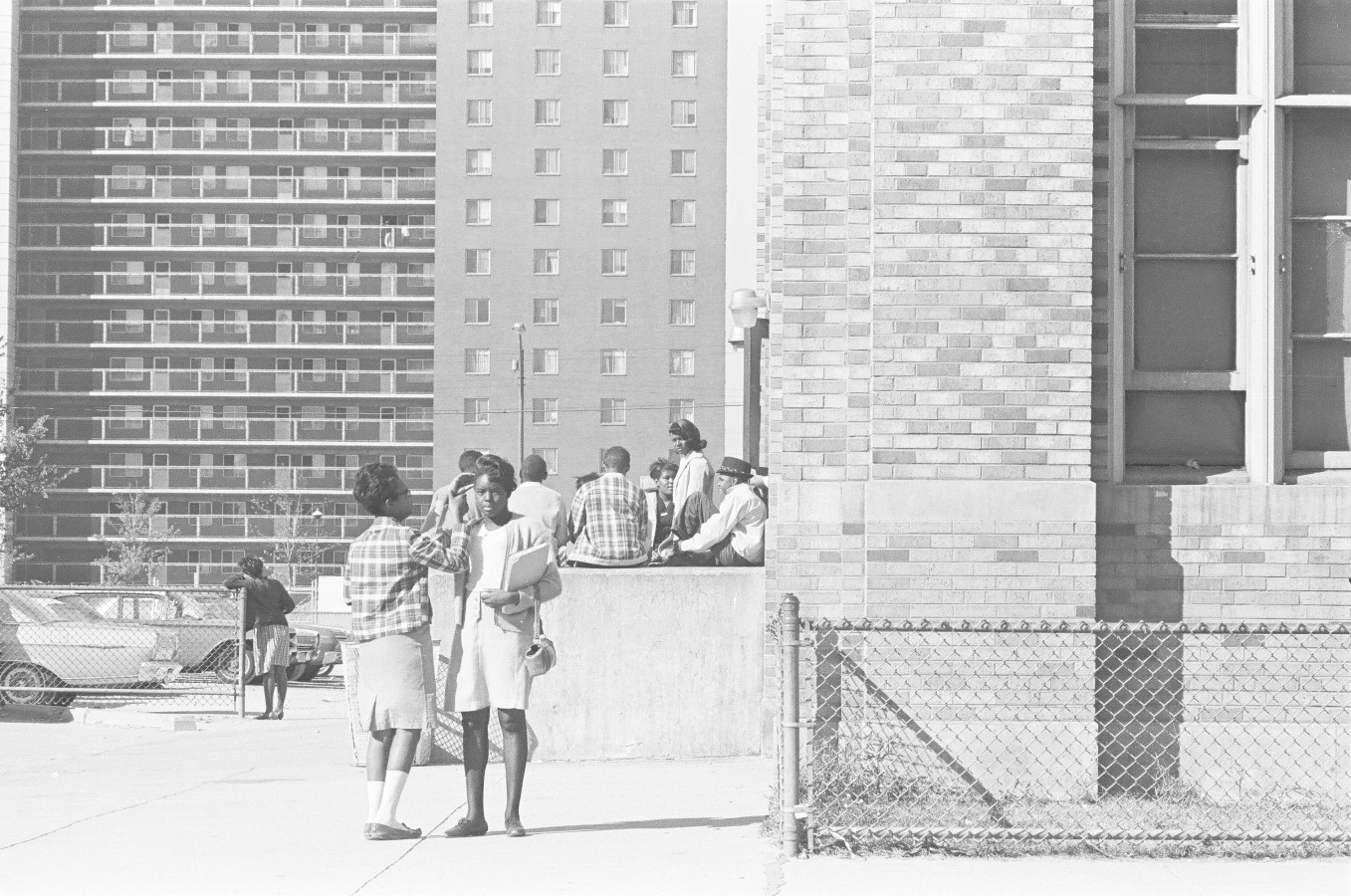
My title is “I Wasn’t Built to Break,” so my theme is to take all the things that have been obstacles and challenges in my life, that could have broken me physically, mentally, and emotionally, but didn’t. This means that I will not go into every single detail of my life but I will focus on certain significant events, starting with growing up in the Robert Taylor Projects.

Anyone who grew up in any of Chicago’s projects is a survivor in my eyes, a warrior. It meant they not only escaped the drugs, violence, poverty, neglect, and gangs, but they also escaped literal death. Perched above the high-risers of Robert Taylor and Cabrini Green, snipers (aka Gang Members) with high-powered rifles would sit on a top floor (in a vacant apartment) and shoot their rivals. These bullets though, often hit innocent bystanders, mostly children.

I remember my Uncle coming to school to get us early because the buildings were shooting, and we had to run to our building. When I say it was a Warzone, I mean that literally. And none of us project kids ever got counseling or therapy for the things we saw. Not even the classmates of the seven-year-old Dantrell Davis from Cabrini who was shot by a sniper on his way to school in 1992 in front of his mother, teachers, police officers, and classmates.

Historical

Writing a memoir is no easy task so my approach is to research and write this as if I am writing a historical novel. Since I enjoy writing Historical Fiction, I want to incorporate history into my testimony. Instead of focusing on my experiences only, I want to take us back into the politics of some of what was going on in the world I did not have knowledge of as a kid. There’s my world where I can only see what’s in front of me and around me and then there’s the world at large. How did the decisions of others affect me, one of 21,000 children growing up in what became known as one of the poorest urban communities in the United States, a concentration of poverty they called it?

I want to go into how the projects under the Chicago Housing Authority (CHA) replaced the Chicago Slums, the discriminatory policies like redlining that kept blacks from purchasing homes in their own neighborhoods, the kitchenettes and one-room basements blacks lived in during the 30s, 40s and 50s, the beacon of hope the projects promised as a replacement, the mixed-community that was there (because whites and blacks both lived in the PJs!), the racial riots that never made the news, and the racist policies that caused many white families to move out of the projects and into the suburbs.

And what about the Plan for Transformation that demolished Public Housing and replaced them with a mixed-income community of condos and townhomes? What did this cultural mix mean for former public housing residents? And who was Robert Taylor? The black man on the board of CHA who opposed building the projects on the same land as the slums? The black man who wanted to spread the buildings out, so they fully integrated blacks throughout Chicago and who, after CHA refused, quit. I hope that if I do this, it will be a much enjoyable read.

I want to incorporate both history and personal testimony with the testimony supporting history. I remember for instance that whole “Homie the Clown” Scare of the early 90s. I remember that because I had nightmares of the clown coming into our apartment and chasing me around the couch. In 1991, rumors surfaced that a man who we called “Homie the Clown” was riding around in a van kidnapping and killing kids.

“Homey the Clown,” was the name of a character played by Damon Wayans on the early 90s sketch-comedy show In Living Color. The character was an angry black ex-con who carried a sock for knocking bad kids upside the head. His catchphrase was “Homey don’t play that.” Our “Homie the Clown” was allegedly dressed as a clown and went around kidnapping kids. Rumors said that he rode in a van and liked to stand next to mailboxes eating bananas.

This sounds silly now, but it was serious back then, just like the recent clown scares. We got let out of school early and children were afraid to walk by mailboxes. It also didn’t help that Stephen King’s IT had also just come out.

Community

It wasn’t all bad though so I want to talk about the close-knit community that existed there too that never made the news. Generations of families grew up together in what is rarely seen today. My mother’s friend, who lived next door, helped her to babysit. People watched one another children, shopped together, stepped up when someone was in need and shared food. We could go next door or downstairs to ask if someone had sugar or flour. We bartered services and passed along information about job openings or what was new at the Aid office and the candy lady was an entrepreneur. She used her food stamps to open a candy store back when you can get one piece of candy for every penny you had, better known as Penny Candy. People threw house parties and sleepovers.

Robert Taylor was not just a concentration of poverty. It was also a thriving community. When things were good, they were really good, and everyone was family. But you didn’t see this on the news. We were not all crack babies. We were not animals.