MSN Reports: “These twins can teach us a lot about racial identity”

As many of you already know, I also happen to be a twin. So naturally, I was drawn to this story. Racial identity also happens to be the central theme of the short story series (Stella Trilogy) I’m writing, each part surrounding a person’s search for identity, knit together by the same blood. Book #1: Between Slavery & Freedom is available now on Amazon, B&N, Kobo, Lulu, iBookstore, etch. In the meantime, check out this article.

BBibCwu.img
© Provided by Vox.com Lucy and Maria Aylmer as children (YouTube)

MSN News Article:

“There’s a set of biracial twins in the UK who are turning heads because one is black and the other is white.” That’s how the New York Post introduced a profile of Lucy and Maria Aylmer, 18-year-olds whose father identifies as white and whose mother is “half-Jamaican” (and, we’re to assume, thinks of herself as black).

It’s just the most recent story of fraternal twins born with such dramatic variations in complexion they’re seen by many — and even see themselves  — as members of two different racial groups.

Each of these situations and their accompanying striking images, is a reminder of how fluid and subjective the racial categories we’re all familiar with are.

What “black and white twins” can teach us about race: it’s not real

Lucy and Maria’s story, and all the other sensational tales in the ” Black and White Twins: born a minute apart” vein are actually just overblown reports on siblings who, because of normal genetic variations that show up in more striking ways in their cases, have different complexions.

But they’re fascinating because they highlight just how flimsy and open to interpretation the racial categories we use in the US and around the world are.

Even the Post’s description of the Aylmer twins is clumsy, asserting that they’re each “biracial,” but stating in the very same sentence that one is white and the other is black.

And the fact that the two, despite having the same parents,  see themselves as belonging to two different racial groups ( “I am white and Maria is black,” Lucy told the Post) proves that there’s a lot more than biology or heritage informing racial identity.

It’s a reminder that the racial categories we use are fickle, flexible, open to interpretation, and have just as many exceptions as they do rules when it comes to their criteria for membership— that’s why they have been described as “not real,” meaning:

  • They’re not based on facts that people can even begin to agree on. (If we can’t even get a consensus that people with the same parents are the same race, where does that leave us?)
  • They’re not permanent. (If Lucy decides one day, like many other people with similar backgrounds, that her Jamaican mother is black and therefore, so is she, who’s to stop her?)
  • They’re not scientific. (There’s no blood test or medical assessment that will provide a “white” result for Lucy and a “black” one for Maria.)
  • They’re not consistent (Other twins with the same respective looks and identical parentage as these twins, might both choose to call themselves black or biracial.)

“Not real” doesn’t mean not important

Of course, none of this changes the fact that the concept of race is hugely important in our lives, in the United States, in the UK where the twins live, and around the world.

There’s no question that the way people categorize Lucy and Maria, and the way they think of themselves, will affect their lives.

That’s because, even though race is highly subjective, racism and discrimination based on what people believe about race are very real. The racial categories to which we’re assigned, based on how we look to others or how we identify, can determine real-life experiences, inspire hate, drive political outcomes, and make the difference between life and death.

But it’s still  important to remember that these consequences are a result of human-created racial categories that are based on shaky reasoning and shady motivations. This makes the borders of the various groups impossible to pin down — as the “black and white” twins demonstrate — and renders modern debates about how particular people should identify, futile.”

Photography

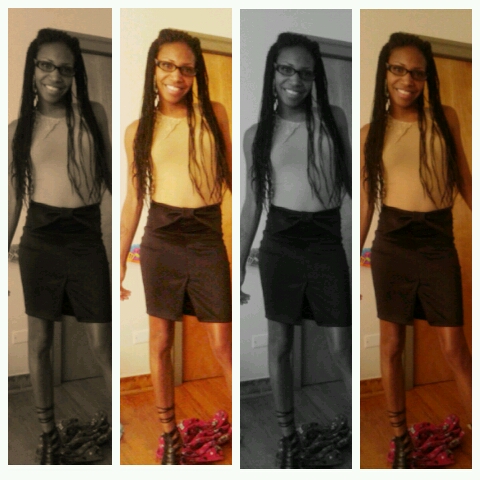
My beautiful sister Pamela
My beautiful sister Pamela, Photo by EC

Honestly, I can’t teach your ways to anyone, nor do I know much about you. I don’t talk about you a lot either, or cough up revelations about how I came to enjoy the way your eyes capture and then freeze our lives. I do remember however our first real encounter. It was the 11th grade. Mrs. Luno coupled us for the school yearbook, and we walked the hallways of Harper High School like we had been together for years. You wrapped your arms around my neck and let my pupils kiss your face. Together we recorded, froze, and transformed time into memory. We followed Jesse Jackson and Arnie Duncan through interviews and meetings. You even let me choose what to see and hold you in my arms during assemblies, plays, and basketball games. Letting me control the way your body felt in my hands, and in seconds we created images both tangible and symbolic; both real and fantasy. It was the first time I came to appreciate this kind of relationship with technology. We had so much in common: Your shutter and my pupil, your film and my retina, and our capacity to record the past; your memory card, and my brain. I still don’t completely understand you, but goodness, don’t I love holding the camera!

Guest Feature – Touched by an Angel

51WE8W9CKFL._SL500_AA300_

We, unaccustomed to courage
exiles from delight
live coiled in shells of loneliness
until love leaves its high holy temple
and comes into our sight
to liberate us into life.

Love arrives
and in its train come ecstasies
old memories of pleasure
ancient histories of pain.
Yet if we are bold,
love strikes away the chains of fear
from our souls.

We are weaned from our timidity
In the flush of love’s light
we dare be brave
And suddenly we see
that love costs all we are
and will ever be.
Yet it is only love
which sets us free.

Touched by an Angel – Maya Angelou

Writer’s Quote Wednesday – Love Is

So as I pondered what to present this snowy Wednesday morning (Yea, you heard it right, it’s snowing in Louisiana again in February, insane. Thought I left this in Chicago, but I digress). I decided to switch it up this week with a song. Today’s Writer’s Quote Wednesday is Jah Cure’s Love is:

Love IsThis song is all about the quote:

“Love is the answer for every question”

We walk around here with our Bachelor Degrees and fancy titles. We hold forums on the state of the world. Everything from poverty, to racism, to religion. We cough up varied professional reasons why the world is the way that it is. As a result to these reasons more questions spring from our natural yearning for truth and for understanding. Some of us profit from these dictionary type languages we hold with one another, professed scholars and philosophers. Self-made experts in the field of such and such, and a how-to book that promises to give you the answer to the question of your existence and how to perfect your life. All of this and yet the answer lies in the simplicity, yet depth, of one word: Love.

It is no secret that the physical is a manifestation of the spiritual. And as the snow falls this cool Wednesday morning I am reminded that the hearts of men are just as cold. But love. Love is the heat with the potential to melt the wicked from the foreskins of our hearts, and so that we may feel again. It is the answer to every question, every solution, and every situation that exist. The world has grown cold because the world is void of love. It is the umbilical cord that connects us to our creator and all of creation and yet it is missing from our lives. Indeed, this powdery morning I am reminded that Love, Is.

writers-quote-wed-20151

Don’t forget to check us out every Wednesday for exciting quotes (and songs!) as part of Writer’s Quote Wednesday, hosted by  Silver Threading.

Self-Publishing Questions?

46-FE3-Self-Publishing

Do you have Self-Publishing or Poetry Questions for The PBS Blog?

Send me your emails at ahouseofpoetry@gmail.com and I will answer them live on my blog. Be sure to send me your contact information so we know where to find you. In the meantime, let’s take a look at our first question:

“As a Self-Publisher, do you think it’s worth it to try to get your books into the bookstores?”

In my opinion, No.

Put it this way: A Self-Publisher is a manufacturer. Bookstores are retailers. In the end I suppose it’s about one’s individual definition of success, but in truth, brick and mortars like Wal-Mart may get you the attention you need and the popularity, but you make more money distributing your books yourself even if its by way of POD publishing. You may not exactly be “making it rain”, but you have the potential to receive a royalty check for the number of books you sold. And naturally, the more books you produce, the more money you have the potential to make. You’ll get royalties from every book every month depending on which ones sold and how many of them sold the month prior. My advice is to simply skip the bookstore thing because everything is online. Just write and do some online self-promotion. There is however an offline community. But they can be driven to your electronic shelves in a number of ways (radio interviews, local newspapers, book signings, speaking events, etc.). Another way to consider, is to try to get your books into the libraries and into the  Schools  instead of the book stores. I say Library not necessarily for the money. I say the library because although everything is online, the offline community is still very much active in the libraries. Not only are computers available, but they have access to hundreds of books freely with a Library card and they can request your book if they know that it exists. That’s the focus I’m on now per offline promotion, among other things, visiting the libraries and following the protocol necessary to get into the system. As well as communicating with your local schools and getting into their systems. Again, you may not make a lot of money but the word of mouth on your new hot masterpiece will sell itself. You’ll get your book into the hands of the people and that is where you want it to be.