Why Renaissance: The Nora White Story by Yecheilyah Ysrayl is a Must Buy!

Thanks so much for the love.

Readers, don’t forget to pick up your copy for just 99cents in eBook from now through Wed., 8/23 on Amazon.

https://www.amazon.com/gp/product/B073J3FMYF

TizzyMatic's avatarTizzyMatic

Ever read a book that you could completely or almost completely relate to?

Made you feel like it was made specifically for you, right? This book did that for the first time in my life and I’m grateful and happy that I had the chance to read it. 

Saying this is a must buy isn’t a stretch – it’s not just cause I can relate to it. It’s the knowledge you gain instead. 

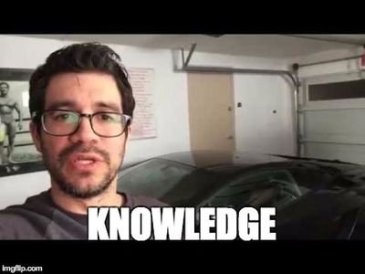
Knowledge Tai Lopez.jpg

*No way you can’t know him*

View original post 670 more words

The Harlem Renaissance No One Talks About – Guest Post by, Yecheilyah Ysrayl…

For some reason I can’t reblog from my mobile anymore.

However, that’s not why you’re here…

Do be sure to check out my latest article on The Story Reading Ape Blog at the link below. We are covering some basic history on The Harlem Renaissance movement, to include what no one talks about.

Click through to the original post at the link below.

http://wp.me/p3mGq7-guo

Don’t forget to pick up your copy of Renaissance and if you’ve read it, and you’re so obliged to do so, I’d be honored if you could leave an honest review!


Thanks,

Yecheilyah 💕

Black History Fun Fact Friday – Historic Rivals: W.E.B. Dubois vs. Booker T. Washington

Today, I thought I’ll do something fun. I would like to do a few of these so let’s call this part one. Let’s see who was at war and why. Of course, we have to start with the famous rivalry of all time:

W.E.B. Dubois vs. Booker T. Washington

Yecheilyah sits in a chair with papers as W.E.B. Dubois and Booker T. Washington step into the ring. Dubois adjusts his tie, shaking hands with members of the NAACP (National Association for the Advancement of Colored People….am I the only one who finds it odd this organization still refers to us as Colored people?? Deuteronomy 28:37…anyway, as usual, I digress lol).

Washington sits in a chair. Surrounded by students, he crosses his legs and flips through a book.

“Ya know,” Washington looks up, “I’ve read The Souls of Black Folk. I must say I am not very impressed.”

Dubois brushes lint from his jacket, “I didn’t think you would be.”

EC: *Clears throat*. Alright gentlemen. We’re about to start.

NAACP members and students step down from the ring and sits in the audience with those reading this blog.

Washington puts his book to the side. “Noted”, he said staring at Dubois. “Besides, I must say Yecheilyah, I love what you’re doing with your work. It is my belief that we should be accountable for ourselves in every way.

EC: “Than…”

“Booker, your proposal”, interrupted Dubois, “that we should take accountability for ourselves is not only unfounded but also paradoxical. It would be difficult for Negros to gain any real power, for instance, if they are denied the right to vote.”

Washington put up a hand, “IF, Negros had real power, it would be in education in the crafts, industrial and farming skills and ownership of their own businesses.”

“And how, Mr. Washington, do you suppose Negros could operate these businesses sufficiently without an education?”

Washington sighs, “I do not care to venture here an opinion about the nature of knowledge. It is clear to anyone who reflects on the matter that the only kind of knowledge that has any sort of value for a race is knowledge that has some definite relation to the daily lives of the men and women who are seeking it.”

Dubois throws his hands into the air, “You’re promoting submissiveness by asking the Negro to relinquish fundamental privileges. First, you ask him to relinquish his political rights and then his civil rights. This only speeds up the process to which Negros have regressed.”

Washington stands, pointing his finger at Dubois “You’re taking my words out of context. I am simply stating that it is my aim to teach students to live a life and make a living by which after they graduate they can return to their homes and find profit and satisfaction in building up the communities from which they’ve come.”

EC: Gentlemen, please. We don’t have time for this. I respectfully ask for you to both be silent so that we can give the people a little bit of a background on you. Is that alright?

NAACP member runs up to ring, hands Dubois a drink of water as he loosens his collar and takes a drink. Member returns to his seat among the bloggers, “I concur. Let’s move on”, said Dubois.

Washington returns to his seat, crosses his legs, “Indeed.”

As you can see, these two were not besties. Tensions always existed among Black intellectuals and Blacks who were more grassroots and this separation exists today. W.E.B. Dubois and Booker T. Washington are great examples of this.

William Edward Burghardt DuBois was born free in 1868 in Great Barrington, Massachusetts in an integrated community. He attended local schools and excelled in his studies. When Dubois finally encountered racism, the experience changed him and he decided to further his education with a focus on equal rights for Black Americans. Dubois was the first Black man to earn his Ph.D. from Harvard in 1895.

Cheers erupt from members of the NAACP. Dubois takes a bow.

Booker T. Washington was born into slavery in 1856 in Virginia. After the Civil War, he worked in a salt mine and as a domestic for a white family and eventually attended Hampton Institute, one of the first all-black schools in America. After completing his education, Washington began teaching and in 1881 was selected to head The Tuskegee Normal and Industrial Institute in Alabama. The school’s purpose was to give African Americans practical, hands-on skills and would later be known as Tuskegee University.

Whistles come from Washington’s students. He waves.

Dubois wanted to focus on creating an educated black intellectual class he called The Talented Tenth, in which ten percent of the intelligent of the race would lead and guide the direction of the other ninety percent.

Dubois: That is right. Political power and sovereignty should remain important.

*Washington rolls eyes*

Washington on the other hand, born into slavery, thought former slaves and their descendants should be financially independent and that black communities could prosper only by way of owning their own businesses.

Washington: Indeed. Blacks should elevate themselves through hard work and material prosperity.

*Dubois coughs*

Both sought to advance the plight of African Americans and by the early 20th century both Washington and Dubois were two of the most influential Black men in the country. However, their ideologies were very different. Dubois was more focused on education and civil rights as the only way to achieve equality. Washington was more grassroots and focused on fundraising for the Institute and teaching young people how to work with their hands, farm, and entrepreneurship. Dubois and Washington’s differences came to a head in 1903…

Washington: How do you young people say it now? ‘Bring that up.’

Dubois: Let’s hear the entirety of the matter first.

EC: Umm. If I can just finish this real quick. I’m almost done.

Washington: May I ask a question?

EC: Sure, of course.

Washington: What is a Bestie?

EC: Its just short for like Best Friends.

Washington: I see. And I assume one would have to be friends first before they are best friends. Am I correct in this assumption?

Dubois: You are taking up all the time.

EC: We do need to move on but I’d love to explain it to you later.

Washington: I would like that.

*Dubois shakes his head*

The men go silent. Smiles and waves at readers.

Dubois and Washington’s differences came to a head in 1903 when Dubois published The Souls of Black Folk where he directly criticized Washington and his approach.

EC: That’s a little below the belt, don’t you think?

Dubois: Well, Negros should stand up against Washington’s contentions.

EC: Dang.

Washington: I am not going to justify that with a response.

Dubois: Then don’t respond.

Washington: Do not tempt me, Mr. Dubois.

EC: Well, that’s our time. Gentlemen, thank you, both for taking the time out of your super busy schedules to have this discussion. I know you have lives to save. Literally. I do hope you can find some common ground.

Washington: I doubt it.


In the end, Dubois and Washington did agree on something. Though they had two different ways of going about it, they each thought education was important to advancing ones life.

Stay tuned for our next rivals!

Who’s Your Favourite Black Author

Do you have a favorite Black Author? You can show them some love by voting for them!

jhohadli's avatarjhohadli

The African American Literature Book Club, which has featured me and my books in the past (thanks to them for that), has asked me to remind readers and fans in my network about the open poll (yes, remind, because I’ve plugged it before so I hope you’ve already voted. I have!).

The poll is for Your Favourite Black Author of the 21st Century. They noted in their email to me that so far it’s been pretty US-centric (and though I did remind them that we in the Caribbean claim Haitian-American writer Edwidge Dandicat and I think Nigeria would have something to say about America’s claim to Chimamanda Ngozie Adichie), I do think we could mix it up some more. That said, I can’t argue with the names currently in the lead; people like…

Bernice McFadden whom I met and co-facilitated a workshop with at the BIM Lit Fest in 2016

View original post 314 more words

Black History Fun Fact Friday – Seneca Village

Got a short fun fact article for you today.

I love finding the hidden treasure of black communities that existed and thrived that we’ll never know about (until we look). I’ve mentioned several of such communities on this blog in the past and here’s another one.

Seneca Village was settled in the 1820s on the eve of Emancipation in New York. The only community of black property in the city at the time, it was located between 82nd and 87th Street east of what is Central Park today.

lvseneca18n

The Village was a thriving community of blacks (two-thirds) and whites started to settle there as well. The community had its own school and a population of over 250 people. Houses were also built on the land, some of them elaborate two-story with barns and others a bit more modest. This was an achievement because New York, like the rest of the country, was a place of slave-ownership. Contrary to what you’ll learn in school, the South was not the only place to find blacks who were enslaved but many northern cities did as well. In 1703, more than 42 percent of New York City households held slaves and slavery was a key institution in the development of New York. According to The New York Historical Society:

“As many as 20 percent of colonial New Yorkers were enslaved Africans. First Dutch and then English merchants built the city’s local economy largely around supplying ships for the trade in slaves and in what slaves produced – sugar, tobacco, indigo, coffee, chocolate, and ultimately, cotton. New York ship captains and merchants bought and sold slaves along the coast of Africa and in the taverns of their own city. Almost every businessman in 18th-century New York had a stake, at one time or another, in the traffic in human beings. During the colonial period, 41 percent of the city’s households had slaves, compared to 6 percent in Philadelphia and 2 percent in Boston. Only Charleston, South Carolina, rivaled New York in the extent to which slavery penetrated everyday life. To be sure, each slaveholding New Yorker usually owned only one or two persons.”

The only difference between Southern and Northern slavery was that instead of plantations, slaves in the North slept in cellars and attics or above farmhouse kitchens in the country. Nonetheless, the enslaved population of the city was emancipated in 1827 and many of these freedmen comprised the residents of Seneca Village.

The Village’s demise came with the building of what is now Central Park. The government claimed the land under the right of eminent domain and evicted the residents. Since then, Seneca Village has been pretty much forgotten in history. Well, until now.

_____________________________

Don’t forget, you can find all the Black History Fun Fact Articles

under the Black History Fun Fact page in the sidebar.

We are already 17 weeks in since the re-launch of this segment last October. Wow!

You Are the One

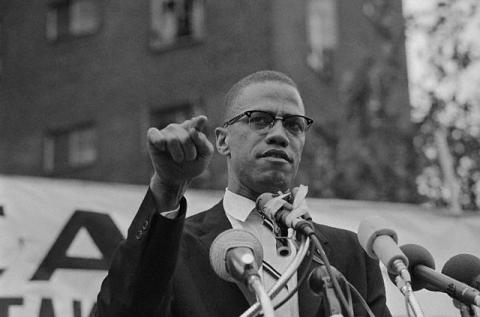
Malcolm X Shown with a Clenched Fist Speaking at a Rally

“The picture of the dry bones in the Valley, is talking about you. You are Lazarus. You are the dry bones. You are the prodigal son. You are the lost sheep. You are the people about whom the bible is speaking. Who will stand up in the last days when the trumpet is sounded. Black people are waking up. Black people are standing up. Black people are rising up.” – Malcolm X

Black History Fun Fact Friday – 5 Harlem Renaissance Women You Probably Don’t Know

If you’re anything like me, you get tired of the same repeated history. Martin Luther King Jr., Rosa Parks, Frederick Douglass, Harriet Tubman, Langston Hughes, and Zora Neale Hurston. These are names to which we are exceptionally familiar. They were great but we know them. Let’s talk about something else.

Admittedly, I didn’t have a lot of time on my hands this week so I decided to compile a list of women who took part in The Harlem Renaissance to which we aren’t too familiar for this week’s fun fact. Enjoy.

Dorothy West

220px-dorothy_west

The daughter of a freed slave, the only child of Isaac and Rachel West, Dorothy West’s father built a fruit and vegetable business that provided the family a more affluent life among Boston’s middle class. Nicknamed “The Kid” by Langston Hughes and sharing an apartment with Zora Neale Hurston, Dorothy West was a young member of the Harlem Renaissance. Not yet 20 in 1926 when her short story ”The Typewriter” won a prize from the Urban League’s Opportunity magazine, Dorothy moved to Harlem and joined the poets, novelists, musicians and other artists.

Alice Moore Dunbar-Nelson

161026-alice-dunbar-nelson-mn-1818_bec0fab5be09e60abe3bda10c1a72980-nbcnews-fp-360-360

When I first came across Alice I kept trying to figure out what was so familiar about her name. It wasn’t until I researched her that it became apparent. She was once married to Paul Lawrence Dunbar before they separated in 1902. Alice Moore Dunbar-Nelson was born in New Orleans, Louisiana, to mixed-race parents. Documented as African American, Anglo, Native American, and Creole, her works cover the complex subjects of race, ethnicity, and oppression. Her first book, Violets and Other Tales (1895), was published when she was just 20. A writer of short stories, essays, and poems, Dunbar-Nelson was one of the few black female diarists of the early 20th century.

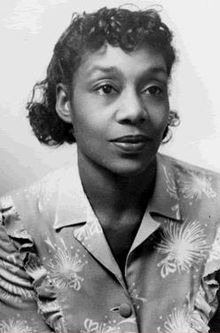
Clarissa Scott Delany

resize

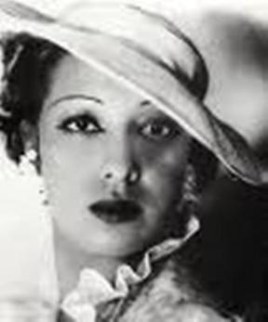
Clarissa looks as if she was fly back in the day lol.

Born in 1901 in Tuskegee, Alabama Delany is most known for her powerful poem “The Mask”. Dying at an early age (26) she did not contribute many works but still contributed by publishing poetry and journal articles into the newspaper Opportunity. After her young years in Alabama, she was sent to New England where she graduated from Wellesley College in 1923. During Delany’s years at Wellesley, she attended meetings of the Boston Literary Guild. Speakers were featured each week. Delany started writing and gained the attention and became associated with the Harlem Renaissance.

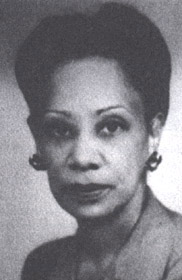
May Miller

miller_m

“To read across May Miller’s life is to read across the history of 20th century America.”

– Myra Sklarew

It begins with May’s father, Kelly Miller. Born a year before Emancipation he was the first African American to attend John Hopkins University and among the first blacks to learn to read in public schools. He studied mathematics, physics, and astronomy. His daughter, May Miller was the most widely published playwright of The Harlem Renaissance. Myra writes how May often told about having to give up her childhood room for visits by W.E.B. Du Bois, author of The Souls of Black Folk, and the poet Paul Laurence Dunbar. She spoke of visits by Booker T. Washington, Carter G. Woodson, and Alain Locke.

Maria Bonner

marita_bonner

One of four children, Marita Bonner was born in Boston to Joseph Andrew and Mary Anne Bonner. She was raised and educated in Boston, attending Brookline School, where she received musical training and in 1918 she entered Radcliffe College, concentrating in English and comparative literature. In Washington Bonner became closely associated with poet, playwright, and composer Georgia Douglass Johnson, whose “S” Street salon was an important gathering place for many of the writers and artists associated with the New Negro Renaissance of the 1920s better known as The Harlem Renaissance: Langston Hughes, Countee Cullen, Jessie Fauset, May Miller, Alain Locke, Jean Toomer, Willis Richardson, and others. She also began to publish her writing in journals like The Crisis of the NAACP and Opportunity, the official journal of the Urban League. Her first published pieces, “Hands” and “On Being Young-a Woman-and Colored,” appeared in The Crisis in 1925.


Yecheilyah Ysrayl is the YA, Historical Fiction author of eight books most notably, The Stella Trilogy, Blogger, and Poet. She is currently working on her next book series “The Nora White Story” about a young black woman writer who dreams of taking part in The Harlem Renaissance movement and her parents struggle to accept their traumatic past in the Jim Crow south. “Renaissance: The Nora White Story (Book One)” is due for release July 15-16, 2017. For updates on this project, sneak peeks of other projects, nuggets and tidbits, video tutorials, writing inspiration, and more, be sure to follow this blog and to subscribe to Yecheilyah’s email list HERE.