Get Out There

tellez-photo-1

I’m glad I didn’t know much about publishing when I published my first book or my second for that matter. Though I surely paid in quality, I’m still glad I was green. Before you judge, hear me out.

There’s a lot of information out there. Everyone has an opinion on how a book should be published. And while it is wise to listen to advice, it is not wise to listen to every single piece of advice (take heed how you hear). That said, with the wealth of information at our fingertips, it can be a blessing and a curse, a double-edged sword (been using this term a lot lately, hmm). It’s a double-edged sword because it’s easy to look at the Industry and decide you’ll never be ready. And who can blame you? At every turn there’s information on how not to do something that you probably already did.

This revelation came while flipping through my first novel The Aftermath, a Sci-Fi Thriller that I rarely talk about. It’s probably because I made every mistake that probably exists! Every piece of advice you’ve read and everything you’ve researched on what not to do I am willing to bet you can pretty much find in this book. But I love it still and I smile every time I run my fingers across it on the book shelf. Reminding myself that I did invest in a new cover last year and after its edited (No, I didn’t get it edited the first time. Told ya’ll I made every mistake you can think of!), I will be adding it back to my electronic shelves.

The funny thing is that despite my mistakes the book received more support than I thought it would even though it was only my second book. (It was my third book technically, my first novel but my third book. My first published work was a 3-part essay and my first official book was a collection of poetry but I’ll talk about my Self- Pub. history another time. You know me by The Stella Trilogy, but I’ve been grinding since 2007.)

After looking at the first edition today I am reminded that I learn more about book publishing with each book that I publish (I mean that literally. I literally learn something new every time I publish a book. Amazing right?). For this, it’s easy to look down on the other books. To give up on them. But the truth is that had it not been for those books I would not be where I am and that’s my message to you.

If you’re trying not to make a mistake you’re wasting your time. It’s inevitable in this field. You’re going to find something wrong (you or someone else). That’s not a bad thing necessarily. If you never make a mistake, how can you learn?

Okay, yes. I will be real with you. There’s a lot to learn but if you don’t get out there you’ll be learning the rest of your life instead of doing. Yes, the student must study but the idea is not for him to be forever learning at the foot of the teacher. The idea is for him to apply the lessons learned and step out on his own. If I had not published my first book, I would not be in the position to publish my ninth (or tenth depending on how you look at it). I would also not have anything to share so far as what I did wrong that I can pass onto others so they won’t make the same mistakes I did.

bitmoji635787237

If you’re looking for someone to push you then you got it. Get on out there! I’m rooting for you.


Yecheilyah Ysrayl is the YA, Historical Fiction author of The Stella Trilogy. She is currently working on her next book series “The Nora White Story” about a young black woman who dreams of taking part in The Harlem Renaissance movement and her parents struggle to accept their traumatic past in the Jim Crow south. “Renaissance: The Nora White Story (Book One)” is due for release summer, 2017. For updates on this project, sneak peek of chapters and the pending book cover release (coming soon) for this project, be sure to follow this blog and to subscribe to Yecheilyah’s email list HERE.

Beyond Imagination

pexels-mark-g-2401568

We live in a world where some aspects of truth are not allowed to exist. They live instead behind the pages of books and underneath the skin of imagination. Writing fiction is fun to me because we have the opportunity to play with these elements, mixing and matching reality and daydreams until anything becomes possible within reach of imagination.

Monsters pop in from outer space, people fly, and houses speak to us. But the truth is stranger than fiction and stretches beyond imagination. Nothing we can make up compares to the unusual reality of the kinds of things that actually take place in the real world. You think you’re watching a movie written by a writer who stuttered embellishments in the darkness of his bedroom, fingers tapping against the keyboard while memory plays hide and seek with his thoughts.

But what if his characters really do exist? What if armies of giants live underground with thousand eye locusts like horses ready for battle?

You think Shrek was the genius of a profound imagination until you realize there were talking Donkeys in the history of man. You think The Matrix is just a movie until you begin to understand a parallel universe.

“Truth is Stranger Than Fiction” isn’t just a fancy tagline put together by a writer of fiction. Not something I dug up between the inspirations of Mark Twain. What it seeks to communicate is the notion that nothing we can create can be as unusual as what we are bound to find in real life and speaks metaphorically of the unsettling realness of truth. The “strangeness” of reality. You think something is weird until you find out just how deep the rabbit hole goes.

Perhaps maybe your characters are not just stick men, but what if they actually do exist?


Realistic Character Changes

bai-kiem-tra-huong-nghiep

With the exception of books I read for review, during my regular reading times I have this bad habit of reading more than one book at a time. I’ll start reading a book and then stop and mark it off so I can go think about it. My intention is to come back after thinking about it for a while but I just end up reading something else. I do come back to it, it’s just. I have a problem.

Anyway, so I’m reading a few books, one of which happens to be C.S. Lakin’s Writing the Heart of Your Story (part of The Writer’s Toolbox Series) and for these kinds of books I am never really finished with them because to me they are part of my study material. So, it is while sitting in the bed, pillow prompted up behind me (while trying to sit as straight as possible because my computer cord has a short in it) that I decided to put my kindle down a moment (see? SMH. Get it together EC) and share my thoughts. I am especially excited because my husband is watching the football game while I’m drafting this which means he doesn’t particularly want me in his face. So, I thought I’d write until I feel like bothering him again.

In Chapter 15, Character Arcs (she dislikes that term by the way), Lakin explains how change for characters come in stages. This caught my attention because I come across this a lot. That is, the characters in the story aren’t given enough time to decide or come upon an epiphany that makes sense. What I mean by making sense is that they are too easily convinced, swayed, or compliant at times where they should be pushing back against the grain.

If the character hates ice cream, it’s unrealistic for him to be convinced to eat an ice cream bar after one conversation with his brother (who loves ice cream) taunting him about it. That’s not realistic. In real life, he would not be so compliant, in fact, he will probably get upset that his brother would even offer him such a treat. There will likely be resistance. Lakin explains it so much better than I do:

“Remember, you have to change characters in stages, starting with their opinions and attitudes and eventually changing their core beliefs.”

– Opinions
– Attitudes
– Core Beliefs
– Self-Image
She goes on to say:

“You can’t have a character talking to someone about the death penalty (which he is all for) and just through that one conversation have his belief changed (fully against) right at the heart of his core belief.”

When I read this I had to share it with you all because it’s such valuable advice that I will definitely be heeding.

At the end of the day, everything about our characters has to reflect that of real people. If in real life it will take someone a while to warm up to change, our characters have to resemble the same. We have to get out of the way of the story and let the characters do their thing.

Speaking of getting out of the way I have one more tidbit. There’s something else I’m seeing more and more and that is this: the author who is so passionate about their cause that the tone of the book sounds as if we’re talking to that author more so than the characters in the story. The author’s purpose or mission is so prominent that we can’t separate the author from the characters in the story.

Let me be clear: The author will, inevitably, come through his or her work in one way or the other. That’s not what I’m talking about. I’m talking about deliberately, or inadvertently, creating characters who are just a replica of yourself.

Be sure that when you’re sending a message through books, that you aren’t inadvertently forcing your beliefs on readers. As a reviewer, the author’s personal belief is something I actually do not count toward my rating because  my job is to focus on the story, not the author’s personal life (I’m working on a separate article about my biggest challenges as a reviewer soon) but it is becoming such a problem that I may find myself taking it into consideration while rating if it gets in the way of the story too much. How do you know if you are forcing (or may appear to be forcing) your own beliefs on the reader?  If your manuscript resembles too much of the following:

  • Posting scriptures directly in text
  • Using more than one paragraph for your character to preach or pray in (this will most likely be skipped. No offense, js)
  • Characters who are too young to realistically understand the meaning of certain scriptures
  • Anything that sounds too much like overt religious or political speech

I believe anything can work just as long as it’s done right. The reason I speak so much about symbolism in writing is first because I just think it’s the best way to reach people in writing, but also because I think it’s a great way to write for those who want to send a message specifically but don’t want to be preachy. Fiction is all about the story. People want to be entertained or informed but most of all they want to disappear from this world a moment and get lost in another one: your book.

This means you want to make it their worthwhile. If you’re giving readers sermons and lessons then you’re not (technically) casting down your nets and may do more harm than good. Readers will likely be turned off, your story will fall flat, and you would have reached no one.

Also, by sermons, I don’t just mean religious in nature but any belief system that may seem forced on the reader. It can even be an age difference. Because I write Young Adult, Historical Fiction, I have to take care not to put my own adult voice inside the head of my characters (I know, we don’t like to say characters but work with me here) but to make sure that their dialogue, emotions, and actions are fitting for their age.

To do this, I try to fall back on my years of experience working with children for a reminder of what it was like to be a kid or a young person in general (or OK, a younger person).

What you can do instead is drip feed (introduce drop by drop, here a little, there a little) the message throughout the story, make it a part of the story. Maybe your character was anti that belief but in the end comes upon a revelation. Something like that but don’t make it blatantly obvious.

Remember that fiction writing is, at its core, about entertainment. Even when we do have messages (who doesn’t?), we must still educate through entertainment.

Now, pardon me while I check on Nora.


Yecheilyah Ysrayl is the YA, Historical Fiction author of eight books, most notably, The Stella Trilogy. She is currently working on her next book series “The Nora White Story” about a young black woman who dreams of taking part in The Harlem Renaissance movement and her parents struggle to accept their traumatic past in the Jim Crow south. “Renaissance: The Nora White Story (Book One)” is due for release spring, 2017. For updates on this project, sneak peek of chapters and the pending book cover release for this project, be sure to follow this blog and to subscribe to Yecheilyah’s email list HERE.


My Ingredients for a Series – Guest Post…

As I prepare to release another series (The Nora White Story, 2017), I thought I’d share how I decide if a book will be a series or a novel. Short, sweet, and to the point.

*Comments disabled here. Meet me on the other side*

Chris The Story Reading Ape's avatarChris The Story Reading Ape's Blog

Blog Post 3

The Preparation Method

I know right away or before the first book is finished whether or not it’ll be a series. For instance, in “Beyond the Colored Line” (Book 2 in The Stella Trilogy), Joseph and his brother Edward come to blows in their mother’s living room. As a consequence, Jo leaves home.

After I finished writing this scene, with Karen’s voice still screaming her brother’s name as he stumbles down the street, I knew I wanted to explore more deeply Joseph’s story. What happens to him on his journey? Where does he go? What does he do? What kind of thoughts run through his mind? I knew that Book 2 would end, and yet there was still more to explore.

The Ingredient List


a. A pinch of completion
b. A tablespoon of deep plot elements

Most people don’t like having to wait for the next book. This is why…

View original post 283 more words

Between Books – When the Blog Comes in Handy

This isn't my PC but this is how it looks. I have sticky notes everywhere! Uhh.
Google Images Pic.

Only a writer would be folding clothes at twelve o’clock at night and contemplating whether they should make a batch of coffee to spend just a few more hours writing, all of this while the History Channel recaps an episode of Pearl Harbor as background noise. It was then that this post was conceived. In fact, I still have a pair of pants under my arm as I am drafting this. What can I say, gotta write when the spirit moves.

As I took a break from my work to finish laundry that could have waited until morning for normal people, I thought about how much this blog has helped to fill in the gaps during my “Between books” stage (thanks for your support BTW!). I like to think I write at a decent speed (six months to complete the first draft) but after that things tend to slow way down as the revision and editing process kicks in. I thus find myself in the waiting room watching as an author after author fangirls over their new release while I’m in chill mode, waiting for my name to be called. It will be awhile before my book is ready. This is when blogging (among other things) helps a great deal.

It helps because while I am in limbo I can keep up with learning new things, reading new books, and keeping myself in tuned with my readers and supporters until the next book is due. It almost feels like teaching but being off for the summer. Some teachers volunteer to teach summer school for some extra funds while others take advantage of the free time. Blogging for me is like a writing summer school, a way to stay active between books. This also helps me to brainstorm on other ways to expand my business beyond the book itself and into other areas of product.

I do admit it’s a challenge to produce blog posts, engage with other bloggers, share content, engage in social media and keep my ear to the Indie Publishing ground all while writing a novel and there are days where I must turn the phone off. It’s either that or pull my hair out. However, I see it all as part of the work and it’s also a lot of fun to me. I’m a worker bee which means that I HAVE to be doing something and while the blog is still a small part of my life in the full scope of things, it does help to keep me active in more ways than one. I guess that’s sort of the point of this post.

It’s important to continue to produce material and sometimes that will take time. The Blog (and the email list) is the answer to how to stay engaged while you wait. Or at least it is for me. The ability to schedule blog posts is a huge time saver and I could sit my butt in the chair and finish what I’d been putting off. Patience truly is a virtue and I am quite pleased with the revelations I’ve been given so far. I can only hope for increased growth. #HWPO is something I try to keep at the back of my mind. That is, hard work pays off. Let’s hope so.

Now, I should probably go ahead and publish this post and get back to these clothes. It is after 1am my time after all. I’m pretty sure I’m somewhere in dreamland when you’re reading this…or not (shout out to my night-owls with the tiny light under the covers scrolling through blog posts).


bitmoji-1051157269


Yecheilyah Ysrayl is the YA, Historical Fiction author of The Stella Trilogy, Blogger, and Poet. She is currently working on her next book series “The Nora White Story” about a young black woman who dreams of being a writer in The Harlem Renaissance movement and her parent’s struggle to accept their traumatic past in the Jim Crow south. “Renaissance: The Nora White Story (Book One)” is due for release spring, 2017. For updates on this project, sneak peeks of chapters, the pending book cover release, and full blurb for this series, be sure to subscribe to Yecheilyah’s email list HERE.

When Publishing a Book Might Not Be for You

unsplash-real-book-1030x687

I’ve always loved to read and to write and this truth has led to many questions asked of me over the years. I would say that in the last two – three years I’ve received questions mostly from young people about publishing a book for the first time. This makes sense considering I taught and tutored children of all ages (to include Young Adults) for years. In fact, teaching is one of those things I’ve done on the side in addition to writing.

Usually, I am shocked by a few things that make me question whether they should go through with it. Of course, these discussions are always difficult because I don’t want to be discouraging but there are reasons to consider not publishing a book or at least not making a career of it. I will try my best to outline the ones that most stick out to me:

You’re Not a Reader

I know we’ve been over this a million times, however, I am constantly running into young people who want to write books but they are not readers. Part of why I am always talking about my love for reading is because it’s been a constant thread in my life even before I started writing. My siblings used to joke that I’d discovered a cure for AIDS. It was their way of saying I was “smart”. I don’t think I was smart (still don’t) I just loved to read.

“If we encounter a man of rare intellect, we should ask him what books he reads.”

–Ralph Waldo Emerson

As a result, my vocabulary grew as it was difficult to advance my reading (or understand what I was reading) when I didn’t know the definitions of words. So, I would carry a dictionary around and every time I didn’t know the meaning of a word I would write it down and look it up. After I’d mastered ten or twenty words I would practice using them in my poetry. It’s only natural that these same words became part of my natural way of speaking.

Of course, I was teased for sounding too “proper” but it didn’t stop me from obsessing over words. I’m not saying I knew anything. The point I’m making is that I did this kind of stuff for fun. It was natural for me and part of who I am. It wasn’t homework and it wasn’t forced upon me. Reading lots of books was something I always carried with me. Me and books, we have a history and we were tight long before Kindle made reading cool.

“A book is the only place in which you can examine a fragile thought without breaking it.”

–Edward P. Morgan

Thus, it has helped me to understand how to write. If you want to write and publish a book but you don’t have a love affair or history of reading it’s going to make the process difficult as you won’t have a working knowledge of the foundation of a book. When I say “a love affair with reading”, I’m not saying you read every now and again. I’m not saying like once a week or once a month. That’s not the kind of history with reading I’m talking about. I’m also not talking about just reading the kinds of books that you like to read.

“As busy as I am, I still take the time to read. To get and stay successful, you should always be learning and growing.”
– Steve Harvey

One can enjoy reading but readers read beyond the joy of it. They read not just for enjoyment but to study, to research, to analyze, to understand what works, and what doesn’t. To notice structure, language, detail. Readers aren’t strictly one type of book, judging not one word in the genre it’s dressed in. One of the many things I enjoy about reviewing books is reading material spanning a wide range of subject matter. Having access to books I probably would not have known about.

“Constant reading pull you into a place (a mindset, if you like the phrase) where you can write eagerly and without self-consciousness. It offers you a constantly growing knowledge of what has been done and what hasn’t, what is trite and what is fresh, what works and what just lies there dying (or dead) on the page.”
– Stephen King

If you want to write a book you must be willing to read for pleasure as well as for the knowledge you need to understand more about what you’re writing. When I say, you must read, I mean every day, widely and passionately.

You Don’t Know What Self-Publishing Actually Is

If you really want to publish a book, do your research. It’s not like you have to know everything but it’s a good idea to have a basic understanding of what book publishing is all about and decide if it’s something you’re ready for. Learning is a constant process just as growth is. There’s so much I don’t know and that I am still learning even after I’ve published eight books. That’s because learning is an ongoing process. By hanging around those who are knowledgeable, reading and researching I am learning something new every day.

No one decides to be a doctor without expecting to become educated to do so. This is how Self-Publishing got its stigma’s in the first place, because random people (those who never wanted to write and had no care for reading) suddenly decided they wanted to try and write a book (Of course those stigmas are quickly fading thanks to Indie Authors who have stepped up to the plate to offer the kind of value the field needs). All I am saying is to do your research and familiarize yourself with the steps. If you don’t know what POD is short for or what an ISBN Number is then you are not ready to publish a book.

You’re Not Passionate About Writing or Books

This may sound funny but there are a lot of people who have not decided what it is they really want to do in life. They want to write a book just because everyone is doing it right now or it’s perceived as easy to do but they have no real passion for it. They like to write, sure, but they aren’t skilled at it. In short, it’s just not them. Sometimes you can miss your calling because you don’t understand your worth or what it is you were put here to do. I can only speak for myself when I say that I’ve always wanted to be a writer. I’m not talking about writing being something that developed over time and I just thought, “OK, this is cool, I think I’ll publish a book”. No, I’ve always wanted to write and publish fiction (and a memoir but that’s another chapter in which I have not yet embarked). This road is hard and paved in criticism. If writing a book is something you just want to “try” I can think of a lot of easier things to do. Maybe publishing a book is just not for you. I say this because when you embrace those things you’ve always been passionate about, it empowers the whole experience.

You’re Not Comfortable Stepping Outside Your Comfort Zone

Probably the most important is knowing who you are. Not just from the perspective of nationhood but who you are internal. If you’re not comfortable doing something different, if you think it makes you look like a sell out because you have to network with people outside your circle, attend events that aren’t related to your personal beliefs, or write in a way that reaches beyond the people you know then maybe you aren’t ready to publish a book on a broad scale. Maybe you’re better off publishing something specifically for mom and dad or for your friends.

Anyone can publish a book but if you are talking about branching out and elevating you should be real with yourself. Are you that kind of person? Or are you better off writing and publishing books for those in your immediate circle? If so, that’s OK. There’s nothing wrong with that but you must be able to define this for yourself. Don’t force yourself to do what you were not naturally built for. It’s unfair to you and to readers. We must keep in mind that we all have different gifts and talents to use to help to reach people on different levels. You can like to do something  but don’t force yourself to make it a part of your life just to say you did it. I like to sing but I am not going to go and record an album. What if that’s not the way you were supposed to contribute to the world? What if you were given something different? If I spend my time singing when I’m supposed to be writing, then I’ve missed my calling.

Your Self-Esteem is Low

I know. It’s hard language and yes, I just added this one. I added it however for good reason. After reading Kristen Lamb’s post on 13 Things Mentally Strong Writers Don’t Do, I had to put this in here. Here’s the thing: If you don’t believe in your abilities, why should I? It’s seriously annoying when writers complain about how their work isn’t good enough. I always attempt to stay positive but the truth is that if you don’t think you can do it no one can help you. Maybe self-esteem building and writer confidence are classes someone can teach because it’s needed. Every day there’s an Indie Author caving to the negative talk and the overwhelming backlash of doing this and don’t do that. It can be frustrating (as we all get frustrated) but Independent Publishing is not for the weak knees, the faint of heart, or the mentally unstable.

The truth is that everyone does not like you, someone thinks you are naïve and your idea is dumb and even more people will tell you about it to your face. They’ll wave their college degrees and years of expertise in your face and laugh at your new Self-Published book. Ignore them for the first shall be last and the last shall be first. It’s always the people who you doubt, who you look down upon, and who you underestimate that succeeds and you can put that on your heart (if you have one).

Self-Publishing is an amazing experience and there’s no better time to Self-Publish a book than right now at this very moment. I will always be encouraging and motivating to those who are courageous enough to slap on their thick skins and step on out there. I am only advising because I know how challenging this road is, that you make sure this is what you are meant to do.

********

Check Out Other PBS Posts on Self-Publishing:

8 Ways to Go From Author to Authorpreneur

4 Common Sense Reasons it Can Benefit You to Self-Publish

The Laying Bricks Series (Building Strong Foundations)

Episode 1

Episode 2

Episode 3

Episode 4

Episode 5

The Business of Writing 101: (6 Basics)

The Workflow

You Are Not JK Rowling

Paperback Comeback

Do It Yourself Promo Tools


Yecheilyah Ysrayl is the YA, Historical Fiction author of The Stella Trilogy. She is currently working on her next book series “The Nora White Story” about a young black woman writer who dreams of taking part in The Harlem Renaissance movement and her parents struggle to accept their traumatic past in the Jim Crow south. “Renaissance: The Nora White Story (Book One)” is due for release spring, 2017. For updates on this project, sneak peek of chapters and the pending book cover release for this project, be sure to follow this blog and to subscribe to Yecheilyah’s email list HERE.
How To: Edit Your Editors Edits.

Practical advice on editing your manuscript when it comes back from the editor. Post Quote: “I’m going to break it down into easy steps so that it doesn’t seem quite as frightening and explain what I did.”

*Comments disabled here.*


Gem Stone's avatar

Hello everyone and welcome to How To Wednesday-Saturday.

This post is later than usual due to my book Ethereal Lives being released last Wednesday. I’m afraid everything has been pushed to the back burner in the excitement, but I’m back now with a How To on editing. How to edit your editor’s edits.

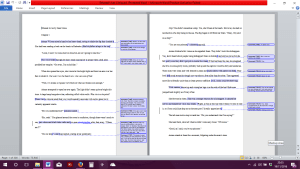
2016-11-19-3 Manuscript with lots of edits.

So, you send your book to your editor and after a great deal of waiting and thumb twiddling, it is finally returned to you, usually, looking something like this:

And, most often accompanied by this:

2016-11-19-4 Editor’s Letter.

Here you have a manuscript with endless comments and corrections and a letter from your editor, usually broken down into segments, listing everything that is wrong with your work. It can be very daunting and leave you wanting to cry as you try to figure out how to fix everything. I know when I…

View original post 551 more words