How dramatic the transformation is when I turn lioness
how dangerous courage is
how beautiful too
how tingly the feeling when you throw caution to the wind
when an introvert speaks
you know that little mustard seed’s got a fire
how revolutionary to be humble in spirit,
but courageous in character.
The weight of this bravery
both heavy and powerful
how sensitive and warrior I am at the same time.
How powerful strength is
when you don’t know that it is there.
Today, I’d like to extend a warm welcome to Dana Kearney. Welcome to the PBS Blog. Let’s get started!
What was you childhood dream?
My childhood dream was to be a doctor. Then I realized hospitals and sick people scare me. So I had to find something else to be and I always loved writing.
Cool. In your own words, what is love?
Love is a connection that you cannot describe. It is so powerful when you feel it you know because you have never felt it before. It is a part of the air you breathe. It is unconditional. Love has been around since the beginning of time. Love lasts through the universe and galaxies. It is a selfless feeling that transforms you into your highest self. Love is when frequencies align, your life is complete, and the passion is at its peak. Love is when you see stars in their eyes. Love is balance with the universe.
Okaay Dana. What would be the most amazing adventure to go on?
A trip around the world would be the most exciting to go on. You could travel many different ways and see so many historic sites.
I love that. Who is your favorite writer?
My favorite writer is Zora Neale Hurston. Her stories transcend, time, space and culture. She takes us through two worlds where some of us live. She describes a time that has passed, but it is also infinite. She gives our lives space, meaning, love, and divinity.
What kind of music do you like?
I like rhythm and blues, hip-hop, pop, old school music from the 50’s, 60’s and 70’s. Sometimes I pick whatever makes me escape into another place and other times I pick what resonates with current moments in time.
Nice. Dana, define racism.
Racism is the power to negatively impact millions of lives through housing, employment, and natural resources based on race.
Nicely put. What’s your favorite TV Show? Movie?
My favorite movie is Gladiator. I love stories of Ancient Times. I love how the actors bring you into the story. They make you root for one over the other. Behind all the backstabbing and treachery it is a love story and a father trying to return home after he avenges his family.
What’s the most difficult thing about being a writer? The most exciting thing?
The most difficult part about being a writer is getting your thoughts into a familiar structure. The most exciting part is giving your perspective on life.
What does that mean, getting your thoughts into a familiar structure?
Putting my thoughts into a format that people are comfortable with. As your thoughts come out they may not be organized or naturally flow.
Ahh. Got it. That’s true. Is there anything you don’t you like about yourself?
I don’t like my need for perfection. It stresses me out but I still strive for perfection.
Life is not always pretty. We all experience hardship every now and again. What is your best advice for reducing stress?
My best advice for reducing stress is take care of yourself. Do what makes you happy. Take time to meditate or pray. Take time to do your favorite things. Take care of yourself.
I love it.
Thank you Dana for spending this time with us. We enjoyed you!
Dana Kearney was raised in Oakland, CA and graduated from the University of California Davis. Dana was a public school educator for ten years. She loves to read, write, swim, teach, and travel. Dana still lives in California and is currently working on Diamonds or Light? Part II
I was sitting here drafting a Black History Fun Fact about the first black-owned TV and radio stations but as I read I noticed a disturbing trend. A trend we can still see present today. To start, I was researching WGPR-TV, first black-owned television station in the U.S. and W.E.R.D., first black-owned radio station in the U.S. WGPR-TV was run and operated in Detroit and W.E.R.D. was based in Atlanta. We’ll go deeper into their history in a separate post but both stations became a platform for black artists, from Jazz and Blues musicians to Dr. Martin Luther King Dr. using it to broadcast his sermons and later, Civil Rights announcements. There are two things I noticed associated with each of these companies as the inspiration to today’s post:
Jesse Blayton, founder of W.E.R.D., also taught accounting at Atlanta University and tried encouraging young black people to enter the field. He was unsuccessful because the students knew that no white-owned accounting firms would hire them and Blayton’s, the only black-owned firm in the South, was small and had few openings.
WGPR-TV was successful from my perspective but because it failed to reach a wider audience, it was eventually sold to CBS. WGPR-TV ran from 1975 to 1995 under its black leadership.
With, black-owned businesses, I notice a disturbing mindset among many of my people in the African-American community that success is synonymous with white support and that, without it, we aren’t as successful as we could be. Society has deceived many of us into thinking unless they have included us in the mainstream public eye, we are unsuccessful. I compare it to publishing in the sense that Traditional Publishing is still seen as a more successful route than Independent Publishing. It is still seen as a sign of prosperity to be signed to a publisher than to be your own publisher through the Self-publishing route because of the exposure. Although many Self-Publisher’s are making far more money, unless the Self-Publisher can look like a celebrity, he or she has not made it (whatever that means). This is flawed thinking and causes many to chase the temporary pleasures of money and fame over integrity.
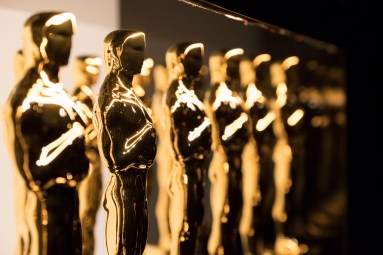
The Oscars is a great example of this and for the record, I admire Spike Lee and Regina King most especially. The talent comprised in these two people is beyond words. However, the black community’s reaction to their Oscar win is a great example of how we do not often see ourselves as being enough. Spike Lee and Regina King are and have always been two powerful artists. What Spike Lee has done with Crooklyn, Four Little Girls, Mo Beta Blues, Do the Right Thing, He Got Game, Malcolm X and more is nothing short of genius work. That Regina King can simultaneously bring to life two characters in Huey and Riley Freeman is nothing short of genius work. Not only did she capture the personas of two little boys but two little black boys. Whether that is Poetic Justice, Boyz N the Hood, Friday, Enemy of the State or Down to Earth, King’s roles are always down to earth. She’s got this skill that allows her to be relatable in any role. She‘s hilarious and you feel she can easily be your sister.
My point here is this: Lee and King did not need to win Oscars for me to recognize their brilliance. Yet, as a community, we champion this as the official ceremony to which we have received a piece of the pie. We have a track record of doing this, in which we do not see ourselves as successful except that we are integrated into mainstream societies expectations of what that success is supposed to look like. Angela Basset does not need an Oscar to be great.
There is nothing wrong with receiving support across all nationalities and nations of people. However, it is important for the black entrepreneur to know and understand that to be young, gifted, and black is also a success by itself and on its own terms.
Today, I’d like to extend a warm welcome to Corey Collins. Corey, welcome to the PBS blog!
What is your name and where are you from?
My name is Corey Collins and I am from Memphis, Tennessee. I went to college in Northern Indiana and to law school in South Florida, where I have lived since 1992.
Nice. My in-laws are in Memphis. When did you publish your first book? What was that like?
I published my first book entitled The Thanks You Getin 2017. I self-published my novel and the experience was exciting, painstaking, exhausting and, ultimately, fulfilling.
Love it. Who is your favorite writer?
My favorite writer (present day) is Zadie Smith. My favorite writer (all time) is James Baldwin.
I. Love. Baldwin! What is your favorite color?
My favorite color is blue.
What do you hate most about writing advice? What do you love?
I dislike folks who impart advice about writing authoritatively as though what works for one writer should apply to all. In my experience, writing definitely is not a “one size fits all” endeavor. I love folks who simply talk about their writing experience in such a way as to give others insight into their process so that aspiring writers might consider what nuggets to incorporate into their own process.
You summed that up perfectly. It is why I don’t like to refer to my information as advice, but tips. Tips based on my own experience I hope others could maybe add to their own experience. Very well stated there Corey. What is your favorite food?
My favorite food is Memphis dry rub barbecue ribs. My second favorite is cashew nuts.
If you could live in a movie, which would it be?
If I could live in a movie, I would live in the final scene of the movie The Shawshank Redemption, one of my top 5 favorite films. The final scene depicts a reunion between two friends who served time in prison together at a city in Southern Mexico called Zihuatanejo. I was fortunate enough to visit that town in 1990 when I participated in a semester broad program during my junior year in college. It made a lifetime impression, with its pristine beaches and hospitable residents. Unlike its more popular neighbor Ixtapa, Zihuatanejo was underdeveloped, less crowded, less noisy. Peace and serenity descended upon me the minute I stepped into the city and upon its beach. The thought of spending my final days living off the sea and the land in Zihuatanejo, like the main characters in Shawshank, makes me smile.
Ha! Shawshank Redemption is one of me and my husband’s favorite movies as well. What would be the most amazing adventure to go on?
The most amazing adventure to go on (and one of my bucket list items) would be to trek through the mountains of Machu Picchu in Peru.
Nice. What is the most difficult thing about being a writer? What is the most exciting thing?
Finding consistent, significant blocks of time to write while working a full time job is the most difficult thing about being a writer. When I am fortunate enough to have significant, uninterrupted blocks of time, entering that zone where ideas and words seem to flow well is thrilling.
I get it. Outside of writing, what are some of your passions?
Outside of writing, I love running. My personal goal is to run at least two half marathons per year and, for the past five years, I have managed to meet that goal. Aside from the health benefits, running, for me, is calming and helps to clear my mind.
How many siblings do you have?
I have one sibling, a younger sister.
Are you employed outside of writing?
Outside of writing, I am employed full time as an in house attorney for a construction company. I review and negotiate construction contracts for the company and manage their litigation.
Okaay. Another attorney in the house ya’ll. What is your favorite TV show / movie?
My favorite TV show is Game of Thrones. My favorite movie is The Godfather.
Thank you Corey for spending this time with us. We enjoyed you!
Collins is a practicing attorney in Miami, Florida, with an innate curiosity about the world and the people in it. Collins attended college at the University of Notre Dame graduating with a dual degree in Government and Spanish in 1991. Thereafter, he spent a year working for a member of the United States House of Representatives before continuing his education at the University of Miami School of Law. He graduated in 1995 and has practiced law in South Florida since then.
Beyond practicing law, Collins chairs the board of directors of the James B. Collins Memorial Fund, Inc., a non-profit corporation formed for the dual purpose of providing scholarships to high school seniors needing financial assistance for college and making an annual donation to the American Cancer Society in the hopes of finding a cure for cancer. He also serves on the board of directors of the St. John Community Development Corporation.
In his spare time, Collins enjoys running, having completed four marathons and twelve half marathons. He also writes short stories.
About the book:
Corey B. Collins is the author of The Thanks You Get, a novel that explores human behavior and the driving force behind people’s actions. His protagonist is Hank Goodman, a public relations executive, who is drawn into a mystery involving one of the wealthiest men in South Florida. Woven throughout Collins’ novel is the theme of families, however defined, and the ties that bind them. Ultimately, Collins hopes to encourage readers to contemplate whether there really is such a thing as coincidence and whether people, with all their faults, are naturally inclined to do the “right thing” as they define it in their lives.
Are you an author? Looking for more exposure? Learn more about my Introduce Yourself FeatureHERE. Stay tuned for our next featured author.
In, building connections as a writer on social media, it’s important that you are authentic in those interactions. What does this mean? It means to be genuine and true, to be real but what does this mean? To be genuine and true is to be yourself in a way that does not force others to accept you, but brings together those who share the same passion as you do. People can tell if you are sharing something just to sell your books or sharing something because you deeply love it and you care about sharing that love with others for their benefit. You genuinely want to educate people, inspire people, empower people, or you want to make them laugh, or help them to heal or evolve. What people get out of getting to know more about you? What value do you offer that helps to make their lives better? This is what building relationships are about. It’s not so much about the book itself, it’s more who you are, who we all are and how your book seeks to make us better. It doesn’t matter if you write fiction or non-fiction, in what way are we better from reading your book? This answer is revealed in your genuine interactions with others. People can tell if the information you are sharing is not authentic. We can tell if you’re sharing something just to sell your book versus sharing something because you want us to be better.
The problem is not that “artistry” doesn’t sell. There is no debate to be had about writing as an art and as a business. It is both. Integrity is everything and I personally believe no one should ever compromise that. Even more so, I believe it is this very integrity that makes us interested in an artist in the first place whether that artist is an author or musician or painter. There’s this debate about wanting to make real money from writing or treating it as an art I do not understand. There is no competition to be had. It is possible to be a serious businessperson and artist at the same time. The problem is too many new Indie authors aren’t authentic about the art enough to build trust among readers to the extent that we care about supporting that author’s work.
This isn’t about trying to find anyone to read our books. You are in search of people who share your passions, goals, and belief system. You aren’t here to force people to share those passions and beliefs but to connect with those who do. This isn’t about trying to make people like you. This is about genuinely connecting with those who do. These are authentic connections. It doesn’t matter how many times you talk about your book if I know nothing about you or share your vision or if I don’t care about what you are bringing to the table, I am not buying the book and I am not the reader you want. You don’t want me. You want the reader interested in the value you are bringing. To get here is to start with offering value where being yourself is not a gimmick.
If you would like to take the step toward helping your potential readers to get to know more about you and your passions and how you can help to make us better through your writing, be sure to take part in my Author Introduce Yourself Feature, specifically designed to help us to get to know you better. Learn how to do so HERE and stay tuned for tomorrow’s featured author.
Also, don’t forget that FOUR of my books are on sale for the month of February. If you are into Black Historical Fiction, Women’s Fiction or poetry, choose your favorite book by clicking HERE and pay just 99cents from now through 2/28.
I’ve been swamped in schoolwork which is stopping me from living my best life on these black history posts. Today, I compiled a list of links I found throughout the week and books I recommend since I did not get to complete a full post on one topic. The books are what I really encourage you to look into. Unlike the internet, they provide more detailed and in-depth research and citations from scholars and others useful for deep research.
Descendants of Last Slave Ship Still Live in Alabama Community
The story of the Clotilda and the people who built Africatown.
I spoke about “Africa Town” once before on this blog (See post here). This article shares some insightful information on the descendants of that town. (You may also remember the book recently released on behalf of Zora Neale Hurston of the Clotilda).
South African paramilitary unit plotted to infect black population with Aids, former member claims
Group said to have ‘spread the virus’ at the behest of Keith Maxwell, eccentric leader of the shadowy South African Institute of Maritime Research, who wanted a white majority country where ‘the excesses of the 1960s, 70s and 80s have no place in the post-Aids world’.
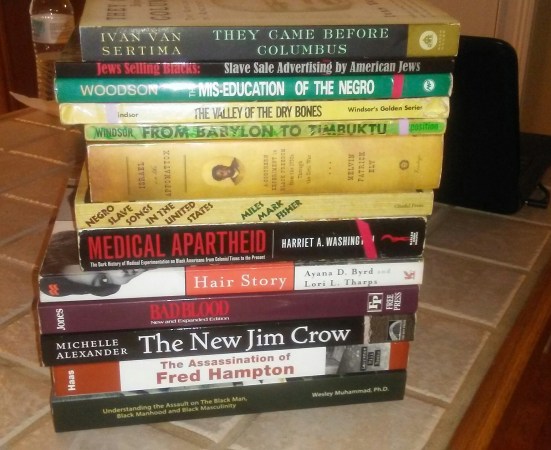
Don’t let February be the only time you are interested in your history. From the shelf, here are some of my favorites. I recommend them all:
They Came Before Columbus, Ivan Van Sertima
Jews Selling Blacks: Slave Sale Advertising by American Jews
The Miseducation of the Negro, Carter G. Woodson
The Valley of Dry Bones: The Conditions that Face Black People in America, Rudolph Windsor
From Babylon to Timbuktu: A History of the Ancient Black-Races including the Black Hebrews also by Rudolph Windsor
Negro Slave Songs in the U.S. Miles, Mark, Fisher
Israel on the Appomattox: A southern experiment in black freedom from the 1790s through the Civil War, Melvin Patrick Ely
Medical Apartheid: The Dark History of Medical Experimentation on Black Americans from Colonial Times to the Present, Harriet A. Washington
Hair Story: Untangling the Roots of Black Hair in America, Ayana D. Byrd and Lori L. Tharps
The Assassination of Fred Hampton: How the FBI and the Chicago Police Murdered a Black Panther
Bad Blood: The Tuskegee Syphilis Experiment, James H. Jones
Understanding the Assault on the Black Man, Black Manhood, and Black Masculinity, Wesley Muhammad
The New Jim Crow: Mass Incarceration in the Age of Colorblindness, Michelle Alexander
There are so many others but this should be enough to get your started! Be sure to check out the other Black History Fun Facts on the Black History Fun Fact Friday page.





 The PBS Blog