Revising The Stella Trilogy: Crafting Authentic Historical Details

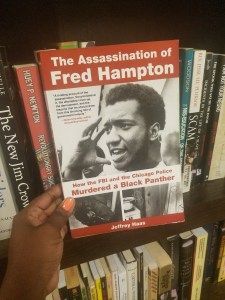
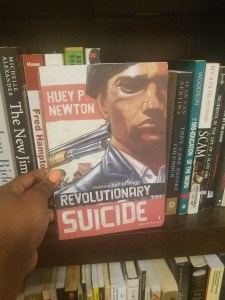
In Beyond the Colored Line, book two of The Stella Trilogy, we meet Noah Daniels who is a member of The Black Panther Party for Self-Defense. There are two books I read that helped me to conceptualize his character in the most authentic way possible: Revolutionary Suicide by Huey P. Newton and The Assassination of Fred Hampton: How the FBI and the Chicago Police Murdered a Black Panther by Jeffrey Haas.

These books helped me to capture the language and the spirit of the movement as realistically as possible. I modeled Noah’s persona after both Huey Newton and Fred Hampton. Noah uses terms like “Pig,” regarding the police like the Panthers did in the 60s, but reading Newton’s story helped me to understand this wasn’t a random term they pulled out of the sky to be derogatory.

Black Panther rhetoric like “All Power to the People,” and the concept of “pig,” came with Newton’s interest in A. J. Ayer’s logical positivism, that nothing can be real if it cannot be conceptualized, articulated, and shared. While I do not agree with this philosophy as a person of faith (because faith is the opposite of this…the belief and expectation of something even when you cannot see it), it was helpful in me understanding the Panthers on a deeper level and thus helped me to make Noah’s story more real.

Not all research needs to be included in the story so you won’t hear Noah quoting A.J. Ayer. The point of research for historical books is to help the writer to better understand the culture of the time so the characters can interact with the setting genuinely.

Historical Fiction is not an easy genre to write because while the story itself is fictional, the dialogue and personas of the characters have to be true to the time. A young person living in 1960 wouldn’t speak like a young person living in 2020. If done right, adding authentic historical details enrich the story by triggering memories of the past.

Excerpt from Chapter Ten:

“That just bugs me. We supposed to march and get hit upside the head by the pigs?” he would say in conversations with his mother when he would visit her. Unlike many young black men raised by their mothers, Noah’s mother had decided early on that her son’s narrative would be different. When he came of age, she would turn him over to be raised by his father. She could provide a lot of things, but she could not teach him how to be a man. She supported most of Noah’s radicalism, but only to an extent.

“Now don’t you go rappin’ ‘bout all that communist jive talk in here boy. Violence and hatred never helped to expand no revolution.”

“But Ma, that’s where you’re wrong. It’s not about violence. It’s about defending ourselves. Violence is only the guilt complex that exists in the minds of America.”

Mama Daniels would lift her head to the ceiling, wishing she’d said nothing.

“To say that a man is violent because he defends himself does not differ from saying a man who is being lynched and thus fighting back is himself violent because he fights back.”

“Boy, what? You know, sometimes I wish you weren’t so smart.”

Noah laughed, “’cause you know I’m right. Mama, white Americans know that they have been violent against Negroes, and they fear that one day the Negro will do unto them as they have done unto the Negro.”

The 1960s presented a new wave of leadership and identity for people of color who went from being Negroes to Blacks. Just the previous year, the heavyweight champion, Muhammad Ali refused induction into the army on both religious and political grounds. The epitome of the black power movement was the Black Panther Party, founded by Huey P. Newton and Bobby Seale. This party organized the use of self-defense in the accomplishment of black justice and was right up Noah’s alley.


Stella: Beyond the Colored Line

Get it Here.

Haven’t read book one yet? Get it here for just $0.99.
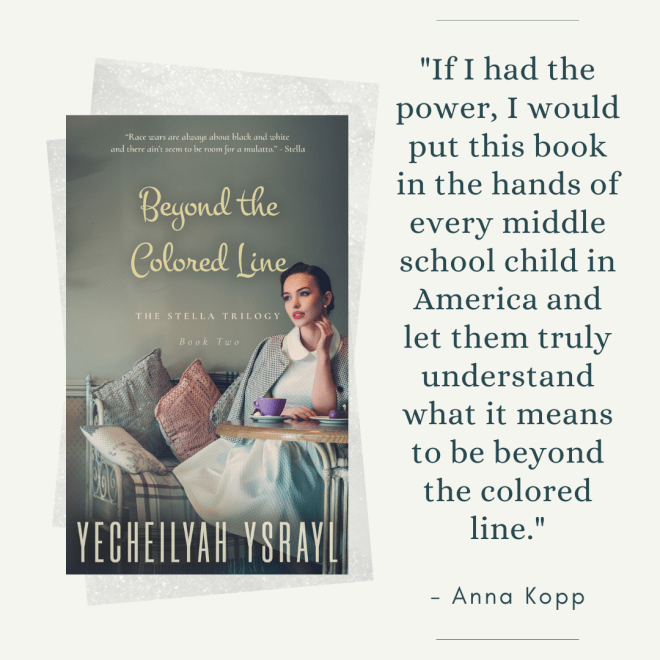
Already read these books? Don’t forget to leave a review!

For Those Who Are Sad

Photo by Ye Fung Tchen on Unsplash

Can I cradle you in the nook of my arms? If you were here, would you let me? Hold you I mean? I don’t just want a hug. I want to hold you so we cry together. Kiss the top of your forehead like a mother would. On the shoulder of comfort, let your tears drench my shirt and I will love you like an infant. Can these words hold your head up? I do not want the soft spot of your pain to blemish the fragile newness of the warrior you are becoming. Your critics will look at what you are, but I see what you can become. But you’ve got to let me do my job. Let me hold you. Cradle you in my arms with these words. Cradle you in my arms with this pen. This is not a blog. Not today. Today this is air. This is breath. This is permission to breathe. These are words wooing lullabies for the exhausted spirits of the broken.

New Words

It was either the fresh smell of an expanding vocabulary or the sweet taste of new words on my tongue. Or perhaps the way they moved around in my mind. It was the way they sounded, like soft wings flapping against the air and the effortless inspiration they stirred while teaching me their foundations. It was 6th Grade English, 8th Grade Creative Writing, AP Literature in High School, and African American studies in College. Ms. Lang was a little woman with a big appetite for dissecting poetry and she fed us well. New words have always been motivational in provoking me to write. I would come home from school with an armful under the flap of my notebook and feast on multi-syllable honey. I would string sentences together that really made no sense because all I really wanted to do was use the words. All I really wanted to do was “simile” sentences on paper like hanging linen that I could sit back and watch as they dried. Metaphor them into something digestible. I would sit there highlighting words I didn’t know. Forget parties, all I wanted to do was crack open the mind of an author and anatomize his usage of irony. I was the sole proprietor of time that day and it never seemed to move as long as I was building. Eventually, I no longer depended on organized schooling for my fix. Instead, pocket dictionaries and thesauruses found a home in my backpack as new words found a home in my poetry. To this day I look forward to different ways to use overly used words, synonyms that could be used much simpler and give my palate something new to get excited about.

There is a Movement in Stillness

I saw a sunflower bow to a bee without moving. It arched its stem, its petals already stretched wide and willing. There it waited for the wind to whistle the way it does when it pushes the flower forward, and here, the flower bowed. Beautiful and with grace, this sunflower let itself go in the wind’s direction, its sweet liquid substance sending the scent of fresh Nectar floating into the air. I couldn’t smell it but it wasn’t for me to smell so I looked down in my notebook and wrote a reminder: “what’s for you is for you.”

I looked up and noticed a bumblebee was already singing its way to our area and the whole time the flower did not move; it waited. The flower was only moved by the wind, the invisible force that guides it, and so this I wrote in my notebook: “do not chase, attract. What is yours will come to you. Put out the right scent and let the invisible force guide you.”

I looked up, and the bee seemed much more anxious and excited, but I knew better than to kill it. This creature was on a mission, so I didn’t swap him away because this wasn’t my business. I was here only as a witness to the meditative buzz of togetherness. I saw a sunflower bow to a bee without moving, so I bowed my head too and wrote: “there is a movement even in stillness.”

“But My Family Don’t Support my Writing”

Popular Complaint: “My family don’t support my writing.”🤷🏾‍♀️

Umm. How can I put this, your family and friends will be the least supportive of your writing (as is the case for most businesses). That’s not a bad thing entirely because they are not really your targeted audience.

New Writer:  *Smacks lips, rolls eyes.* “Okay, so what that mean?” 🙄

It means you have to find those people who are most likely to read the kinds of books you write and often, they are not family members. This specific group of people is called a targeted audience. You are not targeting everyone but focusing on one specific kind of reader. Here’s an example from words from Tyler Perry:

“I clearly believe that I’m ignored in Hollywood for sure and that’s fine. I get it. My audience and the stories that I tell are African American stories specific to a certain audience, specific to a certain group of people that I know that I grew up with and we speak a language.” – Tyler Perry

Say what you want about Perry but he has a keen understanding of his Target Audience. That’s what he is speaking of here. A specific group of people who his films/movies/TV shows are specifically for. That’s why his movies are all along the same lines in the theme. We can see that Tyler Perry makes the same movies because he is targeting a specific audience.

Personally, I am not much of a Tyler Perry fan. There are only a few of his movies I like but that’s not the point.

We can agree or disagree with his movies, but he is an excellent example of someone with knowledge of his Target Market.

When you are targeting a specific group, you are not trying to reach everyone or garner everyone’s support. Your purpose is to appeal to that specific group.

(Feel like I’m saying “specific” a lot but that’s kinda important). 

How many people at Michelle Obama’s book signing were related to her?

New Writer: “What? But those was her fans tho.” 🧐

And you have fans too if you look beyond the praise of family members who will probably never buy.

New Writer: “So you saying my mama can’t buy my book?” 💁🏾‍♀️

Your mom will probably buy your book first, but she’s not the seventeen-year-old black boy with peer pressure issues you wrote it for is she?

New Writer: “I mean naw but…”🤨

…and she’s probably not gonna leave a book review on Amazon, follow you on Goodreads, Twitter, Instagram, or subscribe to your email list and if she does, she probably won’t remember to read it.

New Writer: *smacks lips* “Dang why you gotta be all negative for?” 😒

Because the truth will set a lot of writers free from unrealistic expectations about what it means to be an author.

Loyal family/relatives may buy a book or two and they may be there to cheer you on, lift you, and support you in various ways. Families are good at heaping praises.

They love to like your posts, root you on and tell you repeatedly how they intend to buy your book and how proud they are of you. This is helpful from an encouraging point of view and it feeds the ego, but praise doesn’t sell books. How many of these people follow up? Every year the same family member asks, “where can I buy yo book?” But they never buy.

It is those non-relative readers who your book is specifically written for who will buy with consistency and read your every release, becoming avid readers and fans.

(…and I hate to use the word “fan,” by the way. *Shudders* Be a fanatic for no one.)

👉🏾How many of your genetic relatives have bought your book?

New Writer: “Lemme see, my mama got one, my cousin, boo boo nem, lil Chris…”

So what, all five of them..?

New Writer: “Oh, so you being funny?”🤔

No. I’m being real. Put it this way, would a company whose buyers don’t watch TV, make a commercial to push their product?

New Writer: “Naw that’s stupid.”🙄

🤷🏾‍♀️ So why would authors focus the bulk of their efforts on trying to sell to people who don’t read the books they write?

New Writer: “I guess I see what you saying.”😩

Now, take out some paper. You’re gonna have to write this down.

…wait, what are you doing? Put your phone down this is important. 🤦🏾‍♀️

New Writer: “Imma type it in my notepad.”

Okay but don’t be on Instagram this is important.

New Writer: I’m not dang. 🤳Go. I’m ready.”

Okay, here are a few questions you can ask yourself to help you find your readers. 

  • Who are my current readers/Who am I trying to reach? How old are they? What do they like? Where do they hang out?
  • What’s the #1 thing my readers love/need the most?
  • What problem does my book solve? What are my readers’ pains/issues/struggles/challenges?
  • What do readers gain from reading my book? What do I have to offer?
  • Who would benefit most from reading my book?
  • What makes my book unique?

My Responses to Common Complaints from New Writers is something new I am adding to this blog based on common writing and publishing questions from new Indie Writers. I thought it would be fun to answer them here in the form of dialogue. You will know the posts by the quotation marks around the complaint to differentiate it from other posts.

Did you like this first post? Do you have a common complaint I should address?

Find more articles under the Writing Tips and Resources page here.

Even Salt looks like Sugar Audiobook

I have been MIA on social media lately and I’ll return to my regular blogging soon. In the meantime, the Even Salt Looks Like Sugar is available now in audiobook. If you are a first time audible user this book is free with the 30 day trial.

👇🏿👇🏿👇🏿

>>Click here to order the Audiobook<<

Not into audiobooks? This book is available as an ebook at several retailers.

Buy from your favorite online store here

Buy from Amazon here

Purchase a signed paperback from my website here


Texas, I’ll be at the Trill Healing and Wellness Space in Stafford TX (about 40min from Houston) on November 30th for a signing and book reading of Keep Yourself Full. If you are in the area, I would love to have your support. This is our chance to meet/catch up. Don’t have this book? No worries! Grab your copy now from my website by clicking on the link in my bio. See you soon. Special thanks to Trill Monday Night Markets, Enlightened Souls, and B Infused Natural Detox Waters and more.

What We Do to Ourselves

“It cannot be denied that what we do to others we do equally to ourselves. When we treat ourselves better, we naturally treat others better.”


Keep Yourself Full is available for PreOrder!
*The Release date has been pushed back to August 6, 2019*
CLICK HERE TO PREORDER.
CLICK HERE TO MARK AS WANT TO READ ON GOODREADS

“Today I finished reading Keep Yourself Full, and I am beyond in awe of this book! There were so many amazing points made in this work – even tips that I was not fully aware of. That says so much to me, as someone who thought they were aware of how to care for myself. While reading about self-abuse and indicators of it really opened my eyes to how much I don’t know! I look forward to buying a few copies to send my close friends.”

– K. McCoy

“I must say that I thoroughly enjoyed this book/devotional (It was like a devotional for me). I had been looking for a book such as this that was more of encouragement/devotional type… the topics that you chose were fitting for any individual. I even caught myself reading points that were real and true out loud to my husband (Balance and Value). I am so glad that you decided to write this type of book. I know this will encourage people because it encouraged me as I was reading it.”

– Natashia Crawford 

“This was a wonderful, inspiring read. I felt the book flowed well overall and the various parts seemed to go in a nice order. The writing style was poetic in a way and I felt as though it mimicked the way the verses were told, which I thought was a nice touch. It wasn’t “preachy” at all and it was just a general bout of information to remind everyone we should take better care of ourselves.”
 

– Rachel Poli

“Oh wow, Yecheilyah, I loved it. I’m following some of the advice you gave and finding such a difference in how I think about things. This is a wonderful book.

– Adele

About.


Keep Yourself Full is a spiritual handbook that focuses on our return to self-love. It is a reminder that self-care nourishes the quality of our lives and makes us fit to be of service to others. Through my testimony, I give examples of how we self-abuse and how that differs from self-love, why it is essential not to take things so personally, why we must establish and enforce healthy boundaries, and how assumptions kill relationships. We learn that by investing in our well-being spiritually, physically, mentally, and professionally, we can be of service fully to others. It cannot be ignored that we treat others how we feel about ourselves. When we realize that what we do to others, we are equally doing to ourselves, we can use this awareness to heal. By treating ourselves better, we treat others better. Keep Yourself Full is about keeping ourselves filled with love and all that is good so that we are overflowing with enough to share with everyone else.

CLICK HERE TO PREORDER.


Yesterday’s post on preorders had the wrong links. If you shared it on your sm, please delete it and share this post instead. Thanks so much!