

I really enjoyed reading this. Setting is something we don’t hear a lot about (not like say plot). I especially enjoyed the part about making the emotional connection between the setting and character.
Category: Articles
Lost to History – Unfamiliar Faces: Latasha Harlins and Deadwyler
Rodney King. It is a name that rings all too familiar in the history of Black America. Latasha Harlins however, is a not so familiar face.
Latasha Harlins
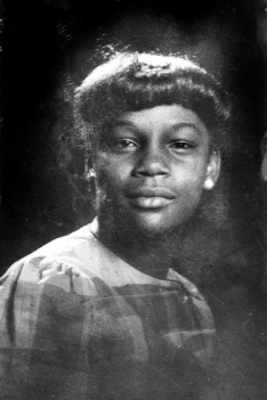
Latasha Harlins died 13 days after the beating of Rodney King on March 16, 1991 at The Empire Liquor Market in South-Central Los Angeles with two dollars in her hand. After attempting to purchase a bottle of Orange Juice, Latasha and Korean Store Owner Ja Du got into a verbal and physical altercation. Du thought Latasha was trying to steal the $1.79 drink, which lead to a fight. Latasha struck Du and the two mouthed words before Harlins turned to walk out the door but it was too late. Ja Du pulled the handgun from behind the counter and shot the teen in the head. The entire ordeal was caught on tape and Latasha died instantly. She was 15 years old. November of that year, a judge sentenced Du to five years of probation, 400 hours of community service, and a $500 fine. Tupac’s “Keep Your Head Up” was dedicated to Latasha Harlins.
The Deadwyler Case
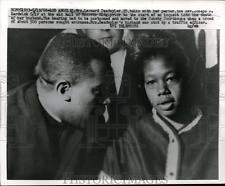
Johnny Cochrane is another prominent name in the black community. Modeling his career from the inspiration of Thurgood Marshall, Cochrane was born in Shreveport LA and gained his fame after defending such big names as Micheal Jackson and O.J. Simpson. An unfamiliar face however lies in the name of a man whose death is responsible for launching Johnny’s reputation: Leonard Deadwyler. Deadwyler’s death galvanized protests and activism that lead to the Martin Luther King Jr. and the adjoining Charles R. Drew University of Medicine and Science. While speeding through several red lights, Leonard Deadwyler raced in an attempt to get his pregnant wife, now in labor, to the hospital. Due to the lack of a black hospital near by, the Deadwhyler’s had to attend a facility 20 miles away. On the way, Leonard was stopped by police and a confrontation erupted which resulted in the shooting death of Leonard who was shot and killed in front of his pregnant wife. Police said the ordeal was the result of a drunken Leonard to the debate of his wife who remembered no such account. Blacks in South Central protested that Deadwyler would not have been speeding, and thus not shot and killed if there was a hospital near by. Leonard’s wife sued with a young Johnny Cochrane as her lawyer who filed a Civil Suit on behalf of the Deadwyler family. They lost the case, but Cochrane had already set himself apart as a talented lawyer as it pertained to Civil Rights, police abuse cases.
How I Stay Positive – The Four Agreements

•Be impeccable with your word.
• Don’t take anything personally.
• Don’t make assumptions.
• Always do your best.
I try to stay true to these steps and in return they help me to maintain peace and positivity in my life.
Be impeccable with your word
We’ve all heard it before: “All a man has is his word”. This is the truest thing ever spoken. It doesn’t matter if that man is poor, if he is rich, if he has a successful career, etc. What sets him apart from the other is his speech. The things he says, how he says them and why. A good man or a good woman can always be dependable when it comes to their words. They are not gossipers, they are not slanderers, and they are not backbiters or murderers of the tongue. They make sure that the words they speak will not bring about negativity and strife either to themselves or others. Be impeccable with your word. If you say you’re going to do something, do it. Flattery will get you nowhere. Let your actions speak.
To be impeccable with your word means to:
• Speak with integrity
• Say only what you mean
• Avoid using words to speak against yourself
• Avoid using words to speak against others
• Use the power of your word for truth and encouragement
2. Don’t take Anything Personally
This was a big one for me and I do believe for most people. The origin of strife and drama is usually because people choose to take things that other’s say way too personal. In return, they react (either by word or deed) in a defensive way. We forget that others have opinions and that these opinions are based on their own experiences and perspective. This means their words are a reflection of them NOT YOU. However, this is rarely if ever understood and we allow negativity to come into our space because we are so caught up in ourselves. We think that the things people say and do is always about us. Even when those things are about us, we are so quick to give up our power. But when we avoid taking stuff personally, we take away the power that others try to have over us and can instead focus on encouragement and positivity for ourselves and others.
Here are some techniques to help:
• Use “I” statements.
• Don’t put yourself down.
• Don’t use excuses or blame others.
• Offer any possible alternatives.
3. Don’t Make Assumptions
This one is just as big as the last one: Don’t Make Assumptions! The problem that leads us here is usually our own convictions. We have issues (as we all have) and sometimes someone gives a message, or comment, or opinion that exposes these issues. The people or person exposing these issues are not intentionally targeting a specific person or group, they are simply stating truths. However, there is almost always someone who will be convicted by such truths and in turn become offended. As a result, because they cannot be sure if such a thing is targeted toward them specifically, they create the assumption that it’s just them and the other person in the world and the other person had so much time on their hands that they decided to speak negatively about them. The product of an assumption is always because someone took something personally or did not verify their sources. To avoid making assumptions, it is always best to gather all of the facts since many assumptions are made because people don’t ask for clarification. I chose to rid assumptions from my life by communicating as much as possible as not to create drama, gossip, and confusion < all of which are the result of an assumption.
4. Always Do Your Best
Stay away from the bare minimum and strive for excellence. Deny yourself the satisfaction of being lazy; instead, approach every project with the same level of professionalism despite the reward. The key to this agreement is to recognize when you are doing your best and accept those results despite the quality. Too often we set our goals by what other people deem important instead of what we know to be important. We whine and we complain that our results are not their results and this is a recipe for disaster and robs you of the positive in your life. As long as you look for confirmation from others you will always be second best. Instead, look to do things differently and to the best of your ability. Create a uniqueness that is exclusive to you and be good at it. This is what draws people into you, whether it is your writing or your blog. Always do the best you can and notice those small progressions in your life. To focus on being positive, encouraging and doing your best, stop focusing on the problem and work toward a solution. Learning comes by trial and error, so do not expect everything to succeed. Sometimes you’ll have to learn by doing it wrong. As such, you will begin to see why it did not succeed and try again the next time. Only this time you are so much more knowledgeable and wise about that thing. You did not focus on the act of failing, you focused on what you can do to succeed. Positive people always see the good in things because they focus on the good.
Everything Must Move – What Watching Movies Taught Me About Writing

This post was conceived while watching one of my favorite movies. Thus, as usual, it is based on my personal experience. So anyway, to the point…
I found myself paying attention to what was going on in the background of this particular scene in this movie instead of what the leading characters were doing. To better understand this, I challenge you to do the same. Choose one of your favorite movies, what’s going on in the backdrop? An old man is laughing with his wife. The waiter is walking away from a table, she looks down at the notepad before walking away. Behind her, the bartender throws a bottle into the air before catching it with his other hand and pouring the liquor into the long line of glasses in front of him. The waiter walks up to the bar, picks up two of the many glasses and walks them over to her table. The old man and his wife smile while nodding thank you.
What just happened? What happened is that there’s an entire event taking place in the backdrop of what’s happening in the forefront. Though not the center of attention, everyone in the scene moves. Though not the primary characters, everyone in the scene is doing something.
While working on my next project, I’ve found it helpful to make sure that everyone in the scene from the smallest to the greatest has something to do, or has a goal they want to achieve (despite how small). There shouldn’t be any stick men and women. If we are at dinner, the people behind Nora’s table should be laughing or talking. Not so that it’s overwhelming, she is the leading lady after all, but they shouldn’t just be sitting there. There should be movement. For instance, in A Beautiful Mind, John Nash sits on a bench in front of the University. With him is his old roommate and together they sit there and talk. As they are speaking, there are people walking by, students, professors, and faculty members. And as the camera zooms in and pans around, we notice the people are looking at John oddly.
For those of you who’ve seen the movie or who are familiar with the man John (this movie is based on a true story, Nash just passed recently matter of fact) you know that John Nash suffered from a severe case of schizophrenia. His college friend does not really exist. From the first time viewer’s perspective, John is just sitting there talking to an old friend. But if you notice the people in the backdrop, they are not just walking by, they are walking by and staring. Why? You assume its because John has always been a little, well, off kilter. Weird. Odd. By the end of the movie however, you realize that the people are staring because John is sitting on a bench talking to himself. They are staring because there is really no one there. Though not the center of attention, even these people have a purpose for being. In this case, they are hints that help lead up to the end of the movie so that it all makes sense.
I’m not saying writing fiction and writing a movie script is the same thing because its not. What I am saying is that everything around us can be useful to help us in our writing. Who says we can’t use non-conventional means to build on creativity? After all, that’s what creativity is anyway, inventing new ways to do things.
Since working on The Renaissance (my 2017 novel project) I’ve been using this technique (making sure everyone in the scene has a purpose) and its really been helping in my development of the story. It helps me to ensure that everything is accounted for and that there are no loose ends. From the protagonist, to the lady swatting at a fly standing behind her, everyone has a goal or a reason for being. Everyone and everything moves.
Unfamiliar Faces – Lost to History: Before Parks

“They said they didn’t want to use a pregnant teenager because it would be controversial and the people would talk about the pregnancy more than the boycott,” Colvin says.
Was Rosa Parks the only woman to refuse to give up her seat on a segregated bus? Below are a few of the women left out of the history books.
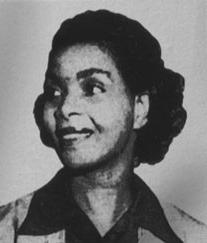
Irene Morgan – We have all heard of Rosa Parks, but there were at least three women who refused to give up their seats on the bus in the Jim Crow south throughout history. Eleven years before Parks, Irene Morgan, later known as Irene Morgan Kirkaldy, a black woman, was arrested in Middlesex County, Virginia, in 1944 for refusing to give up her seat on an interstate bus according to a state law on segregation. The Irene Morgan Decision inspired the men and women of CORE to create a nationwide protest movement called “The Journey of Reconciliation” when groups of civil rights activists rode buses and trains across states in the South in 1947, a precursor to The Freedom Rides of 1961.
The Irene Morgan v. Commonwealth of Virginia, handed down a landmark decision on June 3, 1946, when they agreed that segregation violated the Constitution’s protection of interstate commerce. Irene Morgan v. Commonwealth catalyzed further court rulings and the Civil Rights movement. Eight years later, the Supreme Court decided in Brown v. Board of Education that segregation violated Equal Rights Protection.
Irene Morgan died on August 10, 2007.

Claudette Colvin – Born on September 5, 1939, in Montgomery, Alabama, Claudette Colvin refused to give up her seat to a white passenger months before Rosa Parks on March 2, 1955. Colvin was only 15 years old but she was poor. She didn’t have the NAACP or the connections Parks had. As a result, little is know of her. The NAACP considered using Claudette but they said she was too young. They also looked away because she was pregnant and they did not want to represent a young, unwed mother and bring about negative attention to the movement. They thought Colvin’s condition would make blacks look bad. Colvin went on to serve as a plaintiff in the landmark legal case Browder v. Gayle, which helped end the practice of segregation on Montgomery public buses. Today, Claudette Colvin is still not a name you hear very often concerning bus desegregation, even though she was there before Parks.
“Whenever people ask me: ‘Why didn’t you get up when the bus driver asked you?’ I say it felt as though Harriet Tubman’s hands were pushing me down on one shoulder and Sojourner Truth’s hands were pushing me down on the other shoulder. I felt inspired by these women because my teacher taught us about them in so much detail,” she says.

Aurelia Browder – After Colvin, Aurelia Browder followed suit and was arrested on April 19, 1955, for refusing to give up her seat. Browder was born on January 29, 1919. She joined the NAACP, SCLC (Southern Christian Leadership Conference), the Women’s Political Council (WPC), and the Montgomery Improvement Association (MIA). Aurelia could join all the organizations she wanted but with six children and no husband, her refusal to give up her seat on a bus did not stick, even though she was before Parks.

Mary Louise Smith – Mary was born in 1937, in Montgomery, Alabama. She attended and graduated from St. Jude Educational Institute. On October 21, 1955, at the age of 18, Mary was returning home on the Montgomery city bus. At a stop after Mary had boarded and seated, a white passenger boarded. There was no place for the white passenger to sit and Mary was ordered to give up her seat. She refused. Mary was arrested and charged with failure to obey segregation orders and given a nine dollar fine, which her father paid.
Irene, Claudette, Aurelia, and Mary Louise was followed by Susie McDonald, and Jeanetta Reese, all had been arrested and charged with violating various policies regarding segregated seating on city buses.
Discover more Black History Fun Facts and Lost to History Facts HERE.
Why I Set Blog Goals: A Message For Beginner Bloggers

I don’t want to be stuck in the same place. I hear people talk a lot about how numbers don’t matter and to an extent yes, you don’t want your sole motivation of blogging to be riding on the back of followers and stats but at the same time, life is about evolving. As a student the idea is not for you to be forever learning at the foot of the professor. The idea is to learn, apply, and to grow. One of the greatest gifts a teacher can see is a student who has become a teacher. It shows that the student has applied the lessons and that the professor has done his or her job, for its one thing to know and an entirely different thing to pass on information so that others can understand it.
Why Do I Set Blog Goals? Because numbers don’t lie. They are not here to be ignored. And while they are also not here to lean too much on, they do serve a purpose in the end. That purpose is to market growth and development. This means that if we desire evolution then we must put those things in place that are necessary to get there. What I love about the blogging community is the excitement of seeing someone who has reached a certain viewership or follower number. I love this because if you don’t appreciate the little things in your life, then why are you deserving of more? You are not defined by your numbers, but they are there for you to measure improvement. Life in general is about learning and applying and evolving so it doesn’t make sense to me not to strive for excellence.
Deep down everyone knows that goals are the difference maker between so-so performance and stellar achievement. Studies conclusively show that goal-setters routinely outperform their “wing-it” counterparts. – https://pushingsocial.com/3-goals-that-every-a-list-blogger-swears-by/
In no other area of your life can you grow or increase without a clear definition of where you want to go. You want to write a book but you have steps you need to get there. You want to start a blog. You want to grow a blog, but you need a clear vision of how you are going to get there. You can’t just sit back and wish for more interaction. Nor can you simply know what your goals are, but you need a clear plan on how to reach them. Setting a goal for your blog can be beneficial to increasing your number of views and subscribers, growing your brand, and taking you to that next level.
Quick Tip:
Selecting the right goals are just as critical as achieving them
https://pushingsocial.com/3-goals-that-every-a-list-blogger-swears-by/
There’s a lot I want to do with this blog, including purchasing a domain name for it. But, how do we get there? Some of you may wonder how to set goals for your blog and that’s a different post in itself because you don’t want to set just any goal. You want to set the right goals. Usually we say, “I want this many followers and this many views” or as I’ve just said, “I want my own domain name for my blog” but in my short experience as a blogger these are not the right questions, not in the beginning. Your first goal should be defining your audience. A bloggers strong understanding of their audience is a sure way to see results. Ask yourself: Who are they? What Problems do they have that my content offers (or will offer) solutions for? And as you go throughout the week, push the content that specifically answers these questions. These are the best posts and the ones of value. Just got high interaction on a post? Listen to it. Study it. What did it have that, let’s say your least successful post, did not?
7 Thoughts on the New Roots

When I first heard they were remaking Roots, I was skeptical. I thought, “Some movies do not need to be remade.” I admit, I was looking on the physical and thinking, “Maybe it won’t be as powerful as the first.” But after watching it I must say it remains one of the most powerful series on TV, followed by Underground. But first, here’s a little History:
What is Roots?
Roots: The Saga of an American Family is a book published by Alex Haley in 1976 with a miniseries of the book that first premiered on television in 1977. During this post-civil rights era the show is about the ancestors of Alex Haley, particularly Kunta Kinte, who was kidnapped from his life in Africa and sold as a slave on the Trans-Atlantic Slave Trade. The Show was put out in a series of eight episodes to try and get it out the way as the networks didn’t think it would do well. However, the show proved them wrong, airing over the course of eight days and helping to galvanize a nation. See, to understand why Roots the remake is important in this day and time is to understand the history behind it and what it did to America. The TV series led to a renewed interest in genealogy from blacks who, due to slavery, felt robbed of their identity and cultural heritage:
If you weren’t there—if you’ve only known television in its post-Big Three networks era—it’s hard to understand the impact of the original Roots. Based on Alex Haley’s book of “faction,” the ABC miniseries’ 12 hours (with commercials) were spread across eight consecutive nights in January 1977, an unprecedented programming move that consolidated the show’s status as an event. The subsequent audience ratings were also unprecedented: 85% of television households, or 130 to 140 million Americans (more than half the U.S. population) saw at least part of the series; an estimated 100 million viewers tuned in for the two-hour finale on Sunday, January 30. – http://www.biography.com/news/alex-haley-roots-tv-show
1. Our Culture
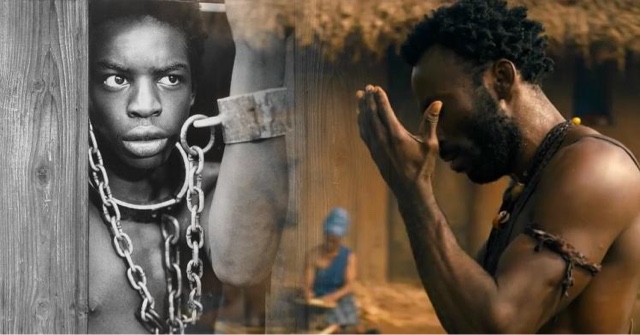
In the remake, it well represented the ancient culture of the African American. For centuries they have taught us we were animals running around naked with large hoops in our ears and swinging from trees. Taught that we were just Africans. While no TV show has gone as deep as to proclaim the unadulterated truth concerning our roots (not even Roots), I enjoyed the pieces of it sprinkled in the opening village scenes in the beginning because its an accurate portrayal of some of our culture. I loved that they showed the ancient garments, the head wraps and the midwives. Even the spreading of the palms to the heavens to pray. This is what we did and how we did it.
2. Stripped
By the time Kunta was on the slave ships he’s naked. Now we’ve seen this before in other shows, but what does it mean? This is highly significant of being stripped of your entire way of life. Gone is the beautiful blue garb, gone is the honor and the esteem, gone is the culture, and gone is the name that defines who you are.
3. Names
I don’t want y’all to sleep on the name part. Kizzy told Chicken George, “Your name is who you are. My daddy took beatings to protect his name”. Very powerful. People like to take names for granted. Often we look at them and they don’t hold any real significance but names are very important. Take away a persons name and you strip their entire identity. Your name is your character, and your persona. Your name is who you are. When we were stripped of our name, we were stripped of everything.
“People say what’s in a name? There’s a whole lot in a name. The African gets respect because he has an identity and cultural roots.” – Malcolm X
4. Biblical Insight
One of my most favorite scenes is when Chicken George introduced his mother Kizzy to his future wife and father-in-law and she said to him: “Massa don’t want you teaching about Exodus. About how the children of Israel walked across the red sea to freedom. He tore that right out the book.” Very powerful scene. Why? Because it’s the whole reason we weren’t allowed to read and write. Massa just didn’t say you couldn’t read because he thought you were an animal, an inhumane being. That’s only part of it. He didn’t want you to read because he didn’t want you to read the bible. Now why is that? Because the bible is black history.
5. Whites Persecuted
Another powerful thing this show portrayed is the persecution of Europeans who help blacks. This is also something they showed in the TV series Underground and I think its something that African Americans cannot sleep on. There are, and have always been, those of other nationalities who were wiling to help blacks to their deaths. Blacks were not the only ones lynched and maimed and murdered but also those who helped them.
6. Less is More
I didn’t like that they cut the series in half. I think it was too short. I also found it funny initially that Kunta’s character wasn’t switched out like in the first one so he looked the same throughout the series. However, I noticed that instead of going verbatim to the original they filled in those parts of the story that were missing from the first part. This was smart I think of the directors because this version has its own original feel. I thought this new Roots wasn’t going to be good compared to the first one but in truth they each are separate shows. While they tell the same story, the new Roots has a modern feel to it. Lawrence Fishburne, T.I. and Mekhi Phifer make their appearance and Kunta is a beast!
7. Now or Then?

I don’t think the new roots can compare to the original. To me, the 1977 version will always stand as a classic. I also do not think the original could speak to today’s youth like the new one can, which makes it an original of its own.
We have to consider that 2016 is not 1977. It’s a different world and the new roots is a fresh way of introducing to new generations the legacy of Roots.
 The PBS Blog