
On the tail-end of his TMZ interview, Kanye West posed a question, “is it true that blacks used to be Republican?” He went on to say, “the majority of African Americans used to be Republican….what was the reason that majority of blacks went from being Republican to being Democrats?”
I thought it would be a good time to merge current events with a fun fact for anyone who may have been left confused. While I won’t say that every black American did so (that wouldn’t be accurate), it is true that until the 1960s, the majority black American voted Republican. And for the record, let me be crystal clear: I am not a Republican and I am not a Democrat. They are two wings of the same bird as far as I am concerned. Malcolm X said it best:
I’m no politician. I’m not even a student of politics. I’m not a Republican, nor a Democrat, nor an American – and got sense enough to know it. I’m one of the 22 million black victims of the Democrats. One of the 22 million black victims of the Republicans and one of the 22 million black victims of Americanism. And when I speak, I don’t speak as a Democrat or a Republican, nor an American.
– Malcolm X, (1964). Speech, The Ballot or the Bullet. Retrieved from http://americanradioworks.publicradio.org/features/blackspeech/mx.html
Due the African American experience in this country (U.S.), most black voters I’ve spoken to support the party they feel are in the best interest of black people (even if they really aren’t, ijs) and back then this party was the Republican party. It was the party of Lincoln, who many blacks saw as a hero because of the Emancipation Proclamation, freeing the enslaved in certain states.
A little-known fact is that Martin Luther King Dr. was closer to Republican candidate Richard Nixon than he was Kennedy. King and Nixon were friends. They met in Ghana in March 1957 and agreed to stay in touch. That summer, Nixon worked with King to strengthen the 1957 Civil Rights Bill.
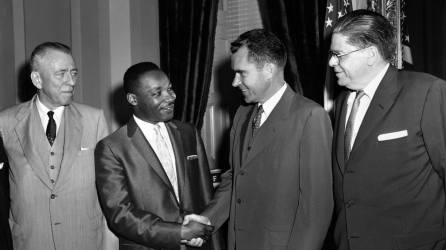
“I will long remember the rich fellowship which we shared together and the fruitful discussion that we had,” Dr. King later wrote to the vice president, telling him “how deeply grateful all people of goodwill are to you for your assiduous labor and dauntless courage in seeking to make the Civil Rights Bill a reality… This is certainly an expression of your devotion to the highest mandates of the moral law.” – MLK
Nixon replied, “I am sure you know how much I appreciate your generous comments. My only regret is that I have been unable to do more than I have. Progress is understandably slow in this field, but we at least can be sure that we are moving steadily and surely ahead.” (Read Nixon’s full letter to King Here.)
King and Nixon talked often and after a black woman in Harlem stabbed Dr. King at his book signing in September 1958, Nixon was among the first to write to him.
Why are we talking about this?
Because what halted their friendship had a lot to do with what also ultimately halted the majority black vote of the Republican Party.
In his fiery inaugural speech in January of 1963, the new governor of Alabama, George Wallace had pledged, “segregation now, segregation tomorrow, segregation forever.” (you know, the clip used in every documentary about the civil rights movement) This launched civil rights protests throughout the city of Birmingham, Alabama.
Birmingham at the time was already a very racists city. It was where lots of Civil Rights activity took place that was met with violence and the city was nicknamed Bomingham because of the number of bombings that took place on a regular basis from people in opposition to integration. Such bombings resulted in the bombing of homes and lead to such tragedies as the bombing of the 16th Street Baptist Church on September 15, 1963 killing four little girls. The church stood in an area common for such attacks.
When King was arrested on October 19, 1960 during a sit-in protest of lunch counters in Atlanta and sentenced to hard labor, Civil Rights Activists approached both sides, Democratic and Republican, rallying for someone to do something to get King out of jail. Nixon even got a visit from Jackie Robinson, asking him to help with getting Dr. King out. Robinson was opposed to John F. Kennedy as President because he thought he was weak on Civil Rights and so did many black Americans at that time. It was common knowledge that the Democrats had the support of Southern racists. During the campaign, Kennedy raised suspicions in the black community by his support of Southerners, meeting privately with them and promising Governor Vandiver that as president he would never use federal troops to force Georgia to desegregate its schools.
Long story short, Nixon shot Robinson down, saying, it would be “grandstanding” to speak out in defense of King, according to his aide William Safire. This forever changed Nixon and King’s relationship….and King’s endorsement.
“I always felt that Nixon lost a real opportunity to express … support of something much larger than an individual, because this expressed support of the movement for civil rights in a way. And I had known Nixon longer. He had been supposedly close to me, and he would call me frequently about things, getting, seeking my advice. And yet, when this moment came, it was like he had never heard of me, you see.”
– Dr. Martin Luther King Jr.
It is my opinion that Nixon withdrew because he had ulterior motives with starting Cointel Pro, the Counter Intelligence Program that destroyed such black revolutionary organizations as The Black Panthers.
Meanwhile, Bobby and Jack Kennedy discussed the political ramifications of getting King out of jail. Senator Kennedy phoned Governor Vandiver asking if there was anything the Governor could do to get King out. (Thomas, Evans (2013). Robert Kennedy: His Life. pp 103.) Vandiver didn’t want to do it but he wanted Kennedy to win the presidency. A call was made to Coretta Scott King, word got out about the phone call, rumors spread, and shortly afterward, King was released from jail. Upon landing in Atlanta, King endorsed Kennedy and because blacks supported King, they supported Kennedy in mass.
While I cannot say for sure this swung the black vote in the Democrats favor 100% (there’s no way to provide proof of this on my part), I do know it had a LOT to do with it.
“Nixon in 1960 won just 32 percent… Four years later, facing Barry Goldwater, Lyndon Johnson won 94 percent of the black vote, which set a demographic pattern that endures.”
(Frank, J (2013, 21 January). When Martin Luther King Jr. and Richard Nixon Were Friends. Retrieved from https://www.thedailybeast.com/when-martin-luther-king-jr-and-richard-nixon-were-friends)
Meanwhile, Kennedy had been in the White House for years and had not delivered on his promise to support new anti-discrimination measures. When he was a Senator, he had promised that he would which resulted in a ton of support from African American voters.
“The first thing the cracker does when he comes in power, he takes all the Negro leaders and invites them for coffee. To show that he’s all right. And those Uncle Toms can’t pass up the coffee. They come away from the coffee table telling you and me that this man is all right. Oh, I say you been misled. You been had. You been took.”
– Malcolm X
Malcolm X, By Any Means Necessary: Malcolm X Speeches and Writings (Atlanta, GA: Pathfinder Press, 1992), 59
It wasn’t until violent protests forced Kennedy to act that he did act. Racial tensions had reached a fever pitch. American citizens were horrified to see blacks being bitten by dogs, beaten with clubs, and drowned with water-hoses. Protests were getting more violent. All of this led up to the signing of the Civil Rights Act. John F. Kennedy proposed and Lyndon B Johnson signed the Civil Rights Act of 1964 which ended segregation in public places and banned employment discrimination on the basis of race, color, religion, sex or national origin, and is considered one of the crowning legislative achievements of the civil rights movement
…and many blacks have been voting Democratic ever since.
“He was sentenced to six months at hard labor, but presidential candidate John F. Kennedy reached out to the King family and helped secure Dr. King’s release, earning him pivotal black votes that would help him win the presidency that year.”
Black Then, (2017, 25 August) October 19, 1960 – Martin Luther King Arrested in Atlanta Sit-In Protest. Retrieved from https://blackthen.com/october-19-1960-martin-luther-king-arrested-in-atlanta-sit-in-protest-video/
“The government itself has failed us. And once we see that all of these other sources to which we’ve turned have failed, we stop turning to them and turn to ourselves. We need a self-help program, a do-it-yourself philosophy, a do-it-right-now philosophy, a it’s-already-too-late philosophy. This is what you and I need to get with. And the only time – the only way we’re going to solve our problem is with a self-help program. Before we can get a self-help program started, we have to have a self-help philosophy.”
– Malcolm X



 The PBS Blog