“But My Family Don’t Support my Writing”

Popular Complaint: “My family don’t support my writing.”🤷🏾‍♀️

Umm. How can I put this, your family and friends will be the least supportive of your writing (as is the case for most businesses). That’s not a bad thing entirely because they are not really your targeted audience.

New Writer:  *Smacks lips, rolls eyes.* “Okay, so what that mean?” 🙄

It means you have to find those people who are most likely to read the kinds of books you write and often, they are not family members. This specific group of people is called a targeted audience. You are not targeting everyone but focusing on one specific kind of reader. Here’s an example from words from Tyler Perry:

“I clearly believe that I’m ignored in Hollywood for sure and that’s fine. I get it. My audience and the stories that I tell are African American stories specific to a certain audience, specific to a certain group of people that I know that I grew up with and we speak a language.” – Tyler Perry

Say what you want about Perry but he has a keen understanding of his Target Audience. That’s what he is speaking of here. A specific group of people who his films/movies/TV shows are specifically for. That’s why his movies are all along the same lines in the theme. We can see that Tyler Perry makes the same movies because he is targeting a specific audience.

Personally, I am not much of a Tyler Perry fan. There are only a few of his movies I like but that’s not the point.

We can agree or disagree with his movies, but he is an excellent example of someone with knowledge of his Target Market.

When you are targeting a specific group, you are not trying to reach everyone or garner everyone’s support. Your purpose is to appeal to that specific group.

(Feel like I’m saying “specific” a lot but that’s kinda important). 

How many people at Michelle Obama’s book signing were related to her?

New Writer: “What? But those was her fans tho.” 🧐

And you have fans too if you look beyond the praise of family members who will probably never buy.

New Writer: “So you saying my mama can’t buy my book?” 💁🏾‍♀️

Your mom will probably buy your book first, but she’s not the seventeen-year-old black boy with peer pressure issues you wrote it for is she?

New Writer: “I mean naw but…”🤨

…and she’s probably not gonna leave a book review on Amazon, follow you on Goodreads, Twitter, Instagram, or subscribe to your email list and if she does, she probably won’t remember to read it.

New Writer: *smacks lips* “Dang why you gotta be all negative for?” 😒

Because the truth will set a lot of writers free from unrealistic expectations about what it means to be an author.

Loyal family/relatives may buy a book or two and they may be there to cheer you on, lift you, and support you in various ways. Families are good at heaping praises.

They love to like your posts, root you on and tell you repeatedly how they intend to buy your book and how proud they are of you. This is helpful from an encouraging point of view and it feeds the ego, but praise doesn’t sell books. How many of these people follow up? Every year the same family member asks, “where can I buy yo book?” But they never buy.

It is those non-relative readers who your book is specifically written for who will buy with consistency and read your every release, becoming avid readers and fans.

(…and I hate to use the word “fan,” by the way. *Shudders* Be a fanatic for no one.)

👉🏾How many of your genetic relatives have bought your book?

New Writer: “Lemme see, my mama got one, my cousin, boo boo nem, lil Chris…”

So what, all five of them..?

New Writer: “Oh, so you being funny?”🤔

No. I’m being real. Put it this way, would a company whose buyers don’t watch TV, make a commercial to push their product?

New Writer: “Naw that’s stupid.”🙄

🤷🏾‍♀️ So why would authors focus the bulk of their efforts on trying to sell to people who don’t read the books they write?

New Writer: “I guess I see what you saying.”😩

Now, take out some paper. You’re gonna have to write this down.

…wait, what are you doing? Put your phone down this is important. 🤦🏾‍♀️

New Writer: “Imma type it in my notepad.”

Okay but don’t be on Instagram this is important.

New Writer: I’m not dang. 🤳Go. I’m ready.”

Okay, here are a few questions you can ask yourself to help you find your readers. 

  • Who are my current readers/Who am I trying to reach? How old are they? What do they like? Where do they hang out?
  • What’s the #1 thing my readers love/need the most?
  • What problem does my book solve? What are my readers’ pains/issues/struggles/challenges?
  • What do readers gain from reading my book? What do I have to offer?
  • Who would benefit most from reading my book?
  • What makes my book unique?

My Responses to Common Complaints from New Writers is something new I am adding to this blog based on common writing and publishing questions from new Indie Writers. I thought it would be fun to answer them here in the form of dialogue. You will know the posts by the quotation marks around the complaint to differentiate it from other posts.

Did you like this first post? Do you have a common complaint I should address?

Find more articles under the Writing Tips and Resources page here.

Nourish Your Offline Relationships

Photo by Priscilla Du Preez on Unsplash

Would you know if your friend is feeling down if he/she didn’t post about it? Would you know when his/her birthday was if Facebook didn’t tell you? Would you have the information necessary to congratulate those you love on their achievements, like weddings, and graduations if they didn’t post about it?

How well do we know the people we call friends?

Yesterday was my husband’s birthday and birthdays always have me thinking about relationships and social media. A few years back I had deactivated my Facebook a few days before my birthday. I didn’t feel like being bothered with accolades from people who hadn’t spoken to me since my last birthday. An interesting thing happens when I do this: The people who know me most will call or text me. Then, at the conclusion of the day I’ll post something on social and out of the woods will come those who thought they knew me and yet didn’t know something as basic as the date of my birth.

I had one person I considered a sister call me three days after my thirtieth birthday. There’s no harm in this. I’m not that sensitive. People don’t have to stop their lives for me. Reach out when you can. What I found odd is not that she called three days later. What was odd is that she thought she had called on my actual birthday. I found this odd because I thought we were closer than that. I had known the woman over ten years. We had lived with one another at some point, interacted with one another’s children, dined together, laughed, and had deep conversations. This wasn’t just any sister, this was someone I thought knew me well. Well enough to know my birthday is not May 29th. It doesn’t surprise me that today, we are no longer in touch.

But don’t get distracted. This is not about birthdays.

This is about the work we put or do not put into relationships now that Social Media automates our lives. Now that there is “an app for that” some of us have become lazy in our interactions with one another.

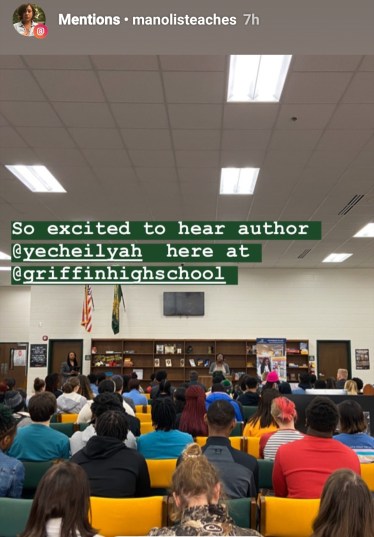
I had the pleasure of visiting Griffin High School last weekend. I spoke to four classes of tenth and eleventh graders about writing, publishing, and my journey as an author. I love young people. I love their innocence and straightforwardness. I love their non-sugarcoating questions. Many of them asked me if I “made a lot of money,” and “how do I deal with criticism?” It swelled my heart to have the pleasure of being there with them. One student asked me if I thought the ebooks would overtake paperbacks. I told him that while digital has enhanced writing in many ways, I think the paperback is here to stay.

Digital books are convenient when I am eagerly expecting reading a book and I don’t want to wait for the paperback to come in the mail. It’s fast and quickly satisfying. Buying a paperback book costs more and takes patience but when it comes there is something immensely gratifying about holding the book in my hands and turning the pages. A feeling I do not get when I read digitally. When I can look in someone’s eyes and talk with them as I did last week, answer their questions, hear their concerns, sign their books organically, hug them and take pictures with them, nothing online can compare to that experience. That human experience.

Let’s say digital books represent social media and paperbacks represent real life. While it may be easier to wait for a notification to tell you that your loved ones are “feeling sad” it is much more productive to hear their voice on the other end of the phone or to give them an inspiring word through text. It is even more fruitful to see them face-to-face, to hear their voices, and look into their eyes. Some things you will never know about a person from their social media pages. If they are like me, quiet, reserved and private, you will only get the basics. Facebook may tell you when it’s my birthday or notify you when I am traveling or checking into a restaurant but for those personal, heartfelt thoughts? There’s no app for that.

Nourish your offline relationships. To nourish someone is to feed them deeply with something good for them. It means to give them something that will encourage them to live well. When you do this, you do not make assumptions about anything you see in the virtual reality. You are not easily offended because someone “didn’t tell you” they were traveling or gathering or graduating. You already know these things because you have built a real-life relationship with the people you love and that bond is stronger than any post, tag, or “Friendversary” that pops up in your Facebook memories.

Hypocrites

Photo by Mario Purisic on Unsplash


They have turned truth into a popularity contest
where contestants compete to measure egos
against evidence
but their faith is all fluff
and their zeal, a Judas kiss.

They forgot where they came from
so the hood is desolate of disciples.
Far be it from them to be seen in the streets of sinners
(the messiah did it, but they don’t really know their scriptures)

They preach salvation
but dine with demons
They walk on water
and dress in white
but they are not wise

Scripture is an early-morning anthem
but when one is hungry, they walked right passed them

Their heads are high, their garments fresh,
the world is ending; the time is dire
but the hypocrites do not reach for the lowly
they preach to the choir.
They teach those who already know the lyrics to the song
too mighty in their own eyes to see their own wrong

They sound intelligent to the human ear
but they crawl on their bellies and their eyes are slits
these die-hard saints are really just snakes
and hypocrites

Reminder: Guest Bloggers Wanted: Black History Fun Fact Friday

Hey guys!

I am stopping through to remind you I am looking for writers interested in submitting articles to this blog for my Black History Fun Fact Friday series. Below is a reminder of the qualifications for submission. Also, notice I have added a deadline to articles for Black History Month. There are four Fridays in February this year and so far we have one article submitted. This means there are only THREE slots left for those of you who want to get in for Black History Month. (This is not a Feb only opportunity, but a weekly one so don’t fret if a Friday in Feb is not open when you submit).

  • Because of the nature of this series interested writers must be Black/African American (this includes so-called Afro Cuban, Jamaican, Haitian, Cuban, Afro Brazilian, Dominican, etc.).


  • Must be original work. Do not copy and paste the article from other blogs unless that blog is your own. If you have a Black History article to share that you published to your site you are welcomed to submit it for Black History Fun Facts. I have no problem with that as long as it is your work.


  • Topics must be relatable to the history of Blacks/African Americans.


  • Articles must be emailed to me for approval at least one week before publishing. If you email your article on 1/31 for example, I will publish it on 2/7 if there are no needed changes. This series is not exclusive to Black History Month but if you want your articles published in time for February, please have them submitted no later than Monday, January 27, 2020. Writers looking for more exposure will be wise to try for a Feb slot. A Black History Article during Black History Month will naturally attract more readers.


  • Please send articles in a Word Document, 12p Font, Times New Roman text.


  • Please do your best to self-edit your work for basic typos/spelling/grammatical errors before submission. Grammarly andProWritingAid are good free self-edit software programs to use.


  • The BHFFF badge will be included in every post but you are welcomed to create your own image to add as well. Canva is a good program to use to make your own images. Unsplash is good for free images.


  • This is Black History Fun Fact Friday not Black History Opinions so do your best to submit articles covering accurate historical information. I will vet the submissions to make sure they do. If you have links to sources, please include them.


  • Please include a photo of yourself, social media handles, websites, or links to books you’ve written on the topic. This will be added to the end of the post as your call to action. This is where you give readers the chance to follow/learn more about you.

Benefits of Guest Blogging:


  • Increase traffic to your own website/blog
  • Build Relationships/Online Influence
  • Build Domain and Search Engine Authority
  • Capture Wider Audience
  • Develop Your Authority on a topic
  • Improve Your Writing
  • Opens the doors for paid business opportunities

The series is Black Historical so submissions should be articles detailing the history of Blacks in some way. You can talk about The Transatlantic Slave Trade, Enslavement, Civil Rights, Police Brutality, Medical/Educational discrimination, Black Power Movement, Inventors, Black Biblical History, and much more. Tell us about a little Known Black Historical Fact or introduce us to a little-known Black Historical person or place. (For example, I once published a post on Sundown Towns, all-white communities where Blacks were restricted from after Sundown).

Topics can vary as long as they cover Black History (this includes Jamaican, Haitian, Puerto Rican, Cuban, Caribbean, and Dominican.) Specifically, I am looking to feature full-length articles that inform and educate on some part of Black History at 300+ words or more. (Do not send a book, but make sure your article is at least 300 words. We want it long enough to inform but short enough to keep the reader’s attention.)


Email articles to yecheilyah(at)yecheilyahysrayl(dot)com

Questions? Comment below, use the contact form on the contact page or send me an email. 

Caution: Careful Not to Share Black History Memes with False Information

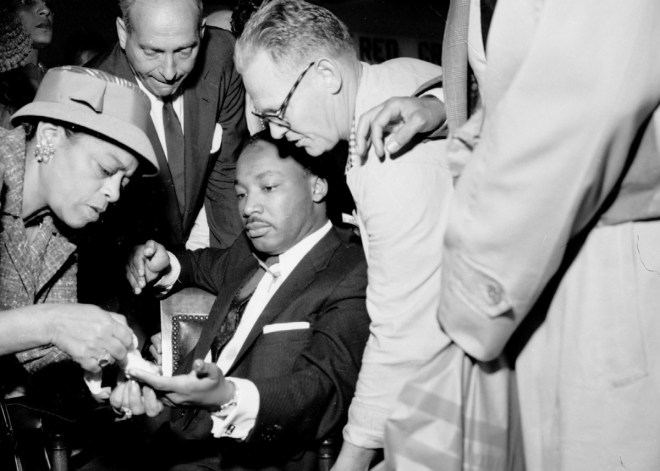
Martin Luther King Jr. recovers from surgery in bed at New York’s Harlem Hospital on following an operation to remove steel letter opener from his chest after being stabbed by a mentally disturbed woman as he signed books in Harlem. (John Lent/AP)

I am reposting this because February is approaching and we will see a lot of false information attached to Black History memes, same as always.

According to a famous Facebook post, King was not killed during an April 4, 1968, assassination attempt, but survived that shooting and was later “smothered by someone in the hospital.”

Is this true?

Let’s see.

Updated 1/28/2021

It’s Throwback Thursday so let’s go back in time a lil bit.

September 20, 1958

The year is 1958 and we are in Harlem, baby. Dr. King is signing copies of his first book “Stride Toward Freedom: The Montgomery Story,” at the Blumstein’s Department Store, on 230 West 125th Street.

It’s a nice afternoon and young King is just twenty-nine years old, releasing his first book and feeling good. And we are feeling good too because we are ready to get our copy. The line is long but before we get bored a voice makes us all stop and look in their direction.

“Is this Martin Luther King?” shouts a well-dressed black woman wearing rhinestone glasses and a matching necklace and earrings but carried an ugly brown bag and an even uglier scowl. The woman stepped out of line, causing groans from the people in front of her.

We don’t know this yet, but she is forty-two-year-old Izola Ware Curry, the black daughter of sharecroppers.

King nodded, “Yes, it is.”

“I’ve been looking for you for five years,” says Curry while pulling a letter opener with an ivory handle from her purse, which we don’t really know is a letter opener because we don’t use those anymore.

“Ooh, snap!” We gasp, placing our hands over our mouths. “Why she come so dressed up for if she was trying to kill somebody?”

“What is she doing?” says another one of us.

“Yea, man. Doesn’t she know this is Martin Luther King?”

“He not all that popular yet,” says a young black boy wearing chino pants and a white polo shirt. He put his hand in his pocket when he said it, smiled and then tilted his head like he was better than us. “Ya’ll not from here, are ya?”

Before we could answer, the sound of screams forces our attention back to the direction of the strange woman. She swings the letter opener at King, and sliced his finger then plunges the seven-inch blade into the left side of his chest.

“Oh, my God!” someone screams and just like that, the store is in an uproar. We are all screaming and running as someone apprehends the woman.

We look at King secretly hoping she didn’t get him because we still kinda want our book.

But when we see somebody who looks like our Grandma rush to his side, we know that’s not going to happen.

Dr. King is sitting in this chair all calm and cool like he ain’t just been stabbed. Meanwhile the letter opener’s ivory handle is still protruding just below his collar.

The police arrive. “Don’t sneeze, don’t even speak,” says Officer Al Howard, fearful of the blade’s proximity to King’s heart. Because of how the letter opener hit him, if King had sneezed, he would have died.

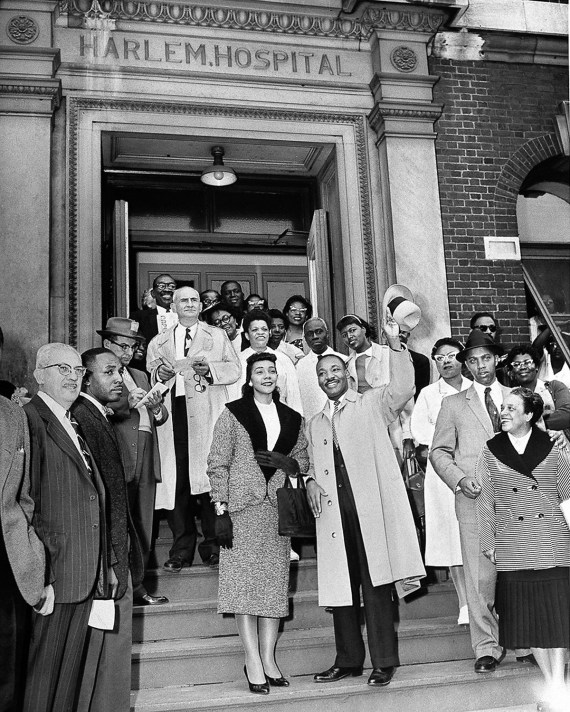
So, they move King slowly and carefully and take him to Harlem Hospital, and he undergoes emergency surgery.


Then, we jump in our time machine and head back to 2021 because it’s wild out here in the 50s.


Oct. 3, 1958
King leaves the hospital almost two weeks after the stabbing

The photo at the start of this post is not of Dr. Martin Luther King Jr. after being shot in Memphis, Tennessee in 1968.

That is a picture of Dr. King ten whole years earlier in 1958 at a New York Hospital after being stabbed at his book signing. He spent almost two weeks in the hospital recovering.

“If I had sneezed, I wouldn’t have been around here in 1962, when Negroes in Albany, Georgia, decided to straighten their backs up. And whenever men and women straighten their backs up, they are going somewhere, because a man can’t ride your back unless it is bent.” – Martin Luther King Jr., “I’ve Been to the Mountaintop.” April 3, 1968

I hope this creative backdrop added some perspective. Although I wrote it like a short story, everything I said here is the truth. Izola Curry, really did attack Dr. King at his book signing in Harlem.

Now to the original post…

There are tons of Black History memes circulating on the internet and this number has increased even more due to it being Black History Month. However, many of these memes are not historically accurate. Please be sure to double check your facts before sharing. Otherwise, you are guilty of spreading disinformation.

Black people have contributed to the world so that we don’t have to make stuff up. If you see a meme with a fun fact on it, just open the internet on your phone and type the name or fact into the search bar. You can tell from there if the material is accurate or not. Sometimes it will even come up that the information is an opinion or cannot be verified by any trusted source.

Use not only your phone to log into Facebook, Twitter, and Instagram. Use it to research these things and educate the people right.

Look for scholarly, peer-reviewed articles on .gov, .edu, or .org sites and trustworthy blogs. Peer-reviewed means information from a reputable source, information that shows that other professionals have reviewed and deemed it worthy of publication.

Wikipedia is not a credible source alone. Other trusted sources should support anything gained from Wiki.

And on the Monday of MLK day when everyone takes off and celebrates his legacy, remember that he was born on January 15, 1929, not whatever Monday you take off.

A Witness to the Experience

My Soul is a Witness: Poetry \ Coming Fall 2020


My Soul is a Witness is a title inspired by the Negro Spiritual song, “Witness,” but I did not choose such a title because I think of myself and my people as “Negroes.” I chose such a title because of the powerful messages and influence these songs had on our people as they transitioned from enslavement to freedom. Powerful messages I hope to also convey through my poetry.

There is a great spiritual awakening happening among Black people today as we strive to unlearn the lies they taught us for over 400 years. Whether that is starting and running our own businesses, embracing our natural hair or re-educating our young people on the parts of our history left out of the history books.

And to what am I a witness?

I am a witness to the trials and struggles my people have endured and I am a witness to our power to overcome those struggles. I am a witness also to my own sufferings which I am sure have been experienced by others. In this way, I am a witness to the fight that we all have. And why the fight? It is easy to present an image of healing and wholeness, but I believe it is much more fruitful if people knew of the struggles that got us where we are today.

From a historical perspective, I have not experienced the Middle Passage or enslavement or Jim Crow, but as a descendent of people who did, I am connected to those experiences just as if I had been there with them. In the Black community, we do not say, “when they fought for freedom,” we say, “when we fought for freedom.” The same can be true of the struggles of our own personal lives. If someone says they have been homeless before, I can relate because I have been homeless before too. I am a witness to what that’s like. If someone says they have a family member who is an addict, I can relate. I also have family members who are addicts. The anguish that causes in a family and what it does to that person and their loved ones are not lost to me. I can relate to that. I am a witness to that experience.

I believe epigenetic trauma is real. Epigenetics is the idea that trauma can leave a chemical mark on a person’s genes, which then is passed down to subsequent generations. (C. Benedict, New York Times) This means that a child or grandchild can experience side-effects from the traumatic experience of his/her elders. Since the concept of epigenetics, more and more studies hint to the inheritability of trauma where our own day-to-day health (and perhaps our children too) may have something to do with our inheritance of our parents and grandparents suffering.

One personal example is my own mother’s struggle with COPD (Chronic Obstructive Pulmonary Disorder). Her grandson, my nephew, suffers from asthma badly, though both his parents do not have asthma. Could he have inherited my mother’s affliction to a degree?

Thus, I do not find it far-fetched that Blacks/African Americans could still struggle from the mental and spiritual grief that plagued our forefathers long ago. We are witnesses to this pain on a deeply personal level which makes the Negro Spiritual deeply personal to us. While our ancestors were escaping physical enslavement, I believe we are escaping mental enslavement today.

As it applies to all people from the perspective of suffering and struggle, we all have a fight we are engaged in and when we overcome this fight, we become witnesses to that experience and can help others to overcome those same tribulations.

If trauma can be passed down, then so can healing. My soul is a witness.


Have you read I am Soul yet? Grab it here. My Soul is a Witness is coming this fall.

My Soul is a Witness

Annndd here she is!

My next collection of poetry releases this year and I have decided on the title, “My Soul is a Witness.” I want to thank the members of my email list for helping me to choose the perfect image (we had a contest featuring several images. If you are not subscribed for exclusive first-looks and sneak peeks, you may click here).

This book releases in the fall and will be available for preorder soon. Exact date to be announced.

Haven’t read I am Soul yet? Get it here.


One of my favorite movies (I have lots of favorites lol) is The Great Debaters. I love the use of language, history, and education, and it also feels like to me they are doing performance poetry, not just debating. When the movie comes on, the Negro Spiritual song, “Witness,” is being sung as the people dance.

Just as with I am Soul, My Soul is a Witness jumped out at me and I felt it in my spirit that this was the appropriate title for the book. The soulful, sacred, and riveting Negro Spiritual songs taught of freedom, of hope, of redemption, and biblical justice and righteousness. I hope these poems do the same for you. I hope that they are liberating, restoring, and reinvigorating. “My Soul is a Witness,” is poetry that reminds us that in our darkest moments, there is still hope. It reminds us that our scars do not cripple us but prepare us for a work, and that our greatest weaknesses make us strong. Here, I give you my ache and my praise. This is a love letter to our overcoming, of yours and mine. My Soul is a Witness.