
Tag: #ThrowbackThursday
90s Throwback Thursday Jams: “Brenda’s Got a Baby” by Tupac
This song is deep. If you can’t see the video, look it up in your country. It’s called “Brenda’s Got a Baby” by Tupac. The song is based on a true story. In March of 1991, The New York Times published an article about a baby who was saved by maintenance men from a trash compactor (umbilical cord still attached) where his 12-year-old mother put him. The maintenance men heard the baby’s cries and called the police—the baby was ultimately placed in Foster Care.
The girl got pregnant as a result of being raped by her cousin. The inspiration for the song came when Tupac read the story in the NYT when he was filming the movie Juice. They filmed the music video in January 1992.
This isn’t the first time Pac’s done this either. He dedicated lyrics to Robert “Yummy” Sandifer, the 11-year-old who died in Chicago and garnered National Attention (the catalyst for the tearing down of the Chicago Projects, read more about him in my post here.) And the killing of Latasha Harlins, a 15-year-old Black girl killed by a Korean store owner in 1992, where he dedicated the song “Keep Ya Head Up”, saying in his sophomore album, “because a bottle of juice is not something to die for.” Latasha’s death, along with the beating of Rodney King that same year, became detonators of the 1992 Los Angeles riots.
Like I said on this blog before, black music and television are also part of black history. I put the most powerful lyrics (in my opinion of course) of the song in bold below.
“Now Brenda’s belly is gettin’ bigger
But no one seems to notice any change in her figure
She’s 12 years old, and she’s having a baby
In love with the molester, who’s sexing her crazy
…he left her, and she had the baby solo
She had it on the bathroom floor and didn’t know so
She didn’t know what to throw away and what to keep
She wrapped the baby up and threw him in the trash heap…”
But no one seems to notice any change in her figure
She’s 12 years old, and she’s having a baby
In love with the molester, who’s sexing her crazy
…he left her, and she had the baby solo
She had it on the bathroom floor and didn’t know so
She didn’t know what to throw away and what to keep
She wrapped the baby up and threw him in the trash heap…”
Why I Write Black Historical Fiction
Historical Fiction (specifically Black Historical Fiction) is my favorite genre to read and to write. I have to specify “Black” because I am not a fan of all Historical Fiction. My interest lies specifically in fiction stories that explore black history in some way.
Historical Fiction is the past recreated around the stories of people who seem real to us, including actual historical figures at times.
As we witness how fictional characters we care about interact with our ancestors and navigate a world now gone from us, it allows us to experience the past vicariously. Through the stories of the characters we can “visit” history and get a feel for what it was like to live in that time. But why is this important? I think a quote from the Toni Morrison Documentary “The Pieces of Me” (Hulu) sums it up:
“You imagine the past because the past has been ruptured. The record of the past of your people has been degraded. It’s been burned up, it’s been taken away.”

Not only has the black past been degraded but also entirely and tragically whitewashed. Dr. Martin Luther King Jr. is a good example of someone whose humanness has been reduced to the one “Negro” who bridged the gap between blacks and whites. A Civil Rights hero who succeeded in making blacks docile enough to accept that merging with white people was the best version of themselves possible. That, if we integrated, we were better people than if we had our own communities and businesses, and could determine the direction of our own destinies. Not that segregation was wrong, but that integration was better. That blacks were better when mixed with something else; that we could not be the midwives of our own selves.
Although King was known as a civil rights leader and Malcolm X as a “black radical” both men were advocates of oppressed people. King told black people their blackness was beautiful, believed in economic freedom and establishing black businesses, preached on black power, and even owned a gun. King was just as “radical” as he was patient…but this isn’t the version of King we are given.
White America adopted Dr. King and used him as the black friend that is used by some to say, “Hey, I can’t possibly be racist because I have a black friend.” King is that friend. Sadly, we have someone whose name is widely known, but who, as a person, is not very well understood.
Forget about the Civil Rights icon, who was Dr. King as a man? Who was Malcolm X as a man? What could we imagine their persona’s to be like? Those of us born after they lived do not know but we can imagine.
What I do as a writer is to take the part of history not taught in schools, and use it as a tool to invent people who could have lived in a world that did exist. To then take these people and let them show us the truth about that time and place. To give these people real feelings and a voice that is authentic to what they could have said or what they could have done. I love to go back to a time before I was born and, through research and creativity, imagine what it would have been like to live in that era.
Stella Returns!
Book One Re-releases on March 24, 2020

About Book One:
Cynthia McNair and her boyfriend, Alex, express some racist feelings toward blacks. The visit Cynthia’s grandmother Sidney McNair, who recounts the story of her ancestor, an enslaved woman named Stella Mae. Cynthia has no idea of her African ancestry or how deep this rabbit hole goes. Will she accept the truth about herself?
There are only TWO days left of the $200 Amazon Giveaway! You can enter as many times as you like! Go, go, go! Link below:
Behind The Original “Friends”

Note: Due to the content of this post I am filing it under Black History Fun Fact Friday.
Erika Alexander (Max/Maxine Shaw/Pam, Living Single) did an interview with The Breakfast Club (I want to say it aired yesterday?? 1/29) that brought out some interesting facts. (Funny because she was not supposed to be a regular on Living Single but…). Like I tell people, Black History INCLUDES music, television, film, art, and much more.
Yvette Lee Bowser created Living Single for Warner Bros and it debuted in 1993. One of the original suggested titles was Friends. Asked if he could have any show on TV, NBC’s President said Living Single. Queen Latifah’s show’s suggested title was called My Girls when they first did their pilot according to Erika Alexander, but it didn’t do well. The networks then chose Living Single, and then the next year they named a separate show Friends. But you got that much from The Breakfast Club. Let’s go a little deeper.
To go further, I wonder why it was decided to call the black show Living Single? Did it have anything to do with black families being largely headed by single women at the time? I am still researching the specifics for 1993 ( the year Living Single debuted) but so far the numbers continue to increase for single-family households in the Black community at the time. In 1991, 68% of Black children were born outside of marriage. In 2011, 72% of Black babies were born to unmarried mothers. In 2015, 77% of Black babies were born to unmarried mothers.
What was really behind the networks naming this show “Living Single?”
Was it the stereotype or assumption that Black men weren’t present that led them to the decision that the black show should be called Living Single? (“We are living Single…”) instead of Friends? (Because I mean, the sistas on Living Single were Besties, you hear me? They were really Friends. Sooo I got questions…)
I know ya’ll probably think I’m reaching so …if you think this is too far-fetched, consider Good Times.
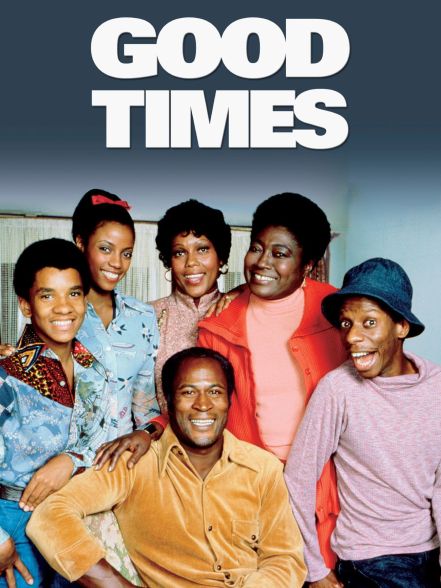
Good Times only had a father figure because Esther Rolle fought for one.
Originally, the show would be based on a single woman raising her kids in the projects in Chicago (I am from Chicago AND I grew up in the projects, trust… we know these things). Rolle said no, she wanted a father for her children and she became a pioneer in fighting for a black father on TV: George Jefferson (played by Sherman Hemsley) on The Jeffersons, Cliff Huxtable (played by Bill Cosby) on The Cosby Show, Phillip Banks (played by James Avery) on The Fresh Prince of Bel-Air. The list goes on and on but one woman opened the door for a complete black family to be shown on television and her name is Esther Rolle.
Good Times was revolutionary because it broke ground not only by showing a low-income family on television but also, a COMPLETE black family. The list of shows Good Times inspired is too numerous to mention, including NBC’s 227 in 1985, Regina King’s first breakout role. Then, in 1989, ABC launched Family Matters as their answer to 227. UPN sought to create the magic of the Cosby Show with Moesha in 1996. It goes on and on and down hill from here…
“I just thought it was a poor representation of what Black women were being able to do. And frankly, if you didn’t fit in that mold, there was nothing you could do. It was like watching a train wreck. I actually didn’t think it was real at first. Took me a long time to sort of get that, no this is real, and yet, it’s not real.”
– Erika Alexander on the Reality TV Shows, The Breakfast Club

The black father was the hardest legacy Rolle fought for. She grew up with one and an intact family; she wanted that to be shown on television. “I had a wonderful father,” said Esther Rolle, “and I couldn’t bear that television virtually ignored black fathers. I could not compound the lie that black fathers don’t care about their children,” she said previously in media reports. “I ruffle a lot of feathers. And I’m also selective–that makes you a troublemaker, but so be it. I laid a cornerstone for black actors, and that makes me happy.”
Although Rolle worked hard for a black father, they still eventually killed James off. So, I ask, what was the real reason behind naming the “Black” show, Living Single Hmm? That is the question.
Caution: Careful Not to Share Black History Memes with False Information

I am reposting this because February is approaching and we will see a lot of false information attached to Black History memes, same as always.
According to a famous Facebook post, King was not killed during an April 4, 1968, assassination attempt, but survived that shooting and was later “smothered by someone in the hospital.”
Is this true?
Let’s see.
Updated 1/28/2021
It’s Throwback Thursday so let’s go back in time a lil bit.
September 20, 1958

The year is 1958 and we are in Harlem, baby. Dr. King is signing copies of his first book “Stride Toward Freedom: The Montgomery Story,” at the Blumstein’s Department Store, on 230 West 125th Street.
It’s a nice afternoon and young King is just twenty-nine years old, releasing his first book and feeling good. And we are feeling good too because we are ready to get our copy. The line is long but before we get bored a voice makes us all stop and look in their direction.
“Is this Martin Luther King?” shouts a well-dressed black woman wearing rhinestone glasses and a matching necklace and earrings but carried an ugly brown bag and an even uglier scowl. The woman stepped out of line, causing groans from the people in front of her.
We don’t know this yet, but she is forty-two-year-old Izola Ware Curry, the black daughter of sharecroppers.
King nodded, “Yes, it is.”
“I’ve been looking for you for five years,” says Curry while pulling a letter opener with an ivory handle from her purse, which we don’t really know is a letter opener because we don’t use those anymore.
“Ooh, snap!” We gasp, placing our hands over our mouths. “Why she come so dressed up for if she was trying to kill somebody?”
“What is she doing?” says another one of us.
“Yea, man. Doesn’t she know this is Martin Luther King?”
“He not all that popular yet,” says a young black boy wearing chino pants and a white polo shirt. He put his hand in his pocket when he said it, smiled and then tilted his head like he was better than us. “Ya’ll not from here, are ya?”
Before we could answer, the sound of screams forces our attention back to the direction of the strange woman. She swings the letter opener at King, and sliced his finger then plunges the seven-inch blade into the left side of his chest.
“Oh, my God!” someone screams and just like that, the store is in an uproar. We are all screaming and running as someone apprehends the woman.
We look at King secretly hoping she didn’t get him because we still kinda want our book.
But when we see somebody who looks like our Grandma rush to his side, we know that’s not going to happen.
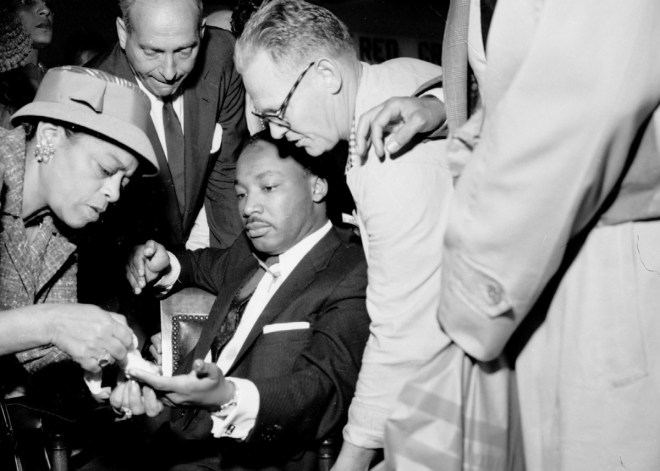
Dr. King is sitting in this chair all calm and cool like he ain’t just been stabbed. Meanwhile the letter opener’s ivory handle is still protruding just below his collar.
The police arrive. “Don’t sneeze, don’t even speak,” says Officer Al Howard, fearful of the blade’s proximity to King’s heart. Because of how the letter opener hit him, if King had sneezed, he would have died.
So, they move King slowly and carefully and take him to Harlem Hospital, and he undergoes emergency surgery.
Then, we jump in our time machine and head back to 2021 because it’s wild out here in the 50s.
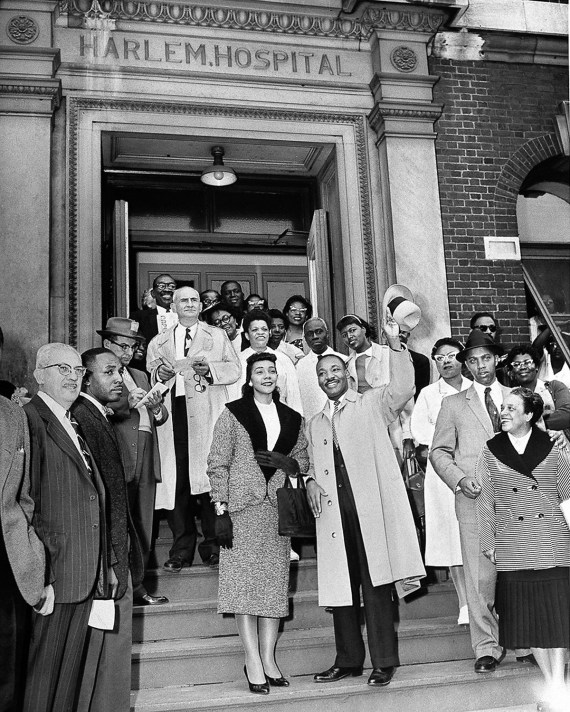
King leaves the hospital almost two weeks after the stabbing
The photo at the start of this post is not of Dr. Martin Luther King Jr. after being shot in Memphis, Tennessee in 1968.
That is a picture of Dr. King ten whole years earlier in 1958 at a New York Hospital after being stabbed at his book signing. He spent almost two weeks in the hospital recovering.
“If I had sneezed, I wouldn’t have been around here in 1962, when Negroes in Albany, Georgia, decided to straighten their backs up. And whenever men and women straighten their backs up, they are going somewhere, because a man can’t ride your back unless it is bent.” – Martin Luther King Jr., “I’ve Been to the Mountaintop.” April 3, 1968
I hope this creative backdrop added some perspective. Although I wrote it like a short story, everything I said here is the truth. Izola Curry, really did attack Dr. King at his book signing in Harlem.
Now to the original post…

There are tons of Black History memes circulating on the internet and this number has increased even more due to it being Black History Month. However, many of these memes are not historically accurate. Please be sure to double check your facts before sharing. Otherwise, you are guilty of spreading disinformation.
Black people have contributed to the world so that we don’t have to make stuff up. If you see a meme with a fun fact on it, just open the internet on your phone and type the name or fact into the search bar. You can tell from there if the material is accurate or not. Sometimes it will even come up that the information is an opinion or cannot be verified by any trusted source.
Use not only your phone to log into Facebook, Twitter, and Instagram. Use it to research these things and educate the people right.
Look for scholarly, peer-reviewed articles on .gov, .edu, or .org sites and trustworthy blogs. Peer-reviewed means information from a reputable source, information that shows that other professionals have reviewed and deemed it worthy of publication.
Wikipedia is not a credible source alone. Other trusted sources should support anything gained from Wiki.
And on the Monday of MLK day when everyone takes off and celebrates his legacy, remember that he was born on January 15, 1929, not whatever Monday you take off.
90s Throwback Thursday Jam – Brandy: Sittin’ Up in My Room
Who else is a youngin and listened to Brandy as a kid? 🙋🏾♀️💃🏾 lol
Throwback Thursday Jams (00s): Alicia Keys – Like You’ll Never See Me Again
I don’t listen to a lot of mainstream music that’s not an early 2000 hit I liked before I stopped, 90s jam or real throwback but I do love me some Alicia Keys and I think her Red Table Talk was the best so far. (The only thing that had me thinking was how the song below was written in dedication to Key’s grandmother, not a man. (Though I do think about my man when I hear it lol… but that’s my point) Why is it, my mind began to think, the video doesn’t reflect that? Most people think this song is about a romantic relationship and the video further perpetuates that. I can’t help but wonder why the video doesn’t showcase the song’s intended purpose).
I’m looking forward to that Alicia and Lauryn Hill collabo! My favorite quote of the evening was:
“I don’t wanna be on nobody’s pedestal. I can just be me. I can be all my flawed, beautiful self, you be your flawed beautiful self and we just hang out and talk and sort it out.” – Alicia Keys
 The PBS Blog