
Good Advice for Author Bloggers.
Tag: books
The Winning Letter
So Monday I set up a poll asking you guys to help me to choose what I should do this week in preparation of launch day, based on what sounded like the most fun. Your choices were:
a). Hold a 3 Day Giveaway (8/19 Wed-8/21 Fri)
b). Hold a 1 Day Giveaway the day of Launch (8/24)
c). Create a Contest with one grand prize winner announced on Launch Day
d). A and C
And the winning letter is (drum roll please):
C. Create a Contest with one grand prize winner announced on Launch Day.
I thought sure A would win!
To spice this up a bit, I have decided to do a Trivia Day instead of a contest to give more people a chance to win lots of FREE prizes. This gotta be fun!
Thanks guys! Stella will see you all Launch Day with the Grand Trivia Event.

Its the countdown! 5 Days to Go!
Family Tree Chart: Character Development
So last week, in a post called 3 Reasons I am Not a Professional Author, I spoke about how I started using a Family Tree to build my characters. I do this using Microsoft Word which I am learning more and more about each day. Family Trees can also be done in Microsoft Power Point.
What this method helps me to achieve is a greater depth in character development. It helps me to create a background, a foundation if you will, for my characters so that they evolve into real living people and are not just stick men and women with names. By creating a background, I can better design the main character out of the genetics of the people that came before them. In this way, I am not just making people up, but they are coming from an ancestral bloodline of sorts. Your primary characters can actually have a lineage and a family to which they belong to go with the personality your writing gives them.
Over the course of this week, I have put together a sample Family Tree and a few steps to help you to get started. I thought I would be able to accomplish this over the weekend but quickly discovered it was a lot more work than I remembered. To make this as simple as possible I will give you the steps as to do this the easiest way possible (which is not exactly how I put mine together but it works). Please understand that this is just a sample and that you can go much deeper than what is presented. To save time, I only scratched the surface here:
Step #1: WRITE
So if you read the previous post to which I mentioned this method, you know that I don’t use a timeline when I write. I start by writing the story as it comes to me. You can use this method either way. It is however, a good idea to start writing first because the juices start to flow and you have an idea of the characters you can start adding to the chart. Once I’ve written a few pages and I have an idea of the characters, I can then proceed to build on their lives by way of the timeline. All of this is simultaneously done as I’m writing so the timeline is not completely finished in one sitting. I may get to a point in the book where I want to switch some things around or change some names. In simplest form, I’m writing the story and using the family tree to organize my characters as I move along the process. The chart also helps me to sit back and take a full view of everyone even after the book is finished, to study the characters, and to recall names quickly. It’s easier for me to look at my chart instead of rely on memory or scan the document, to recall an important feature so as not to create inconsistencies when I’m writing. I know it seems like a lot and some of you are probably asking yourself, “Shouldn’t I just write so that the emotion and descriptive language makes the characters realistic?” Of course. The chart does not replace writing in personality and all of that good stuff, it just helps with names and family history.
Step #2: OPEN MICROSOFT WORD

Step #3: GO TO THE INSERT TAB

Step #4: CLICK ON SMART ART (it is between Shapes and Chart in Microsoft 2007 & 2010)

Step #5: When you get into Smart Art, CLICK ON THE HIERARCHY CHART and choose a chart
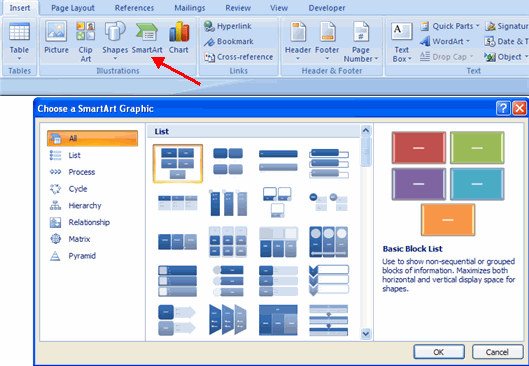
Step #6: Start building, adding names and traits or whatever it is you want to add
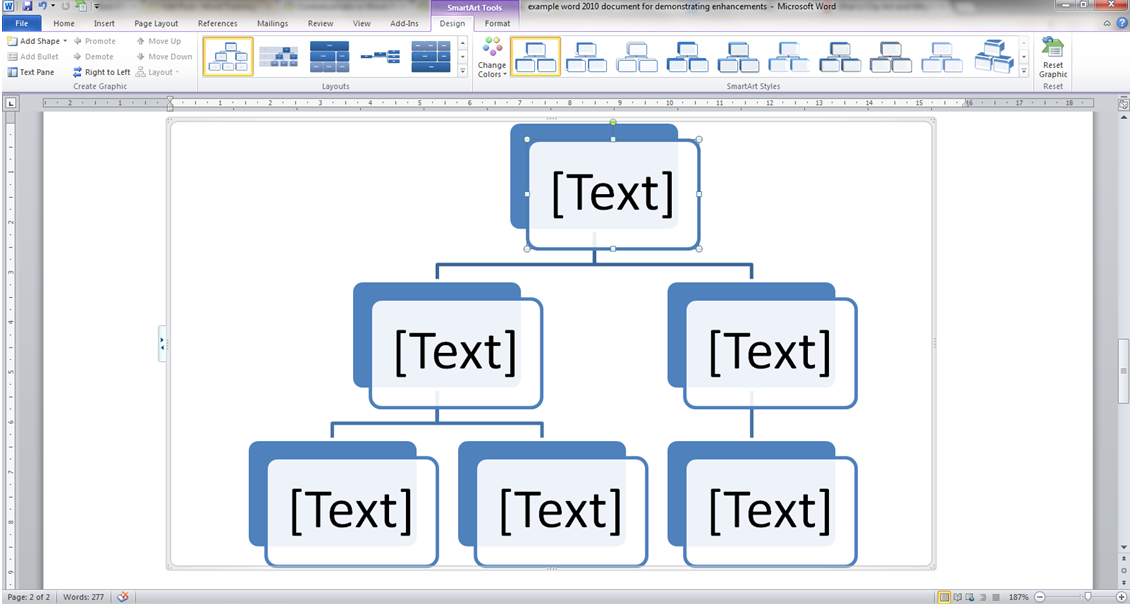
Remember that this is not a normal family tree. You don’t have to just add names but in this chart you will also add other important things about the character, such as height, weight, hair and eye color, etc.
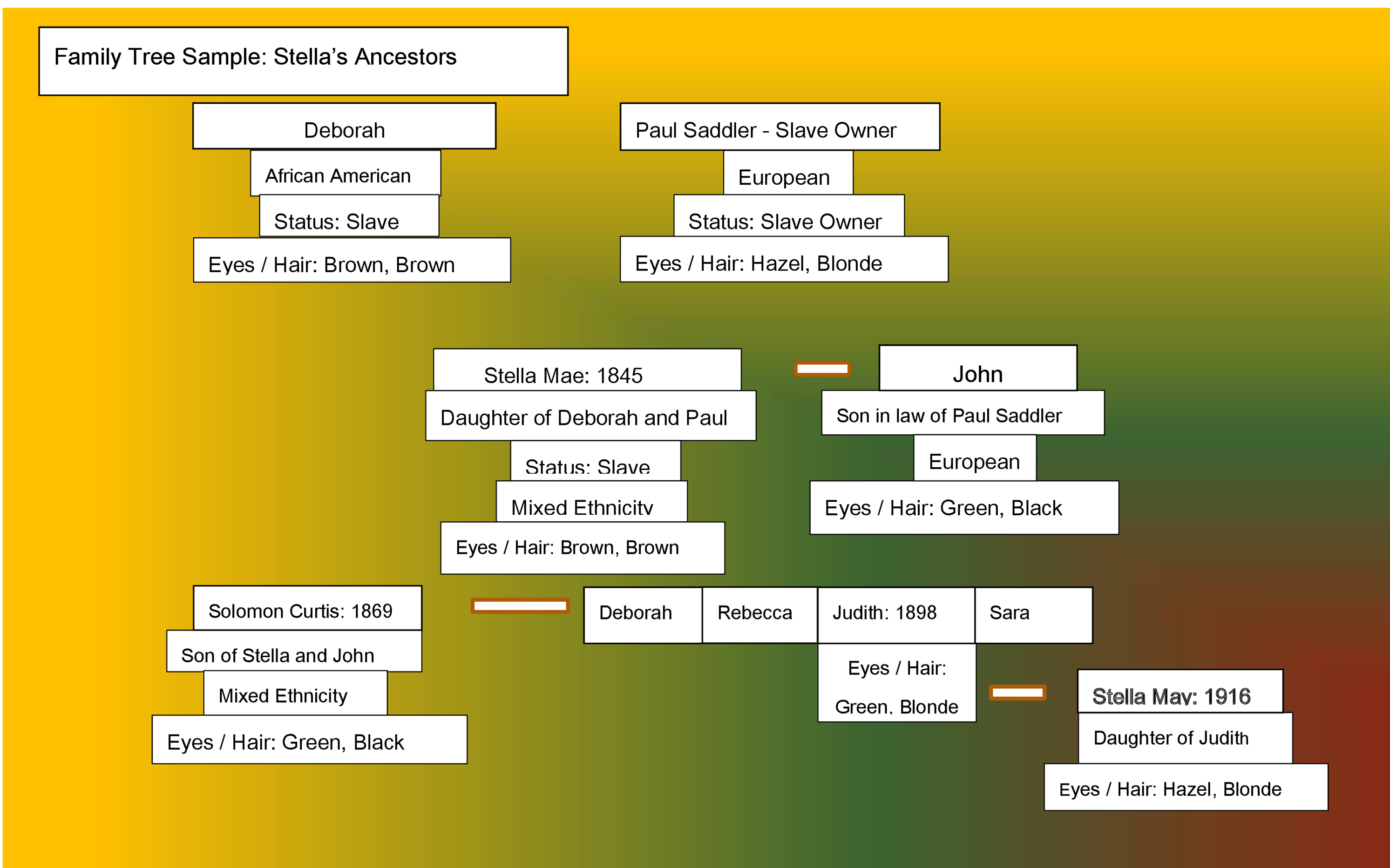
OK so I hope that you can see this well. This is my chart which I created using a slightly different design than the Smart Art. I customized it and created my own boxes. I saved it as an image file and then used Microsoft Publisher to crop out the white spaces that come from Word.
In my chart, we see that Stella is named after her great grandmother Stella Mae.
When Blacks stepped off the slave ships and into the shoes of their new lives, their ancestral names were stripped away. After chattel slavery ended, one of the first signs of freedom was for slaves to change their names. Having started with just a first name, they wore the last names of their masters, in which the majority of them continued to wear after emancipation. Others altered their last names slightly after freedom to disassociate from their masters. Another percentage went far as to just make up a last name, as in Booker T Washington’s case. According to his Autobiography, “Up From Slavery”, Booker noticed while in class that many of the students had two names. So when the teacher called for his name he calmly announced “Booker Washington” so as to fit in. Later, he found out that his mother had named him “Booker Taliaferro”. And just like that he became Booker T. Washington:
“By the time the occasion came for the enrolling of my name, an idea occurred to me which I thought would make me equal to the situation; and so, when the teacher asked me what my full name was, I calmly told him “Booker Washington”, as if I had been called by that name all my life; and by that name I have since been called.”- Up From Slavery, Page 17, Boyhood Days
Instead of take on the last name Saddler, the first Stella decides to take the last part of her first name, Mae, and change it into May. Her family would then go on to be known as the May’s.
Interpretation of Chart:
- Deborah was a slave on Paul Saddlers Plantation. They produce a daughter who Deborah names Stella Mae.
- Stella Mae and John produce a son who Stella names Solomon Curtis. According to the chart, he inherits his father’s green eyes and black hair but this is an error on my part. His eyes are actually Brown like his mothers, but he inherits his father’s jet black hair.
- Solomon goes on to have four girls: Deborah, Rebecca, Judith, and Sara.
- Judith, the middle daughter, goes on to give birth to a daughter who she names Stella, after her grandmother.
- We see that Judith inherits her green eyes from her father Solomon and her grandfather John. For the sake of space I did not include Judith’s mother in the sample chart; she is white.
- Stella inherits her eye and hair color from her great great grandfather Paul. Stella’s father is also not included in the chart; he is black.
As genetics would have it, Stella is easily capable of easing on pass the color line by inheriting more external European features than African American.
3 Reasons I am Not a Professional Author
(The post where I originally mentioned this in case you missed it)
see also
…if yeez LUV yer books… it’s okay to LUV yer Authors, too… let them know it!…

…I’m an unashamed user of the SOSYAL NETWURKS in pursuit of my ‘business of writing’… in reflective self-honesty, I try to steer clear of SPAMMING, which I find as abhorrent and annoying as most of yeez Lads and Lassies of Blog Land… that does not preclude from time to time an acceptable amount of inclusion in my posts, elements of my own WURK… there’s a proper way to do that… I like to think, in balance, the majority of my posts are aimed at entertaining, p’raps even educating, and certainly empathising with my fellow scribblers in support of their wee masterpieces… that balance is generally about 90% for others, 10% for my stuff… and I’m comfortable with that… when occasions arrive, such as this present period, running up to and including the launch of my latest Jack Calder crime thriller, KILLER CITY, there will inevitably be a…
View original post 190 more words
Launch Date Reveal!
One of the most exciting aspects of Self-Publishing is being able to build up suspense for the next project at your own pace and I have (finally) set a date for the release of my next book. As many of you already know, it releases this month but I had not given an exact date. So, without further ado, please Follow This Link to view the flyer that reveals the date for the release of “Beyond The Colored Line.” The flyers came out really nice and I’m going to enjoy sending them off.
Launch week for this blog is gonna be off the chain, yaaasss. 🙂
3 Reasons I am Not a Professional Author

I strive to implement levels of professionalism in everything that I do whether it includes monetary compensation or not. In which case people who know me are already familiar with my level of organization and from that end, professionalism. However, I do not consider myself a professional author in the traditional sense of the word. Here’s why:
I’ve heard my share of advice from author blogs, books, tweets, Facebook, Twitter, articles, the list goes on and on (and on). I’ve taken valuable advice under my wing and even incorporated some into my day to day schedule and strategic writing techniques since it is, after all, wise to consider the advice of others. But the truth is that I will never be a professional author because my writing process is not the same as what is perpetuated in the mainstream.
The professional says:
- Use the same business name across all accounts. This is the easiest way to brand yourself and to get people used to associating you with that name.
Makes sense, but I totally transgressed this rule! My blog, author website, and social media sites, for the most part, all have different names which I heard is bad. To balance this, I have taken to using one picture to represent every account. This photo you see associated with this blog will probably never change because it’s attached to all of my accounts: My personal Facebook Page, Twitter, Blog, IG, You Tube, LinkedIn, etc. I believe images are a strong form of communication and that many people have already become used to seeing this picture and associating it with Yecheilyah Ysrayl. I have also taken to using the same email address to represent these accounts across the board (with a few exceptions).
The professional says:
- Plan out your book before you write it. Create an outline for your new masterpiece.
Umm, I think I’ll just go ahead and skip this step. I do not write outlines before each book. I just write and organize as I go along. Once I start to build on a story idea and start to write and develop some kind of form to the story, then I know what it is I need to research or the books I need to read for better clarity of this particular genre. It only makes sense to me that you write something down first and get an idea of how the story will develop, only then will you be able to clearly see what kind of information you will need for this story and can thus move on from there. For instance, its not until I start writing the story that I am able to create a Family Tree of my characters.
I know, I just said something else different didn’t I? Yes, a family tree. I found it easiest to organize my characters (after I’ve written about them) using a Family Tree. I’ll speak more about this in a separate post, but after I’ve written the characters into the story to some extent, I sit back and think about how to better develop them as real people. Not just by way of physical attributes (ethnicity, hair, eyes, relationships, persona, etc.), but also lineage. Where did this person come from? I do this by using a Family Tree, which can be created easily using Microsoft Word. The reason I choose this method is because the one rotating around blogs and professional websites is boring to me. (You know, that long list of questions you ask yourself about the people in your story: Hair:__________ Eyes:_________ Nose Shape________ …just kill me now). Not to mention I’m a visual learner. I have to see it to better understand it and laying out the family in this way helps me to accomplish this. Far as outlines go for the entire story, the first draft is the outline.
The professional says:
- Stick to one specific genre.
I write in whatever genre the story that just popped into my head falls in. I heard this is a no no. According to the rules, in order to brand yourself it’s important to stay within a certain genre because it’s easy to become known for it. But in my opinion, brains don’t work like that. Well, at least mine doesn’t. What am I gonna say, “Sorry totally awesome story idea, I can’t use you right now because your Sci-Fi and I only write Romance”. That’s like telling me to write one kind of poem. Yea, that’s probably never going to happen. I mean sure, every idea is not meant to be built on. Some of them should just stay ideas until it is time for that idea to be brought forward. However, because the creative mind is not one dimensional, I find it hard to believe that I can force my thoughts to only create stories that appeal to one category.
The truth is that I will probably never do exactly as the professionals say do. If the world says this is how it is to be done, you can rest assured that chances are Yecheilyah’s over here doing something completely different…and maybe even a little weird. 🙂
Word to the Wise

As we approach the month of August, when teachers return to work and students go back to school, I couldn’t help but to get excited that in just a few short weeks (mid August) I will be publishing another book. I’m really excited about this one and this excitement led me to a thought which in turn led me to something I think all Self-Publishers should take into consideration. I know that finances are a big deal to Self-Publishers and we are always looking for the most cost effective, yet professional, way to produce so here goes:
Never use POD (Print on Demand) services like LuLu and Createspace for anything other than Printing your books. Do not use POD editing services, POD promotional services, or POD book cover design services. Why? Because you can save a lot of money not doing so.
The most effective and creative action we can take as Self-Publishers is to use Print on Demand Companies as Printer Companies for our books, and then sell them from our own Author websites. Let people buy your books from YOU and you take a percentage of that income to pay the Printing Company (Createspace) to print the book AND if you don’t have the funds to buy your books in bulk from the POD, you can still send it to the buyer directly from the POD service. Remember to apply wisdom to everything that you do, so remember that you still have to pay the POD to print the book and to ship it so set your prices high enough to actually reap a profit but low enough to be reasonable. When people have to go to YOUR website this helps build you as an Author brand.
However, there are some exceptions to be understood when considering these methods:
- You’ll never make Amazon’s Best Sellers List using this method because your buyers are not buying from Amazon they’re buying from you. If making Amazon’s Best Sellers list is important to your writing goal (which is understandable) I suggest you ignore this post, carry on and not use this method. (It would be wise to use Amazon to sell your e-books and your Author site to sell your print books, kill two birds with one stone).
*Here’s another secret*
Amazon, Createspace, Kindle Select etc., is extremely popular right now. When people hear your book is on Amazon they go and inquire, they get excited and you feel like you’ve accomplished something great, AND YOU HAVE. But, it’s not really that big of a deal. If you really want to build yourself as a Self-Publisher, invest in your own Self-Publishing Company and make YOUR name the one people get excited about. It doesn’t have to be anything fancy, just your name alone will do. (I will draft another post for another day on building a Self-Publishing Company and creating a name brand in the most cost effective way possible).
- If you don’t buy in bulk and are shipping directly from your POD, you won’t have the chance to include promotional products with the book since it ships directly from the POD, which doesn’t help you with promotion.
BUT …
(OK so I’m really letting all the cats out the bag, gonna have to get a dog)
…you can send readers a separate gift with the money you saved AHEAD of the books arrival with these special offers (bookmarks, flyers, business cards, gifts etc.). Make sure to expedite the mail so that it gets there BEFORE the book for a professional outcome. Include a little note that thanks them for the purchase and that you hope they’ll enjoy the free gift. Don’t forget to include your contact information (business card) and to also inform them that their book is on the way! Readers will appreciate this, trust me. Why? Because, who doesn’t like to get mail filled with free goodies? Plus, if your readers are anything like yours truly, they’re extremely anxious for the book’s arrival and a little something ahead of time will help calm their nerves while they wait .
I hope this information has been helpful. Now, get off the internet and back to writing :).
 The PBS Blog