Caution: Careful Not to Share Black History Memes with False Information

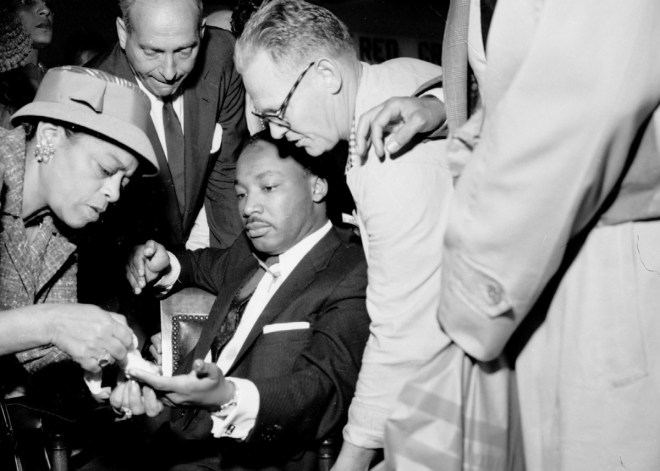
Martin Luther King Jr. recovers from surgery in bed at New York’s Harlem Hospital on following an operation to remove steel letter opener from his chest after being stabbed by a mentally disturbed woman as he signed books in Harlem. (John Lent/AP)

I am reposting this because February is approaching and we will see a lot of false information attached to Black History memes, same as always.

According to a famous Facebook post, King was not killed during an April 4, 1968, assassination attempt, but survived that shooting and was later “smothered by someone in the hospital.”

Is this true?

Let’s see.

Updated 1/28/2021

It’s Throwback Thursday so let’s go back in time a lil bit.

September 20, 1958

The year is 1958 and we are in Harlem, baby. Dr. King is signing copies of his first book “Stride Toward Freedom: The Montgomery Story,” at the Blumstein’s Department Store, on 230 West 125th Street.

It’s a nice afternoon and young King is just twenty-nine years old, releasing his first book and feeling good. And we are feeling good too because we are ready to get our copy. The line is long but before we get bored a voice makes us all stop and look in their direction.

“Is this Martin Luther King?” shouts a well-dressed black woman wearing rhinestone glasses and a matching necklace and earrings but carried an ugly brown bag and an even uglier scowl. The woman stepped out of line, causing groans from the people in front of her.

We don’t know this yet, but she is forty-two-year-old Izola Ware Curry, the black daughter of sharecroppers.

King nodded, “Yes, it is.”

“I’ve been looking for you for five years,” says Curry while pulling a letter opener with an ivory handle from her purse, which we don’t really know is a letter opener because we don’t use those anymore.

“Ooh, snap!” We gasp, placing our hands over our mouths. “Why she come so dressed up for if she was trying to kill somebody?”

“What is she doing?” says another one of us.

“Yea, man. Doesn’t she know this is Martin Luther King?”

“He not all that popular yet,” says a young black boy wearing chino pants and a white polo shirt. He put his hand in his pocket when he said it, smiled and then tilted his head like he was better than us. “Ya’ll not from here, are ya?”

Before we could answer, the sound of screams forces our attention back to the direction of the strange woman. She swings the letter opener at King, and sliced his finger then plunges the seven-inch blade into the left side of his chest.

“Oh, my God!” someone screams and just like that, the store is in an uproar. We are all screaming and running as someone apprehends the woman.

We look at King secretly hoping she didn’t get him because we still kinda want our book.

But when we see somebody who looks like our Grandma rush to his side, we know that’s not going to happen.

Dr. King is sitting in this chair all calm and cool like he ain’t just been stabbed. Meanwhile the letter opener’s ivory handle is still protruding just below his collar.

The police arrive. “Don’t sneeze, don’t even speak,” says Officer Al Howard, fearful of the blade’s proximity to King’s heart. Because of how the letter opener hit him, if King had sneezed, he would have died.

So, they move King slowly and carefully and take him to Harlem Hospital, and he undergoes emergency surgery.


Then, we jump in our time machine and head back to 2021 because it’s wild out here in the 50s.


Oct. 3, 1958
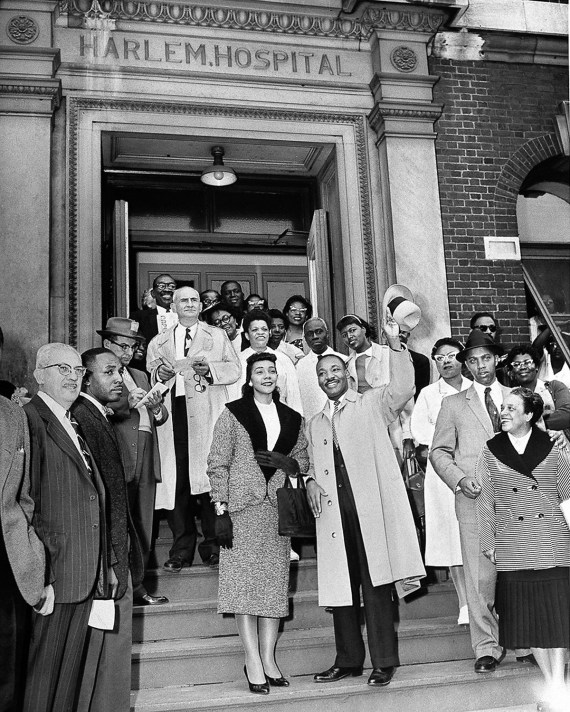
King leaves the hospital almost two weeks after the stabbing

The photo at the start of this post is not of Dr. Martin Luther King Jr. after being shot in Memphis, Tennessee in 1968.

That is a picture of Dr. King ten whole years earlier in 1958 at a New York Hospital after being stabbed at his book signing. He spent almost two weeks in the hospital recovering.

“If I had sneezed, I wouldn’t have been around here in 1962, when Negroes in Albany, Georgia, decided to straighten their backs up. And whenever men and women straighten their backs up, they are going somewhere, because a man can’t ride your back unless it is bent.” – Martin Luther King Jr., “I’ve Been to the Mountaintop.” April 3, 1968

I hope this creative backdrop added some perspective. Although I wrote it like a short story, everything I said here is the truth. Izola Curry, really did attack Dr. King at his book signing in Harlem.

Now to the original post…

There are tons of Black History memes circulating on the internet and this number has increased even more due to it being Black History Month. However, many of these memes are not historically accurate. Please be sure to double check your facts before sharing. Otherwise, you are guilty of spreading disinformation.

Black people have contributed to the world so that we don’t have to make stuff up. If you see a meme with a fun fact on it, just open the internet on your phone and type the name or fact into the search bar. You can tell from there if the material is accurate or not. Sometimes it will even come up that the information is an opinion or cannot be verified by any trusted source.

Use not only your phone to log into Facebook, Twitter, and Instagram. Use it to research these things and educate the people right.

Look for scholarly, peer-reviewed articles on .gov, .edu, or .org sites and trustworthy blogs. Peer-reviewed means information from a reputable source, information that shows that other professionals have reviewed and deemed it worthy of publication.

Wikipedia is not a credible source alone. Other trusted sources should support anything gained from Wiki.

And on the Monday of MLK day when everyone takes off and celebrates his legacy, remember that he was born on January 15, 1929, not whatever Monday you take off.

A Witness to the Experience

My Soul is a Witness: Poetry \ Coming Fall 2020


My Soul is a Witness is a title inspired by the Negro Spiritual song, “Witness,” but I did not choose such a title because I think of myself and my people as “Negroes.” I chose such a title because of the powerful messages and influence these songs had on our people as they transitioned from enslavement to freedom. Powerful messages I hope to also convey through my poetry.

There is a great spiritual awakening happening among Black people today as we strive to unlearn the lies they taught us for over 400 years. Whether that is starting and running our own businesses, embracing our natural hair or re-educating our young people on the parts of our history left out of the history books.

And to what am I a witness?

I am a witness to the trials and struggles my people have endured and I am a witness to our power to overcome those struggles. I am a witness also to my own sufferings which I am sure have been experienced by others. In this way, I am a witness to the fight that we all have. And why the fight? It is easy to present an image of healing and wholeness, but I believe it is much more fruitful if people knew of the struggles that got us where we are today.

From a historical perspective, I have not experienced the Middle Passage or enslavement or Jim Crow, but as a descendent of people who did, I am connected to those experiences just as if I had been there with them. In the Black community, we do not say, “when they fought for freedom,” we say, “when we fought for freedom.” The same can be true of the struggles of our own personal lives. If someone says they have been homeless before, I can relate because I have been homeless before too. I am a witness to what that’s like. If someone says they have a family member who is an addict, I can relate. I also have family members who are addicts. The anguish that causes in a family and what it does to that person and their loved ones are not lost to me. I can relate to that. I am a witness to that experience.

I believe epigenetic trauma is real. Epigenetics is the idea that trauma can leave a chemical mark on a person’s genes, which then is passed down to subsequent generations. (C. Benedict, New York Times) This means that a child or grandchild can experience side-effects from the traumatic experience of his/her elders. Since the concept of epigenetics, more and more studies hint to the inheritability of trauma where our own day-to-day health (and perhaps our children too) may have something to do with our inheritance of our parents and grandparents suffering.

One personal example is my own mother’s struggle with COPD (Chronic Obstructive Pulmonary Disorder). Her grandson, my nephew, suffers from asthma badly, though both his parents do not have asthma. Could he have inherited my mother’s affliction to a degree?

Thus, I do not find it far-fetched that Blacks/African Americans could still struggle from the mental and spiritual grief that plagued our forefathers long ago. We are witnesses to this pain on a deeply personal level which makes the Negro Spiritual deeply personal to us. While our ancestors were escaping physical enslavement, I believe we are escaping mental enslavement today.

As it applies to all people from the perspective of suffering and struggle, we all have a fight we are engaged in and when we overcome this fight, we become witnesses to that experience and can help others to overcome those same tribulations.

If trauma can be passed down, then so can healing. My soul is a witness.


Have you read I am Soul yet? Grab it here. My Soul is a Witness is coming this fall.

My Soul is a Witness

Annndd here she is!

My next collection of poetry releases this year and I have decided on the title, “My Soul is a Witness.” I want to thank the members of my email list for helping me to choose the perfect image (we had a contest featuring several images. If you are not subscribed for exclusive first-looks and sneak peeks, you may click here).

This book releases in the fall and will be available for preorder soon. Exact date to be announced.

Haven’t read I am Soul yet? Get it here.


One of my favorite movies (I have lots of favorites lol) is The Great Debaters. I love the use of language, history, and education, and it also feels like to me they are doing performance poetry, not just debating. When the movie comes on, the Negro Spiritual song, “Witness,” is being sung as the people dance.

Just as with I am Soul, My Soul is a Witness jumped out at me and I felt it in my spirit that this was the appropriate title for the book. The soulful, sacred, and riveting Negro Spiritual songs taught of freedom, of hope, of redemption, and biblical justice and righteousness. I hope these poems do the same for you. I hope that they are liberating, restoring, and reinvigorating. “My Soul is a Witness,” is poetry that reminds us that in our darkest moments, there is still hope. It reminds us that our scars do not cripple us but prepare us for a work, and that our greatest weaknesses make us strong. Here, I give you my ache and my praise. This is a love letter to our overcoming, of yours and mine. My Soul is a Witness.


What the Losses Taught Me

Top of the World, Observation Level, World Trade Center, MD, Copyright © Yecheilyah 12.31.2019
I couldn’t help but think about “Vision” on the Top Floor of the World Trade Center in Baltimore. The view is a beautiful layout of the city and the binoculars let you see everything up close. That’s what 20/20 is about for me, seeing clearly.

20/20 = Perfect Vision

At this time of the year, most people are talking about their wins but I believe it is my losses that have caused the most growth and given me the most lessons. It was the letdowns, betrayals, and disappointments that have cultivated in me the strength I’ve had to endure last year and all the other years before it.

Keep Yourself Full didn’t do as well as I had thought and while it bothered me at first, I can honestly say that as of today I’m okay with it. I’ve been Self-Publishing my books for a while now and what I’ve learned is that experience brings clarity.

Hindsight is 20/20 and what I see now are the mistakes I made with this particular book, the audience I thought would be there but wasn’t, and the solace in knowing that my poetry is inspiring enough.

A ‘Snellen chart’ is an eye chart that’s used to help you determine the clarity of your distance vision. Somebody with 20/20 vision has normal acuity (sharpness or keenness of thought, vision, or hearing) meaning if they were to stand at a distance of 20 feet from the eye chart, then they would be able to clearly see each row of letters. This person has good eyesight.

What’s being said is that if you look back at situations that went poorly, you can clearly see (20/20) what you could have done better.

This entire year is 20/20 which means a time of looking back and reflecting on all I’ve done. I know the word “reflection,” is being used a lot this time of the year so it may not hit you as hard but I caution you not to let its repetitiveness water down its powerful meaning.

Reflection is serious thought or consideration but it also shows, expresses, or is a sign of something and an image of something in the mirror. To reflect is to give serious thought and consideration to ourselves, the image in the mirror. It is to look at ourselves. What do we see? What are we showing or expressing?

My philosophy (for lack of a better term) is “do you but do you intelligently.”

I believed, and still, believe, we should not just decide, but that we should make informed decisions. From this point forward it’s not just about making decisions but knowing why I am making those decisions. It’s about being intentional in every way. From this point forward, everything I do has a reason. Everything is a strategic move. From publishing a book to publishing a post.

There are projects I will retire this year and projects I will relaunch. Looking back, I can see clearly what works and what doesn’t work for my writing business.

I am flawed and imperfect. I will mess up but I am striving every day, learning, and correcting as I go along (with all the failures and pitfalls that come with it). I know these losses can do nothing but make me stronger, and wiser so that when I look back, there is nothing to regret.

The losses taught me to focus the first time around and to trust my discernment so I can see things for what they are, not for what I want them to be. The losses are a reminder to see things clearly.


Go to my IG page here to check out more vacation pics at some awesome museums including The Smithsonian Museum of African American History and Culture. Visit me on the web at yecheilyahysrayl.com and subscribe to this blog for notification of more posts.

Black History Fun Fact Friday: What Hollywood Left out the Harriet Movie

I did not intend on writing about this today but then…

I saw the Harriet movie.

Yep. I went to see it.

I know many are protesting the film, but I don’t jump on bandwagons. I wanted to see it for myself to develop my own opinion. I also knew I wanted to write about it.

There are some truths, such as her being referred to as Moses. Unfortunately, there are also a lot of inaccuracies. The movie is Hollywoodish and leaves a lot out. In an interview, I heard the script was written twenty years ago, so that may have something to do with it. In any case, if you are planning to see it, here are some things you may want to know.

  • Harriet Tubman never had a friend named Marie Buchanon.
  • There was never a Black Bounty Hunter named Bigger Long after Harriet Tubman. The same is true of the Brodesses son. They did have a son (Jonathan) but little is known about him. His role in the movie is made up.

While “Bigger Long” is a fictional character, it shouldn’t be overlooked that Black trackers existed and were active during slavery. I think it is vital that as we are striving for historical accuracy, we are not so “Pro-Black” that we forget that a lot of our own people sold us out, and continue to sell us out. While Bigger Long may not have been a real person in Harriet’s life, there were black slave catchers. The movie, it seemed to me, had a lot of ‘women vs. men’ undertones. Not only was Bigger Long the sole antagonist against Harriet (even more so than the Brodesses, son), he was also the one responsible for the death of one of the Black women in the most diabolical, sinister, and brutal way.

The William Still character is based on a real historical figure. Still was a black abolitionist based in Philadelphia, Pennsylvania, businessman, writer, and conductor on the Underground Railroad. In the movie, he was over-the-top with his reactions to Harriet’s return from the missions. Holding his hand to his chest, spinning Harriet around, and at one point, he even falls out of a chair. Some people laughed, but I didn’t find it funny. To me, it made him look like a bufoon.

The Black men in this movie seemed weak to me. I worry this was intentional. Hollywood has a habit of showing black men as less capable when contrasted against the black woman’s strength. Rarely is there a balance to showing black couples as equally competent. The imaginative Marie shows Harriet how to shoot a gun and helps her in her cause. Harriet was a warrior but I am certain the surrounding men weren’t that simple-minded and faithless.

  • Tubman didn’t change her name when she reached freedom. She changed it before then, around the time of her marriage, possibly to honor her mother.
  • Three of Tubman’s sisters were sold, not just one.
  • Two of Tubman’s brothers, Ben and Harry, accompanied her (1) they went with her initially, at the onset of her escape not later as depicted in the film (2) after a notice was published in the Cambridge Democrat offering a reward for her return, Harry and Ben had second thoughts and returned to the plantation so she made the voyage alone.
  • Tubman had spells, dream-states, and visions (I believe she was deeply spiritual, her spells were my inspiration for Nora’s spells in Renaissance), but she also endured seizures, severe headaches, and narcoleptic episodes for the rest of her life from the hit to the head.

This next point wasn’t in the movie but since we are talking about Harriet Tubman I think it’s important to mention.

The Fake Quote:

It’s a good quote and a powerful one. I wish I could say it belonged to Harriet but with every source I checked there’s no documented, historical proof that Harriet Tubman ever said:

“I freed a thousand slaves. I could have freed a thousand more if only they knew they were slaves.”

According to Africacheck.org, The Maxwell Perspective, and Snopes, there are a few possible origins of the quote’s attribution to Harriet:

  • The confusion began when feminist writer Robin Morgan updated her 1970 essay “Goodbye to All That” during the 2008 US Democratic Party’s primary presidential candidate race between Hillary Clinton and Barack Obama. Morgan supported Clinton, and in the essay challenged other women who did not. She wrote: “Let a statement by the magnificent Harriet Tubman stand as reply. When asked how she managed to save hundreds of enslaved African Americans via the Underground Railroad during the Civil War, she replied bitterly, ‘I could have saved thousands – if only I’d been able to convince them they were slaves.’” The implication was that women who didn’t support Clinton were similarly enslaved, and didn’t know it.
  • One expert was Milton Sernett, professor emeritus of history and African American studies at Maxwell School“My impression is that this is a late 20th century quote from a fictionalised account of Tubman’s life,” Sernett told history blogger Ralph Luker, who first queried the quote.
  • More than this, at meetings in 1858 and 1859 Tubman repeatedly said she had personally rescued 50 to 60 people from slavery. So she would never have said she “freed a thousand slaves”.

A quote that has historical proof, and that has been proven to come from her that you can use:

“I was the conductor of the Underground Railroad for eight years, and I can say what most conductors can’t say — I never ran my train off the track and I never lost a passenger.” 

– Harriet Tubman at a suffrage convention, NY, 1896.

“During public and private meetings between 1858 and 1859, Tubman repeatedly told people that she had rescued 50 to 60 people in 8 or 9 trips (this was before her very last mission, in December 1860, when she brought away seven people.) Sarah Bradford exaggerated the numbers in her 1868 biography. Bradford never said that Tubman gave her those numbers; instead, Bradford estimated that it was the number. Other friends who were close to Tubman contradicted those numbers. Tubman also instructed another 70 or so freedom seekers who found their way to freedom on their own”

http://www.harriettubmanbiography.com/harriet-tubman-myths-and-facts.html

Is it possible Tubman freed far more than what is documented even if only through instruction? Absolutely, but we have no proof she said she freed a thousand and could have freed a thousand more.

“My impression is that this is a late 20th-century quote from a fictionalized account of Tubman’s life. “Whoever wishes to use the dubious quote as a political zinger ought to cite a reliable source.”  – Milton Sernett, Harriet Tubman: Myth, Memory, and History

A few more things not addressed in the movie:

  • Tubman’s time as a Union spy (touched on a little at the end of the film), nurse, and cook.
  • Her 1869 marriage to Nelson Davis—a soldier, some 20 years her junior—and the couple’s 1874 adoption of a baby girl named Gertie
  • Her work as a suffragist,
  • Neurosurgery undertaken to address her decades-old brain injury.
  • Her financial hardship later in life.
  • The opening of the Harriet Tubman Home for the Elderly in 1908.

Now, the movie wasn’t a total fail for me. There are some things I liked that are worth mentioning.

I loved the show of Harriet’s spirituality, which I do not equate to anything Christian. Her reliance on her faith, praying, and praising during difficult times. I loved the show of her hands raised and open, historically how we (Israelites/Blacks/AFAM) prayed. Harriet’s spiritual intuition was a beautiful show of faith and her belief that the Almighty was central in guiding her in her journey.

Should you see the film? That is up to you. I will caution that if you plan to bring your children, print this post out (or another fact sheet you’ve vetted), and use it as a reference so they can properly discern the facts in the movie from the fiction.


Check out more Black History Fun Facts here.

Black History Fun Fact Friday: “In Africa they Didn’t Teach about the Period of Enslavement of Our People.”


I thought this quote was an interesting and thought provoking one to share considering the crisis going on today.

What Crisis?

The one where schools are trying to remove Black History Courses from their Curriculum.

The one where today’s kids only know about Slavery and the Civil Rights Movement.

The one where the only Historical Black people most people can name are Harriet Tubman, Rosa Parks, and Martin Luther King Dr.

What about Toussaint Louverture, general and leader of the Haitian Revolution?

Or Florence Mills, nicknamed “Queen of Happiness,” and one of the most successful entertainers of the 1920s Harlem Renaissance Movement? You know Zora Neale Hurston and Langston Hughes, but what of the people mainstream society doesn’t speak of?

THAT Crisis

To the quote…

“In Africa, they didn’t teach about the period of enslavement of our people. They forbade us from speaking about it. They would kill people for speaking about that history. So we were not allowed for hundreds of years to speak about what was happening and to teach what was happening.”

– Queen Diambi: The Queen of Congo

My people across the water, is this true? Not hard to believe with the history they restrict here in America.

Now, for our first atrocity of the week…

My raggedy To Kill a Mockingbird

A public school in Biloxi Mississippi is trying to pull To Kill a Mockingbird from the eighth grade curriculum because the language is “uncomfortable.”

If the language in To Kill a Mockingbird makes thirteen-year-olds “uncomfortable,” then I assume the school district is also insisting they stay off Twitter and never listen to rap music. – Julia Dent

“The book is about life in the South during the Great Depression, specifically the life of a black man named Tom Robinson who had been framed for raping a white woman. Local lawyer Atticus Finch agrees to defend the innocent man, angering the racist white community who subject him and his children to abuse. Despite proving Robinson’s innocence, the jury still convicts him because of the color of his skin. I won’t spoil the ending for you if you haven’t read it, but it is even more violent and sad (but with a bit of a happy ending).”

And if you haven’t read the book yet, do that (and I do not mean watch the movie. Read the book).

>>Click Here to Keep Reading<<

Next up is the Winston-Salem School Board who voted SEVEN to ONE AGAINST a Black History Course

“Black American children need to know their history “not later, but now,” Winston-Salem City Council Member D.D. Adams said after a mandatory African-American history course for the district was rejected by the school board.

>>Click here to Keep Reading<<

and this one goes in depth


I shared these same articles with my email list and I am sharing them with you too because I am seeing more and more instances of Black history removed. This is one of several reasons why I write Black Historical Fiction. Who will restore what was lost? No greater person can do it than writers. Someone has to write it down even if through Fiction and Poetry.

The little crumbs of black history they have allowed to exist is being erased bit by bit. As the so-called Black man, woman, and child is being awakened to the knowledge of their true heritage, even what they thought they knew is being removed. A few weeks ago, I was watching Michael B. Jordan’s Raising Dion series on Netflix. Dion was being singled out by a white teacher during an altercation Dion had with another student, a white boy. His aunt told his mother it was time for her to have “the talk” with him. When she told him, Dion said he thought “Dr. King fixed all of that.”

Huh? Dr. Martin Luther King Jr.?

MLK is recent. The 60s was not that long ago and Black History did not begin with The Civil Rights Movement (The NAACP wasn’t even created by Black people. It was founded by Jewish white men.)

Black people, ask yourself why our children are only being taught about the Civil Rights Movement. Chicago Public Schools have been on strike for about two weeks ending today. Maybe parents should consider teaching their own children. It can’t be any worse than the school system.

Image from the movie, “To Kill a Mockingbird”

February is around the corner but you don’t have to wait a whole year to research your history. Here are a few good articles for you.

For The Origins of Black History Month revisit that fun fact here, which I published to this blog a couple years ago.

Here’s an article I found earlier this week written by William Spivey. He was featured on the blog a few years ago about his upcoming book. He wrote an excellent piece on Breeding Farms during slavery.

This young woman is getting a lot of attention of Social Media for being the first Black Teen Author Ever To Write 3 Books Being Used By School Districts Across The Country. She is an excellent example of how Black writers can change things through writing.


Peace and hair grease!

For more Black History Fun Facts visit the Black History Fun Fact page here. If you are interested in submitting a Black History Fun Fact as a guest post on this blog let me know! That would help me to be more consistent with this if I had help. I am putting together something now to promote that but until then, comment below if you’re interested or email me at yecheilyah (at) yecheilyahysrayl dot com. (The post on Roots has been added to the Black History Fun Fact page.)

Next week we are talking about Nina LittleJohn (Yah Willing) who opened a medical facility to treat Blacks in Spartanburg, South Carolina.

Black History Fun Fact Friday – Mathieu de Costa

Me and Hubby had a wonderful time on our vacation. It’s been a long time since we’ve been out of the country, so it was refreshing to breathe another air. Canada is rich with Black history and many Black Canadians trace their ancestry to the so-called African American in America as the Underground Railroad brought tens of thousands of fugitive slaves to Canada. While many of these returned to the United States after emancipation, a significant population remained, largely in Southern Ontario, widely scattered in the country and the city, including Toronto.

Mathieu Da Costa (Groupe CNW/Postes Canada)

The first recorded (recorded being the key word here…I am sure there were others, but this is the first record. The first known black person to live in Canada is said to have been a slave from Madagascar named Olivier Le Jeune) free Black person in Canada was a Black man named Mathieu de Costa. He was a free man who spoke several languages (among them French, Dutch, Portuguese and a mixture of French-Spanish dialect and First Nations languages) and is remembered as a skilled interpreter and the first man of African heritage to visit and live in Canada. He lived in Port Royal (Nova Scotia) for a short time, and a plaque to honor his life and time spent there has been placed on a monument at the Port-Royal National Historical Site. A school in Toronto, and a street in Montreal and Quebec City have been named after him. Because of his ability to speak several languages, it is said that he helped to bridge the gap between Europeans and Natives living along the Canadian Atlantic Coast to live peacefully.

Hubby and I at an Ethiopian Restaurant in downtown Toronto Canada.

As a group, black people arrived in Canada in several waves. We are planning a return trip this winter to explore Canada’s Black history that we did not have the time to explore this trip such as Uncle Tom’s Cabin Historic Site and Buxton National Historic Site, in Chatham-Kent, Ontario. (It was about 3 hours from where we were so we didn’t have time to visit this round). If you remember, we touched on Josiah Henson in the truth about Uncle Tom post here. In 1842 former fugitive slave Josiah Henson established the Dawn Settlement, a center for education, training, and community planning. With financial backing from American abolitionists, Dawn became a diverse settlement featuring a school, brickyard, sawmill, farmland, and profitable lumber industry. “At its peak, about 500 people lived at the Dawn Settlement. Henson purchased 200 acres of land adjacent to the community, where his family lived.” (Ontario Heritage Trust) The Uncle Tom’s Cabin Historic Site is an open-air museum and African American history center near Dresden, Ontario, Canada, that includes the home of Josiah Henson. While the development of administrative problems and the school closure in 1868 caused many Blacks to abandon the land (some going back to America when slavery ended and some spreading out throughout Toronto), Josiah and his wife Nancy lived on the land the rest of their lives.

Although we didn’t get to visit these sites, we visited Markham, Woodstock, Orville, and Toronto and got some much-needed rest. My goal for this trip was to step outside of my comfort zone and try something new. On this trip I:

  • Got my locs retwisted before leaving (something I don’t usually do. I like my natural do, but this was about being different sooo)


  • Stayed with friends on seven acres of land in a big country house instead of a hotel.


  • Ate largely vegetarian (except for the curry chicken and shawarma. Shawarma is a Middle Eastern dish of sliced meat and vegetables wrapped in a cone-shaped bread and roasted. It is basically like one HUGE burrito. Also Jamaican Porridge is delicious. I’ll replace my oatmeal with it any day).


  • Showered in well water


  • Used Cinnamon, sweet milk and a touch of vanilla in my coffee instead of my usual French Vanilla Creamer


  • Drank no alcohol


  • Splurged on something cute without worrying over it (because I’m cheap). I just paid really fast before I changed my mind. In fact, before leaving the store I went into the dressing room and changed, wearing the pants and earrings home.

Peace and hair grease!

We had an amazing time but it sure does feels good to be back (nothing like being able to boo-boo in your own toilet and sleep in your own bed). Be sure to check out other fun facts on the Black History Fun Fact Friday page here.