Avoiding Bad Publishing Advice

Self-publishing can be overwhelming for various reasons, including the limitless number of people who offer advice. The problem is that counsel is not universally applicable. Even the word “Bad” in the title is subjective. Who determines what is bad? Is there any advice that works for us but not for others?

Here is a quick list of things to remember as you continue your publishing journey.

Experience Levels Vary—Resist the urge to follow the advice of people who have not been where you want to go. Some advice may come from beginners who haven’t seen long-term results. For example, some people have self-published several books but have never worked with professionals.

This leads to the next point.

Beware of Personal Bias—People tend to recommend what worked for them, even if it’s not objectively the best method. Someone might tell you to publish a first draft or not to worry about editing because it is what worked for them. But one size does not fit all. What succeeded for one author may not suit your genre, audience, or goals. Remember to apply sound advice that suits you and not make emotional business decisions.

Different Goals Need Different Strategies—Be careful with advice that applies the same strategies to different goals. Your publishing route and the kind of book you write require a different publishing approach. Writing a memoir, a children’s book, or a business book each requires something different.

Outdated Strategies Circulate Often—The publishing landscape changes quickly, so not all tips stay relevant. (Even the articles I have on this website, which date back to 2016, need an upgrade.) Stick to current guidance as much as possible.

Paid Services May Drive Certain Advice—Some give advice to upsell you on courses, editing, or marketing packages. When working with service providers, discern whether a suggestion suits your goals or if it is to persuade you to buy into the service. Many vanity publishers will not care if your story makes sense or if you wrote it in two days. They will encourage you to publish that book as long as you have the money to pay, even if the manuscript is not ready.

You Can Waste Time and Money—Make sure people can show you receipts for their claims. What social proof do they have to support their advice? Remember, reading a book about swimming will not teach you how to swim. Accept advice from people who have been in the water and have done the work. Bad advice can lead to wasted money and, perhaps most importantly, time.

There are many more things to watch out for, such as advice that leads to confusion and second-guessing your decisions. Ultimately, remember that this journey is yours, and you should do what aligns best with your identity and goals. Watch out for conflicting advice that can cause your voice to get lost. Trying to mimic others too closely may make your work less authentic or original.


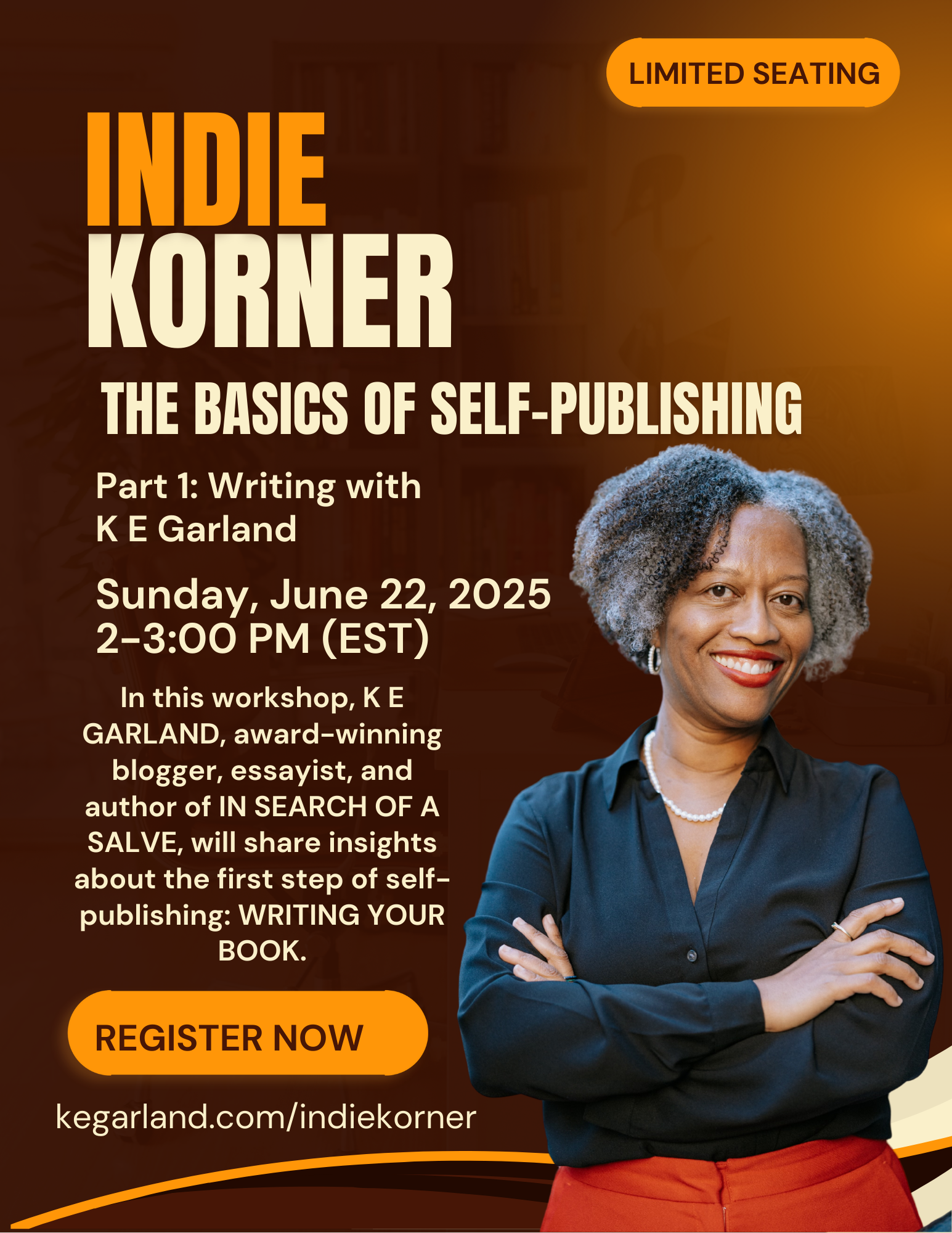
Need More Help? Register for Indie Korner!

Part I: WRITING WITH KE GARLAND
6/22/2025 | 2-3:00 PM (EST)

Part one is led by KE Garland, who will detail the first step to self-publishing: writing a fantastic book! In our excitement, we tend to skip this step, but no matter how you publish, you still must write something people want to read. Garland will walk us through the first draft, revisions, professional editing, choosing a genre, and everything you need to prepare your manuscript for a publisher, even if that publisher is you!

Part 2: PUBLISHING WITH YECHEILYAH
6/23/2025 | 7-8:00PM (EST)

Yecheilyah leads part two. She will explain the different forms of publishing, from traditional to vanity to hybrid to self-publishing, and why a basic understanding of them matters. She will also discuss how to avoid publishing scams and walk us through the foundational steps to get that amazing manuscript you learned how to write on day one, published at the highest professional level.

REGISTRATION IS OPEN!!

To take advantage of this EXCLUSIVE, limited-seating virtual masterclass, click the buttons below to register for one or both courses. Because they are connected, it is highly recommended that you register for both!


See you in June!

https://www.kegarland.com/indiekorner.html

https://www.yecheilyahysrayl.com/indiekorner

Ways to Connect with Readers Outside of Social Media

Social media is a necessary tool for connecting in today’s world and it is a must for all businesses to have a social media presence in some capacity.

There are people whose entire livelihoods are built into their social media accounts. Platforms like TikTok, Instagram, Facebook and now Threads have become creator economies where high performing content gets you paid.

But what happens if you are hacked, the app malfunctions, or in the case of TikTok, the app is banned? Now all that work you’ve done and all those people you connected with are gone in an instant.

That’s why I believe authors should focus as much energy into building their own communities.

Community Membership Website

Outside of meeting up with people in person, community membership platforms are the next best thing. I am a member of a few, and I love that the person has their own social app, which they control. There are paid membership sites like Mighty Networks and Skool, and free ones like Discord. The only reason I don’t have one of my own is because I am already managing so many websites, including this blog. Otherwise, I would definitely consider it.

Blogging

This blog has helped me tremendously in my work, and Imma stick beside her.

Email List

By email list, I do not necessarily mean an author newsletter that reads like an ad. These newsletters usually have updates on the author’s latest books and events and usually go out once a month or so. (Pretty much whenever the author has a new book out.)

However, most author newsletters are boring, long, and cluttered with too many images.

The emails I am talking about are where the author speaks to their readers like friends. They might share thoughts on what’s happening in the world lately, how they feel, or offer an inspiring story. They might also throw in an update, but not so many that it becomes a billboard for their books. These emails might come out several times a month, and readers are okay with them because they are fun and inviting.

These emails are usually simple and sent using third-party providers like Mailerlite or Mailchimp. They give people the option to unsubscribe if they want, which is kinda legal. If you are sending out mass spammy marketing emails with no way for people to unsubscribe, you are breaking privacy laws.

Text List

By text list, I mean a professional text line for your business, not your personal number. This can be used to offer short, quick updates, alerts for sales, or an inspiring quote. Personally, I don’t have a text line, nor do I want one, but it is an option. Many businesses use them and do well.

In-Person Meet-Ups

This one is pretty self-explanatory. In person meetings, workshops, and events will always provide a special kind of value you won’t find online and I don’t think we should neglect them. Zoom meetings can also be a great way for meeting up to see people face to face.

As for socials, remember to back up your content, download your data, and save viral moments like videos you might want to repurpose later!

Click here for more Indie Author Basics to encourage you through the Self-Publishing / Indie Author Process!

How Blogging Is Good Practice for Book Publishing

Disclaimer: I do not think blogging is for everyone. These articles are here to help guide and encourage you to discover your own systems and practices, as each person’s journey is and will be different.


Three of my books were conceived through blogging: I am Soul, The Women with Blue Eyes, and Black History Facts You Didn’t Learn in School.

Let me be clear: I did not start this blog to write these books.

I started this blog for some other reason, and in the process of being creative, I wrote about these topics until they culminated into whole books.

After three years of writing poetry dedicated to Black people and Black womanhood, I compiled those poems into a book called I am Soul.

After sharing excerpts from an exciting short story out of my wheelhouse but fun to write, it eventually culminated into an urban fantasy novel.

After writing Black History articles every Friday for Black History Month that went beyond February, the project culminated in a full-length volume people can now enjoy anytime they pick up the book instead of waiting for Friday.

I hope you see where I am going with this.

In the same way that journaling can help us to organize our thoughts, writing about your area of expertise on a blog can be good practice for book publishing.

Posting content on social media and a blog is a form of publishing. Whenever you hit that post button on a blog article or a Facebook post, you are publishing content. Here are two powerful ways it helps to prepare you to write a book.

It Helps You to Get Used to Writing Publicly

When writers publish books, they open themselves to be judged, not just praised. When you post content online, you engage in a similar vulnerability. Your thoughts are now live for everyone to see, critique, or admire. This is similar to what happens each time an author publishes a book. Writing on a blog or posting to social media helps you to get used to hearing feedback about your writing.

It Helps You to Build an Audience / Readership

One of the significant issues new self-published authors face is publishing books with no readership. While established authors like Ashley Antoinette can pop out with a new book and surprise readers, new authors may have a hard time doing the same because they don’t have the audience for it to be successful. They can publish books on a whim, but they also run the risk of people not buying them. Blogging can help with that.

While practicing how to write publicly, you also build up a tribe of readers who like what you write! You attract people who enjoy the same things you do, not just with writing but with life. You might all like to travel, garden, or camp. You might all be married, single, or divorced. You might all be business owners, work a job you love, or retired.

These genuine connections help build bridges of commonality that eventually lead to mutual support systems. You also get instant feedback that will help you test-drive your story idea.

Click here for more Indie Author Basics to encourage you through the Self-Publishing / Indie Author Process!

Are You REALLY Promoting Your Book?

Are you really promoting your self-published book?

Or does it just look and feel like you are promoting your book?

  • If you are only telling people you wrote a book, but you are not telling them what the book is about, you are not really promoting your book.
  • If you only show us the cover of the book but do not educate us about the content and core message, you are not really promoting your book.
  • If you only post Amazon links to social media but do not discuss the book and what we can learn from it, you are not really promoting your book.

These things can be a part of book promotion. Still, alone, they do nothing to generate enough interest in people to want to buy the book, and that is what book promotion is:

A culmination of your activities and strategies to create awareness and generate interest in your book.

This includes but is not limited to:

Advertising: Paid Ads (or just ads in general), digital or print material, website or landing page, etc.

Publicity: Interviews, book reviews, media coverage, guest blog posts, podcasts, etc.

Social Media: Building engagement with readers through entertainment and educational content using any of the many social media platforms. Blogging can also fall under this and is a powerful tool for community.

Events: Conferences, Author Talks, Book Signings, Book Fairs

The purpose is to create enough buzz to interest readers to purchase the book.

  • Anytime you share a review from someone who reads your book, you ARE promoting your book.
  • Anytime you create content (graphics, excerpts, videos, etc) that educates or entertains people about your book’s message (nonfiction), characters, or plot (fiction), you ARE promoting your book.
  • Anytime you talk about the book on a podcast or in an interview, you ARE promoting your book.
  • Anytime you share your journey and what it was like writing the book, you ARE promoting it.
  • Anytime you write on a topic that is relatable to the things we can find in your book, believe it or not, you ARE also promoting the book.

We can do many things that look like book promotion on the surface but are ineffective in raising awareness among our readers about the book’s topic and why it’s important to them.

But I hope this post gets you thinking about deeper ways to connect with your audience!

If this has helped you, let me know!

Click here for more Indie Author Basics to encourage you through the Self-Publishing / Indie Author Process!

Tell Us What You Published Instead of How You Published

How often have you heard a traditionally published author say, “I’m a traditionally published author?”

They might say they are a published author but not a traditionally published one. That’s because there are millions of traditionally published authors.

In the same way, introducing yourself as a self-published author does nothing to help the person understand what you write.

It is not bad to call yourself a self-published author or to be proud of that. However, since many self-publishers have smaller budgets, we often desperately identify how we published instead of what we published to get people to take a chance on our books. But this strategy does not work well.

When I pitch schools and bookstores to carry my book, I rarely introduce myself as a self-published author. They will already know this when they look up my ISBN.

Instead, I discuss the book and why it is a good fit for their audience.

Instead of telling people, “I’m a self-published author,” and pushing your book in their face, identify your genre, book, and how it serves your target audience.

You can do this in one sentence:

Original: “I am a self-published author of three books.”

Revised: “I am the author of The Stella Trilogy, a Historical Fiction series that explores African American History, civil rights, and the struggles of Blacks in America.”

I hope this helps someone!

Click here for more Indie Author Basics to encourage you through the Self-Publishing / Indie Author Process!

Building Emotional Connections with Readers

Being an author is hard work. Being an Independent Author with no large publishing company, financial backing, or publicity to support you is downright grueling. Who would even want to do this? It is certainly not for the weak.

However, there are things that set some authors apart from others.

And usually, I talk about producing a professional book, but I am not even talking about that here. It is also not about:

  • If those authors are better writers.
  • If those authors are better people.
  • If those authors have more money or even make more money.

It is not even about those authors having a better-quality book (tons of pretty books are not selling).

It is about how those authors have taken the time to nurture and edify their audience with their message before, during, and after their book is published.

These authors have an identity people are familiar with because they have authentically shared their stories, experiences, and knowledge surrounding their topic. This increases their value and creates an emotional bond that makes people want to go out and buy their book when they do publish it.

But this is different from what most self-published authors do.

Most self-published authors, especially new authors, publish a book on a random topic no one has heard them speak on before and hope people will buy it.

We call this hope marketing and it does not work.

You must absolutely take the time to educate and inform people about the content of the book you are writing if you expect them to care enough about it to buy it.

While I have bought books on a whim, for the most part buying a book is an emotional decision. This means we must build awareness that gives people a reason to buy.

People need to know who we are, what we do, and why it’s important to us.

None of this is about selling a book. That part comes later. In the beginning, it is about awareness and emotional connections.

It is as deep as understanding your morals, values, and identity and communicating how this ties into the topic you are discussing.

Click here for more Indie Author Basics to encourage you through the Self-Publishing / Indie Author Process!

Yecheilyah’s Book Reviews – Leaving Fatherland by Matt Graydon

Title: Leaving Fatherland

Author: Matt Graydon

PublisherCranthorpe Millner Publishers

Published: August 20, 2024

Pages: 326 pages


Matt Graydon’s gripping, well-researched historical fiction debut Leaving Fatherland explores the difficulties of growing up with an abusive father in the context of World War II, Hitler’s ascent, and how our early years have a significant influence on our adult life. Right away, we are introduced to the abuse Oskar Bachmann suffers at the hands of his father, Karl, who assaults his son both physically and mentally. He refers to him as weak and wishes that he, like his brother Emil, had joined the Hitler Youth.

The first time Karl hits Oskar in the book shocked me, even though the author did an excellent job showing the cruelty that led up to it. This would profoundly affect Oskar throughout his life, a life the author shares with us in such detail that it reads like an autobiography.

Contrasted against Karl’s cruelty is his mother Aneta’s kindness and gentleness, a welcome relief. She encourages him to read, which becomes his safe space. Aneta also finds a way to buy Oskar a tourist-class ticket to America to complete his education.

“The pages of the books I wrapped around my mind and soul like blankets brought distraction and great solace from the relentless strife of home life.”

-Leaving Fatherland, Oskar Bacchman

Oskar continued on to study psychology at Manhattan’s University of New York, a decision he made especially to gain a deeper understanding of his father. Even though Karl is mean to him, Oskar still loves him, evident in his desperate attempt to understand him. In his own words: “I’ve learned it’s possible to hate what your father is and yet still yearn for his approval.” As he navigates the city and makes new friends, Oskar is still affected by his father’s actions as shocking revelations about Karl’s ties to Hitler emerge.

I love the research that went into this book, even down to the Black man taxi driver referring to the ten-dollar bill as a “sawbuck.” Even though the author is not Black, his depiction of the driver and his persona was spot on. Bachmann referring to him as a “Negro cab driver” and how he had not seen many Black people growing up in Germany also fit the times (1930s).

Although a lengthy read, Oskar’s life is filled with many secrets and unexplainable fortunes, culminating in a surprising revelation that connects everything together.

89707

Ratings

  • Plot Movement / Strength: 4/5
  • Entertainment Factor: 4/5
  • Characterization: 5/5
  • Authenticity / Believable: 5/5
  • Thought Provoking: 5/5

Overall: 5/5

Leaving Fatherland is Available Now on Amazon!

Leaving Fatherland_WEB FRONT(1)


About the Author

Matt Graydon Author Photo

Matt Graydon has loved writing since childhood. In his early career, he trained and then worked as a journalist for local and national newspapers, developing research skills that proved vital in his historical fiction writing. He later worked as a senior public relations executive for major corporations in a global context, interacting with people from many cultures around the world. In recent years he rekindled his love of creative writing, attending expert writing courses by Faber and others to develop his craft. He is an active member of the UK’s Society of Authors and belongs to the Phoenix Writing Group in Dorking. He has had both poetry and short stories published, most recently Saigo No Tatakai, an account of a kamikaze attack in the Second World War told from both sides.

Matt lives in Surrey, with his wife, adult children and an unruly cockapoo. When not writing, he spends as much time as possible outside gardening, or engaging in astronomy and photography.

Links:

Website: www.mattgraydon.com

Facebook: Matt Graydon Writes

Instagram: @matt_graydon_writes

Twitter: @graydonwrites


To have your book reviewed on this blog, apply here!

Stay tuned for our next dope read!

IMG_8994

Yecheilyah’s Book Reviews is a reputable review service that features writers from all over the world, both traditionally and independently published. We are listed on Kindlepreneur as a top-tier book review blog and Reedsy as one of their vetted active book blogs that provide insightful, excellent book reviews.

*Books are read in the order they are received.